My parents refused to let me come on vacation, saying, “There’s no room for you in Cabo or Aspen,” so I quietly took $42,000 in commission money and booked a $28,000 villa in the Maldives for the people who actually raised me. When they saw our family photos on the beach, my biological parents were furious—and I cut off contact for good.

The envelope arrived on a Tuesday. I remember because Tuesdays were supposed to be my light days, just two showings and paperwork. I’d grabbed my mail on the way up to my apartment, thumbing through the usual junk. Credit card offers. A grocery store flyer. Something from my dentist. Then I saw it.
Heavy cream stock. Law office return address. Whitmore & Associates. Estate planning attorneys. My heart kicked into overdrive. This was it.
The trust fund. Grandma’s trust fund. The one my parents had controlled since I turned 18, the one they’d promised would be fully available when I turned 28. Today was three weeks past my birthday, and here it was, my financial freedom, finally landing in my hands.
I fumbled with my keys, nearly dropped my purse, and barely made it inside before I ripped the envelope open. The check slipped out first. I caught it, turned it over, and felt my stomach drop through the floor.
$14,650.28.
I stared at the numbers. Blinked. Read them again.
$14,650.28.
That couldn’t be right.
Grandma had set up the trust when I was born. I’d overheard my parents talking about it once when I was a kid, something about a life insurance payout and investments, how it had grown over the years. I’d never known the exact amount, but my parents had always made it sound substantial. Life-changing. Enough to set me up after college.
My hands shook as I unfolded the accompanying letter.
Dear Ms. Tate. Per the terms of the Sarah Elizabeth Tate Memorial Trust, we are pleased to inform you that you have reached the age of majority distribution. 28 years. Enclosed, please find the final disbursement of the remaining principal amount.
Remaining principal amount.
The words blurred. I grabbed the second sheet, a financial statement dense with line items and numbers that made my vision swim. But certain phrases jumped out, like neon signs in the dark.
Administrative management fees. $8,450. Annual.
Expense reimbursements. $12,300. Average annual.
Trustee compensation. $15,000 annual.
The dates ranged back 10 years.
Ten years of fees. Ten years of reimbursements for expenses I’d never authorized. Never even known about. Travel expenses. Educational consultation fees. Something called administrative overhead.
I did the math in my head, my real estate brain automatically calculating. Rough estimate? They’d drained somewhere between $100,000 and $130,000 from my inheritance. Legally. Because they were the trustees. And I’d been too scared to question them.
My phone buzzed. A text from my mother.
“Sweetie, did you get your little check?
Don’t spend it all in one place.”
Little check.
I wanted to throw the phone across the room. Instead, I sank onto my couch, that pathetic check still clutched in my hand, and let the memories come.
I was 16, finishing my junior year of high school. Dad had come home one night with a thick packet of Disney World brochures, spreading them across the dining room table with this huge grin. Ella, my older sister, the golden child, had squealed and hugged him. Mom had already started planning outfits.
“What about me?” I’d asked.
Dad hadn’t even looked up.
“The hotel’s fully booked, kiddo. We could only get one room and it’s barely big enough for the three of us. You understand.”
I’d nodded. I always understood.
They left me with Aunt Sarah for the week. I’d spent it babysitting my cousin Delilah, who was six at the time, while Uncle Beau worked double shifts at the construction site. When my parents came back, tanned and laughing, they’d brought me a single pressed penny from the Magic Kingdom. Ella had gotten a full Minnie Mouse outfit and a photo album.
The hotel hadn’t been fully booked. I’d found the reservation confirmation months later, accidentally, when I’d borrowed Mom’s iPad. Standard room, four-person occupancy. They just hadn’t wanted me there.
Then there was college. I’d worked two jobs, campus library during the day, waitressing at night to cover what my scholarships didn’t. My parents had said the trust was locked up until I graduated, that I needed to learn the value of hard work. Meanwhile, Ella had gotten her full ride paid for, along with a monthly allowance, a car, and a laptop.
Graduation night, I’d walked across that stage alone. Mom and Dad had texted that morning.
“Something came up. We’ll celebrate when you visit next.”
Something came up.
I’d found out later that they’d taken Ella to Paris. A sister trip to celebrate Ella’s engagement. They’d raised glasses of champagne in front of the Eiffel Tower while I’d eaten frozen pizza in my dorm room, packing up four years of my life into boxes.
The student loans had taken me six years to pay off. Six years of living in a cramped studio, driving a car held together with prayer and duct tape, eating ramen more nights than I wanted to admit. I’d finished paying off the last one eight months ago. I still remembered the feeling, like I could finally breathe.
And all that time, my parents had been draining my trust fund. Billing it for their management services, taking what Grandma had left for me, and turning it into their personal ATM.
The worst part? I’d known something was wrong. Deep down, I’d known. But every time I’d tried to ask about the trust, Dad had shut me down.
Once, when I was 22 and desperate, barely making rent, I’d called him. Asked if there was any way to access the funds early, just a small loan against my own money. His voice had gone cold.
“You want to know what happens to ungrateful children who question their parents, Sadie? I’m the trustee. That means I have the legal authority to petition the court to freeze those funds if I have concerns about your mental stability. You keep pushing me, and I’ll have you declared incompetent. You won’t see a dime until you’re 50. If ever.”
I’d apologized. I’d apologized for asking about my own inheritance. After that, I’d learned to stay quiet. To smile and nod. To accept the crumbs they offered. And never, ever ask for more.
But now? Now his power was gone. The trust was dissolved. The check was in my hand, pathetic as it was, and he couldn’t hold it over me anymore.
My phone buzzed again. I glanced at the screen and felt my blood pressure spike. Facebook notification. It wasn’t my parents, they had blocked me long ago to hide their spending. This was from a distant cousin, Marcy, who had uploaded a new album titled “Family Reunion” to her own timeline.
I opened the app. The photo showed my entire family—Dad, Mom, and Ella—lounging on a pristine white beach, drinks in hand, brilliant turquoise water stretching behind them. The caption read:
“Cabo vibes with the Tate crew, family vacation, living our best life.”
Cabo San Lucas. A five-star resort. Judging by the luxury loungers and the umbrella drinks, this week, right now, they’d left me behind. Again. Only this time, they’d used my money to do it.
I stared at that photo until my eyes burned. Then I closed the app, deleted the notification, and sat in the silence of my apartment.
$14,650.28.
That’s what my grandmother’s love was worth to them. That’s what I was worth.
I almost didn’t go to Aunt Sarah’s that night. I’d promised her I’d come for dinner, just a casual Tuesday thing we did once a month, but I felt raw, scraped, hollow. The last thing I wanted was to put on a brave face. But then I thought about canceling, about sitting alone in my apartment with that check on my coffee table, and I couldn’t do it. I couldn’t let them take this from me too.
So I went.
Aunt Sarah lived 40 minutes outside the city, in a neighborhood where the houses were small and the yards were big. Uncle Bo’s truck was in the driveway when I pulled up—an old Ford, meticulously maintained, the bed full of tools from whatever job site he’d been working. The front door opened before I could knock.
“There’s my girl,” Aunt Sarah said, pulling me into a hug that smelled like rosemary and warmth.
She was small, barely 5’3″, but her hugs were the kind that made you feel safe, protected. I held on maybe a second too long. She pulled back, studying my face.
“You okay, honey?”
“Long day,” I said, forcing a smile. “Real estate stuff.”
She didn’t look convinced, but she didn’t push. That was Aunt Sarah. She gave you space to breathe, to come to her when you were ready.
Inside, Uncle Bo was at the stove, flipping pork chops in a cast iron skillet. He looked up and grinned, his weathered face crinkling.
“Hey, Sadie girl, just in time. Hope you’re hungry.”
“Starving,” I lied.
Dinner was simple: pork chops, mashed potatoes, green beans from their garden. Nothing fancy, nothing Instagram-worthy. Just food, made with care, shared at a table that had seen decades of family dinners.
Uncle Bo served the plates, and I watched as he studied the pork chops, picking through them with his fork. Then he took the biggest, best-looking piece, the one with the perfect char, the juiciest part, and put it on my plate.
“That one’s for you,” he said simply.
Something cracked inside my chest. I looked down at that pork chop, at the care in such a small gesture, and I felt my phone buzz in my pocket.
I pulled it out. A notification from my bank app. A deposit had just cleared. Forty-two thousand dollars. Commission payment. Riverside Commercial Property. The deal I’d been working on for three months. A massive commercial property sale, one of the biggest in my career. The commission I’d earned through late nights and endless negotiations. Through my own skill and determination.
Forty-two thousand dollars. Nearly three times what my parents had left me from Grandma’s trust.
I looked at Uncle Bo, at Aunt Sarah, at the worn-but-clean tablecloth, and the mismatched chairs, and the single pork chop that had been chosen specially for me, and I realized something.
I’d spent so long thinking I needed my parents’ approval, their love, their validation. I’d let them control me because I’d thought family was supposed to be blood, supposed to be the people who raised you. But family wasn’t blood. Family was the person who gave you the best piece of meat. Family was the woman who hugged you before you could knock. Family was the people who showed up, consistently, without conditions.
I still had others to love. And for the first time in twelve years, I wasn’t afraid anymore.
The fragile peace I built lasted exactly three days before the phone rang, shattering the silence as I was leaving a property showing.
Mom’s name flashed on my screen, and I almost didn’t answer. But old habits died hard, and some part of me, the part that had been trained to jump when they called, made me swipe to accept.
“Hi, Mom.”
“Sadie! Sweetheart!” Her voice was sugar-sweet, that particular tone she used when she wanted something. I’d learned to recognize it years ago. “How are you, honey? We’ve been thinking about you so much.”
Sure you have.
“I’m fine. Busy with work.”
“Oh, that’s wonderful. We’re so proud of you, working so hard.”
A pause, perfectly calculated.
“Listen, sweetie. I’m calling because we have the most exciting news. We’re planning a family trip to Aspen for Christmas week. Doesn’t that sound amazing?”
My stomach tightened.
“That’s nice.”
“We want you to come with us. All of us together. Me, your father, Ella, and little Jojo. It’ll be magical. Snow, skiing, hot chocolate by the fire. Real family bonding time.”
Family bonding time. Right. Like Cabo. Like Disney World. Like Paris.
“I don’t know, Mom. I have work commitments.”
“Oh, but you have to come. Ella specifically asked for you. She said it wouldn’t be Christmas without her little sister there.”
That was a lie. Ella had probably said something closer to, who’s going to watch Jojo while I’m at the spa?
I waited. There was always a catch with Mom. Always.
“The thing is,” she continued, and there it was, the slight shift in her tone. “We’re renting this gorgeous villa, and we need everyone to chip in for the cost. It’s only fair, right? We’d need you to wire $2,000 by Friday. And, well, Ella mentioned she’d love to attend some of the evening parties at the resort. There are some influencer events she was invited to, so she’d need someone to babysit Jojo at night. You’re so good with kids, and it would just be a few hours here and there.”
There it was. The real ask. $2,000 plus free nanny service. That’s what I was worth to them. Not a daughter. Not family. An ATM with a babysitting certificate.
“So what do you think?” Mom pressed, her voice still dripping with fake warmth. “Can we count on you?”
Something inside me snapped. Not loudly. Not dramatically. Just a quiet, final breaking of whatever tether had kept me tied to the hope that they might change.
“No.”
“No?”
Silence on the other end.
“What?”
“No, Mom. I’m not coming to Aspen. I’m not wiring you money. And I’m not babysitting.”
“Sadie Marie Tate—”
“I saw Marcy’s photos from Cabo, by the way. Looked like you had fun spending Grandma’s trust fund on umbrella drinks.”
Her intake of breath was sharp.
“How dare you? That money was used for legitimate administrative purposes. Management fees.”
“Right. Funny how those fees paid for luxury vacations while I ate ramen and worked two jobs to pay off student loans.”
“You ungrateful—”
I hung up.
My hands were shaking. But not from fear. From adrenaline. From the rush of finally, finally standing up for myself.
The phone immediately started ringing again. Mom. I declined the call. It rang again. Declined. A text came through.
“Your father is going to hear about this disrespect.”
I blocked the number. Then I blocked Dad’s number. Then Ella’s. And I stood there in the parking lot of a commercial property, breathing hard, feeling like I’d just jumped off a cliff.
But I wasn’t falling. I was flying.
That night, I couldn’t sleep. I lay in bed, staring at my ceiling, my mind spinning. They would never see me as anything other than a resource. A convenient tool to be used when needed and ignored when not. No amount of compliance, no amount of bending over backward, would ever make them love me the way I’d wanted to be loved.
But I had $42,000. I had half a million airline miles I’d been hoarding from my real estate credit card, points I’d been saving for “some day.” And I had people who actually deserved to be treated like family.
An idea started forming. Petty? Maybe. But also perfectly, beautifully justified.
If my parents wanted to use money to show their values, fine. I’d show mine.
I spent the next morning on my laptop. Researching. Flights. Resorts. Packages. My credit card points could cover flights for four people. Round trip. To somewhere incredible. Somewhere my parents had probably fantasized about but never been able to justify spending their own money on.
The Maldives kept coming up. Private overwater villas. Crystal clear water. White sand beaches. The kind of place you saw in magazines and thought, some day, maybe, if I win the lottery.
I checked the prices. With my airline miles, I could cover the flights. The villa would be expensive, but I found a two-bedroom ocean residence with a massive deck and a pull-out sofa in the living room that Delilah would love. It was $28,000 for the week, all-inclusive. With my commission, I could actually afford it. It would be tight, but I could do it.
I sat back, my heart pounding. This was crazy. This was impulsive. This was everything I usually wasn’t. But when I imagined Aunt Sarah’s face, Uncle Bo’s expression, Delilah’s excitement…
I booked it.
Four round-trip tickets to Malé, Maldives. One luxury residence for seven days. Grand total, after miles and points: $28,000 from my commission. It was the most money I’d ever spent at once in my life.
And it felt amazing.
I showed up at Aunt Sarah’s house that evening unannounced, my laptop tucked under my arm. Uncle Bo answered the door, surprised.
“Sadie, thought you weren’t coming till Thursday.”
“I know. But I need to talk to all of you. Is everyone home?”
“Yeah, Delilah’s upstairs. Everything okay?”
“Everything’s perfect.”
We gathered in the living room, Aunt Sarah on the couch, Uncle Bo in his worn recliner, Delilah cross-legged on the floor, her phone in hand like always. They looked at me with varying degrees of curiosity and concern.
I took a breath.
“So, I had a conversation with my mom yesterday. She invited me to Aspen for Christmas.”
Aunt Sarah’s expression tightened. She knew. She always knew.
“And I said no. Actually, I told her no, hung up, and blocked her number.”
Delilah’s eyes went wide.
“Holy shit.”
“Language,” Aunt Sarah murmured, but she was staring at me with something like pride.
“The thing is,” I continued, “I realized something. I’ve been spending my whole life trying to be part of a family that doesn’t want me, and I’ve been ignoring the family that’s been there all along.”
Uncle Bo cleared his throat.
“Sadie—”
“Let me finish.”
I opened my laptop, turning the screen toward them.
“I just closed a huge commission, $42,000. And I have a bunch of airline miles I’ve been saving. So I did something kind of impulsive.”
I pulled up the confirmation email.
“I booked us a trip, the four of us, to the Maldives. Private overwater villa, seven days, all-inclusive. We leave in two weeks.”
“Uh.”
The silence was deafening. Aunt Sarah’s hand flew to her mouth. Uncle Bo just stared, his usually composed face completely blank. Delilah jumped to her feet.
“Are you serious? The Maldives? Like, the actual Maldives?”
“The actual Maldives.”
“Oh my god.” Delilah practically bounced, her phone forgotten. “This is insane. This is absolutely insane.”
Aunt Sarah’s eyes filled with tears.
“Sadie, honey, we can’t, that’s too much.”
“You can, and you will,” I said firmly. “You’ve been my family when my own blood couldn’t be bothered. You’ve fed me, supported me, loved me, without conditions. This isn’t charity. This is me saying thank you, and saying that you’re my real family.”
A tear slipped down Aunt Sarah’s cheek. Uncle Bo stood up, walked over, and pulled me into a hug so tight I could barely breathe. His voice was rough when he spoke.
“You didn’t have to do this.”
“I know. I wanted to.”
He pulled back, his eyes suspiciously bright.
“Then I guess we’re going to the Maldives.”
Delilah was already on her phone, typing furiously.
“I need to tell everyone. This is the best thing that’s ever happened to me. Can I make tiktoks there? Please say I can make tiktoks.”
“You can make all the tiktoks you want,” I said, laughing.
Aunt Sarah stood, walking over to touch my face gently.
“Your grandmother would be so proud of you.”
My throat tightened.
“I hope so.”
“I know so. You took what they tried to steal from you, and you turned it into something beautiful.”
She kissed my forehead.
For the first time since opening that envelope with the $14,650.28 check, I felt like maybe Grandma’s legacy hadn’t been stolen at all. Maybe I’d carried it with me the whole time.
Arrival in the Maldives felt less like travel and more like stepping through a portal into a different reality. The water was impossible. That was the first thing I thought when I stepped out onto the villa’s private deck. The Indian Ocean stretched out in front of us, so perfectly turquoise it looked photoshopped.
Our overwater residence sat on stilts above the reef, the glass floor panels in the living room revealing fish darting below. The sun was warm without being scorching, the breeze carrying the scent of salt and plumeria.
“This isn’t real,” Delilah breathed beside me. She’d been practically glued to her phone since we arrived, filming everything. “This literally cannot be real.”
“It’s real,” Uncle Beau said from behind us.
He’d barely said a word since we’d landed, just kept looking around with this expression of quiet awe.
Aunt Sarah emerged from one of the bedrooms, her eyes red-rimmed. She’d cried three times already—once on the plane, once when we arrived at the resort, and once when she saw the villa. Happy tears, she kept insisting, but I knew it was more than that. It was the weight of years of struggling, of making do, of never getting to experience something like this, suddenly lifted. Even temporarily.
“I think I’m going to swim,” I announced. “Anyone want to join?”
“Give me five minutes to change!” Delilah ran back inside.
Uncle Beau settled into one of the loungers with a book, an actual paperback thriller he’d bought at the airport. Aunt Sarah joined him, and I watched them for a moment, her hand finding his, their fingers intertwining automatically after decades of marriage.
That’s what love looked like. Quiet, steady, present.
The next few days blurred together in the best possible way. We snorkeled over coral reefs, ate fresh seafood prepared by private chefs, watched the sun set from our deck every evening. Delilah filmed constantly, her TikTok account exploding with content.
“Day in the life at a Maldives villa.”
“My cousin surprised us with a luxury vacation.”
“Point of view: your family actually loves you.”
That last one was captioned with a longer story. I’d watched her film it one afternoon while Aunt Sarah and Uncle Beau were napping. She sat on the deck, the ocean behind her, and spoke directly to the camera with surprising maturity.
“So, my cousin Sadie basically got screwed over by her parents and sister. They stole her inheritance, used her as a free babysitter, and treated her like garbage her whole life. And when they tried to do it again, demanding money and free labor, she said no. Instead, she took her own money that she earned herself and brought us here, her real family. The people who actually showed up for her.”
She panned the camera to show the villa, the water, the paradise around us.
“This is what it looks like when someone values you. Not posting fake family photos for clout. Not using people as ATMs. Actually showing up and showing love.”
She turned the camera back to herself.
“Anyway, if you’re struggling with toxic family, just remember, blood doesn’t make you family. Love does. Actions do.”
She posted it that night. By morning, it had half a million views. By noon, it had two million. By evening, my phone—which I’d left on for emergencies—was melting down with notifications.
I was lounging on the deck, a frozen mocktail in hand, when I finally checked my messages. Fifty-three missed calls. One hundred forty-seven texts. Most from numbers I didn’t recognize, probably people who’d gotten my contact info from Ella’s previous doxing attempts, which I’d forgotten to worry about in paradise.
But some were from familiar contacts. Old friends. Former co-workers. People I hadn’t talked to in years.
“Saw Delilah’s video. Is it true?”
“Oh my god, I always thought your family was weird. This explains so much.”
“You’re an inspiration. Seriously.”
I scrolled through them, my stomach twisting with a complicated mix of validation and anxiety. Then I saw the email.
Subject: Contract Termination, Ella Tate Partnership.
It was from Baby Bloom Brands, one of the major sponsors Ella had landed six months ago. She’d bragged about it constantly on her Instagram, some kind of partnership promoting organic baby products.
I opened the email. It was sent to Ella, but she’d forwarded it to me with a string of obscenities and threats.
“Dear Miss Tate. After careful consideration and review of recent social media content involving you and your family, Baby Bloom Brands has decided to terminate our partnership agreement, effective immediately. Our brand values center on authentic family connection and positive parenting, and we feel the current public perception is not aligned with our message. Per section 7.3 of your contract, we are within rights to terminate without penalty due to reputation concerns.”
The rest was legal jargon, but the message was clear. Ella had been cancelled.
And she blamed me.
Her forwarded email was unhinged.
“You ruined me. Do you have any idea what you’ve done? That was $15,000 a month, Sadie. $15,000. I have a child to support. How could you be so selfish? How could you turn our family problems into content for your stupid cousin to exploit? You’re going to pay for this. I will make sure everyone knows what a vindictive, ungrateful bitch you are.”
I read it twice, then deleted it. Then I ordered another mocktail and went back to watching the sunset.
The video continued to explode. Four million views. Five million. News sites picked it up.
“Woman uses inheritance to treat real family after parents steal trust fund.”
The story was everywhere. Delilah was handling it like a pro, her follower count skyrocketing. She’d even started responding to comments with grace and humor.
But Ella wasn’t taking it well.
On day five of our trip, Delilah came running onto the deck, her phone in hand, her face pale.
“Sadie, you need to see this.”
She pulled up Ella’s Instagram. My sister had posted a video—one of her usual overproduced things, shot in perfect lighting with her camera at the ideal angle. But the content was venomous.
“I need to address something,” Ella said, her voice quavering with fake emotion. “My sister Sadie has been spreading lies about our family online. She’s manipulated the story to make herself look like a victim when, in reality, she’s the one who’s been ungrateful and cruel.”
She held up her phone, playing what sounded like old voicemails, but they’d been edited, cut, and spliced to make me sound horrible.
“I don’t owe you anything,” my voice said—except I’d actually said, “I don’t owe you anything more than I’ve already given,” in response to her demanding I buy her a new car.
“Maybe if you weren’t so selfish,” another clip played—taken from a conversation where I’d said, “Maybe if you weren’t so selfish, you’d realize Mom and Dad treat us differently,” but now it sounded like I was just calling her selfish, unprompted.
The video went on, painting me as a vindictive, jealous sister who’d stolen from the family and was now flaunting wealth while Ella struggled as a single mother. The comments were a mix of support and vitriol, her loyal followers—the ones who’d stuck around—were eating it up.
“Team Ella” started trending.
But worse than the video itself was the caption.
“Since my sister wants to play dirty, I guess I will too. Her contact info and address are in my bio, feel free to let her know what you think about family betrayal.”
“She doxxed you,” Delilah whispered. “She actually doxxed you.”
I stared at the screen, my peaceful vacation buzz evaporating. My phone started ringing immediately. Unknown numbers. I declined them. Text messages poured in, too many to read, most of them hostile.
“You’re a disgrace.”
“Hope you choke on your fancy vacation.”
“Your sister is a saint and you’re garbage.”
I heard the sliding glass door open behind me. Uncle Beau stepped out onto the deck.
“Sadie? What’s wrong?”
I showed him the video. His jaw tightened as he watched, his expression darkening with every second. When it ended, he looked at me.
“What do you need?”
That simple question almost broke me. Not, how could you let this happen? Not, what did you do to deserve this? Just, what do you need?
“I need to block all these numbers and enjoy the rest of my vacation,” I said, surprised by how steady my voice was. “She can’t touch me here, and when we get back, I’ll deal with it.”
Aunt Sarah had joined us, reading the comments over my shoulder.
“That girl needs help.”
“That girl is a grown woman who’s chosen to be cruel,” Uncle Beau said flatly. “Don’t make excuses for her, Sarah.”
I blocked the unknown numbers. Turned off notifications for everything except calls from people in my contacts. Then I handed my phone to Uncle Beau.
“Can you hold this for me? I don’t want to look at it anymore.”
He took it without question.
“Done.”
Delilah was still scrolling through Ella’s comments, her expression fierce.
“I’m going to respond. I’m going to make a video explaining—”
“No,” I said gently. “Let it go. People who believe her aren’t going to be convinced by facts. The people who matter already know the truth.”
She looked frustrated but nodded.
That night, we had dinner on the deck. Fresh grilled fish, coconut rice, mango salad. The food was incredible, but I barely tasted it. Aunt Sarah noticed. She reached across the table and squeezed my hand.
“You okay, honey?”
“I will be,” I said. And I meant it.
Because Ella could post whatever she wanted. She could send her followers after me. She could edit videos and spin stories and play the victim. But I was sitting in a private villa in the Maldives, surrounded by people who loved me, while she was sitting at home, cancelled by her sponsors, losing her income, watching her carefully curated life fall apart.
I didn’t need revenge. Karma was handling it just fine.
The journey back to reality was a 32-hour endurance test. By the time we landed back in the States, I was exhausted in that bone-deep way that comes from too much travel and not enough real sleep. Uncle Bo drove us all back into the city, dropping Aunt Sarah and Delilah at their house first. Delilah hugged me goodbye, whispering:
“Call if you need anything, okay? Anything. D22.”
Then it was just me and Uncle Bo for the final 20 minutes to my apartment. We didn’t talk much. The silence was comfortable, the radio playing old classic rock quietly in the background. But as we got closer to my building, I felt tension creeping back into my shoulders.
I’d had my phone off for most of the flight, but I’d turned it on during our layover in Dubai. The messages had been relentless. Most were blocked numbers now, but a few had gotten through. One from my father.
“You’ve embarrassed this family for the last time, we’re coming to collect what you owe us.”
I’d shown it to Uncle Bo. He’d read it without expression, then said:
“I’m staying with you tonight.”
“You don’t have to.”
“I’m staying.”
I hadn’t argued.
My apartment was exactly as I’d left it. Small, tidy, safe. I dropped my suitcase by the door and felt some of the tension ease. This was my space. They couldn’t reach me here.
Uncle Bo set his overnight bag down and looked around.
“What needs fixing?”
“What?”
“I’m here. Might as well make myself useful. What needs fixing?”
I smiled despite myself.
“The bookshelf in my bedroom is kind of wobbly. I’ve been meaning to tighten the screws.”
“Show me.”
We spent the next hour in comfortable domesticity. Uncle Bo fixed the bookshelf, then noticed a loose cabinet door in the kitchen and repaired that too. I made us a simple dinner, just pasta and jarred sauce, a far cry from the gourmet meals in the Maldives, and we ate at my small kitchen table.
“This is good,” Uncle Bo said, twirling spaghetti on his fork.
“It’s Prego.”
“Still good.” He smiled. “You know what I mean.”
I did. It wasn’t about the food. It was about the quiet, the simplicity, the absence of drama. It was about being home.
They showed up at 8:47 p.m.
I was washing dishes when I heard the pounding on my door. Not knocking. Pounding.
“Sadie, open this door right now!”
My father’s voice, loud enough that I could hear it clearly from the kitchen.
Uncle Bo was on his feet instantly, moving toward the door, but I grabbed his arm.
“Don’t,” I said quietly. “Let me handle this.”
I pulled out my phone and opened the Ring app. The doorbell camera showed all three of them. Dad, red-faced and furious. Mom, arms crossed, her expression cold. And Ella, holding her phone up, clearly recording.
More pounding.
“Sadie Marie Tate, you owe us for the damage you’ve caused. Ella lost $15,000 a month because of your lies.”
I tapped the intercom button.
“I can see you on my camera. This conversation is being recorded. Leave immediately, or I’m calling the police.”
“You little—” Dad’s face contorted with rage. “You don’t get to dismiss us. We’re your parents. Open this goddamn door.”
“No. Leave. Now.”
Mom leaned toward the camera, her voice saccharine and poisonous at once.
“Sadie, sweetie, we just want to talk. Family should be able to talk things out, don’t you think? Be reasonable.”
“There’s nothing to talk about. You stole my inheritance. Ella doxed me, and now you’re harassing me at my home. Leave, or I’m pressing charges for trespassing.”
Ella shoved forward, screaming into the camera.
“You ruined my career. You turned our private family business into a public spectacle. You owe me compensation, you selfish bitch.”
“The only thing I owe you,” I said, my voice cold and steady, “is nothing. Everything I did, I did with my own money that I earned. You’re not entitled to my income, my time, or my presence. Leave.”
Dad’s face went from red to purple.
“You think you can talk to us like this? You think you’re untouchable now because you have some money? I will make your life hell, Sadie. I will destroy everything you’ve built. I’ll call your boss, I’ll duh—”
Wham.
He kicked the door. Hard. The frame shook, and I heard the deadbolt rattle. My heart jumped into my throat.
Uncle Bo was moving before I could react. He crossed to the door in three long strides.
“Bo, don’t—” I started, but he was already unlocking the deadbolt.
The door flew open, but it wasn’t me standing there. It was Uncle Bo. All six foot four of him, filling the doorframe like a mountain made flesh.
The change in my father’s expression was instantaneous. The rage drained from his face, replaced by something I’d never seen there before.
Genuine fear.
Uncle Bo didn’t yell; he didn’t need to. His voice was low, calm, and somehow more terrifying because of it.
“Daniel.”
My father took a step back.
“Bo, this doesn’t concern you.”
“You’re harassing my daughter. That concerns me very much.”
“Your daughter?” Dad’s laugh was shaky. “She’s my daughter. This is family business.”
“Family doesn’t kick down doors. Family doesn’t steal inheritances. Family doesn’t threaten.”
Uncle Bo took one step forward, and all three of them retreated.
“You’re not her family. You’re bullies who got mad because she finally stood up to you.”
“Now you listen here—” Dad tried, his voice rising.
“No, you listen.”
Uncle Bo’s tone didn’t change, but something in his posture did. He seemed to grow larger, more solid.
“You have five seconds to get off this property. If you’re still here after that, I’m going to break the leg you used to kick that door. Are we clear?”
The silence was absolute. Mom grabbed Dad’s arm.
“Daniel, let’s go. This isn’t worth it.”
But Ella, foolish and furious, stepped forward with her phone.
“You just threatened assault. I got it on video. We can sue you for—”
Uncle Bo looked at her, and whatever she saw in his face made her words die in her throat.
“You threatened to ruin Sadie’s career. You doxxed her, exposing her to harassment and potential danger. You showed up at her home uninvited and damaged her property.” His voice was still calm. “You want to compare legal problems? Please. Try me.”
Dad’s hand closed around Ella’s wrist.
“We’re leaving.”
“Smart choice,” Uncle Bo said.
They backed away toward the stairs. My apartment was on the second floor, and they moved like cornered animals. Mom kept her eyes down. Ella was crying, mascara running. And Dad? Dad looked small, diminished.
At the top of the stairs he turned back.
“This isn’t over.”
“Yes,” Uncle Bo said. “It is.”
They left. I heard their footsteps heavily descending the stairs, then the slam of the building’s front door vibrating through the floorboards. Uncle Bo stood there for another moment, watching through the doorway, making sure they were really gone. Then he closed the door, locked it, and turned to me.
I was shaking.
“You okay?” he asked gently.
I nodded, then shook my head, then started crying.
He pulled me into a hug, this solid, safe presence that smelled like sawdust and Old Spice.
“It’s okay. They’re gone. I’ve got you.”
“They were going to…” I couldn’t finish.
“But they didn’t. And they won’t.” He pulled back, hands on my shoulders. “Bullies are always cowards, Sadie. Always. They only attack when they think you’re weak and alone. But you’re not alone.”
I wiped my eyes.
“Thank you. For being here. For…”
“You don’t thank family,” he said simply.
My phone buzzed. A text from an unknown number.
“You think you’ve won? Wait until we destroy your job. See how smug you are when you’re unemployed.”
I showed Uncle Bo. He read it and his jaw tightened.
“Time to get a restraining order.”
“Will they approve it? I mean, they didn’t actually hurt me.”
“They threatened you, damaged your property, and you have it all on video. That’s enough.”
He pulled out his own phone.
“I’m calling the police to file a report right now. You’re documenting everything. Starting tonight.”
I nodded, feeling numb but also strangely calm.
Uncle Bo made the call, walking through what happened with professional efficiency. Within 20 minutes, two officers were at my door, taking statements, reviewing the Ring footage. One of them, a woman in her 40s with kind eyes, looked at me seriously.
“You did the right thing not opening that door, and you should absolutely file for a restraining order. This kind of escalation, it doesn’t get better on its own.”
“Will they retaliate?” I asked.
She glanced at her partner, then back at me.
“Some people do, but you’re building a paper trail now. Every violation gets documented. Every threat makes their case worse and yours stronger.”
After they left, Uncle Bo insisted on staying the night, taking my couch despite my protests. I tried to sleep but kept startling awake, convinced I heard pounding on the door again.
Around 2 a.m., I gave up and went to the kitchen for water. Uncle Bo was awake too, sitting on the couch with his phone.
“Can’t sleep either?” I asked.
“Just keeping watch. Old habits.”
He’d done two tours in Afghanistan, so some things never left you.
I sat down beside him.
“Do you think they’ll really try to ruin my career?”
He was quiet for a moment.
“Probably. It’s all they have left.”
“What if they succeed?”
“Then you’ll rebuild. You’re good at what you do, Sadie. One incident won’t erase that.” He looked at me. “But I don’t think they’ll succeed. Because you’re prepared now. You’re not the scared kid they used to control.”
“I was scared tonight.”
“Being scared and being weak aren’t the same thing. You stood your ground. That’s what matters.”
I leaned against his shoulder and he put his arm around me. We sat like that until sunrise, this quiet vigil, and I realized something.
I’d spent 28 years looking for a father’s protection, and I’d had it all along. I just hadn’t known where to look.
By the time the morning of the open house arrived, I woke up with a knot in my stomach that no amount of coffee could dissolve. This listing was everything. A $3 million luxury property in the most exclusive neighborhood in the city. Modern construction with floor-to-ceiling windows and smart home technology throughout.
I’d worked for three months to get this listing, beating out agents with twice my experience. It was supposed to be my breakout moment. The sale that would establish me as a serious player in luxury real estate.
My boss, Richard Sterling, had made that clear when he’d assigned it to me.
“Don’t screw this up, Tate. We have five serious buyers flying in specifically for this showing. These are the kind of clients who can make or break careers.”
No pressure.
I’d spent the previous week preparing: professional staging, catering arrangements, security coordination, photography for the listing materials. Everything was perfect. Everything had to be perfect.
Uncle Bo had gone home yesterday after making me promise to call if anything felt wrong. I’d filed the police report, started the restraining order paperwork, and blocked every number I could think of. Two days of silence had passed. No calls, no texts, no appearances.
Maybe they’d actually backed off.
Or maybe they were planning something worse.
The open house was scheduled for 2 p.m. on a Saturday. I arrived at 11 a.m. to do final checks. The house was stunning. All clean lines and natural light, the kind of place that photographed like a dream. The catering staff arrived at noon, setting up the dining room with elegant hors d’oeuvres and champagne. Security arrived at 1 p.m., two professionals I’d hired specifically for high-end events like this. They’d check in each visitor, verify appointments, and maintain a subtle presence.
“We expecting any trouble?” asked Marcus, the head of security.
I hesitated.
“I have a complicated family situation. There’s a possibility they might try to cause a scene.”
“You have photos?”
I pulled up pictures on my phone: Dad, Mom, Ella.
“These three. If they show up, do not let them in, and call me immediately.”
Marcus studied the photos, then forwarded them to his partner.
“Got it. We’ll keep an eye out.”
By 1:30, everything was ready. I changed into my best outfit, a tailored navy suit that said professional without being stuffy, and reviewed my notes one last time.
At 1:45, the first guests arrived. A couple in their 60s, pre-qualified, genuinely interested. I gave them the tour, highlighting the features, answering questions. They loved it.
More guests trickled in. By 2:30, the house was full, approximately 20 people, all dressed well, all serious buyers or their representatives. Richard Sterling had come too, standing in the corner with his phone, observing.
This was going perfectly.
That should have been my first warning.
At 2:47 p.m., I was in the master bedroom showing a couple the walk-in closet when Marcus appeared at the door, his expression tight.
“Miss Tate? A word?”
I excused myself, stepping into the hallway.
“What’s wrong?”
“Two women just slipped past the checkpoint. They were wearing oversized sunhats and dark sunglasses, registered as Sarah and Emily Wilson. But once they got into the living room, they took the gear off. It’s them.”
My blood turned to ice.
“They’re inside?”
“They’re downstairs. We realized too late.”
Before I could respond, a woman’s voice echoed up the stairs, loud and sharp.
“There she is. That’s the thief I was telling you about.”
My heart stopped.
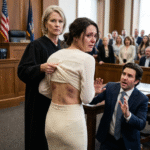
I moved to the stairs, looking down into the open-concept living room. Every guest had turned toward the commotion. Mom and Ella stood in the center of the room, and Ella had her phone up, live-streaming.
“Everyone needs to know what kind of person they’re dealing with,” Ella announced, her voice carrying to every corner of the house. “This woman, Sadie Tate, stole from her own family. She took our retirement money and spent it on herself, flaunting it online while we struggle.”
“That’s not—” I started, but Mom cut me off.
She swayed dramatically, one hand pressed to her forehead.
“I can’t… I can’t breathe.”
Then she collapsed onto one of the staged sofas, a picture of theatrical distress. Several guests gasped. Someone asked if they should call 911.
“No need,” Mom said weakly. “It’s just the stress. The stress of having a daughter who betrayed us so completely.”
I stood frozen at the top of the stairs, my mind spinning. Every eye in the house was on me. Richard looked horrified. The potential buyers looked confused, uncomfortable, eager to leave. Three months of work, my career, everything I’d built—they were trying to destroy it all.
Ella continued to livestream, narrating every moment.
“This is the person selling you this house, everyone. A liar and a thief. Ask yourselves, do you really want to work with someone like this?”
Something inside me snapped—not into panic, into clarity. I walked down the stairs slowly, deliberately, pulling out my phone. As I descended, I locked eyes with Marcus.
“Call the police,” I ordered, not breaking stride. “Criminal trespassing and disturbing the peace. I want them removed.”
“You can’t,” Ella started.
“I can, and I am.”
I turned to address the room, keeping my voice calm and professional.
“Ladies and gentlemen, I apologize for this disruption. These two individuals are my estranged mother and sister. They’ve been harassing me for weeks after I refused to give them money. I have documented evidence, police reports, and pending restraining orders. This is, unfortunately, an escalation of that harassment.”
One of the older gentlemen, a man in an expensive suit who’d been seriously considering the property, stepped forward.
“You’re filing a police report?”
“Yes, sir. Immediately.”
He looked at Mom and Ella with undisguised disgust.
“Then I’d say you’re handling this with remarkable professionalism, Miss Tate.”
Mom sat up, her fainting spell apparently forgotten.
“You don’t understand—she ruined her sister’s career. She—”
“I understand perfectly,” the man said coldly. “I’ve seen this kind of manipulation before. My own daughter deals with a similar situation.”
He turned to me.
“I’ll wait to continue the tour after they’re removed.”
Other guests nodded in agreement. One woman actually moved to stand beside me, a silent show of support.
Ella was still filming, but her expression had changed. She was realizing this wasn’t going as planned. Marcus and his partner moved in, each taking an arm.
“Ladies, you need to leave. Now.”
“Get your hands off me!” Ella shrieked, trying to pull away. “This is assault. You’re all witnessing assault.”
“You entered under false names,” Marcus said calmly. “That’s fraud. You’re trespassing on private property. You have two choices. Walk out now, or be carried out and charged with resisting.”
Mom started crying real tears this time, but born of rage, not grief.
“Sadie, please. Don’t do this. We’re your family.”
I looked at her and felt… nothing. No guilt. No pain. Just a vast, empty relief.
“No,” I said quietly. “You’re not.”
They were escorted out, Ella screaming profanities the entire way. Several guests actually applauded when the door closed behind them.
Richard Sterling appeared at my elbow, his expression unreadable.
“My office. Monday morning.”
My stomach dropped.
“Richard—”
“To discuss the restraining order paperwork,” he continued. “You need to file it immediately. I’ll be a witness to this incident if needed.”
He looked around at the disrupted open house.
“Now, let’s get back to business. You have properties to sell.”
I almost collapsed with relief.
The police arrived within ten minutes. I gave my statement, provided the security footage, and watched as officers went outside to speak with Mom and Ella, who were sitting in their car, refusing to leave the neighborhood.
The gentleman in the expensive suit—Mr. Harold Brennan, I learned—stayed through the entire process. When the police finally left, taking Mom and Ella’s information and issuing them citations, he approached me again.
“That took guts,” he said. “My daughter’s been fighting her ex-husband’s family for three years. She’s learning what you clearly already know. Bullies don’t stop until you force them to.”
“Thank you for staying,” I said. “You didn’t have to.”
“Actually, I did.” He smiled. “I’m buying the house. Full asking price. Let’s write up the offer.”
I stared at him.
“I—what?”
“You heard me. Anyone who can handle that situation with that much grace and professionalism is someone I want to work with. Plus, the house is gorgeous. It’s a win-win.”
By the time the open house officially ended at 5 p.m., I had three offers. One at asking price, two above it.
Richard pulled me aside as I was packing up.
“You did good, Tate. Really good.”
“Really? Even with the scene?”
“Especially with the scene. You kept your cool, protected the clients and handled it by the book.”
He paused.
“Get that restraining order. Document everything. And if they try this again, you call me immediately. We take care of our agents here.”
I nodded, not trusting my voice.
As I drove home that evening, my phone rang. Uncle Bo.
“How’d it go?” he asked.
“They showed up. Caused a scene. Got arrested for trespassing.”
Silence. Then:
“You okay?”
“I’m okay. Actually I’m better than okay. I sold the house.”
“Course you did. You’re a Tate.”
I smiled.
“No. I’m a Miller.”
His laugh was warm and rich.
“Damn right you are.”
The courthouse hallway was surprisingly quiet for a Monday morning, a stark contrast to the noise that had filled my life for the past three months. I sat on the wooden bench, sandwiched between Aunt Sarah and Uncle Bo, a thick folder of evidence resting on my lap like a shield.
Inside that folder lay the wreckage of my biological family’s choices. The Ring footage of a father kicking a door, police reports of a mother feigning illness, and screenshots of a sister’s digital cruelty. My lawyer, Patricia Whitmore, had called it airtight, but my heart still hammered a nervous rhythm against my ribs.
When the hearing room doors finally opened, the process was clinically efficient. Judge Reynolds reviewed the footage with a furrowed brow. He watched my father’s violence and my sister’s screaming fit at the open house, his expression hardening into disapproval.
“This is clear harassment,” he ruled, his voice echoing in the high-ceilinged room. “Temporary restraining order granted. The respondents are prohibited from contacting you, directly or indirectly. Any violation results in immediate arrest.”
The scratch of his pen on the order sounded louder than a shout. It was the sound of a heavy chain finally snapping.
As we walked out into the crisp afternoon air, I didn’t feel triumphant. I just felt light.
A week later, I was packing. My lease was up, and I was moving to a condo with a doorman, a physical barrier to match my legal one. While clearing out the back of my closet, my hand brushed against a dusty box shoved deep under the bed. I pulled it out, coughing slightly in the stale air.
I knew what was inside before I lifted the lid, but seeing them still made my chest ache.
A boule of a watch, nestled in velvet. A coach handbag, leather still smelling new, tags attached. I had bought them five years ago, expensive peace offerings for parents who only spoke the language of materialism. I had spent money I didn’t have, hoping these luxury tokens would buy me a seat at their table.
But I had never given them. Some deep, self-protective instinct had warned me that it wouldn’t matter. They would take the gifts, offer a distracted thank you, and nothing would change.
For a long moment, I held the watch, tracing the cold glass face. It represented time I could never get back. I ran my fingers over the coach bag, feeling the weight of the baggage I was finally ready to drop.
I didn’t put them in the moving truck. Instead, I drove to a local women’s shelter. When I handed the box to the coordinator, she gasped.
“These will help someone look professional for a job interview,” she said. “Someone starting over.”
“That’s exactly what they’re for,” I smiled.
Transforming a symbol of rejection into a tool for someone else’s freedom felt like the final step of my own exorcism.
Christmas came three weeks later, wrapping Aunt Sarah’s small house in the smell of glazed ham and pine needles. There was no tension, no walking on eggshells, no performative perfection. Just a crooked tree decorated with Delilah’s childhood crafts and the sound of genuine laughter.
After dinner, as the snow began to fall outside, Uncle Beau signaled for me to follow him into the garage. It was his sanctuary, smelling of sawdust and oil. He leaned against his workbench and handed me a large manila envelope.
“What’s this?” I asked, sensing the gravity in the air.
“Open it.”
My fingers trembled as I slid the papers out.
Petition for adult adoption.
I stared at the words, the legal jargon swimming before my eyes.
“You don’t need to carry the name of people who don’t deserve you,” Beau said, his voice rough with an emotion he rarely showed. “Sarah and I talked about it. We want to make it official. You’re our daughter, Sadie. In every way that matters.”
The tears came then, hot and fast. I looked up at this man, this mountain of a man who had stood between me and my father’s rage, who had saved the best pork chop for me, who had shown up when it counted.
“Is that a yes?” he asked gently.
“Yes,” I choked out. “A thousand times yes.”
We signed the papers at the kitchen table, the scratching of the pen far sweeter than the judge’s signature had been. Aunt Sarah cried openly, and Delilah cheered, hugging me so hard I thought my ribs might crack.
Sadie Marie Miller.
Later that night, driving home to my new condo, I stopped at a red light and looked at my reflection in the rearview mirror. I looked the same, but everything had changed.
I had started this journey with a check for $14,650.28 and a soul hollowed out by betrayal. I was ending it with a protected career, a home that was truly mine, and a family that had chosen me as deliberately as I had chosen them.
The daughter’s revenge wasn’t destruction. It wasn’t burning their world down. It was building a beautiful, impenetrable life in the ruins they had left behind. It was choosing love over bitterness.
And finally, for the first time in 28 years, I was free.