My Furnace Died on Christmas Eve—and the Hospice Dog I Adopted Exposed What Our Home Was Really Built On
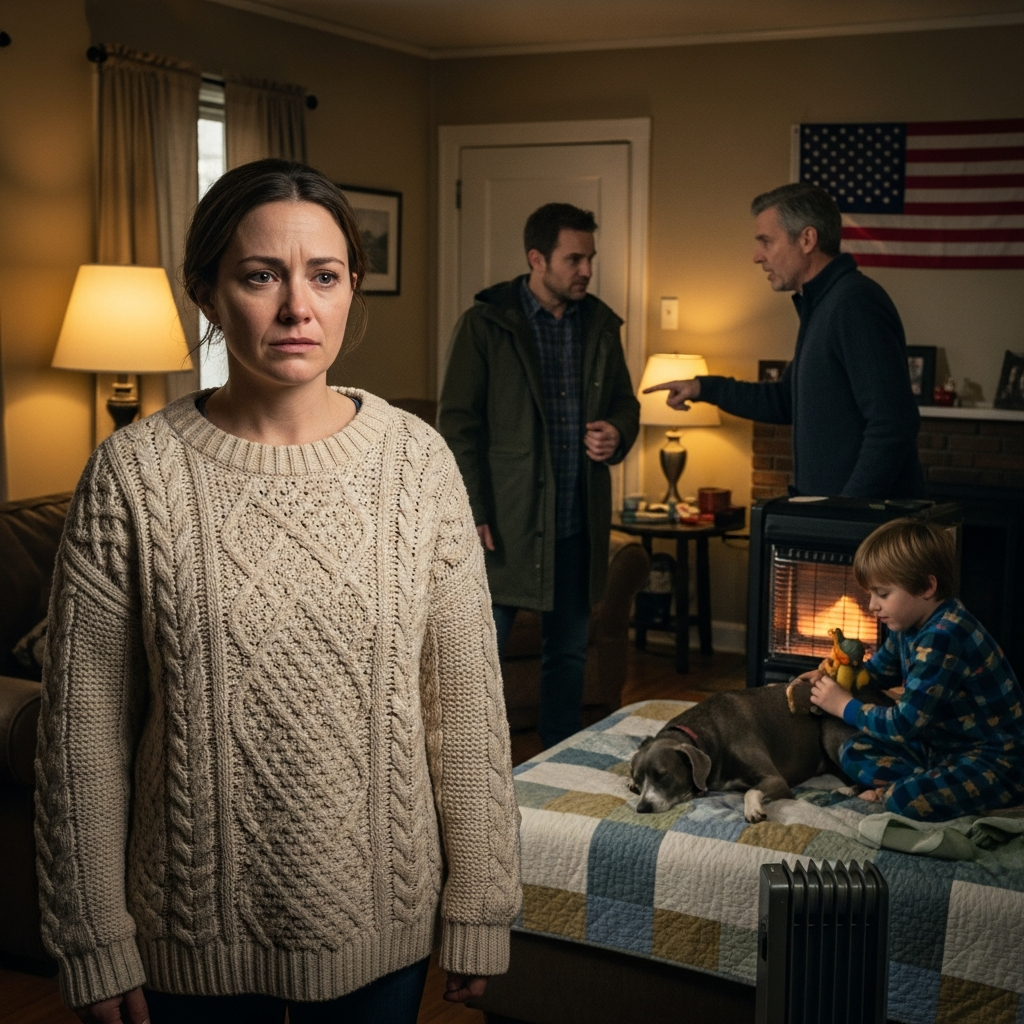
The furnace coughed like it was clearing its throat for a final speech, then went quiet.
At first I thought it was the wind, because Milwaukee in late December always sounds like it’s chewing on the corners of your house. Then the vents stopped breathing, and the living room air turned still and thin, like it had decided not to help anymore. Maggie lifted her gray head from her blanket, blinked once, and let out a slow sigh that felt like a judgment.
Upstairs, a nightlight clicked on in the hallway, and my nephew Ben’s plastic dinosaur threw its shadow across the wall like a tiny monster guarding a future he didn’t understand yet. The kitchen smelled like wrapping paper and cinnamon candles, the kind you buy when you’re trying to make your life look festive enough to match the photos on other people’s cards. A roll of tape stuck to my thumb, and I stood there staring at the thermostat like it owed me an apology.
David wasn’t home.
He’d left three hours earlier with an overnight bag and the kind of brisk, confident voice he uses when he wants me to accept things without asking questions. “Urgent client situation,” he’d said, already halfway out the door. “Out of town. I’ll call when I can.”
He didn’t kiss me goodbye.
I told myself that didn’t mean anything, because when you’ve spent years living with disappointment, you learn how to turn small hurts into “practical details.” I watched his taillights fade through the snow and went back to wrapping gifts for a child who wasn’t mine and a dog who was dying.
Maggie’s hospice meds sat in a neat row on the counter beside a bowl of oatmeal I’d made soft enough for her to eat without pain. The spoon clinked against the ceramic, and the sound felt too loud in a house that suddenly didn’t know how to be warm. The refrigerator hummed, steady and indifferent, like it had never heard of grief.
Ben had fallen asleep in the guest room after begging to open “just one” present. I’d tucked him in under a quilt that used to belong to my mother and listened to him breathe, safe and unaware. Children sleep like they trust the world, even when the adults are quietly breaking it.
Maggie didn’t sleep like that.
Her body looked smaller every day, as if time was gently taking pieces from her. Her eyes followed me from room to room, calm but watchful, like she was making sure I didn’t abandon her the way so many people had before. She was twelve, according to the shelter paperwork, but she carried herself like she’d been old for a long time.
When the furnace died, I grabbed my phone and called the emergency line on the sticker someone had slapped on the unit years ago. A recorded voice told me they were “experiencing high call volume” and suggested I try again later, as if cold is something you can reschedule.
I hung up and stood in the kitchen with my hands on the counter, breathing in the scent of cinnamon and tape adhesive and dog food. The house made a small creak behind me, and I felt the floorboard settle under my weight like a tired knee.
A sharp truth landed, simple and rude.
A house will tell the truth the minute you stop paying attention.
I pulled on my boots and went down to the basement with a flashlight, stepping carefully around boxes labeled CHRISTMAS and TAXES and OLD PHOTOS. The air was colder down there, damp in the corners, and the concrete smelled like it always does: dust, old paint, and whatever was quietly growing behind the walls.
I crouched beside the furnace and ran my hand over the metal casing. It felt cold, too smooth, too dead. I tapped it with my knuckles like it was a door. Nothing.
Behind me, the basement stairs groaned.
“Mom?”
Ben’s voice hit me like a soft punch. I turned and saw him standing halfway down, hair sticking up, dinosaur tucked under his arm. His eyes were half-asleep but already worried.
“It’s okay,” I said, the lie automatic. “The furnace is just being dramatic.”
Ben blinked. “Like Uncle David,” he muttered, then froze like he’d said a swear word.
Upstairs, Maggie gave a quiet cough—one small sound that made my throat tighten. Ben’s face changed when he heard it. Children don’t understand hospice, but they understand frailty. They understand when something is trying to leave.
“Is Maggie okay?” he whispered.
“She’s tired,” I said. “Come on. We’ll do a blanket fort.”
Ben nodded like it was a plan he could believe in.
We hauled extra quilts into the living room and built a sloppy fortress around the couch, because sometimes you can trick your nervous system with a little fabric and a flashlight. Ben crawled in first, brave and eager, and Maggie followed slowly, her nails clicking on the hardwood like a quiet metronome.
I sat inside the fort with them while the house cooled around us.
Outside, the snow fell in dry little pieces, and the street looked like a postcard someone forgot to mail. Every porch light on the block glowed warm and steady, like a neighborhood of people pretending nothing ever falls apart.
Ben shined the flashlight on the ceiling of the fort and whispered, “Do you think Santa knows where Uncle David went?”
I smiled in the dark. “Santa’s tracking is better than ours,” I said, and Ben snorted quietly.
Maggie rested her chin on my foot, and her warmth felt like a promise I didn’t deserve.
My phone buzzed.
David’s name lit up the screen.
I answered with my voice already composed, because that’s what women learn to do when they’re trying to keep a house standing. “Hey,” I said, like everything was normal.
“Clara,” he said, too smooth, too cheerful, like he’d practiced. In the background I heard clinking—glasses, maybe—and a muffled laugh that didn’t sound like “urgent client situation.”
My stomach did that cold sinking thing that happens when your body recognizes danger before your manners catch up. “How’s it going?” I asked.
“Fine,” he said quickly. Too quickly. “Listen, I just wanted to—”
“The furnace died,” I cut in, because I was tired of him controlling the pace of my reality. “It’s Christmas Eve. It’s twenty degrees outside. The vents stopped.”
There was a pause. Then he sighed like the cold was my personal inconvenience. “Clara, can’t you just use space heaters?”
“We have one,” I said. “In the closet. Behind the vacuum. Because I’m the one who thinks about backup plans.”
He didn’t respond to that.
Ben shifted beside me in the blanket fort, listening. Maggie breathed slow and shallow against my foot.
David cleared his throat. “How’s the dog?” he asked, and his voice changed slightly—less warm, more guarded.
“She’s asleep,” I said.
“Good,” he replied, as if Maggie being asleep made his life easier. Then he said it, the sentence that turned my stomach into stone. “Clara… this isn’t sustainable.”
I stared at the phone. “What isn’t?”
“All of it,” he said, like he was listing items in a budget. “The dog. The bills. The… taking in everyone else’s problems.”
Ben’s eyes widened in the dark. He hugged his dinosaur tighter.
I felt resentment rise, hot and clean. “Ben is upstairs,” I said quietly. “He can hear you.”
David scoffed. “He’s a kid,” he said. “He won’t understand.”
A sharper truth arrived, and it hurt because it was familiar.
Kids understand everything. Adults just hope they won’t.
“I have to go,” I said.
“Clara—”
I ended the call.
Inside the blanket fort, the flashlight beam trembled as Ben’s hand shook. He didn’t look at me. He looked at Maggie.
“Is Uncle David mad at Maggie?” he whispered.
I swallowed. The air inside the fort smelled like fabric softener and dog breath and fear. “Uncle David is… struggling,” I said. “And he’s handling it badly.”
Ben nodded slowly, absorbing the kind of lesson children should never have to learn on Christmas Eve. Then he asked the question that made my chest ache.
“Are you going to send Maggie back?”
I put my hand on his shoulder. “No,” I said. “Not because it’s easy. Because it’s right.”
Ben’s shoulders dropped slightly, like he’d been holding himself upright with worry. Maggie exhaled against my foot, and the sound felt like agreement.
I didn’t realize then that this wasn’t the night the furnace died.
It was the night my marriage finally admitted it had been dying for a while.
Two months earlier, David and I had walked into the Milwaukee shelter with a different kind of cold inside us.
The shelter smelled like bleach and wet fur and old towels that had been washed too many times. Dogs barked in layered desperation—high yips, deep booms, frantic scratching—and the sound climbed my spine like panic. Volunteers moved between kennels with practiced gentleness, smiling too hard, because if you don’t smile hard in a place like that, you might not survive it.
David kept his hands in his pockets. He’d been quiet in the car, staring through the windshield at the gray sky like he was waiting for it to tell him what to do. We hadn’t been talking much for a long time unless it was about schedules or bills or another medical appointment.
Infertility turns love into paperwork if you let it.
We’d let it.
“No puppies,” David told the volunteer, his voice crisp. “We need something calm.”
The volunteer nodded, sympathetic. “Senior dogs can be wonderful,” she said. “They just want a soft place.”
We walked past kennels where dogs performed hope—jumping, spinning, pressing their bodies to the bars as if wanting could become adoption. One dog barked at the ceiling like it was arguing with fate. Another wagged so hard its whole back end wiggled, like it had never learned that people leave.
Then, in a quieter corner, I saw a kennel that didn’t beg.
Maggie lay on a thin blanket, curled like punctuation. Her fur was faded, her muzzle gray as ash, and her eyes held the kind of calm you only get after you stop expecting rescue.
Her tag read: MAGGIE.
Underneath, on a laminated card: Senior. 12 Years. Health Concerns. Hospice Adoption Only.
Hospice.
The word made the air feel thinner.
I knelt by the kennel. Maggie lifted her head a fraction, just enough to look at me. No tail wag. No whining. Just attention.
“Hi,” I whispered, because I didn’t know what else to say.
Maggie blinked slowly, and something in my chest cracked open.
David stood behind me, arms crossed. “That one’s hospice,” he said flatly.
“I can read,” I replied, and I felt my cheeks heat.
The volunteer crouched beside us, her voice softer now. “She’s sweet,” she said. “But she needs comfort care. She might have weeks. She might have a couple months.”
Weeks.
I looked at Maggie again. She held my gaze like she wasn’t afraid of time, just tired of being alone inside it.
“I want her,” I said.
David laughed, sharp and bitter. “Clara,” he said, “no.”
The volunteer’s eyes flicked between us, alert, like she’d seen this kind of argument before. She moved back a step, giving us privacy the way you do when you sense a storm that isn’t yours.
“I can handle it,” I said, even though I didn’t know what “it” was. I think I meant loss. I think I meant loving something that was leaving, because I’d been practicing that kind of grief for years.
David’s jaw tightened. “We can’t even handle our own lives,” he said.
There it was, standing in the kennel aisle between the barking and the bleach.
The endless tests. The phone calls. The quiet collapse of hope. The way our marriage had become a place where we tiptoed around disappointment like it was a sleeping animal that might bite.
I swallowed. “Maybe caring for her will give us something to do besides mourn,” I said.
David’s eyes narrowed. “A dog won’t fix a marriage,” he snapped.
“I know,” I whispered. “But it might fix me.”
He stared at me like I’d become someone he didn’t recognize.
Then he said the sentence that would haunt me: “It’s her or me.”
Maggie’s ears twitched at the change in tone. She tried to stand, wobbling slightly, like her body had forgotten the full instruction for hope.
I reached through the bars and touched her shoulder. Under the fur, her bones felt too close.
A sharp truth arrived, clean and cold.
Control isn’t love. It’s fear wearing authority.
“I’m taking her,” I said.
David’s face hardened. “Then we’re done,” he replied, already turning away like he wanted to punish me with absence.
The volunteer didn’t look surprised. She just nodded slowly. “I’ll get the paperwork,” she said.
While she walked off, Maggie lowered her head again, resting her chin on her blanket like she’d decided to trust me without ceremony. No grand gesture. Just the quiet acceptance of someone who doesn’t have time for drama.
I didn’t feel like I was rescuing her.
I felt like she was handing me a job.
Be here. Do the care. Don’t run.
We brought Maggie home in a borrowed crate padded with an old towel that still smelled faintly like disinfectant. She trembled in the back seat, not from fear exactly, but from the effort of staying upright.
David drove with both hands clenched on the wheel.
Our house sat on a residential street with modest yards and porches decorated with pumpkins in October and inflatable snowmen in December. The porch rail leaned slightly, and the mailbox had a dent from the day David backed into it during a snowstorm and called it “character.”
Inside, the old radio on the kitchen counter played a soft station—classic hits, the kind of music that sounds like memory. The hardwood floors creaked in the same places they always had, like the house had opinions.
Maggie stepped into the living room and stood still, taking the space in slowly, reading it the way a tired person reads a new room: where’s the safest corner, where’s the exit, who here is kind.
David stood near the door with his coat still on. “I’m going to stay at my brother’s,” he said.
I blinked, even though I knew it was coming. “For how long?”
He shrugged. “Until you come to your senses,” he said, and his voice was flat like a door closing.
Then he left.
The lock clicked, and the house settled with a small creak, as if exhaling.
Maggie turned her head toward the sound, then looked at me.
I knelt beside her and whispered, “It’s okay.”
I wasn’t sure who I was talking to.
The first week with Maggie was not tender in the way people like to post about online.
It was work.
It was alarms on my phone—7:00 a.m. pills, 7:30 soft breakfast, noon water check, 6:00 p.m. pills again. It was measuring doses with shaking hands because the fear of doing it wrong felt bigger than the task itself.
It was warm dishwater and cracked knuckles from washing bowls and wiping paws. It was gently lifting Maggie onto a towel to clean her when her legs didn’t cooperate. It was changing blankets and shaking them out in the cold backyard air, watching tiny dog hairs float like soft snow.
Care is labor. It’s also repetition.
Maggie slept a lot. When she woke, she didn’t demand entertainment. She just wanted to be near me, her eyes tracking my movements as if my presence was the only thing she could count on.
At night, I sat on the floor beside her bed with a mug of tea and listened to the house. The refrigerator hummed. The pipes ticked. The furnace clicked on and off with a tired hesitation, like it was deciding whether effort was worth it. The old radio played softly, and the music felt like someone trying to remember how to be human.
Sometimes grief doesn’t scream.
Sometimes it just turns the volume down on everything.
On day nine, Maggie wagged her tail.
It was barely a movement—more like a thought—but it happened when I walked into the room with her food. The smallness of it made me laugh out loud, surprised by my own joy.
Maggie blinked at me as if to say, Calm down, lady.
That tiny wag was a victory that felt bigger than it should have, and that’s how I knew how starved I’d been for proof that my care mattered.
David texted a week later: We need to talk.
I stared at the message while stirring chicken and rice until it smelled like bland devotion. Maggie lay on the kitchen mat, her breathing slow. The steam from the pot fogged my glasses, and for a second the world looked softer than it was.
I didn’t answer right away.
I did the care. And I resented the care.
I resented David for making love a hostage negotiation. I resented myself for wanting him to approve of my kindness like I was a child bringing home a report card. I resented the years we’d spent trying for a baby until we’d forgotten how to be anything else.
And I resented the house for holding all those years in its walls like old smoke.
Then the phone rang.
My sister’s name flashed on the screen.
Her voice sounded thin, like she’d been holding herself together with tape. “Clara,” she said, “I need a favor.”
Maggie lifted her head, alert, as if she recognized the tone of a life asking for help.
“What’s going on?” I asked.
There was a pause on the line, and then my sister exhaled. “Mark’s been… struggling,” she said. Mark was her ex, Ben’s father, a man who treated responsibility like a rumor. “Ben can’t stay with him right now. Can he stay with you for a while?”
My throat tightened.
I looked at Maggie’s medication chart on the whiteboard. I looked at the guest room that still held my mother’s old quilt. I looked at the staircase where the nightlight always clicked on at 2 a.m., as if the house had insomnia too.
“Yes,” I said, and the word felt like both a weight and a promise. “Bring him.”
Ben arrived that night with a backpack, a plastic dinosaur, and a face that tried hard to look brave.
He stood in my entryway and glanced at Maggie’s bed, the whiteboard full of medication times, and the extra blankets piled on the couch. Children notice logistics the way adults notice mood.
“Is she sick?” he asked immediately.
“Yeah,” I said gently. “She’s old, and her body is tired.”
Ben nodded, solemn. “Like Grandma,” he said, and my chest tightened. My mother had died two years earlier, and Ben still said her name like she might walk into the kitchen at any moment and tell us to put on slippers.
Maggie lifted her head and looked at Ben.
Ben crouched slowly, careful, respectful like someone had taught him that living things deserve space. “Hi,” he whispered.
Maggie sniffed his fingers, then rested her chin on his knee.
Ben’s face softened. “She likes me,” he said, surprised.
“She likes calm,” I told him. “She has good taste.”
That night, Ben slept in the guest room. I lay awake listening to the house settle around the new weight of a child.
Harsh truth: my house had been built for a family I never got. Now it had one anyway, just not the way I’d planned.
In the mornings, Ben ate oatmeal at my kitchen table, feet swinging above the floor, asking questions like he was collecting facts to feel safe.
“Do we have school tomorrow?”
“Where does Maggie go potty?”
“Are you and Uncle David getting divorced?”
That last one came out as he stirred his oatmeal, casual as if he were asking about the weather.
I froze with the coffee pot in my hand. The kitchen light hummed. Maggie’s water bowl clinked as she shifted.
“I don’t know yet,” I said quietly.
Ben nodded, absorbing uncertainty with the tired skill of a child who’s practiced it.
Sometimes he sat on the floor beside Maggie and read aloud from his library book, his voice steady. Maggie listened like she understood every word. His stuffed reindeer—something he’d grabbed at the last minute—ended up on the top step of my staircase like a tiny guard who’d clocked in for the night shift.
Child as future, I thought. Not a fantasy. Not a dream. A living person watching how adults behave.
Two weeks into Ben staying with me, Maggie had a bad morning.
She didn’t want food. She didn’t stand when I called her. Her breathing sounded wet at the edges, and her eyes looked dull, like the light inside her was trying to decide whether it was worth staying.
I sat on the floor beside her and pressed my forehead to hers.
Ben hovered nearby, silent.
“Is she dying?” he asked softly.
My throat tightened. “She’s… closer,” I admitted.
Ben nodded, then looked at my phone on the counter like it was a tool he wanted to master. “Do we take her to the doctor?”
“Yes,” I said, and I felt the cruel math of adulthood tighten inside me. “We take her.”
At the clinic, the waiting room smelled like disinfectant and dog treats. A sad little Christmas garland drooped across a bulletin board, cheerful in the way people are cheerful when they’re trying to ignore mortality.
Maggie lay on a blanket in my lap, her head heavy. Ben sat beside me clutching his dinosaur, his small fingers white on plastic.
Dr. Patel came out with practical kindness in her eyes.
She examined Maggie gently, listening to her chest, checking her gums, moving with the quiet respect you use when time is fragile. “She’s declining,” Dr. Patel said. “We can adjust pain meds. We can do supportive care. But this is hospice. The goal is comfort.”
Comfort.
The word was both mercy and heartbreak.
I heard myself say something that surprised me with its clarity. “I don’t want to stretch her life if it’s just suffering,” I said. “I want her to feel safe.”
Dr. Patel nodded. “Then you’re doing it right,” she said.
In the car afterward, Ben buckled himself without being asked and stared out the window for a long time. Then he asked the question that made my eyes burn.
“Aunt Clara,” he said, “are you going to be okay when she dies?”
I swallowed hard. “I don’t know,” I admitted. “But I’m going to do the care anyway.”
Ben nodded like he was storing that sentence somewhere important. “Okay,” he whispered. “I can help.”
That was when I understood something I’d been resisting.
Care isn’t only what you give.
Sometimes it’s what you accept.
Winter deepened, and the house began failing in little ways, like it was mirroring my life.
The back door didn’t seal right, and cold air slid in along the frame like a quiet insult. The upstairs bathroom fan whined like a dying lawnmower. One porch step sagged slightly, and I could feel it under my foot like a loose tooth.
I went to Menards with Ben on a Saturday. The fluorescent lights buzzed overhead, and the aisles smelled like lumber and paint and ambition. Ben pushed the cart like it was a mission.
We bought weather stripping, furnace filters, and a new doorknob because the old one stuck, and I was tired of things that stuck.
A man in an orange vest helped me load a box into the cart.
His name tag said ETHAN.
“Big projects?” he asked politely.
“Small ones,” I said. “The kind that keep a house from giving up.”
He nodded like he understood more than he should. “Those are the ones that matter,” he replied.
Ben looked up at him with the blunt curiosity only children have. “Do you know about furnaces?” he asked.
Ethan chuckled. “I do HVAC,” he said. “I know enough to keep people warm.”
Ben’s eyes widened. “We need warm,” he said solemnly.
Ethan smiled and slid a business card onto the cart handle. “If it acts up again, call,” he said. “No pressure.”
No pressure.
The phrase felt like a gift.
At home, I stuck the card to the fridge with a magnet shaped like an apple. Ben noticed immediately.
“Is Ethan your boyfriend?” he asked over peanut butter toast.
I almost laughed. “No,” I said. “He’s a furnace wizard.”
Ben nodded like that explained everything.
Then the sink started leaking.
It began as a slow drip under the kitchen cabinet—steady, patient, irritating. I put a bowl under it and told myself I’d fix it “tomorrow,” which is what adults say when they’re trying not to collapse.
Two nights later, I woke up to the sound of water.
Not a dramatic flood. Just the soft, relentless trickle of something going wrong. I padded downstairs in socks and opened the cabinet to find a thin stream sliding down the pipe, soaking the wood.
The smell of damp particleboard hit my nose, sharp and sour.
I shut off the water line with shaking hands and sat on the kitchen floor staring at the wet patch like it was proof I was failing.
Ben came downstairs in pajamas, hair messy, eyes soft with sleep. He sat beside me without asking questions.
“I heard the drip stop,” he said.
“Yeah,” I whispered.
Ben leaned his head against my shoulder. “It’s okay if you can’t fix everything,” he said quietly. “You’re still… doing it.”
My eyes burned. Maggie’s collar tag clinked softly as she shifted in her bed, the sound small and ordinary, like life insisting on continuing.
The next morning, I called Ethan.
He arrived in a work jacket with a tool bag and a calm face. He knelt by the furnace like a doctor at a bedside, listening, tapping, checking. He fixed a small issue—a failing igniter, he said—and warned me again the unit was tired.
Then he crawled under the sink without me asking and tightened a fitting with a practiced twist.
“It wasn’t a moral failing,” he said lightly when I apologized. “It was a loose connection.”
I laughed once, the sound surprising me. “Story of my life,” I muttered.
Ethan glanced toward the living room where Maggie lay near the vent. “Is she hospice?” he asked softly.
I nodded.
His expression softened. “My dad did hospice,” he said quietly. “Different kind. Same clock.”
Not pity. Recognition.
When he left, the house felt slightly less hostile. The furnace breathed again, imperfect but alive. The sink stayed quiet. I stood in the kitchen and listened to the refrigerator hum and thought, maybe this is what repair looks like—small, steady, unromantic.
That night, David showed up.
I heard his car door slam, hard. The porch light flickered once and steadied. Snow pushed against the windows like it wanted to erase tracks.
Ben was upstairs brushing his teeth. Maggie slept by the vent, her breathing shallow, her body curled tight like she was conserving every ounce of heat.
David knocked, then opened the door without waiting, like he still thought the house belonged to him.
He stepped into the entryway and looked around. His eyes landed on Ben’s backpack by the stairs, on Maggie’s bed, on the whiteboard full of medication times. His face tightened.
“What is this?” he asked.
“My life,” I said, and my voice surprised me with its steadiness.
He frowned. “Your sister’s kid?” he asked, like Ben was clutter.
“Yes,” I replied.
David’s gaze flicked to Maggie. “She looks worse,” he said.
“She is worse,” I answered.
His shoulders dropped slightly, and for one moment I saw the man I married—the man who used to bring me greasy diner fries on bad days and call it medicine. That man was still in there somewhere, buried under bitterness.
“I didn’t think you’d really do it,” he said softly.
“Do what?” I asked.
“Choose her,” he said.
I felt a truth sentence rise, sharp and calm. “I didn’t choose her over you,” I said. “I chose kindness over ultimatums.”
David flinched.
Ben appeared at the top of the stairs, toothbrush in hand, eyes wide. He froze when he saw David, his face tightening the way children’s faces tighten when adults bring tension into a house.
David lifted his chin, defensive now. “We need to talk about the house,” he said.
Of course.
When people are losing love, they often reach for property.
“I’m on the deed,” he continued. “I’ve been paying into it for ten years. We can’t just—”
“You haven’t paid anything since you left,” I interrupted, still calm. “And if you want to discuss legal details, we can do it through a mediator.”
David’s eyes narrowed. “So that’s it,” he said. “You’re turning cold.”
I almost smiled at the irony.
“I’m turning clear,” I replied.
Maggie coughed once, a small rasp. Ben’s eyes flicked toward her, worried.
David glanced at Ben, then back at me, and for a second I saw discomfort flash across his face—the discomfort of being watched by the future.
Ben stepped down one stair and asked, in his small steady voice, “Uncle David… are you mad at Maggie?”
The question hung in the entryway like smoke.
David’s mouth opened, then closed. He looked at Maggie, and something softened despite himself. Then his jaw hardened again, like shame turning into pride.
“I’m not mad at the dog,” he muttered. “I’m mad at… everything.”
Ben nodded, absorbing the adult truth the way kids do: quietly, sadly. “Okay,” he said. “But Maggie didn’t do anything.”
David didn’t respond.
He turned and walked out. The door shut. The house creaked, settling back into its bones.
Ben came down the stairs slowly and stood beside me. “Was I rude?” he asked.
“No,” I whispered. “You were honest.”
Ben stared at the closed door and said something that cracked me open. “I don’t want to grow up and use houses instead of feelings,” he said.
I knelt beside him and touched his shoulder. “Then we practice not doing that,” I whispered.
That night, after Ben fell asleep, I sat at the kitchen table and stared at the whiteboard full of medication times and repair reminders. Maggie slept in the living room, her breathing slow and fragile.
The radio played softly, a song from the seventies that my mother used to hum while washing dishes. The tune made my eyes sting.
I understood then what the moral test was.
It wasn’t whether I could keep doing care.
It was whether I could keep doing care without letting someone else control the story.
In January, Maggie’s good days and bad days began arriving in patterns.
On good days, she ate her soft food and followed Ben into the living room, nails clicking. On bad days, she didn’t move much, and her breathing sounded heavier. Dr. Patel adjusted her meds twice, and each adjustment felt like turning a dial on a clock I couldn’t stop.
Meanwhile, Ben’s life kept happening.
He had spelling tests and snow days and a science project that involved a shoebox diorama of the solar system. He taped little planets to strings in my kitchen, and glitter fell onto the floor like tiny mistakes.
One afternoon, I picked him up from school and he climbed into the car wearing mittens on the wrong hands. “I got in trouble,” he announced.
“For what?” I asked, bracing.
“For telling a kid his dad was acting like a broken furnace,” he said.
I glanced at him in the rearview mirror. “That’s… oddly specific,” I said.
Ben shrugged. “He was yelling at his mom in the parking lot,” he said. “I didn’t like it.”
My chest tightened. “What did the teacher say?” I asked.
Ben sighed like a small old man. “She said I should use ‘kind words,’” he replied. “But I was being kind. Furnaces need fixing.”
I laughed, then felt the laugh break into something tender and painful.
In the evenings, I packed Maggie’s pills into a day-of-the-week box and made Ben toast with apple butter. I wiped counters. I folded laundry. I listened to the house creak and hum, and sometimes the ordinary tasks felt like prayer.
Other times they felt like chains.
One night, I snapped.
Ben spilled oatmeal on the floor, and Maggie chose that exact moment to have an accident near the door. The furnace made a fresh noise that sounded like a complaint. I stood in the kitchen holding paper towels, and something in me went hot.
“Can everybody just—” I started, and my voice rose.
Ben froze, eyes wide.
Maggie flinched, her ears twitching.
I stopped myself mid-sentence.
Resentment is real. It also teaches you what you need.
I took a breath and said, quietly, “I’m sorry.”
Ben swallowed. “It’s okay,” he whispered. “It’s a lot.”
My eyes burned. “Yes,” I admitted. “It is.”
Ben nodded slowly and picked up the paper towels without being asked. He wiped the oatmeal carefully, then looked up at me. “We can do it together,” he said.
A child offering partnership.
That’s when I understood the care, deeper than obligation.
Care is what builds the kind of home a child remembers as safe.
February brought a letter from a lawyer.
Not dramatic. Not cruel. Just official.
David had filed for divorce.
I stood at my kitchen counter with the envelope open, staring at the words like they were written in another language. Maggie slept near the vent. Ben was upstairs doing homework, the scratch of his pencil faint through the floor.
The house creaked softly, as if reacting.
A sharp truth arrived and sat beside me.
Some marriages end long before the paperwork catches up.
My sister called that evening. “How are you holding up?” she asked, voice gentle.
“I’m… doing the care,” I said, and I heard the exhaustion in my own words.
“Do you want me to take Ben back?” she asked quickly, guilt rising.
“No,” I replied. “He’s… good here. And I’m good with him.”
There was a pause, and then my sister whispered, “You’re doing a lot, Clara.”
I didn’t correct her.
I didn’t say I resented it sometimes.
I didn’t say I’d never been trained to want help.
Instead I said, “Can you bring over a casserole?”
My sister laughed softly, relieved. “Yes,” she said. “Tomorrow.”
That night, after Ben fell asleep, I opened my banking app and stared at numbers.
David had always loved numbers. Taxes. Budgets. Little graphs that make life feel obedient.
He’d always been better at controlling money than he was at handling grief.
I looked at the mortgage payments. The vet bills. The furnace estimate Ethan had left. The grocery receipts from Pick ’n Save, folded in my purse like evidence of daily life.
Care became math, whether you want it to or not.
I called a mediator the next day.
A boundary doesn’t have to be loud to be strong.
Spring came slowly, like Milwaukee wasn’t sure it wanted to commit.
The snow melted into gray slush. The light stretched longer into evenings. The neighborhood kids started riding bikes again, their laughter echoing down the block like proof the world keeps going even when you don’t feel ready.
Maggie had a stretch of better days, and I didn’t trust it.
She ate more. She stood longer. She wandered into the backyard and sniffed the air like she was remembering who she used to be.
Ben moved back with my sister in March when Mark finally got himself into a more stable arrangement, but Ben came over often—sometimes with his backpack, sometimes just with his dinosaur and questions.
His stuffed reindeer stayed on my top step anyway, like the house had adopted him too.
One Saturday, Ben and I took Maggie for a slow walk.
Not a heroic walk. A shuffle down the sidewalk past mailboxes and porch swings and a neighbor grilling even though it was barely fifty degrees, because Midwestern optimism is stubborn. Maggie paused under a maple tree and looked up at the branches, her eyes bright for one moment.
I stopped and listened. Birds. Distant traffic. A lawnmower starting somewhere. Nature, neutral and indifferent, doing its work.
“I’m glad you’re here,” I whispered to Maggie.
She leaned into my leg, warm and solid. Then she stepped forward again, slow and determined.
That afternoon I went to a diner on North Avenue for the first time in months, because I needed to sit somewhere that wasn’t filled with my own history.
The diner smelled like coffee and fries and old booths. A waitress called me “hon” and refilled my mug without asking. I ate soup and toast, simple food that tasted like survival.
Ethan walked in while I was stirring my coffee.
For a second my body tensed, because joy still felt like something I needed permission for. Then he spotted me and hesitated, polite, and I waved him over before my fear could stop me.
“How’s the furnace?” he asked as he slid into the booth.
“Still breathing,” I said.
Ethan smiled. “Good,” he replied. “How’s Maggie?”
I swallowed. “Some days good,” I admitted. “Some days… not.”
Ethan nodded slowly. “That’s hospice,” he said, and his voice held no pity, only understanding.
We talked about small things. The weather. Grocery prices. The way the lake wind can make your bones ache. The fact that I still hadn’t fixed the porch step.
Ethan didn’t try to fix my feelings.
He just sat there, steady, like a warm cup in your hands.
Before he left, he said, “If you need help with that porch step, I can swing by. No pressure.”
No pressure again.
It made me want to cry, which felt ridiculous.
But grief makes you weird. Kindness makes you weird too.
Late April brought Maggie’s decline back with quiet vengeance.
One morning she didn’t get up. Not even for chicken and rice. Her breathing sounded like it was coming through water. I sat beside her and rubbed her ears, and her eyes followed me with tired love that made my throat ache.
I called Dr. Patel.
Her voice was gentle and firm. “It may be time,” she said.
Time.
The word hit like a door closing softly.
Ben was coming over after school. I stared at my phone, then at Maggie, then at the calendar on my fridge—Ben’s visits, vet appointments, mediator dates, furnace service reminders. All my life reduced to boxes.
I called my sister. “Can Ben come later?” I asked.
She paused. “Is it Maggie?” she whispered.
“Yes,” I said, and my voice cracked.
“I’ll tell him,” she said gently. “He’ll want to say goodbye.”
When Ben arrived, he didn’t run in like usual.
He walked slowly, his backpack heavy on one shoulder. He knelt beside Maggie’s bed and whispered, “Hi, Maggie,” and his voice shook.
Maggie opened her eyes and looked at him. Her tail moved once, faint as a sigh.
Ben swallowed hard. “Thank you for liking me,” he said.
I felt tears spill, silent and hot.
Ben turned to me. “Are you going to… do the thing?” he asked, careful.
I nodded. “Yes,” I whispered. “I want her comfortable.”
Ben nodded like he understood the difference between cruelty and mercy, which is a hard thing for a child to know.
He reached into his backpack and pulled out his dinosaur. He placed it gently beside Maggie’s blanket like an offering.
“So she won’t be lonely,” he whispered.
My chest cracked open in a clean way.
Child as future. The next generation insisting on tenderness.
Dr. Patel came to the house that evening.
The sun was low, the light gold and thin through the windows. The old radio played quietly, and the music sounded like memory trying not to fall apart. The house hummed and creaked, alive in its ordinary way, like it didn’t understand what was ending.
Dr. Patel moved with respect, explaining everything in calm language. She didn’t rush me. She didn’t pretend this was easy.
Ben sat on the couch holding my hand.
I lay on the floor beside Maggie, my palm against her chest. Her heartbeat was weak but steady, a small drum slowing.
“I love you,” I whispered into her fur. “Thank you for choosing me.”
Maggie’s eyes looked at me one last time, and I swear they held something like peace.
Then her breathing eased, and the tension in her body softened like a knot finally untied.
The house creaked once, settling.
Ben’s grip tightened on my hand, then loosened. He didn’t sob. He just stared, quiet and devastated, because sometimes grief is too big for noise.
After Dr. Patel left, the house felt too quiet.
I cleaned up because my body needed action. I washed Maggie’s bowl in warm dishwater that smelled like soap and failure. I folded her blanket slowly, the fabric still holding her heat. I wiped the floor where her bed had been like I was erasing evidence of love.
Ben watched me and asked, softly, “Are you mad at her for leaving?”
I swallowed. “No,” I whispered. “I’m mad at time.”
Ben nodded like time was a person who deserved blame.
We sat at the kitchen table with cocoa and marshmallows because children need sweetness when death shows up. The kitchen light hummed. The refrigerator clicked. The house kept living.
Ben looked toward the empty spot by the vent. “What happens now?” he asked.
A truth sentence landed, quiet and steady. “Now we keep living,” I said. “And we remember. And we try not to turn love into control.”
Ben nodded slowly. “Okay,” he whispered. “I can help with that too.”
A week later, I picked up Maggie’s ashes.
The box was small, lighter than it should have been for how much she’d changed my life. The shelter gave me her old tag in a tiny envelope, the letters worn from her collar.
I drove home with the box on the passenger seat and buckled the seatbelt around it, because my body didn’t know how to treat loss casually.
At home, I set the box on the mantle beside Ben’s crooked salt-dough ornament from school, glitter cracked at the edges. Two kinds of fragile permanence.
I stood in the living room staring at the mantle while the house made its usual sounds. It didn’t know Maggie was gone. It just kept humming and creaking and holding.
That afternoon, David texted: Can we talk in person?
I stared at the message until my eyes felt tired.
I used to believe talking was the thing that saved people.
Now I knew talking is only useful if it’s paired with honesty.
I typed back: Mediation is next week. We can talk there.
His reply came fast: You’re punishing me.
A sharper truth came and sat in my throat. No, I thought. I’m protecting myself.
I didn’t type that.
Instead I set the phone face-down on the table and went outside to look at the porch step.
The wood had rotted at the edge, soft and dark like a bruise. I pressed it with my thumb and felt it give slightly. The step didn’t collapse, but it warned me it could.
The house was telling me again: fix what you can before it breaks someone.
I called Ethan.
He came over with a toolbox and a calm smile. He didn’t ask why I sounded tired. He didn’t act like my life was entertainment. He just showed up.
We replaced the board together. Hammer taps sounded bright in the spring air, steady and practical. Sawdust drifted onto the porch like pale snow.
“Your house has good bones,” Ethan said.
“Some days,” I replied.
Ben arrived after school and watched us from the yard.
He squinted at Ethan and asked, loud enough for Ethan to hear, “Is Ethan your boyfriend now?”
Ethan laughed, warm. “I’m just the guy with the hammer,” he said.
Ben frowned. “That’s how it starts,” he said solemnly, like he’d read a manual.
I laughed in spite of myself, and the laugh felt like light coming through a crack.
That summer, I didn’t become a different person overnight.
I still woke some mornings and expected to hear Maggie’s nails on the floor. I still got hit by grief in the grocery aisle when I passed the senior dog food. I still hated the quiet at night when the house settled and there was no small snore in the corner.
But I began doing small things that made my life larger than loss.
I volunteered at the shelter on weekends—folding towels, cleaning kennels, sitting with older dogs who didn’t beg. I learned how to be present without trying to control the outcome.
Ben came with me once, cautious at first, then serious. He sat beside an older dog named Rosie and read aloud from his book like he was giving comfort a job to do.
On the drive home, Ben stared out the window for a while, then said, “I think you’re better now.”
I blinked. “Better how?” I asked.
Ben shrugged, struggling for words like children do when they’re trying to name adult things. “Like… you don’t look like you’re disappearing,” he said.
The sentence hit me harder than it should have.
Because it was true.
I had been disappearing. Not dramatically. Just slowly, in small daily surrenders.
Maggie didn’t give me a miracle.
She gave me a practice.
Show up. Do the care. Tell the truth. Set boundaries. Let love be labor, not a leash.
On an August evening, Ethan invited me to a small outdoor concert in a park near the lake.
It wasn’t a grand date. It was folding chairs, a local band, and a picnic table with potato salad. The air smelled like grass and sunscreen and grilled hot dogs.
Ben came too, because my life didn’t split neatly into romance and responsibility. It braided.
Ben ran around with other kids, laughing, his voice bright and unburdened. I watched him and felt something settle in me—something like permission.
Child as future, I thought. Not the future I planned. The future I’m responsible for anyway.
Ethan sat beside me on the bench. “You okay?” he asked softly.
I looked at the kids running, then at the sky turning gold at the edges. The lake wind moved through the trees like a slow breath.
“I’m… here,” I said.
Ethan nodded like that was the most important thing. “That’s a big deal,” he replied.
On the drive home, Ben fell asleep in the backseat, his head against the window. Streetlights passed over his face in soft flashes, making him look both small and grown.
I parked in my driveway and sat for a moment, listening to the house.
The porch step felt solid under my foot now. The porch light was steady. The refrigerator hummed. The old radio played softly inside, a song that sounded like forgiveness.
Ethan walked me to the door and paused, respectful.
“I don’t want to rush you,” he said.
“Thank you,” I replied, and I meant it.
Then I said the truth I’d been practicing. “I’m still learning the difference between love and control,” I admitted.
Ethan’s eyes softened. “So am I,” he said. “We can learn slowly.”
Slowly felt safe.
In October, on the anniversary of the day I met Maggie, Ben and I went back to the shelter.
The air inside still smelled like bleach and longing. Dogs barked, hopeful and frantic. Volunteers moved with practiced care, keeping their hearts intact by staying busy.
We walked to the quiet corner where Maggie’s kennel had been. The space was empty now, the blanket gone.
Ben stood there holding my hand.
“I miss her,” he whispered.
“Me too,” I said.
Ben looked up at me, eyes serious. “Do you think she knew?” he asked.
“Knew what?” I whispered.
“That she saved you,” he said.
My throat tightened.
I glanced around at all the waiting lives. Then I looked at Ben, at his face full of quiet courage.
“I think,” I said slowly, “she didn’t think in terms of saving. She thought in terms of being together.”
Ben nodded. “That’s better,” he said.
We walked past a row of kennels. Rosie lay on her blanket, eyes tired but alert. Not Maggie. Someone else. A different story.
Ben squeezed my hand. “We could,” he whispered, cautious and hopeful.
I felt the familiar urge—to fill emptiness quickly, to use care as a way to avoid my own grief.
Then I did something new.
I breathed. I listened to my body. I let the truth settle before I acted.
“We can think about it,” I told Ben. “We don’t have to decide out of panic.”
Ben nodded slowly, learning what boundaries look like in real time.
At home that evening, the porch light clicked on as dusk came. The house creaked in its familiar way, no longer accusing, just alive. On the mantle, Maggie’s small box sat quiet and honored.
Ben set his dinosaur on the top stair like a guard, then turned to me.
“Aunt Clara,” he said softly, “do you think we’re going to be okay?”
I looked around my living room—patched, imperfect, still standing. I thought about Maggie’s last breath and the way comfort can be a kind of bravery. I thought about David’s ultimatum and the boundary I finally learned to draw. I thought about Ben’s questions and the way a child can force adults into honesty.
I smiled, and it wasn’t a performance.
“Yes,” I said. “Not perfect. But okay.”
Then I went into the kitchen and put the kettle on, because care is many things.
But sometimes it’s just making warmth on purpose—and trusting that the house can hold it.

