I jolted awake to furious pounding on my front door at 2 a.m. — my daughter and son-in-law stood outside, gripping a hammer, and they certainly weren’t there to see if I was alright.
PART 1
I woke up to the sound of pounding on my front door, the kind that makes your heart slam into your ribs before your eyes are even open. I glanced at the glowing red digits on my bedside clock.
2:00 a.m. Exactly.
For a moment, lying there in the dark of my little house in a working‑class Illinois suburb, I thought I was dreaming. Then the third blow hit, harder than the others, and my daughter’s voice tore through the quiet.
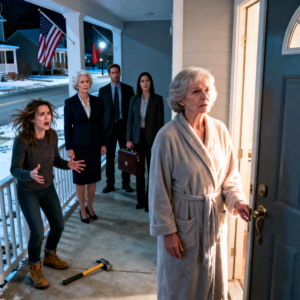
“Mom! Open this door right now!”
Lucy sounded like someone I didn’t know—hoarse, furious, not the baby I’d rocked to sleep or the teenager I’d sewn dresses for. My hands shook as I felt around for my slippers. At sixty‑eight, every movement is a negotiation with your knees and your back, and that night my bones felt every one of those years.
The pounding kept coming. Each hit echoed through the house like a war drum, reverberating through the plaster walls Charles and I had once carried in ourselves.
“Mom!” she screamed again. “Open the door!”
I shuffled to the bedroom window and eased the curtain back just enough to see the porch. Lucy stood in front of the door, hair wild, fists slamming into the wood. I couldn’t make out her face clearly in the streetlight, but I didn’t need to. Her whole body was shaking with rage.
Next to her stood David, my son‑in‑law. He held something in his hand.
A second later he lifted it, and the streetlight glinted off metal.
For a heartbeat I thought it was an axe. In the half‑dark, it could have been. Then my eyes adjusted, and I saw the truth.
A large carpenter’s hammer. Heavy. Solid. The kind that could break a lock—or a wrist—if someone swung hard enough.
My blood went cold.
“We’re coming in this time whether you like it or not!” David shouted, his voice icy and controlled in a way that scared me more than if he’d been screaming. There was no hesitation, no doubt. It was a promise.
I let the curtain fall and stepped back. My legs barely held me up. How had it come to this? How was my own daughter standing on the other side of my front door in the middle of the night, trying to force her way into the house her father and I had built with forty years of sacrifice?
I took a breath. Then another. I couldn’t let panic paralyze me. I had prepared for this. I had prayed I was wrong, that this moment would never come, but for weeks I’d known deep in my bones it would.
The first hammer blow hit the lock.
The metallic clang snapped through the quiet like a gunshot. I flinched, my heart trying to climb into my throat, but the reinforced deadbolts held. I’d paid extra for the highest‑security locks the hardware store in town carried. David didn’t know that yet.
“Mom, please,” Lucy yelled, her voice shifting suddenly from furious to pleading. “We just want to talk. We’re worried about you. Open the door. Please.”
Lies. Every word of it.
I knew exactly what they wanted. I had seen the papers. I had listened from the hallway when they thought I was asleep or too confused to understand. I knew their plan for my house, my money, and my life.
The hammer hit again and again. The door shuddered, but the lock held.
Behind me, in the dim light of the living room, a calm voice said, “Let them in, Audrey. I’ll open it.”
I turned.
Amelia stood just inside the hallway, her silver hair in its usual neat bun, wearing the same navy blazer she’d once worn into courtrooms downtown. She’d been my neighbor for thirty years, my friend for just as long—and now, my lawyer.
She wasn’t alone.
Next to her was a man in a dark suit holding a leather briefcase. Behind them, two tall figures stood quietly in the shadows of the dining room. I knew their names—Alex and John—but right then they were just silhouettes and steady eyes and the kind of stillness that meant I wasn’t alone.
“Are you sure about this?” I whispered, my voice almost swallowed by the pounding from outside.
Amelia nodded once. Her gray eyes were steady, full of compassion and steel at the same time.
“It’s now or never,” she said. “They’ve already crossed every line. It’s time they see the consequences of their choices.”
I swallowed. She was right. I couldn’t keep hiding in my own house, living in fear of my own child. If they were willing to show up at two in the morning with a hammer and threats, there was no going back.
I walked toward the front door. Every step felt heavy, like I was walking underwater. My bare feet were cold against the hardwood Charles and I had installed one tax refund at a time.
On the other side of the door, David hit the lock again.
“It’s about time,” he muttered when my footsteps creaked near the entrance. “Open up already.”
My hand closed around the knob. It was cool and solid under my palm. For a moment, just a heartbeat, I thought about walking away. I thought about going back to my room, pulling the covers over my head, pretending this whole nightmare wasn’t happening.
But it was happening.
And I had spent too much of my life pretending things were fine when they weren’t.
I turned the knob. The deadbolt slid back with a soft click. I pulled the door inward.
The streetlight spilled into the entryway, lighting all of us in a washed‑out yellow. Lucy and David froze on the porch. Their eyes went wide, not just at me in my bathrobe, but at the people standing behind me.
Amelia stepped forward. The man with the briefcase moved with her. The two security guards shifted to either side, clearly visible now.
“Good evening, Lucy,” I said, my voice steadier than I felt. “Good evening, David. Please come in. We have a lot to talk about.”
Lucy went as white as copy paper. Her mouth opened, but nothing came out.
David’s fingers slipped. The hammer dropped to the concrete with a hard metallic clang that echoed through the quiet street, as final as a judge’s gavel.
Before I tell you what happened inside my house that night, I need you to know who I am and how I got here. Because none of this makes sense—not the locks, not the hammer, not the stranger’s look in my daughter’s eyes—until you understand what it cost to build this life and this house in the first place.
My name is Audrey Rivers. I’m sixty‑eight years old, and I’ve lived my whole life in and around the same stretch of Illinois, on streets where the mailboxes lean a little and the American flag hangs from a few front porches all year, not just on the Fourth of July.
PART 2
I was born in a tiny house with a leaky tin roof, just outside the city. When it rained, water fell in slow, stubborn drops into every pot my mother owned. My father worked whatever jobs he could find—loading trucks, sweeping warehouses. My mother washed other people’s clothes for cash. There were six of us kids, and there was never quite enough of anything.
I learned to sew at eight because if I didn’t fix hand‑me‑downs, they didn’t fit. By twelve, I was sewing for neighbors for a few dollars a week. At fifteen, I left school and took a job in a downtown sewing factory. I earned three dollars a day and came home smelling like steam and fabric glue.
When I was eighteen, I met Charles.
He drove a city bus that passed by my factory every morning. For months he’d tap the horn and wave when he saw me at the stop. One cold March day, he actually pulled over on his break, walked up to me with those big calloused hands shoved in his jacket pockets, and asked if I wanted a coffee.
He was shy and gentle and had the kind of steady presence you can lean on. A year later, we were married in a small church with folding chairs and sheet cake. I wore a light blue dress I’d sewn myself. He wore the only suit he owned. The reception was macaroni and cheese and store‑brand soda at my parents’ house. It was still one of the happiest days of my life.
The first years were brutal. We rented a room barely bigger than a parking space—seven by ten feet, no closet, no heat in half the winter. Charles drove double shifts. I worked at the factory during the day and took extra sewing home at night. We saved every spare dollar in a rusted coffee can under the bed.
When I got pregnant with Lucy, I was terrified. We could barely afford ourselves. The pregnancy was rough. I made it to seven months at the factory before my back and the nausea forced me to quit. Charles picked up weekend shifts and slept four hours a night. I watched him carry the weight of our tiny family without complaint.
Lucy was born on a Tuesday afternoon in March at the county hospital, the kind of American public hospital where the linoleum is scuffed and the nurses are tired but kind. When they laid her in my arms, I cried from joy and fear in equal measure. She was so small, and the world felt so big.
We brought her home to that little room and somehow made it work. Charles got a better route that paid more overtime. I started sewing from home, Lucy sleeping in a crib beside my machine as I hemmed dresses until my fingers cramped. We went without new clothes, new furniture, new anything so she could have enough.
When Lucy was three, we did something impossible.
We bought a piece of land.
It was nothing special—just a small lot on the edge of a working‑class Illinois town, no utilities, patchy grass—but it was ours. It took us two years of weekends to turn that rectangle of dirt into a house.
We poured the foundation ourselves, nailed studs side by side with friends, learned how to hang drywall from a neighbor who worked construction. The first version of the house was two rooms and a bathroom with bare concrete floors and unpainted walls.
It was the most beautiful place I’d ever seen.
Lucy took her first steps on that concrete. She said her first words leaning against those unpainted walls. Every Christmas, even when money was tight, we made a small dinner—roast turkey if we could swing it, mashed potatoes, green bean casserole from a Midwestern church cookbook—and strung cheap lights around the windows.
As the years passed, we added on. A dining room. Two more bedrooms. Ceramic tile instead of concrete. A little porch where we could sit in the summer and listen to kids ride their bikes up and down the block. I turned one of the extra rooms into a sewing studio. We rented out two small rooms to students from the community college down the road for extra income.
Every upgrade in that house had a story. A secondhand stove bought with tax refund money. New paint paid for with overtime. A roof repair instead of a new dress.
Lucy never saw the cost. Children rarely do.
For her, the clean clothes, the full pantry, the solid roof were just… normal. She didn’t see Charles limp in after twelve hours of driving a city bus, or my hands swollen from sewing late into the night.
We threw her a fifteenth birthday party that cost almost a thousand dollars—money we’d been saving for two years. She wanted a specific brand‑name dress that cost three hundred. I bought it, even though it meant delaying a roof repair and praying through thunderstorm season. The look on her face when she twirled in that dress made it feel worth it.
Lucy graduated high school with good grades. We hoped she’d go to college, maybe be the first Rivers to get a degree. She said she wasn’t interested. She wanted to work, make her own money, be independent. It hurt, but we respected it.
She got a job at a clothing store in the mall off the interstate. The pay was decent for a teenager, and she spent every dollar—new clothes, nights out, the newest phone every year. We never asked her to contribute to the house. We wanted her to enjoy what we’d never had.
When she was twenty‑three, she met David.
He was five years older and introduced himself as a lawyer. In reality, he did small‑time paperwork in a cramped office above a strip mall, but he dressed sharp and talked smooth. Lucy was dazzled.
From the first dinner he ate at our table, something about him bothered me.
His eyes lingered on the framed photo of the house being built. He asked casual questions that weren’t really casual at all.
“So this lot… it’s in your name, right, Audrey?” he asked once, reaching for another roll.
“Mine and Charles’s,” I said.
“No mortgage?” he pressed, all fake‑polite curiosity.
“No mortgage,” Charles said, and there was pride in his voice.
“Wow,” David said, looking around like he was calculating more than the square footage. “You two did well. This neighborhood’s gone up a lot. I bet this place is worth a small fortune now.”
Charles told me later I was overreacting. “He’s just making conversation,” he said. I nodded, but something in my stomach stayed tight.
Lucy and David got married two years later in a modest ceremony. Charles and I spent five thousand dollars—our emergency savings. David didn’t contribute a cent. His family barely showed up. It should have been a warning.
After the wedding, Lucy and David “temporarily” moved into our house to save for their own place.
Temporary turned into permanent.
MONTHS became years. They paid no rent. They ate our food, used our utilities, and complained about the paint color in the room we gave them. Every time Charles or I hinted that they should start saving or contributing, David had an excuse.
“We had car trouble this month.” “Lucy needed new clothes for work.” “My job is slow right now; things will pick up.”
They never picked up.
PART 3
Charles was sixty‑two when the chest pains started. He brushed them off as indigestion until he collapsed behind the wheel of his bus on a hot July afternoon. Paramedics rushed him to the big hospital in Chicago. Massive heart attack, they said. He lived, but the doctors were clear.
“You can’t keep driving,” the cardiologist told him. “Your heart won’t take it. You need rest. Real rest.”
Rest doesn’t pay an American mortgage or an electric bill, even in a paid‑off house. Charles’s pension was small, barely four hundred dollars a month. I was still sewing, but arthritis was starting to curl my fingers. I couldn’t do the hours I used to.
Charles lived three more years after that first heart attack. Three long years where I watched the strongest man I knew shrink inside his own skin.
He spent his days in the old armchair by the front window, watching kids on bikes and dogs on leashes, the life he’d helped build passing by without him. I became cook, nurse, bookkeeper—everything.
Lucy and David kept living in our house. They promised to help. They didn’t.
“We’re barely getting by ourselves,” David would say, opening our fridge like it belonged to him. “Once my practice takes off, things will be different.”
It never took off.
Charles’s medications cost almost three hundred dollars a month. Insurance covered some, but not enough. I sold the ring he’d given me for our tenth anniversary and the gold earrings my mother left me. Every sale felt like losing a piece of myself, but there was no alternative.
One night, about two years after his heart attack, Charles called me into our bedroom. He was sitting on the edge of the bed, breath shallow, an envelope in his hand.
“Audrey,” he said, his voice thin but determined, “I need you to listen carefully.”
“Don’t talk like that,” I said automatically. “The doctor said—”
“We both know what’s coming,” he interrupted softly. “I need you to promise me something. When I’m gone, you protect this house. Protect what we built. Don’t let anyone take what’s yours.”
I didn’t fully understand then. I thought it was just a sick man’s anxiety. But Charles had seen what I refused to see.
He’d seen the way David’s eyes measured the square footage. The way conversations about “the future” always circled back to the house.
Charles died on a dull winter morning. I woke up and knew before I even opened my eyes. The air was wrong. Still. Too quiet. His chest wasn’t rising.
There was no drama. No last words. Just absence.
I used the last of our savings to give him a simple, decent funeral. Lucy cried, but not as much as I expected. David stood stiffly in his suit, watching the people who came, paying more attention to the cars they drove than the grief on their faces.
After the funeral, the house felt enormous. His coffee mug stayed on the shelf for weeks. His slippers sat by the bed untouched. I didn’t move anything. As long as his things were there, some part of him was too.
His pension stopped immediately.
I had my sewing clients, the rent from the student rooms, and a small payout from Charles’s life insurance—ten thousand dollars that was supposed to be my cushion in old age.
That’s when David really showed his hand.
A week after the funeral, he sat across from me at the kitchen table. Lucy was out.
“Audrey, we need to talk about the future,” he began, voice smooth and practiced. “This house is too big for you alone. The upkeep, the property taxes, the maintenance… it’s a lot.”
“I manage just fine,” I said. “I’ve worked my whole life. I know how to stretch a dollar.”
He gave me a look of polite pity that made my skin crawl.
“Sure. But you’re almost sixty‑five. How much longer can you keep sewing? What happens when your eyes get worse? When your hands can’t thread a needle anymore?”
He paused, then leaned forward.
“Lucy and I have been thinking. We could sell this house, get you something smaller and easier—a nice little condo maybe—and invest the rest. You’d have steady income without worrying about repairs. We’d take care of everything. All you’d have to do is sign some paperwork.”
My blood ran cold.
“Sell this house?” I repeated. “The house your father‑in‑law and I built with our own hands, where my daughter was born?”
“Don’t think of it as losing something,” he said. “Think of it as securing your future.”
“I am not selling my house, David.”
For a second, his polite mask slipped. I saw something cold in his eyes.
“Fine,” he said, standing. “It was just an idea. Think about it.”
That night, I lay awake replaying Charles’s last request.
Protect this house.
In the months that followed, David’s strategy shifted. He stopped talking directly about selling and started talking about my mind.
“Audrey, don’t you remember?” he’d say with a little frown. “I told you about this last week. It’s worrying you forgot.”
“Mom, that’s not how it happened,” Lucy would add, voice soft and patient like I was a child. “You’re mixing things up. Maybe you should see a doctor.”
At first, I doubted myself. I was sixty‑five. People my age forget things. But the “things” I was supposedly forgetting were always the same kind—conversations about money, documents, the house. Never trivial details. Never gossip or recipes.
One afternoon I walked past Charles’s old study and saw David rifling through the desk drawers.
“What are you doing in here?” I asked.
He snapped a drawer shut.
“Lucy asked me to find some old photos,” he said easily. “Where do you keep the albums?”
“In the hallway closet,” I replied. “Not in your father‑in‑law’s desk. His private documents are in there.”
“Oh,” David said, shrugging like it was nothing. “Since everything’s family now, I didn’t think it mattered.”
He brushed past me. That night, I opened the drawers one by one. Nothing obvious was missing, but unease crawled up my spine. I took the most important papers—the deed, the life insurance policy, my old will—and hid them in a safer place.
Then came the night that changed everything.
I’d gone to bed early, exhausted. A few hours later I woke up needing the bathroom. As I stepped into the hall, I heard voices from the dining room.
“It’s been six months since Charles passed,” David was saying. “We need to speed things up. The longer we wait, the more chance she does something reckless with the money.”
“Like what?” Lucy asked.
“Donate it to some church, leave it to charity, rewrite her will and cut us out,” he said flatly. “We can’t risk that.”
“She wouldn’t cut me out,” Lucy protested weakly. “I’m her only daughter.”
“Are you sure?” he asked. “She’s been looking at you differently. She suspects something.”
Silence. I stood in the shadows, heart hammering.
“Do you think we should go ahead with the plan?” Lucy whispered.
“Absolutely,” David said. “I have everything ready. We just need her signature. We’ll tell her they’re insurance forms, bank authorizations. She’ll trust you. And if she doesn’t—we have the other option.”
“The other option” made my stomach drop.
“You start documenting her confusion,” he continued. “We call a doctor, get him to write that she’s not capable anymore. Then we file for legal guardianship. Once we’re in control, we sell the house, move her into an assisted living facility, and use the money to build a better life. For all of us.”
“What if she finds out?” Lucy asked.
“She won’t if we handle it right,” he said. “And even if she does, who will believe her over medical records and family testimony?”
I slid back down the hallway, shaking so hard I could barely walk. In our bedroom, I sat on the edge of the bed I’d shared with Charles and cried harder than I had at his funeral. Grief hurts, but betrayal burns.
That night, I made a decision.
I was not going to sit quietly while they dismantled everything Charles and I had built. If they were going to make me fight for my home and my mind, then I was going to fight.
PART 4
The next morning, after they both left for work, I went through their room and David’s briefcase. I felt sick doing it, but I couldn’t ignore what I’d heard.
What I found made my blood turn to ice.
Inside a folder were draft legal documents—papers petitioning for my conservatorship. My name. My address. Lines claiming I was confused, forgetful, a danger to myself.
There were notes about “episodes”: times I’d supposedly wandered off, forgotten bills, left the stove on. All lies.
On a yellow legal pad, in David’s neat handwriting, I saw: “Dr. Sanchez – willing to cooperate for $2,000.” Below it: “Open joint accounts—mandatory. Power of attorney. Nursing homes $3–4K/mo.”
They weren’t just thinking about my future. They were planning it without me.
My hands shook as I took photos of every document with my old phone. I put the images on a USB drive and sewed it into the hem of a curtain in the spare room, the way my mother once hid emergency cash.
Then I put everything back exactly where I’d found it.
I couldn’t confront them yet. Not without help.
I thought of Amelia—my neighbor across the street with the tidy yard and the law degree she’d hung up ten years earlier. We’d shared cups of coffee and church potlucks and late‑night talks on porches. If anyone would believe me, it was her.
The next day, I told Lucy I was walking to the grocery store. Instead, I crossed the cracked sidewalk between our houses and rang Amelia’s bell.
She opened the door and took one look at my face.
“Audrey, what happened?” she asked. “You look like you’ve seen a ghost.”
“Worse,” I said. “I’ve seen my daughter for who she really is.”
At her kitchen table, over coffee that went cold, I told her everything. The conversations. The documents. The plan to have me declared legally incompetent and moved into a facility so they could sell my house.
Amelia listened without interrupting, her expression growing graver with every detail.
When I finished, she sat quietly for a long moment.
“This is serious,” she said at last. “This isn’t just family drama. This is attempted financial exploitation. Elder abuse.”
“I don’t want my daughter in handcuffs,” I whispered. “I just want them to leave me and my house alone.”
“I understand,” she said. “But if they file those papers and get even a friendly doctor to sign off, it could take years to undo. We need to protect you now, while you’re clearly in full control of your decisions.”
In the weeks that followed, Amelia became my secret ally.
We met at odd hours—early mornings, late afternoons when Lucy and David were out. Amelia helped me draft a new will, one that couldn’t be easily challenged. She helped me set up a trust putting the house in a structure designed to keep it out of David’s reach. We quietly moved my modest savings to different banks where Lucy and David weren’t listed as contacts.
“You also need a medical power of attorney,” she said. “If you choose someone now, while you’re clearly competent, it will be very hard for any court to appoint someone else over you.”
“Who would I even choose?” I asked. “I don’t have other close family.”
“You can appoint a professional,” she said gently, “or… you can appoint me. If you trust me.”
I looked at the woman who had brought us casseroles when Charles was in the hospital, who had watered my plants when I was sick.
“I trust you,” I said. “If you’re willing, I want it to be you.”
“Of course,” she replied. “We’ll do it properly. Everything clean, notarized, filed.”
While we quietly put protections in place, David and Lucy turned up the pressure.
They started talking about my “memory issues” in front of neighbors.
“Mom gets so confused lately,” Lucy told one woman over coffee at our kitchen table. “Yesterday she didn’t remember if she’d taken her medication. I had to check all the bottles.”
I wasn’t on any daily medication.
“The other day she went out without telling anyone,” Lucy added sadly. “We found her hours later walking in the park, saying she was looking for my dad. Sometimes she forgets he’s gone. It breaks my heart.”
None of that had happened. I sat in the next room, listening as my own daughter painted me as a confused old woman. The neighbors made sympathetic noises. No one asked for my version.
The worst part was knowing that if I stormed in to defend myself, it would only make me look exactly like the “unstable” person they were describing.
One afternoon, a man showed up at the house, short white coat, clipboard in hand.
“Mrs. Rivers?” he said. “I’m Dr. Sanchez. Your family asked me to stop by for a quick wellness check. Just to make sure everything is okay.”
“At your age, regular checkups are important,” Lucy said behind him, smile stretched tight.
I remembered the note in David’s briefcase. Willing to cooperate for $2,000.
Dr. Sanchez asked me what day it was, who the president was, to remember three words and repeat them back. His questions were simple, but his eyes kept flicking toward David like they were on the same team.
I answered each question calmly and correctly. I didn’t joke. I didn’t ramble. I gave him nothing he could twist.
After a while, he sighed.
“Everything seems fine for now,” he said. “But at this age, things can change quickly. I’d recommend evaluations every couple of weeks.”
“That won’t be necessary,” I said. “I have a primary care doctor. I’ll handle any follow‑up with him.”
“Mom, he’s just trying to help,” Lucy protested.
“In my house,” I replied, “I decide who treats me and when.”
Later that night, I heard David hissing at Lucy through their bedroom door.
“You’re making this too obvious,” she whispered. “The doctor thing was over the top.”
“What do you want me to do? Wait another six months?” he snapped. “We don’t have that kind of time. Once she spends that insurance money, there will be nothing left.”
The next day, Amelia scheduled a full neurological evaluation for me at the university hospital in downtown Chicago. Dr. Rodriguez, a specialist with degrees all over his wall, put me through hours of tests—memory, problem‑solving, concentration.
At the end he folded his hands and said, “Mrs. Rivers, your cognitive function is excellent. Better than many people ten years younger. There is no sign of dementia or serious impairment.”
He wrote a formal report. Amelia had it notarized and tucked it into a folder with the other documents we were quietly collecting.
“Now we need their words,” she said. “Recordings. The more clearly they reveal their intentions, the better.”
The idea of recording my own daughter made me feel like I was the one betraying her.
Then I remembered the conversation about “getting me into a facility” and “using the money to build a better life.”
Amelia bought me a small recorder I could slip into my pocket. For the next two weeks, I turned it on any time David or Lucy brought up my memory, the house, or the future.
I caught David explaining to Lucy how much the house might sell for—”at least a hundred fifty grand in this market”—and how they could split it. I recorded Lucy telling a friend, “At first I felt bad, but David helped me see it differently. She had her life. She lived her years. Now it’s our turn. In a facility she’ll have nurses and activities. She’ll be fine.”
Every new file broke my heart a little more.
It also made me stronger.
One evening, David walked into the kitchen with a stack of papers and dropped them on the table in front of me.
“I need you to sign these,” he said.
“What are they?” I asked, not touching them.
“Power of attorney documents,” he said. “So Lucy and I can help you manage your finances. You’re getting older, Audrey. It’s time to let younger people shoulder some of the burden.”
“I’m not signing anything until my lawyer reviews it,” I said.
His eyes narrowed.
“Your lawyer? You don’t have a lawyer.”
“I do now,” I replied. “And she’ll look at every word.”
He leaned in, his voice dropping.
“Listen carefully,” he said. “You’re going to sign these papers today, tomorrow, or next week. But you are going to sign them. We can make this easy, or we can make it hard.”
“Are you threatening me in my own kitchen?” I asked.
“I’m telling you reality,” he said. “Either you cooperate, or we go to court. We tell a judge you’re confused, paranoid, can’t manage your affairs. We’ll get guardianship either way. Signing now just spares everyone the trouble.”
My legs shook, but my voice held.
“Get out of my kitchen,” I said.
“This is my house too,” he snapped. “I live here.”
“You live here because I allow it,” I replied. “And that can change.”
He laughed, sharp and ugly.
“You’re going to kick us out? You’ll look even more unstable. Go ahead, Audrey. See how that plays in front of a judge.”
He grabbed the papers and stalked out.
That night, I called Amelia.
“Tomorrow,” I said, “I’m changing the locks.”
“Are you sure?” she asked quietly. “Once you do that, there’s no walking this back.”
“He threatened me in my own house,” I said. “I won’t live like a guest in the home I built.”
“Then I’ll be there,” she said. “And we’ll be ready for whatever comes next.”
PART 5
The locksmith arrived the next morning while Lucy and David were at work. In two hours, every lock in the house was replaced—the front door, the back door, even the door to Charles’s old study.
“You’ll sleep better,” the locksmith said as he packed up.
“I hope so,” I replied.
Amelia stayed with me. “You know they’re going to be furious,” she said. “Maybe even show up with the police.”
“Let them,” I said. “I have nothing to hide.”
Lucy got home first around six. I heard her key scrape uselessly against the new lock. After a few tries, she knocked.
“Mom? The key’s not working. Did you change the lock?”
I opened the door just enough to stand in the gap.
“Yes,” I said. “I changed the locks.”
“Why would you do that?” she demanded. “This is my home too.”
“This is my house,” I said evenly. “I needed to feel safe in it.”
“Safe from what? From your own family?” Her voice climbed. “From your daughter?”
“From people who are trying to push me out of my own life,” I answered. “From people who want to take my house and put me in a facility I don’t want.”
Her face drained of color.
“I don’t know what you’re talking about,” she said.
“I know everything, Lucy,” I replied softly. “I found the documents. I heard the conversations. I know exactly what you and David have been planning.”
“Mom, you’re confused,” she said quickly. “This is exactly what we’ve been worried about. You’re imagining things.”
“I’m not confused,” I said. “I have photos. I have recordings. I have legal advice. What I don’t have anymore is the ability to pretend I don’t see what’s happening.”
Just then David pulled into the driveway. He took one look at the open door and the way Lucy was standing and understood.
“What is this?” he demanded, walking up the steps. “You changed the locks?”
“Yes,” I said. “You and Lucy have one week to collect your things. We’ll agree on times you can come by. After that, you will not live here anymore.”
“You can’t do that,” he snapped. “We live here. We have rights. This is an illegal eviction. I’ll call the police.”
“Call them,” I said. “I’d be happy to explain your plan to have me declared incapacitated, the doctor you tried to bring into it, the fake narratives you’ve been telling our neighbors.”
His hand froze over his phone.
We stared at each other for a long moment. For the first time, I saw something in his eyes that looked like doubt.
“This isn’t over,” he said finally.
“I know,” I replied. “But your free stay in my house is.”
I closed the door and slid the deadbolt into place.
They pounded and yelled. Lucy cried. David cursed. Amelia put an arm around my shoulders while I shook.
“You did the right thing,” she whispered. “It doesn’t feel like it,” I said. “It feels like I just lost my daughter.”
“You lost her a long time ago,” Amelia said gently. “You’re just seeing it clearly now.”
A week later, they came back with a rented van, cardboard boxes, and a friend to help move furniture. Amelia was there, along with Alex and John from that night at the door. They stood by, witnesses and quiet protection.
“Seriously, Audrey?” David said, eyeing the security guards. “You think we’re dangerous now?”
“I think you’ve already shown me who you are,” I replied. “You have three hours. Take what belongs to you from your room. Nothing more.”
Lucy brushed past me without meeting my eyes. Her face was swollen from crying. A part of me wanted to reach out, to fix everything the way I did when she scraped her knee at five years old. But the part of me that had listened to her plan my future with her husband stayed still.
They filled boxes with clothes, shoes, personal items. Amelia took photos of everything that left.
“Documentation,” she’d explained. “In case they later claim you kept anything that was theirs.”
At one point, David tried to open the door to Charles’s old study. Alex stepped in front of him.
“That room’s off‑limits,” he said calmly.
“I have personal documents in there,” David protested.
“No, you don’t,” Alex said. “This room’s been locked since the locks were changed.”
David’s jaw clenched. For a second, I thought he might do something reckless. Then he backed away.
Lucy started to slip things into a box that weren’t hers—my mother’s vase, framed family photos, an antique clock that had been Charles’s father’s.
“That stays,” I said, putting a hand on the clock.
“It was Dad’s,” she said. “Which makes it mine.”
“Your father’s will left all his personal belongings to me,” I replied. “I plan to leave this clock to your daughter when she’s an adult.”
“Now you remember you have a granddaughter?” Lucy shot back, tears flashing. “You haven’t let her set foot in this house in weeks.”
“Because you tried to use her to pressure me,” I said quietly. “Asking a nine‑year‑old to convince her grandmother to sign papers she doesn’t understand isn’t love, Lucy. It’s manipulation.”
Her hands shook. “You’ve become bitter,” she said. “Selfish. You used to give us everything. What changed?”
“I found out you were planning to take everything,” I said. “That changes a person.”
Two hours in, David pulled a folded letter from his pocket.
“If you’re going to be stubborn,” he said, “then we’ll do this the formal way. This is a letter from a certified psychiatrist stating that you have clear cognitive impairment and require legal supervision. Once we file this, a judge will see you exactly as you are—as someone who needs help making decisions.”
Amelia held out her hand.
“May I?” she asked.
He handed it over, smirking.
She read it once, then laughed—short, sharp, and humorless.
“This is a terrible forgery,” she said. “The doctor whose name is on this letter lost his license two years ago for falsifying documents. That’s public record. Present this to a judge and you won’t just lose—you’ll invite a criminal investigation.”
David’s smile vanished. He snatched the papers back and crumpled them.
“This isn’t over,” he muttered.
“You keep saying that,” Amelia replied. “And you keep giving us more evidence every time you open your mouth.”
When the van was finally packed, David climbed into the driver’s seat without looking back.
Lucy lingered in the doorway.
“Mom, please,” she whispered. “We can still fix this. We can come to some kind of agreement. It doesn’t have to end like this.”
“You should have thought about that before you plotted to have me declared incapable,” I said. “Before you chose money over your own mother.”
“The house is my inheritance,” she said desperately. “You know that.”
“Inheritance comes after death,” I replied. “You wanted to hurry that up. Maybe not my heart stopping, but my independence. My dignity. That’s not love, Lucy.”
She opened her mouth, then closed it. Finally she turned and walked to the van.
I watched them drive away down our quiet Midwestern street until their taillights disappeared.
The house felt huge and echoing behind me.
For a few days, I thought it might finally be over.
I was wrong.
PART 6
Three days later, a man in a windbreaker knocked on my door and handed me a thick envelope.
“Ma’am, are you Audrey Rivers?” he asked.
“Yes,” I said, my stomach already sinking.
“You’ve been served,” he said gently. “Have a good day.”
Inside was David’s petition to the county court for my conservatorship. According to those pages, I was confused, paranoid, prone to “episodes,” and a danger to myself.
I called Amelia. She arrived within the hour and read every line, her mouth a hard line.
“They’re moving fast,” she said. “This is serious, Audrey. With the wrong judge and no evidence on your side, they could win—at least temporarily.”
“Can they do this? After everything?” I asked.
“They can try,” she said. “But they picked the wrong target. We have your neurological evaluation. We have your power of attorney. We have recordings and photos. We’ll need more help, though.”
She brought in Joseph Harris, a family‑law attorney she trusted.
“Mrs. Rivers,” he said in his downtown Chicago office, “I’m going to be honest. Courts tend to err on the side of what they think is protection. They’d rather restrict someone’s rights than risk leaving a vulnerable person unprotected. But in your case, we have something rare—clear evidence of a financial motive and a pattern of manipulation. If we present this properly, you have a strong case.”
The weeks leading up to the hearing were some of the hardest of my life.
David and Lucy went on a campaign to rewrite the story. They called distant relatives, neighbors, anyone who would listen.
According to them, I was a confused old woman being manipulated by Amelia, the “greedy neighbor” who wanted my house. They said I’d locked them out for no reason, refused to see my granddaughter, and couldn’t keep track of basic things.
A cousin I hadn’t seen in a decade sent a statement to the court claiming she’d “always noticed” my memory issues. A distant nephew wrote that I often seemed disoriented at family gatherings. None of it was true. All of it went into the file.
Lucy posted pictures of Catherine on social media—big brown eyes red from crying—with captions about how much she missed her grandmother but I wouldn’t see her. Strangers messaged me, calling me cruel.
I missed Catherine so much it hurt. Amelia and Joseph told me any direct contact before the hearing could be twisted into another accusation.
One night, around eleven, police lights flashed outside my window. Two officers stood on my porch when I opened the door.
“Ma’am, we received a welfare call,” one of them said politely. “A family member is concerned you might be in danger or not taking care of yourself. Do you mind if we come in and take a quick look?”
I let them in. I showed them my kitchen, my tidy living room, the sewing room where half‑finished dresses hung in careful rows. I showed them the court papers David had filed, the evaluation from Dr. Rodriguez.
“Ma’am,” one officer said finally, “you seem perfectly capable. We’ll file a report saying we found no cause for concern.”
“Thank you,” I said, my voice shaking with a mix of humiliation and relief.
Joseph gathered statements from people who actually knew me.
The grocery store owner wrote that I’d been shopping there for twenty years and always seemed sharp and organized. My sewing clients testified that I handled measurements, deadlines, and payments without a hitch. My primary care doctor submitted records showing I kept appointments and followed instructions.
Two weeks before the hearing, Lucy showed up at my door alone.
She looked older—eyes bruised with dark circles, shoulders slumped.
“Mom, please,” she said. “Can we talk? Just five minutes.”
“Any communication should go through my lawyer,” I said, but something in her face made me step aside.
We sat on opposite ends of the couch like strangers.
“David doesn’t know I’m here,” she said. “He’d be furious.”
“You’re married to him,” I said. “Not owned by him.”
She flinched.
“I thought we were doing the right thing,” she said. “At first. He kept saying we were protecting you, that you weren’t safe living alone, that this was the only way to make sure you were cared for.”
“Protecting me by taking my house and my choices,” I said. “That’s an interesting definition of love.”
“If I withdrew my support…” she began, then stopped. “If I told the judge I didn’t want to be part of this anymore… could you forgive me?”
“Would you do that?” I asked. “Would you stand up in court and say this is wrong?”
I watched the war play out behind her eyes. After a long moment, she shook her head.
“I can’t,” she whispered. “He’s my husband. I have to stand by him.”
“Then you came here to ask for forgiveness without changing anything,” I said. “That’s not how this works.”
“I came to ask you to drop it,” she said, tears spilling over. “Withdraw your opposition. Let David manage your finances. I promise we’ll take care of you. You’ll never lack for anything.”
“Get out, Lucy,” I said quietly. “I’m done being managed.”
At the door she turned back.
“David says if you fight this, he’ll destroy you in court,” she said. “He has witnesses. Documents. He says you’ll lose.”
“Tell David I’ve spent my whole life losing things,” I replied. “I’m done handing them over.”
The morning of the hearing, I put on the same navy suit I’d worn to Charles’s funeral. My hands shook as I buttoned it. Amelia rode with me to the courthouse in downtown Chicago. Joseph met us inside.
Lucy and David were already there with their attorney. David gave me a polite nod and a cool, confident smile. Lucy stared at the floor.
The judge was a middle‑aged man with tired eyes and a voice that filled the room.
David’s lawyer went first, painting a picture of a confused woman in decline and a devoted daughter and son‑in‑law trying to keep her safe. He presented letters from relatives, statements from neighbors David had charmed, and notes from Dr. Sanchez.
Joseph stood.
“Your honor,” he said, “before we get into anything else, I’d like to address the medical evidence.” He held up Dr. Sanchez’s notes. “The physician who wrote this lost his license for falsifying documents. We have the records here.”
The judge’s eyebrows lifted.
Then Joseph presented Dr. Rodriguez’s report, detailing my clean neurological evaluation.
“Mrs. Rivers is not only competent,” he said, “she performs above average for her age.”
He walked the judge through the photos I’d taken of David’s draft conservatorship documents, complete with dates showing they’d been prepared months before any “concerns” were raised. He showed the note about paying a doctor to “cooperate.”
Finally, he played the recordings.
David’s voice talking about “accelerating the inevitable” and using the house money to move into a downtown apartment.
Lucy’s voice reassuring a friend that I “had my life” and now it was “their turn,” that I’d be “better off” in a facility.
The courtroom went so quiet I could hear the air conditioner humming.
Lucy put her face in her hands and cried quietly. David stared straight ahead, jaw tight.
“Your honor,” Joseph said, “this is not a case of a vulnerable elder in need of protection from herself. This is a case of a capable woman who uncovered a calculated attempt to take control of her assets. Every step she’s taken has been in self‑defense.”
The judge called a recess. We waited in the hallway, my stomach in knots.
When we returned, he read his decision.
“I have reviewed the filings, the medical evaluations, and the recordings presented,” he said. “The petition for conservatorship is denied in full. Mrs. Rivers remains in complete control of her affairs.”
My knees nearly gave out with relief.
The judge wasn’t finished.
“Furthermore,” he said, looking directly at David and then at Lucy, “I am forwarding this entire file to the State’s Attorney’s office to determine whether criminal charges are appropriate. The pattern here strongly suggests attempted financial exploitation under the guise of care.”
David shot to his feet.
“Your honor, this is a misunderstanding,” he began.
“Sit down, sir,” the judge said sharply. “You are fortunate this is a civil hearing. For now.”
Outside the courthouse, under a gray Chicago sky, Joseph shook my hand.
“We won,” he said. “They could try to appeal, but with this record, it would be a waste of their money. The criminal side is out of our hands now.”
For the first time in months, I felt like I could breathe.
PART 7
Life didn’t snap back to normal after the hearing. It rarely does after a war, even if you win.
The State’s Attorney opened an investigation. A month later, I got a call.
They’d looked into David’s practice. Turns out I wasn’t the first person he’d tried to control this way. Other clients had suspicious documents, shady “agreements,” signatures that didn’t quite look like their own.
One afternoon, Amelia knocked on my door, eyes wide.
“Turn on the news,” she said.
There on the local station was David’s booking photo. He’d been arrested on multiple counts of fraud and forgery.
He eventually took a plea deal—three years in state prison.
That night, my phone rang. Lucy.
“Mom,” she sobbed, “David’s in jail. I don’t have money for bail or a lawyer. I lost my job because I missed so many shifts for court. I don’t know how I’m going to pay rent. Please. I need help.”
Forty‑three years of being her mother rose up in me. Every instinct said fix it.
Then I remembered the recordings. The night at the door. The way she’d looked at me like I was an obstacle instead of a person.
“I’m sorry you’re going through this,” I said slowly. “But I can’t step in.”
“How can you be so cold?” she cried. “I’m your daughter.”
“And you tried to take my home and my freedom,” I said. “You are not a child, Lucy. You made choices. Now you’re living with them. I won’t undo that for you.”
“So that’s it?” she said. “You’re abandoning me?”
“I’m not abandoning you,” I replied. “I’m letting you experience consequences. It’s the only lesson left for me to give you.”
She hung up.
Months passed.
I settled back into my house—the house on the quiet Midwestern street with the sagging mailbox and the little American flag still clipped to the porch rail from the last Fourth of July. I still sewed, though not as much. I turned one room into a small workshop and taught neighborhood girls how to use a machine, how to fix hems, how to make something of their own two hands.
Amelia and I had dinner together a few nights a week. We played cards, watched old movies, argued gently about politics and recipes. She refused to let me retreat completely into my walls.
But the evenings were still hard.
When the sun dropped behind the houses and the shadows stretched long across my living room floor, the silence pressed in. I’d sit in Charles’s old chair and listen for sounds that weren’t there—his cough, the murmur of the TV, the creak of his boots in the hallway.
I thought about Lucy constantly. Some days I was sure I’d done the right thing. Other days I woke up from dreams where she was small again, curls wild, climbing into my lap, and I’d cry until my chest hurt.
About six months after David was sentenced, on a rainy fall afternoon, the doorbell rang.
When I opened it, Catherine stood on my porch.
She was ten now, taller, with Lucy’s eyes and my father’s stubborn chin.
“Hi, Grandma,” she said softly.
For a second I couldn’t speak.
“Catherine,” I managed. “What are you doing here, sweetheart? Where’s your mom?”
She pointed to an old sedan parked at the curb. Lucy sat behind the wheel, hands at ten and two like she was holding on for dear life.
“She told me to ask if we could talk to you,” Catherine said. “She said she doesn’t expect you to forgive her. She just wants to try to rebuild something. Even if it’s small. Even if it takes a long time.”
My heart cracked open and knit itself back together in the span of a breath.
“Tell your mom she can come in,” I said. “But only if she’s ready to tell the truth. No excuses. No half‑apologies.”
Catherine nodded and ran back to the car. I watched her lean in through the open window. A moment later, Lucy stepped out.
She looked older than her years. Thinner. Lines around her mouth that hadn’t been there before. She walked up the path slowly, like every step brought back a memory.
At the door, our eyes met.
“Mom,” she said, voice shaking, “I tried to take your house. I agreed to plans that were wrong. I chose money and comfort over you. You have every right not to trust me.”
I swallowed.
“I don’t hate you,” I said. “I have loved you every day of your life. But trust… trust is something else. I don’t know if I’ll ever get that back.”
“I understand,” she said. “I’m not asking for trust. I’m asking if we can try something. Supervised visits with Catherine. Occasional conversations. I’m not after your money. I’m not after your house. I just don’t want my daughter to grow up without knowing her grandmother.”
I looked at Catherine, standing on the porch with her backpack still on, hope written all over her face.
Amelia’s voice echoed in my head: She may try to manipulate you again.
But the woman in front of me didn’t look calculating. She looked broken in a way that felt honest.
“We can try,” I said finally. “With clear boundaries. With my lawyer in the loop. With the understanding that the first sign of pressure or deceit and it ends.”
“I accept,” Lucy said. “Any condition.”
I stepped back and let them in.
That night, after they left—after Catherine had hugged me three times and asked if she could come back next week, after Lucy had thanked me with tears in her eyes—I sat alone in Charles’s chair.
I looked around the house we’d built with sweat and overtime and shared dreams. The house I’d almost lost to my own child.
“I did it, love,” I said into the quiet, speaking to the empty room the way I sometimes did. “I protected what was ours. But it cost so much.”
Tears slid down my cheeks.
“Did I do the right thing?” I whispered. “Was it worth losing her the way I did?”
There was no answer, of course. Just the hum of the refrigerator, the tick of the old clock, the sound of rain against Illinois windows.
But under the grief and the doubt, something steady sat in my chest.
I had survived.
I had kept my home and my autonomy when people who should have protected me tried to take them away. I’d proved—to them, to the court, maybe mostly to myself—that a sixty‑eight‑year‑old woman on a quiet American street could still stand up and say no.
The victory didn’t feel triumphant. It felt tired and bittersweet and human.
But it was mine.
And after everything I’d been through, no one was ever going to take that away from me again.

