I was the “paper soldier” of the family—until my brother’s superior officer walked into my parents’ living room and looked straight at me like he recognized something I’d spent years keeping quiet.
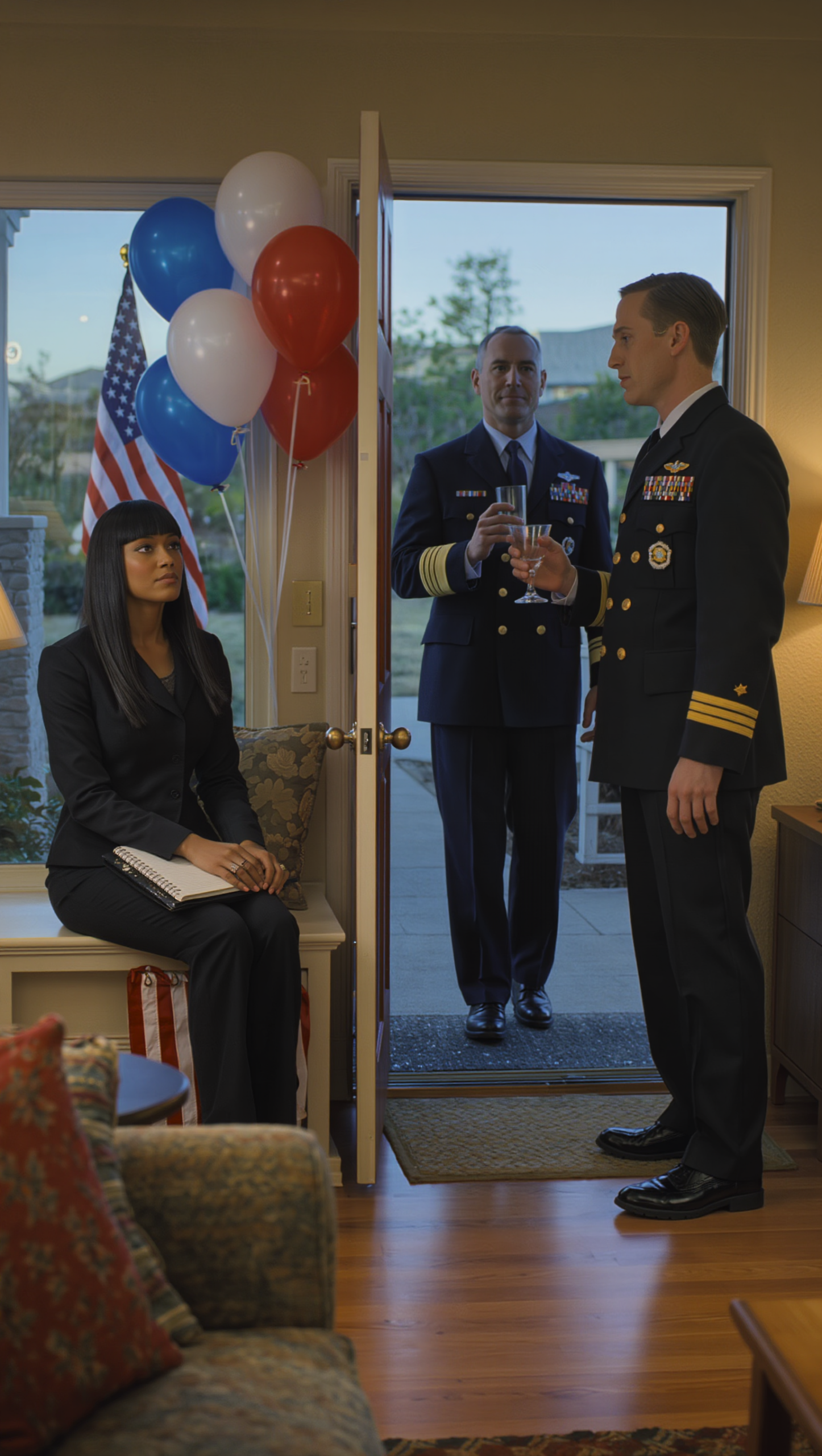
I was the “paper soldier” of the family—until my brother’s superior officer asked, “Is that… the SEAL commander?”
Even Mom and Dad froze.
They laughed when my father said it. He was standing right there smiling, that proud, booming smile he saved for everyone but me. “My son fights for his country,” he said, raising his glass. “And my daughter, well, she keeps the papers straight.”
It wasn’t the first time I’d been turned into a punchline. But that night, something different happened. Something inside me didn’t just bruise. It cracked. I’d spent years pretending it didn’t matter, letting them think I was made for the quiet corners—for holding coats and cleaning up after their stories. I told myself they didn’t mean harm, but watching them laugh, watching my mother nod along as if this was the natural order of things, I realized what I’d become to them: an easy way to feel taller.
I remember lifting my glass too, pretending to drink, pretending to smile. But behind that mask, something settled—a stillness I hadn’t felt before. It wasn’t anger. It was the end of patience. That was the night I stopped trying to be seen, and though they didn’t know it yet, it was the night the story they’d been telling about me began to die.
The interstate stretched out in front of me like a ribbon of pale steel, the kind that hums beneath the tires when you’ve been driving too long with the window cracked open. Cold air cut through the heater vents, carrying that thin, dry scent of December. The radio played old country songs—those lonely ones about distance and duty that make you think of things you’ve tried not to think about.
By the time I saw the first exit for Colorado Springs, my back ached from sitting too still. The sun was setting behind the mountains, washing the snow caps in orange and copper. I slowed down not because I needed to, but because a small part of me didn’t want to arrive just yet.
My parents’ street hadn’t changed. The same Christmas lights framed the porch in crooked lines, the same flag whipped against its pole, frayed at the edges. In the driveway, three cars I didn’t recognize were parked nose to nose. From inside came music, laughter, the clatter of dishes. The front door was cracked open just enough for warm light to spill into the cold.
I paused on the porch, brushed the road dust off my coat, and stepped inside.
The smell hit first—barbecue, bourbon, something sweet baking in the oven. The living room was a sea of red, white, and blue balloons, banners strung across the walls. A handmade sign above the fireplace read, “Welcome home, Sergeant.”
My mother saw me first. Her arms came around me in a quick, distracted hug that smelled like perfume and kitchen heat. She was gone before I could say hello, already fussing over a cake that needed cutting.
Across the room, my father stood with a drink in hand, his voice carrying above the noise. Beside him, Ryan—my little brother—grinned wide in his pressed uniform, shaking hands, laughing at all the right moments. Dad’s hand rested heavy on his shoulder, like a man displaying a prized trophy.
People turned to look when I stepped closer, not out of surprise exactly, but out of polite recognition, like I was someone they used to know. My father’s eyes found me and brightened with that old booming charm. He lifted his glass, his voice full of the confidence I’d grown up beneath.
“Our boys in the mud,” he said proudly, patting Ryan’s back, “and our girls in the office. One fights, one files.”
The room broke into laughter. I nodded, smiled, even lifted my own glass, though my hand felt heavier than the crystal deserved. The bubbles inside the champagne trembled, caught the light, then disappeared. I swallowed air that felt thicker than it should.
Ryan caught my eye across the crowd and gave me a small, knowing grin. It wasn’t cruel. Not exactly. Just comfortable—familiar. The way someone smiles when they’ve been told the same story so many times, it’s become true.
I drifted toward the edge of the room, to the old window seat by the curtains. From there, I could see everything: the shining plates, the people my parents always wanted to impress, the framed photos along the wall. Ryan’s picture dominated the center—his smile bright, the background a field of flags. Next to it, tucked a little lower, was mine: my graduation portrait, years old, the colors fading.
Dad once told me he framed what he was proud of.
I stared at that wall longer than I meant to. The voices behind me blurred into one steady current of laughter and small talk. My mother’s tone floated above them all—that careful, brittle cheer she always carried when guests were around.
I’d spent most of my adult life away from this house, away from these moments, yet standing there, I realized nothing about them had changed—only me. I’d built a life measured in precision, in silence, in the kind of discipline that leaves no room for applause. But here, it meant nothing. Here, I was still the quiet one in the corner.
Someone called for another toast, and the crowd gathered closer around my father and Ryan. I stayed where I was, by the window. The yard lights shimmered against the snow, faint and distant, like stars trying to be seen through fog. I heard Ryan laugh deep and easy, the sound of someone perfectly at home in their own story. My father’s voice joined his, full of pride. The words were lost to the chatter, but the tone—God, I knew that tone. It was the sound of a man who’d chosen his favorite child and never looked back.
I sipped the last of my drink. It was warm now, flat. For years, I told myself this didn’t matter—that I could stand here invisible and be fine. That if I stayed calm enough, polite enough, useful enough, they’d see me eventually.
But watching them now—my father’s broad shoulders, my mother’s practiced smile, Ryan’s easy confidence—I felt something shift. It wasn’t anger, not even hurt. Not this time. It was the quiet click of understanding, the kind that changes the air around you.
I looked down at my hands, at the faint calluses that never seemed to fade, no matter how long I stayed on the ground. They were steady, but the space inside my chest wasn’t. It was hollow, echoing. The laughter rose again behind me, and I realized I couldn’t remember the last time any of them had asked about my life, or even looked me in the eye when they spoke.
Maybe they never had.
I turned toward the sound, watched as my father clapped Ryan’s back and raised another glass. The light caught the rim—a flash of gold, like a flare before it burns out. That was when it happened. Not a thought, not even a decision. More like a pulse. A quiet, steady voice somewhere deep inside that said, enough.
I didn’t move, didn’t speak, but something inside me did. It was small, invisible, and final.
They kept laughing. They didn’t notice. But I knew that moment would stay with me long after the music stopped, long after the lights dimmed and the house went silent, because that was the night something in me ended—the part that still believed they might see me someday.
And though no one in that room realized it, that was also the night I decided they finally would.
I used to believe that if I worked hard enough, if I stayed disciplined and humble, eventually they’d see me. Not applaud me, not brag—just see. But in my family, effort was never enough unless it came from the right person.
When I was sixteen, I brought home a physics test with a perfect score. My teacher had written exceptional in red ink across the top. I remember sliding the paper across the dinner table, my heart racing with that shy kind of pride that only comes before the world teaches you to hide it.
My father barely glanced at it. He smiled—the way people smile when they’re not really listening—and said, “That’s nice, sweetheart. But let’s see what Ryan can do.”
Ryan was twelve then, too busy setting things on fire in the garage to care about physics, but that didn’t matter. My mother put her hand over mine and whispered, “Don’t make your brother feel small.”
And that was the lesson that stuck. The first rule of our household: never outshine the sun.
I learned quickly that every success I had came with a penalty. Win a medal, it meant I was trying too hard. Speak up, I was showing off. Stay quiet, I was dependable—predictable, easy to forget. In that house, humility wasn’t a virtue. It was a survival tactic.
Years blurred into repetition. Ryan stumbled through high school, flunked algebra twice, crashed two cars, and still managed to be called spirited. I kept my head down, graduated early, and earned a scholarship. When the acceptance letter came, my mother smiled, but it didn’t reach her eyes. She said she was proud, then followed it with her favorite caution: Don’t forget where you come from.
I didn’t. I just wanted to see what else was out there.
When I was twenty-two, I applied to the United States Air Force. My father sighed so deeply it sounded like disappointment had a physical weight. “Why would a woman want that kind of life?” he asked.
“Because I can,” I told him.
He didn’t answer. He just walked out of the room, shaking his head as if I’d said something foolish.
The day I got my acceptance notice, Ryan was sitting on the porch drinking a beer. He looked at the envelope, grinned, and said, “So, you’ll be filing flight plans?” His laugh was easy, almost affectionate.
I didn’t laugh with him. I never forgot the sound, though—light, careless, as if the air between us would never carry the same weight for me as it did for him.
Training was brutal. The first six months tore everything I thought I was apart and built it back into something harder, sharper. I learned to control my fear until it became another tool, a steady pulse beneath focus. We were pushed to the edge of exhaustion.
But I loved it—every second of it—because for once, effort meant something.
There were no favorites in the cockpit. The only thing that mattered was the mission, the precision, the calm when chaos hit.
Three months into my first assignment, we were testing a new engine model on a prototype called the Delta 7. It was supposed to be routine: clear sky, light wind, perfect visibility. At 15,000 feet, a warning light blinked red across the console.
Then came the smell—sharp, chemical, unmistakable.
Fire.
The right engine flamed out so fast it felt like the air got sucked from the sky. My co-pilot froze. I remember his eyes, wide and unfocused, his voice cracking through the comms. “We’re losing her.”
There was no time for fear. Just muscle memory and a checklist running backward in my head. Cut the throttle. Isolate the line. Adjust pitch. Trust the numbers even when your body screams.
The ground came up faster than it should have, a smear of brown and gold turning solid. When the wheels hit, the jolt snapped my shoulder. I didn’t even feel the pain until the fire truck surrounded us and someone shouted that we were still alive.
I woke up ten hours later with my arm strapped and a dull ache crawling through my body. On the bedside table sat a single envelope, my mother’s handwriting.
Call when you’re free. Ryan’s back from training.
That was it. No question about the hospital tag on my wrist. No word about the report they’d probably seen on the news—just a reminder that someone else had done something worth celebrating.
I laughed—quiet, breathless, sharp enough to hurt my ribs.
When I finally called home, my father picked up. The first thing he said wasn’t “How are you?” or “Are you all right?” He went straight to habit.
“So, do you still push papers for the Air Force?”
Something inside me faltered, then steadied. I said something like that. He chuckled, content with his version of reality, and moved on to ask about Ryan’s next leave. I let him talk until his voice became background noise.
That was the first time I truly understood it. Some people don’t want the truth because it asks too much of them. It forces them to measure themselves against something real.
After that day, I stopped trying to make them see. I stopped sending photos, stopped calling after long missions. I started to let the silence grow. It filled the spaces where disappointment used to live. It didn’t hurt less, but it felt cleaner somehow—honest, in a way our conversations had never been.
Sometimes late at night on base, I’d sit on the tarmac after the others left. The smell of jet fuel would linger in the cold air, the lights along the runway flickering like tiny fires. I’d watch the planes disappear into the dark, each one a streak of sound swallowed by distance.
That’s what I’d become for them, I thought—a sound they chose not to hear.
Still, I kept flying. I kept showing up. And every time I touched the sky, it reminded me who I really was. Not their daughter, not Ryan’s sister, not the afterthought in someone else’s story—just a pilot who refused to crash, no matter how many times the world tried to set her on fire.
The desert around Edwards never slept. Even at night, the air hummed like static, the kind that crawls under your skin after too many hours in the hangar. The runway lights stretched for miles, a constellation built by human hands. It was quiet there, but not the peaceful kind of quiet. This one was loaded, tense, as if the ground itself was holding its breath.
After the accident, they transferred me permanently to the base. Out there, everything we did existed behind locked doors and coded clearances. We didn’t talk about flight schedules. Didn’t post pictures. Didn’t even call home on days we tested new prototypes. Secrecy wasn’t a policy. It was oxygen.
I led a small team—six young pilots, all sharp and eager, the kind who still thought flying made them immortal. They called me ma’am in a way that mixed respect with fear, which was fine. Fear kept you alive.
Every morning started before dawn: checklists, briefings, wind reports, long hours of waiting for the weather to turn from barely safe to just safe enough. My notes filled pages—angles, thrust ratios, micro-adjustments to the Delta engine, numbers that meant everything in the air and nothing on paper. We chased perfection, knowing it could kill us. That was the job.
It was on a night like that, when the wind blew sand across the tarmac like smoke, that everything went wrong again. The sky was copper with dust, and visibility dropped to almost nothing. I’d ordered the tests suspended, but one of the new guys, Lieutenant Harris, wanted to squeeze in a quick run on stealth mode. I remember his grin—too confident, too young. He’d said it would take five minutes.
Five minutes later, the radio crackled. Static. Then his voice, tight and thin. “Ma’am, controls are freezing.”
I was already moving before my brain caught up. I grabbed the emergency headset, ran across the hangar, shouting coordinates over the wind. The lights from the tower sliced through the sand, blinking in and out like dying signals. The control panel showed him descending too fast.
I called out the sequence. Cut throttle. Reboot hydraulics. Manual override. My breath came out in short bursts. I didn’t realize I was yelling until my throat burned.
Harris’s plane came in hot, wheels skidding, sparks slicing across the runway like fireworks. The landing gear collapsed, the fuselage tilted, and then silence. A long, unbearable silence.
When the dust cleared, he was sitting in the cockpit, shaking but alive.
I climbed up, pulled the hatch open, and saw his face—boyish, pale, terrified. He said, “You got me home.”
I told him to shut up and breathe.
The report the next day was clinical, detached: prevented aircraft loss and personnel casualty. That was it. No story, no names—just another line in a file that would never see daylight.
A month later, the base commander called me into his office. He stood behind his desk holding a small velvet box: the Distinguished Flying Cross. He said I’d earned it, that my quick response had saved not just Harris, but the aircraft itself. Then he reminded me the incident and the award were classified. There would be no ceremony, no photographs, no record outside the system.
He shook my hand, thanked me, and dismissed me.
I carried the box back to my quarters, set it on the metal table beside my flight helmet, and stared at it. It gleamed faintly under the fluorescent light, a small, polished secret. I should have felt pride. Instead, all I felt was the echo of silence.
Two weeks later, I took leave and drove home. My mother met me at the door, still in her apron. She hugged me quickly, said I looked thin, then called out to my father that I was here.
He came into the kitchen holding a newspaper, smiling wide. “Your brother got featured in the gazette,” he said, his voice booming like always. “He’s a hero.”
He passed me the paper. Ryan’s face took up half the front page.
Local soldier saves fellow cadet.
The headline glowed in black ink. There was a picture of him shaking hands with a colonel, the American flag behind them.
I stared at it until the letters blurred.
My father kept talking—something about how proud he was, how brave Ryan had been, how the story had run all week. My mother added that the neighbors had stopped by to congratulate them. No one asked about my trip or the bandage still wrapped tight under my sleeve.
I smiled, nodded, said the right things. “That’s wonderful. He deserves it. I’m glad he’s home safe.”
Dinner that night was noisy and full of stories, mostly Ryan’s. My father poured drinks. My mother refilled plates. I sat between them, listening, pretending not to notice how easily my presence blended into the furniture.
When the house finally went quiet, I slipped outside. The porch light buzzed faintly. The air was cold enough to sting, and the sky above was wide, endless, scattered with stars. I looked up, and for the first time in weeks, I let my shoulders drop.
Out there, above the desert, I’d flown through storms that tried to break metal. I’d kept a man alive when every system had failed. I’d been trusted with secrets the world would never hear.
And yet in this house, none of it existed. Here, I was still the girl who sat safely behind a desk.
The irony wasn’t lost on me. My whole life had become a classified document—sealed, redacted, invisible. My silence, required by duty, had been mistaken for shame. I thought about the medal sitting back in my quarters, locked in a drawer. No one would ever see it, and maybe that was fine.
But standing there under the Colorado sky, I realized something that felt like both truth and betrayal. In their world, recognition was louder than reality. And in mine, reality didn’t need to be heard to be real.
The stars blurred above me, trembling in the cold air. Somewhere far beyond them, another plane was probably cutting through the dark, its engines screaming into nothing. I closed my eyes, breathing in the thin, sharp air of home. It didn’t smell like jet fuel or iron or smoke—just pine, snow, and the faint sweetness of my mother’s perfume still clinging to my coat.
For a moment, I almost believed I could tell them everything, that if I tried hard enough, they’d listen. But I knew better. They didn’t want the truth. They wanted the story that made them proud.
So I kept it to myself, like always.
That night, before going back inside, I whispered a promise only the stars could hear. I won’t let you make me small. Not here. Not anymore.
Then I turned off the porch light and went to bed.
November came with a kind of cold that bit straight through the jacket, the kind that made every mountain in the Rockies look carved from steel. I had just finished a week of simulator training when my phone buzzed across the desk. The name on the screen made my stomach tighten before I even answered.
My father’s voice filled the line, bright and booming as ever, carrying the excitement of a man preparing to host an audience. He didn’t start with “How are you?” He never did. He went straight into his performance.
“We’re hosting a veterans appreciation dinner next month. The mayor’s coming. A few officers from Fort Carson. Maybe even someone from the Air Force. We’ll celebrate Ryan’s service. I’ll need your help with logistics. You’re good with that stuff.”
That word again—logistics. His polite way of saying housework, decorations, errands, details, the invisible labor that made his events look effortless. I pinched the bridge of my nose and kept my voice even.
“Sure, Dad. Send me the list.”
He sounded satisfied, maybe even proud, the way people do when they’ve successfully assigned you the smallest possible role in their story.
A few days later, an email popped into my inbox with the subject line: guest list, veterans dinner. It was neat, color-coded, just like everything my father did when he wanted the world to admire his organization.
I scrolled through names—local officials, retired officers, old friends from his Rotary Club. Then, at the very bottom, one name stopped me.
Colonel Everett Cole.
I sat back in my chair. The name hit like a gust of cold air through an open hangar door. Everett Cole—my former commanding officer at Edwards, the man who’d watched me pull a burning Delta 7 back to the ground in one piece. The only person outside my classified circle who had seen exactly what I was capable of and lived to tell about it.
I hadn’t seen him in years. Now he was working as a training adviser for the Army at Fort Carson, only ten miles from my parents’ house.
I stared at the screen for a long time. The cursor blinked beside his name, steady and patient. Then I closed the laptop and looked out the window. A training jet was descending over the base, its engine cutting through the still air like a pulse.
The sound filled the room, sharp and precise, and it reminded me of something I’d forgotten: silence only has power when you choose it.
That evening, I drove to my parents’ house for dinner. The smell of roast chicken and candle wax hit me the second I stepped in. My mother greeted me with a kiss on the cheek—the kind that barely touched skin—and told me to set the table. Ryan was already there in jeans and a new leather jacket, scrolling through his phone like the guest of honor he was born to be.
Dad poured wine, then leaned back in his chair with that confident grin of his. The conversation moved as it always did: Ryan’s career, the upcoming event, who would attend, how much recognition he deserved. My mother fluttered around him like a stagehand fixing props between acts.
At one point, she looked at me and said in her soft, practiced tone, “Don’t make it about yourself, darling. Ryan deserves his night.”
Then Dad chimed in like punctuation. “You’ll handle the checklist, decorations, seating. That’s your department.”
Neither of them looked up. It was as if I were invisible again, a piece of furniture taking notes. I nodded because that’s what I’d always done.
But something in me—the quiet, patient part that had spent a lifetime being polite—shifted.
Dinner carried on with the rhythm of habit. My mother listed the menu. Ryan offered to give a small speech. Dad talked about who should sit where so the mayor could see the family’s star more clearly. I sat there sipping wine, my expression still and easy. Inside, though, I could feel the hum start again, the same low vibration I used to feel in the cockpit before takeoff—the kind that warns you everything is about to move.
When I left that night, the air outside was sharp enough to sting. My breath came out in small clouds as I walked to my car. The street was quiet, empty, except for the soft sound of wind scraping through the trees.
I started the engine but didn’t drive. My phone screen still glowed with the email open, Colonel Everett Cole’s name shining back at me like a challenge. I could picture his face as clearly as if he were standing in front of me: the calm authority, the way he never raised his voice, but everyone heard him anyway.
He’d been there the day everything went wrong and right all at once. He’d seen me fight to land that burning jet, seen the way I didn’t flinch. And afterward, he was the one who told me, in that measured, even tone of his, that survival isn’t luck—it’s skill and composure.
I hadn’t realized then that he was teaching me something about life, not flying.
Now, all these years later, fate had set him right in the middle of my family stage.
I rested my forehead against the steering wheel, watching the frost spread across the windshield. A small smile tugged at the corner of my mouth—not joy exactly, more recognition. The universe has a cruel sense of timing.
Inside the house, laughter rose again, faint through the walls. I could hear my father’s voice, deep, animated, probably telling another story about Ryan’s bravery. My mother’s giggle followed, light and proud.
For once, I didn’t feel the familiar ache of exclusion. I felt distance—perspective. Let them have their dinner, I thought. Let them have their applause.
Because soon, for the first time, someone would walk into their perfect little world who knew the truth they’d spent decades ignoring.
When I finally pulled away from the curb, the headlights cut through the cold, washing the road ahead in silver. The radio stayed off. I didn’t need the noise. The silence in the car wasn’t the kind I’d learned to endure. It was the kind I chose—the kind that holds steady right before a storm.
By the time I reached the base gates, I already knew I’d say yes to helping with the dinner. I’d plan it down to the last chair, every napkin folded, every glass polished, just the way they wanted.
But this time, it wouldn’t be for them.
This time, I’d make sure the stage they built for Ryan had enough light to show everyone what they’d never wanted to see.
The night air pressed against the window as I parked outside my quarters. Somewhere in the distance, a jet thundered across the dark sky, the sound rolling over the desert like a warning. I stood there for a long while, listening to the echo fade, then whispered to myself, barely audible in the dark.
“Not about me, huh? We’ll see.”
The next two weeks became a blur of details—rental invoices, catering calls, and endless lists that somehow all landed in my inbox. I handled it exactly the way they expected me to. The right wine. Soft lighting. Tablecloths pressed smooth as uniform sleeves. I even ordered the custom banner my father wanted.
Heroes among us.
Every evening, my phone lit up with his name, checking progress like a general overseeing troops. He always ended the call the same way. “Keep it modest. We don’t want to show off.”
I’d smile to myself after hanging up, a private, bitter kind of smile. There was no we in that sentence. Only one person in this family was ever allowed to shine. The rest of us just polished the stage lights for him.
Ryan stopped by my parents’ house a few days before the dinner. I was there too, hanging garlands and triple-checking the seating chart when he walked in. He smelled like cologne and confidence, the kind of man who never had to earn attention. It simply waited for him to arrive.
He clapped me on the shoulder like we were old teammates. “You really outdid yourself, sis. Maybe logistics is your calling.”
Then came that easy laugh, the one he’d inherited from Dad.
Mom was close enough to hear. She smiled, gentle as ever, and said, “He’s just teasing you. You know how boys are.”
I straightened the banner on the wall, fingers tightening around the fabric. “Yeah,” I said. “I know exactly how boys are.”
They moved on without noticing the edge in my voice. To them, my silence was compliance, as always.
That night, I stayed late to finish the decorations. The house was empty except for the low hum of the heater and the smell of pine cleaner lingering in the air. My father’s office light glowed down the hall. I was walking past when I heard his voice—loud, cheerful, the way it always got when he talked about himself by talking about us.
“My daughter works admin for the Air Force,” he was saying into the phone. “She’s smart, detail-oriented. Not everyone’s cut out for combat, you know.”
I froze at the door. Through the crack, I saw him pacing, one hand tucked behind his back, his chin lifted like a man giving an interview he’d rehearsed his whole life. He laughed at something the other person said, then his tone softened, almost proud.
“She’s safer that way. She’s always liked the easy route.”
I gripped the door frame until my knuckles turned white. The word echoed—easy. Again and again, like the sound of a loose bolt rattling inside my skull.
Easy.
The smell of jet fuel flashed in my head. The cockpit fire. The scream of the alarm. My shoulder tearing open as I wrestled the Delta 7 to the ground.
Easy.
The hospital lights, the stitched skin, the scar that still throbbed in cold weather.
Easy.
If that was easy, what did hard look like?
I stepped back from the door before I did something I couldn’t take back. The house suddenly felt too small, the air thick with the scent of his bourbon and the crackle of his laughter.
Outside, snow had started to fall—thin, slow flakes drifting through the glow of the porch light. I stood on the steps, breathing in the scent of wood smoke from a neighbor’s chimney, trying to steady the pulse in my throat. The cold bit at my face, but I stayed there for the first time in years. I let the anger come without smothering it.
It didn’t roar. It whispered—calm, sharp, deliberate.
I reached into my coat pocket and pulled out my phone. My fingers moved before I even decided to. The screen lit my face in pale blue. There in my inbox was an old message, three years old, from Colonel Everett Cole. The subject line was only four words.
Still flying, Lieutenant.
I’d never answered. I didn’t know what to say back then. But now, reading it under the falling snow, I realized I didn’t have to. The universe had already written the reply. He would be there tomorrow night. He would see everything.
I turned the phone off and tucked it away.
The porch light flickered above me, the kind of light that can’t decide whether to stay or die out. When I went back inside, my mother was in the hallway draping a blue table runner over her arm. She looked at me over her glasses, casual, as if we were discussing the weather.
“You’ll wear something soft tomorrow, right? Maybe that blue dress. Military uniforms make people uncomfortable.”
I stopped halfway up the stairs. On the chair near the wall hung a dark navy scarf, the same shade as my dress uniform. My hand brushed it as I turned to face her.
“Don’t worry,” I said. “I’ll wear what feels right.”
She smiled, distracted, already turning away, but I stayed there, fingertips grazing the fabric.
Something clicked into place inside me—quiet, deliberate, irreversible. It wasn’t rage. Rage was loud and brief. This was something else. Something steadier. A switch.
For years, I’d let them script who I was supposed to be: the helpful daughter, the support act, the one who didn’t embarrass anyone by standing too tall. Tomorrow, for the first time, I would stop playing along—not to humiliate them, not even to prove anything, just to remind them that silence doesn’t mean weakness. It means control.
I glanced out the window again. The snow had stopped, but the world still looked muted, as if holding its breath. Somewhere out there in the dark, the colonel was likely finishing his own preparations for the same event. He had no idea he’d become the final witness in a story my family had spent decades writing wrong.
When I finally went upstairs, the sound of my father’s laughter still drifted through the vents, muffled and careless. It didn’t sting anymore. It only confirmed what I already knew.
Tomorrow night, that laughter would stop.
I wasn’t angry. I wasn’t scared.
I was ready.
The day of the dinner arrived colder than anyone expected. Colorado had a way of doing that—pretending to be kind, then biting without warning. By sunset, the thin layer of snow that covered the lawn outside the community hall had turned to a faint shimmer under the streetlights, reflecting the soft yellow glow of the building like the calm before a storm.
I arrived early, long before the guests, because that’s what was expected of me. The hall smelled of pine garland and polished wood. I moved quietly from table to table, checking the place cards, testing the microphone, adjusting the projector Ryan had borrowed for his presentation. Every detail was perfect—sterile, polite—exactly the way my father liked things.
When I stepped back to take it all in, I realized what I’d built.
A stage.
A stage for the story they wanted to tell.
Ryan arrived next, shaking snow from his boots, his uniform sharp enough to slice air. He spotted me by the podium, smiled that effortless smile, and came over. His arms looped around my shoulders, heavy with the scent of cologne and confidence.
“Hey, sis,” he said lightly. “When they call me up, don’t cry.”
“All right,” I said. “You always get emotional. Don’t worry, I won’t.”
The words came out colder than I intended, but I didn’t take them back. For a moment, he hesitated—just a flicker in his expression, like he’d heard something new in my voice. Then he laughed, patted my shoulder, and walked off to greet his fan club.
By the time the guests started to pour in, the room had warmed with bodies and noise. Laughter bounced off the ceiling, the low hum of conversation blending with the soft jazz from the speakers. Silverware clinked, glasses touched, and the air was heavy with that particular brand of self-congratulation that always blooms when people are proud of themselves for showing up.
My father was in his element. He moved through the crowd like a conductor, one hand on a shoulder, the other always holding a drink. He looked years younger under the warm light—flushed, pleased—his voice rising above the chatter as if the room belonged to him.
Then he raised his glass to the real soldier of the family.
“My boy, Ryan.”
Applause erupted. Someone whistled. Ryan bowed slightly, that easy grin never faltering. My mother’s eyes shone with pride, her hand on her chest.
I stood by the back wall, half in shadow, watching them bask in the spotlight I had literally arranged for them.
Out of the corner of my eye, movement caught my attention. Colonel Everett Cole. He had just entered, his overcoat dusted with snow, his posture straight even after retirement. He greeted a few people quietly before settling into a seat near the back.
Our eyes met across the room. He gave a slight nod—just enough to acknowledge, not enough to draw attention. I inclined my head in return. No smile, no wave. There was no need.
Then a voice from the crowd—an older man with a flushed face and a beer in his hand—called out to my father.
“And your daughter, sir? She’s in the Air Force, right?”
My father chuckled, the kind of chuckle that fills a room, smooth and dismissive. “Oh, Oilia. She’s our in-house secretary. Keeps the paperwork straight for the pilots.”
Laughter broke out—big, comfortable laughter, the kind people use when they’re glad the joke isn’t about them. I felt it roll over me like static. I didn’t move. I didn’t blink.
Someone near the bar added, “Every army needs a paper pusher, right?” And another round of laughter followed.
I scanned the room. My mother’s face was pale but composed. When our eyes met, she gave a small shrug, a tiny pleading motion that said, Don’t make this a scene.
Colonel Cole didn’t laugh. He sat still, shoulders square, eyes fixed on my father. His glass was half full, his hand tight around it, the knuckles whitening before he set it down slowly.
The noise in the room began to blur. The laughter, the music, the applause—it all melted into one long hum. I could hear the faint buzz of the lights overhead, the scratch of my heartbeat in my ears. I inhaled. The air was thick with the smell of cheap champagne and expensive perfume.
And in that moment, I knew if I stayed one minute longer, I would either break or explode.
So I walked out.
No one noticed.
No one ever did.
Outside, the night was colder—sharper, alive. Snow drifted from the dark sky in slow, deliberate spirals, collecting on the shoulders of my coat. The wind cut across my face, but it felt cleaner than the air inside.
I walked fast, my boots crunching against the thin crust of ice. Behind me, the muffled sound of music and laughter seeped through the walls, distant now, like a memory already fading. By the time I reached my car, my hands had stopped shaking.
I sat there for a moment, the engine off, the silence pressing in. In the rearview mirror, the golden light from the hall glowed faintly—a halo of warmth around a world that didn’t belong to me.
They were still laughing in there, still raising glasses, still telling their perfect story.
I wasn’t running from it.
I was preparing to end it.
As I started the car, a flake of snow landed on the windshield and melted instantly, leaving a small trail of water that slid down like a teardrop. I watched it for a long moment before driving off, the tires crunching through the slush, the headlights cutting a path through the storm.
They thought I was gone for good—escaping, sulking, proving them right.
But I wasn’t leaving to hide.
I was leaving to return as someone they’d have to see.
My apartment was only ten minutes from the hall. When I opened the door, the familiar warmth met me—quiet, clean, the kind of stillness that never existed in my parents’ house. On the wall hung a framed photo of my old flight crew, six of us lined up in full gear, the desert sky of Edwards stretching wide and merciless behind us.
I paused there for a moment, tracing the outline of our shadows against the tarmac. Every face in that picture carried something no medal could measure—fear, fatigue, and pride that came from surviving what others never knew existed.
I turned to the closet and pulled out the navy garment bag that had stayed untouched for years. The zipper sounded louder than I remembered. Inside lay the Air Force mess dress, folded in perfect alignment, the fabric heavier than it looked—heavier than memory itself.
I laid it carefully on the bed, smoothing the creases like one might touch an old wound. Gently, deliberately, one by one, I attached the medals. Each clink of metal against cloth echoed like a heartbeat: the first service ribbon, the second flight commendation, and then the Distinguished Flying Cross.
As I pinned it, the light from the lamp struck the silver edge, throwing a bright shard of reflection across the mirror.
I looked up.
The woman staring back wasn’t the one they saw at the dinner table—the quiet daughter who poured wine and smiled through jokes. She wasn’t the paper pusher or the background character.
The mirror showed someone else entirely, someone who had flown through fire, guided a crippled jet down to earth, and walked away from the wreckage without waiting for applause.
I fastened the wings over my chest. My hands trembled slightly, not from fear, but from the weight of truth. The metal felt cold against my skin, grounding me in a way words never could.
On the nightstand, my phone buzzed. The screen lit up with an old email thread I hadn’t touched in years from Colonel Everett Cole. The subject line read: If you ever stopped by Fort Carson, let’s catch up. Proud of you.
I hadn’t replied when he sent it. I hadn’t known how. But now, as I read it again, I smiled. No need to answer. Tonight, he would understand why I never wrote back.
I slipped into the jacket, adjusted the collar, and stood in front of the mirror one last time. Everything fit tight at the shoulders, crisp at the seams. My reflection looked almost foreign, but it wasn’t. It was me—stripped of apology, finally visible.
Outside, the snow was falling harder. I stepped into the cold, the air biting at my face as I crossed the parking lot. My car’s headlights carved a narrow path through the white.
And for the first time in a long while, I didn’t feel the usual pulse of anxiety before facing them—only calm. That rare, clean calm you feel when an aircraft levels out after turbulence. The kind of silence pilots trust.
On the radio, a familiar song played: The Sound of Silence. The words drifted through the cabin, soft and deliberate, and in the naked light I saw ten thousand people, maybe more. I found myself smiling at the irony. The song had never sounded less like despair and more like peace.
The hall came into view, lights glowing golden against the snow. Cars lined the lot, mufflers steaming in the cold. I parked near the entrance, killed the engine, and sat for a moment in the dark.
My breath fogged the window, but through it I could see inside: my father laughing near the podium, Ryan beside him, my mother at the bar, her hand fluttering as she spoke to someone. And at the back of the room, alone, sat Colonel Cole—quiet, composed, his gaze fixed on nothing and everything.
I opened the door. The wind swept in, cold and sharp, but I barely felt it. My heels sank slightly into the slush as I crossed to the building. The closer I got, the louder the faint hum of music grew, a piano melody light and careless.
I stopped just outside the glass doors. Through the window, the room was drenched in amber light, warm and comfortable. It was the same stage I’d built with my own hands, now alive with laughter and small talk.
For a heartbeat, I stood there watching them from the other side of the glass—a ghost at the edge of their celebration.
Then I reached for the handle.
The piano stopped midnote.
Warm air rushed out as I stepped inside. The noise died instantly. Every head turned. The laughter that had filled the room seconds ago froze in the air, fragile as glass. The light caught my medals, scattering silver across the walls. For a split second, it looked as if the room itself had flinched.
My father’s smile faltered. My mother’s hand went still around her wine glass. Ryan blinked, uncertain whether this was real or some kind of joke.
No one moved. No one spoke.
I walked forward, each step steady, the echo of my heels sharp against the polished floor. The only sound left was the faint whistle of wind sneaking through the cracks of the door behind me.
My mother’s voice broke the silence—soft and strained, her lips barely moving. “Oilia, change back. You’re making a scene.”
I stopped, turned to her, and met her eyes.
“No, Mom. I’m finally showing one.”
The sound of my heels against the floor cut through the music before anyone even noticed I was there.
The Air Force mess dress felt heavier than it had in my hands an hour ago, every stitch, every medal, every polished inch of it carrying a story that no one in that room had ever cared to ask about. When I stepped fully into the light, the piano stopped midnote. The laughter followed, dropping like glass shattering on tile for a long heartbeat.
No one moved. The air itself seemed to tighten to hold me in place while I took in what I’d walked into: the bright lights, the long tables, the laughter that had filled this hall seconds before. I could see everything with unnerving clarity.
My father by the podium, one hand midair, frozen in the middle of a story he’d been telling about Ryan’s discipline and courage. My mother still smiling, but with her mouth open just a little too wide. Ryan standing near the center of it all, glowing under the soft yellow light, basking in the attention that was never meant to be shared.
I kept walking—slow, deliberate—the medals on my chest brushing softly against each other. Each sound, faint but distinct, seemed to ricochet off the walls. I felt hundreds of eyes tracking my every step. I didn’t speed up. I didn’t smile. I didn’t break the silence.
When I stopped, it was right where my father could see me close enough to smell his aftershave and the faint burn of bourbon on his breath. He blinked at me, trying to process what he was seeing.
Ryan’s voice cracked the stillness. “What is this? Halloween?”
He laughed—loud and uneasy—and a few others followed. A nervous ripple of chuckles moved through the crowd like static. It sounded rehearsed, defensive, small.
I didn’t say a word. I let the moment stretch thin, almost unbearable.
My father’s hand dropped from his glass, his expression shifting—first confusion, then irritation, then something quieter, sharper.
My mother found her voice next, though it was barely more than a whisper. Her face stayed frozen in that social smile, the one she used at church and charity events.
“Oilia, change back. You’re making a scene.”
Her words reached me like a soft wind in a hurricane—too fragile to matter. I met her eyes and felt something inside me settle into place. For once, I didn’t look away.
“No, Mom. I’m finally showing one.”
The words came out steady, almost gentle, but the room felt it—the shift in gravity. It wasn’t defiance. It wasn’t anger. It was truth.
Then another voice broke the silence. Deep, measured, unmistakably authoritative.
“Lieutenant Colonel Grant.”
The sound of my name—my rank—hit the air like a bell. The entire room turned as one.
Colonel Everett Cole was standing at the back, tall and composed, his uniform immaculate. The silver eagle on his shoulders gleaming under the light.
My father stiffened. Ryan’s face drained of color.
Colonel Cole began to walk forward, his steps even, precise—every inch the man I remembered from the base, steady as a heartbeat under fire. The crowd parted for him without a word.
When he reached me, he stopped, heels together, shoulders squared, and saluted. The sound of his hand snapping to his brow echoed through the silence.
“Ma’am,” he said, his tone clipped, clear, respectful, “it’s been an honor to serve under your protocols during the Delta trials.”
No one breathed.
The air in the room changed—dense, heavy, electric.
My father’s expression went from confusion to disbelief to something dangerously close to fear. My mother’s hand trembled against her glass until I thought it might slip. Ryan stood rooted, his mouth slightly open, the easy arrogance wiped clean from his face.
For a second, no one seemed to know what to do. Then a low murmur rippled through the guests—soft, startled, growing louder by the second. Words I couldn’t make out. Questions half whispered. The sound of realization traveling like shock waves through the room.
I held Colonel Cole’s gaze. He didn’t look away. He didn’t smile.
“Thank you, Colonel,” I said finally, my voice calm, even. “I didn’t expect to see you here.”
“Nor did I,” he replied, lowering his hand. “But I’m glad the people who needed to know finally do.”
His eyes flicked toward my father and then back to me, a flicker of empathy hidden under the stoicism of command.
“If any of you ever wondered what quiet courage looks like,” he said, raising his voice so that everyone could hear, “this is it.”
The words landed like a verdict.
I didn’t turn to see their faces. I didn’t need to. I knew what I’d find—shock, confusion, the fragile scaffolding of a family myth collapsing in real time.
“Enjoy the evening, everyone,” I said softly, and then I walked away.
No one stopped me. No one clapped. No one dared to speak. The silence was complete—pure, resonant, almost holy. It followed me as I crossed the room, each step echoing louder than the applause they’d once saved for Ryan.
For a moment, I almost pitied them, all those people still sitting there, watching the world they built crack open in front of them.
Almost.
As I reached the door, I glanced back—not at my father, not at my mother, not even at Ryan, but at Colonel Cole. He gave a small nod, not of approval, but of understanding. It was the kind of gesture soldiers exchanged when no one else in the room would understand the cost of silence.
Outside, the cold hit me like clarity. The night air smelled of snow and exhaust, sharp and clean. The wind caught the hem of my coat as I stepped down the stairs. Through the glass doors behind me, I could still see them—motionless, stunned, small under the golden light that had once felt so warm.
For years, I’d believed that to earn their respect, I had to prove myself—that if I did enough, achieved enough, stayed quiet long enough, they would finally see me.
But standing there in the snow, watching the life I’d left behind through the glass, I realized something simple.
I didn’t need their recognition.
I never had.
I started the car, the engine humming low. For a moment, I sat there, hands on the steering wheel, letting the warmth creep through my gloves. My reflection in the rearview mirror looked back at me—steady, calm, a faint smile tugging at the corner of my mouth.
Inside the hall, they were probably starting to move again—murmuring, whispering, trying to rewrite what had just happened into something that made sense. They’d call it awkward, dramatic, maybe even disrespectful.
That was fine.
They could name it whatever they wanted.
The truth didn’t need defending.
When I pulled out of the parking lot, the headlights carved a path through the snow, and the song still playing faintly on the radio caught me off guard—the last verse of The Sound of Silence.
I smiled, not out of triumph, but peace, the kind that comes only when you’ve stopped asking to be seen.
Back in that hall, they’d fill the silence with noise again—apologies, explanations, maybe even pride disguised as shock—but they would never erase the image of Colonel Cole standing to attention in front of me.
That moment belonged to the truth.
And in that truth, in that silence, I finally stood taller than I ever had in their eyes.
Snow drifted across the highway in ribbons of white, swirling under the headlights like ghosts refusing to settle. My hands were steady on the wheel, though a faint tremor lingered in my fingers—residue, not fear, the kind that comes after release.
Inside the car, it was quiet enough to hear the hum of the tires, the rhythmic sweep of the wipers, my own breathing sinking to their slow, patient tempo.
The phone buzzed on the passenger seat. I glanced over at the glow of the screen.
Mom: How could you embarrass us like that?
Another message followed before I even finished reading the first.
We didn’t know. Why didn’t you ever tell us? We’d have been so proud.
The words reflected faintly on the windshield, overlapping with the snow outside until they blurred into meaningless light. For years, I’d wanted those words—wanted them clean, honest, earned. But now, reading them felt like touching something that had already died.
A new message appeared.
Ryan: You made me look like a fool.
A short, quiet laugh escaped me, barely a sound.
“I didn’t have to,” I murmured to the dark.
At the next rest stop, I pulled over. The silence wrapped around the car like fog. I turned off the engine and the hum died away. The world outside was frozen, unmoving, the parking lot coated in a thin layer of silver light.
I reached for the phone again. Three names.
Dad. Block contact.
Mom. Block contact.
Ryan. Block contact.
Three small clicks, each one sharper than the last—simple, clean, final. The sound reminded me of releasing a parachute after landing, weight leaving the body in a rush that almost felt holy.
I leaned back in the seat. Exhaling, my reflection in the glass looked calm—unfamiliar. For so long, I’d believed strength meant holding everything together: explaining, enduring.
But sitting there in the dim light of a winter night, I realized strength could also mean letting go and not looking back.
Outside, snow whispered against the glass, tiny soft collisions fading into silence. I thought of the hall, the stunned faces, Colonel Cole’s voice slicing through the air, the salute that no one else dared to make.
I’d imagined vindication would feel louder—like victory, like thunder—but instead it felt quiet, clean, a silence so vast it left no space for regret.
I watched the snow until it blurred the world into white. Then I turned the ignition again and the car came to life. Headlights carved two lines through the storm, and I drove forward—away from the noise, away from the need to be understood.
For the first time, I wasn’t escaping.
I was free.
A year later, I lived in Fallon, Nevada, a desert town where the sky stretched so wide it seemed to swallow everything small. The air smelled of dust and engine fuel, and the sun hit the ground in hard, unbroken light. Out here, time didn’t rush. It hummed—steady and distant—like the turbines I’d grown up trusting.
My new assignment was quiet: advising UAV flight trials for the Air Force. It was the kind of work that asked for precision, not performance—patience, not applause.
I liked that.
Every morning, I walked into the hangar while the metal walls still held the chill of the night. The simulators waited in silence, screens flickering to life as I took my seat. The steady whir of engines filled the air, blending with the scent of hot steel and oil. It was the same rhythm I’d always loved—mechanical, exact, endless.
In the afternoons, I went home to a small wooden house on the edge of town, its porch facing west. From there, I could see the horizon fade from gold to violet each evening. I spent hours on that porch fixing the old model planes I’d brought from Edwards—replacing wings, sanding surfaces, painting over scratches. Each repair felt like stitching something invisible back together inside myself.
One evening, my laptop pinged with a new message from Everett Cole.
You handled that night with more grace than any general I’ve met.
I read it once, smiled, and deleted it—not out of disrespect, just because I didn’t need to hold on to proof anymore. Some truths are better left to live quietly, like old echoes fading into distance.
The next morning, I took a test flight over the desert. The sky was impossibly clear, a clean blue stretching forever. Sunlight shimmered across the canopy, scattering tiny diamonds of light across my gloves.
Through the headset, the control tower called out, a familiar voice softened by static. “How’s the view up there, Colonel?”
I smiled.
“Quiet,” I said. “Just how I like it.”
The jet banked left, slicing through a thin layer of cloud, leaving a pale white trail behind. Below me, the desert spread wide and endless, the color of warmth and survival.
No applause, no flashbulbs—just sky and air and the truth of flight.
They called me a joke once, I thought.
But silence.
Silence answered louder than any applause ever could.
For the first time in years, I felt weightless again—not escaping the past, just rising beyond its gravity.

