I arrived at my in-laws’ house without warning on Christmas Eve. I found my son scrubbing floors in his underwear while their grandchildren opened presents by the tree. My wife was laughing with them. I walked in, picked up my son, and said five words. My mother-in-law’s champagne glass shattered. Three days later—47 missed calls.
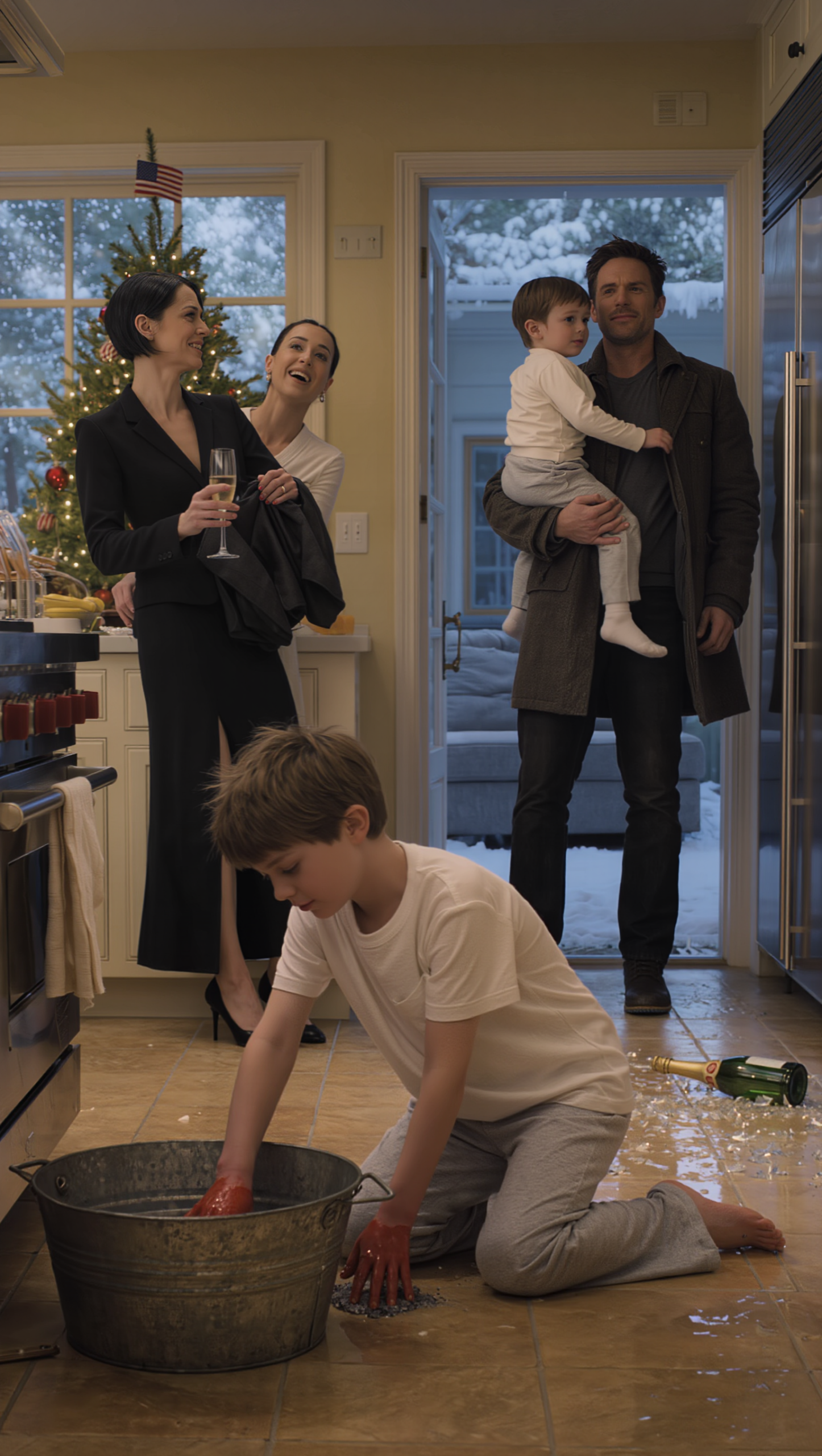
I arrived at my in-laws’ house without warning on Christmas Eve. I found my son scrubbing floors in his underwear while their grandchildren opened presents by the tree. My wife was laughing with them. I walked in, picked up my son, and said five words. My mother-in-law’s champagne glass shattered.
Three days later—
47 missed calls.
At 38, Frank O’Connell had transitioned from investigative journalism at the Chicago Tribune to running his own production company, Undercurrent Media. The move had been Ashley’s idea three years ago, back when she still looked at him like he’d hung the moon instead of like he was a burden she’d inherited.
His phone buzzed. Another text from Ashley: Running late. Mom needs help with the Christmas decorating. Can you get Todd from school? Frank glanced at the calendar. December 20th. This would be the fourth time this week Christa Raymond had needed help with something.
He typed back, Got him. See you tonight.
The afternoon sun cast long shadows across the suburban Chicago street as Frank pulled up to Meadowbrook Elementary. Todd emerged from the building small for his seven years, shoulders hunched in a way that made Frank’s chest tighten. Other kids rushed past him, shouting and laughing, but Todd walked alone.
“Hey, buddy!” Frank reached over to open the passenger door.
Todd climbed in, his backpack nearly as big as he was. “Hi, Dad.”
“How was school?”
“Fine.”
Frank had been conducting interviews for fifteen years. He knew evasion when he heard it.
“What did you do in class? You had that snowman project, right?”
Todd’s jaw tightened, a gesture so similar to Frank’s own that it was like looking in a mirror. “Mrs. Patterson said it was good.”
“Can I see it?”
“I left it there.” Todd stared out the window, fixed on the classroom display as if he could will the subject away.
Frank knew his son was lying. He also knew that pushing now, in the car, wouldn’t help.
“Want to stop for hot chocolate?”
For the first time, Todd’s face brightened. “Really?”
“Really.”
“Just us?”
“We can go to Bernie’s.”
Twenty minutes later, they sat in a corner booth at Bernie’s diner, the kind of place that still had vinyl seats and served breakfast all day. Todd wrapped both hands around his mug, marshmallows melting into white swirls.
“Dad,” Todd said quietly. “Are we going to Grandma Christa’s for Christmas?”
“That’s the plan.” Frank watched his son’s fingers tighten around the mug.
Todd shrugged, but his knuckles stayed white. “Just wondering.”
Frank leaned forward. “You can talk to me about anything, Todd. You know that, right?”
“I know, but—” Todd’s eyes stayed fixed on his hot chocolate.
Frank’s phone buzzed again. Ashley: Can you bring the good champagne when you come for dinner tomorrow? Mom’s making her special lamb.
He texted back, Sure.
What he didn’t text was the thought burning in his mind: When did your mother’s dinners become more important than your son?
The Raymond house sat in Kenilworth, one of Chicago’s wealthiest suburbs—a Georgian colonial that Christa never failed to mention was historic. Frank pulled into the circular driveway at 6:30 the next evening, Todd silent in the back seat.
“Remember,” Frank said, turning to look at his son, “you don’t have to pretend to be happy if you’re not. Just be yourself.”
Todd nodded but didn’t meet his eyes.
The front door opened before they reached it. Bobby Raymond Mills stood there—Ashley’s older sister—wearing a cashmere sweater that probably cost more than Frank’s monthly podcast budget.
“There they are. Come in, come in. You’re late.”
“We’re actually five minutes early,” Frank said evenly.
Bobby’s smile never wavered. “Well, everyone else has been here for thirty minutes.”
She turned to Todd. “Your cousins are in the playroom. Run along.”
Frank watched Todd trudge toward the back of the house, his small frame disappearing around the corner. Bobby’s children—Madison, nine, and Harper, six—had already received more Christmas presents in the past week than Todd would get all year, if the shopping bags Frank had seen Ashley hiding were any indication.
Christa Raymond swept into the foyer, champagne glass in hand, diamonds at her throat catching the chandelier light. At 62, she maintained her appearance with the dedication of a general planning a campaign.
“You brought the Veuve Clicquot,” she said, voice bright and thin. “How thoughtful. Though I must say, the moët is really superior for lamb. I’ll keep that in mind.”
Frank held out the bottle anyway.
Harvey Raymond appeared behind his wife, tall and silver-haired, with the bearing of someone accustomed to deference. He’d made his fortune in commercial real estate and never let anyone forget it.
“Frank. Good to see you. Ashley’s in the kitchen with her sister.”
Dinner proceeded as these dinners always did. Christa held court at the head of the table, directing conversation like a conductor leading an orchestra. Harvey discussed business deals. Bobby talked about Madison’s acceptance into an exclusive summer program. Renee Mills, Bobby’s husband, made safe jokes and laughed at Harvey’s stories.
Ashley sat across from Frank, and he studied his wife in the candlelight. They’d met nine years ago when he was covering a story about urban renewal and she was volunteering at a community center. She’d been passionate then, bright-eyed, talking about making a difference. Now she wore pearls that matched her mother’s and laughed at jokes that weren’t funny.
“Todd seems quiet tonight,” Christa observed, her tone suggesting this was somehow Frank’s fault. “Is he feeling well?”
“He’s fine,” Frank said. “Just tired from school.”
“Madison never gets tired from school,” Bobby interjected. “Of course, she’s in the advanced program. Keeps her engaged.”
Frank felt Ashley’s hand on his knee under the table. A warning.
He took a breath.
“Actually,” Christa continued, “I’ve been meaning to discuss Todd’s schooling with you both. Bobby found a wonderful tutor. Very exclusive. She works with gifted children, but I think Todd might benefit from some extra attention to help him catch up.”
“Catch up to what?” Frank asked.
“Well, to his peers, naturally. You want him to have every advantage.”
“Todd is doing fine.”
“Fine isn’t excellent, Frank.” Christa sipped her champagne. “The Raymond family has standards.”
“He’s seven years old.”
“Exactly. These are formative years. We wouldn’t want him to fall behind.”
Ashley’s grip tightened on Frank’s knee. When he looked at her, she gave a slight shake of her head.
After dinner, Frank found Todd in the playroom. Madison and Harper were building an elaborate castle with brand-new Legos, the expensive kind. Todd sat in the corner with a puzzle that looked like it had been gathering dust in a closet for years.
“Hey, buddy. Ready to go home?”
“Can we?” Hope flickered in Todd’s eyes.
“In a few minutes. Mom wants to say goodbye to everyone.”
Frank made his way back through the house, passing the gallery wall of family photos. Dozens of Madison and Harper—professional portraits, candid shots, vacation photos. Todd appeared in exactly three: his newborn photo, one from his first Christmas, and last year’s obligatory family shot. In that last one, he stood at the edge of the frame, slightly out of focus.
He found Ashley in the kitchen helping her mother wrap leftovers.
“We should get Todd home,” Frank said. “School tomorrow.”
“Oh, stay for coffee,” Christa insisted. “We barely got to talk.”
“It’s already 8:30.”
“Fine,” Frank said, the word clipped despite himself.
“I don’t see why you’re in such a rush,” Christa said. “We’re family.”
In the car, Todd fell asleep before they left the driveway. Ashley stared out the passenger window.
“Your mother suggested a tutor for Todd,” Frank said finally.
“I know. She told me.”
“You don’t think that’s insulting?”
“I think she’s trying to help.”
“By implying our son isn’t good enough.”
Ashley turned to him, and in the dashboard lights he saw exhaustion in her face. “Why do you always have to make everything a confrontation? She’s my mother. She wants what’s best for her grandchildren.”
“All of them? Or just Bobby’s?”
“That’s not fair.”
“Isn’t it?” Frank’s voice stayed low, controlled. “Did you notice Todd playing with a puzzle that looked older than he is while Madison and Harper built with Legos that probably cost three hundred dollars?”
Ashley’s mouth tightened. “Maybe if you made more money, we could buy Todd those things ourselves instead of relying on my family’s generosity.”
The words hung in the air between them.
Frank’s hands tightened on the steering wheel. “I make enough,” he said quietly. “We’re not struggling, and I’ve never asked your family for a dime.”
“No,” Ashley said, eyes forward. “You just judge us for having it.”
Frank didn’t respond. What could he say? That he’d watched his wife slowly transform into a person he barely recognized. That every dinner at the Raymond house felt like watching Ashley choose her family over their son. That he was starting to wonder if she’d married him as an act of rebellion she now regretted.
When they got home, Frank carried Todd upstairs and tucked him into bed. His son’s room was modest but filled with things he actually played with—books they’d read together, drawings taped to the walls, a globe they’d spun to pick imaginary adventures.
“Dad,” Todd said, eyes opening sleepily.
“Yeah, buddy.”
“I don’t want to go to Grandma’s for Christmas.”
Frank’s heart broke a little more. “We’ll talk about it. Get some sleep.”
But they both knew they’d go. They always did.
December 23rd arrived with freezing rain that turned Chicago’s streets into skating rinks. Frank spent the morning editing a podcast episode about housing discrimination, his headphones blocking out the world. His phone sat face down on the desk, already carrying six texts from Ashley about last-minute Christmas shopping and preparations for the Raymond family gathering.
Around noon, he heard the front door open. Ashley appeared in his office doorway, shopping bags in hand.
“I’m taking Todd to get fitted for his Christmas outfit,” she announced. “We’re meeting Mom and Bobby at Nordstrom.”
Frank pulled off his headphones. “Fitted? He’s seven. Kids grow. Just get him something comfortable.”
“The family photos are important to Mom. She hired a professional photographer.”
“Of course she did.”
“Don’t start, Frank.”
“I’m not starting anything. I’m just saying that maybe our son would prefer to actually enjoy Christmas instead of being treated like a prop for your mother’s Instagram.”
Ashley’s jaw tightened. “You’re being ridiculous. It’s one photo session. Every family does this.”
“Every family doesn’t make one grandchild feel less important than the others.”
“Oh my God.” Ashley threw up her hands. “You’re obsessed with this. Mom treats all the kids the same.”
“Does she? When’s the last time she took Todd shopping for something special? When’s the last time she asked about his interests instead of lecturing us about tutors and summer programs?”
“She’s trying to help him succeed.”
“He’s seven, Ashley. He doesn’t need to succeed at being seven. He needs to be loved.”
“He is loved by everyone.”
“You’re the one creating problems where there aren’t any because you can’t stand that my family has money and you grew up in—”
She stopped, but the damage was done.
“In what?” Frank’s voice went quiet. Dangerous. “Say it.”
Ashley’s face flushed. “I didn’t mean—”
“In a two-bedroom apartment in Bridgeport,” Frank said, finishing it for her, “where my mom worked two jobs and we ate spaghetti four nights a week.”
Frank stood. “You’re right. I didn’t grow up with catered dinners and historic houses. I grew up with a mother who noticed when I was sad, who would have burned the world down before she let anyone make me feel small.”
“I’m not making him feel small.”
“No,” Frank said. “You’re just laughing while your family does it.”
“I don’t have to listen to this. Come on, Todd.”
Todd appeared in the hallway, already wearing his coat. He wouldn’t look at Frank.
“Buddy,” Frank started, but Ashley had already taken Todd’s hand and pulled him toward the door. It slammed hard enough to rattle the windows.
Frank stood in the sudden silence of his empty house. His phone buzzed: a text from his mother, Margaret O’Connell.
Still coming for Christmas Eve? Made your favorite cookies.
He’d promised his mom they’d stop by her apartment before heading to the Raymonds on Christmas Eve. It was a tradition—dinner with Margaret, then the obligatory appearance at the Raymond family extravaganza. Margaret lived simply on her pension from thirty years as a public school secretary, but her home was filled with warmth that Christa’s mansion lacked.
Frank texted back: Wouldn’t miss it. Tell me you made the snickerdoodles.
Three batches and fudge. See you at 4:00.
The next day, Christmas Eve, Frank woke to an empty bed. A note sat on Ashley’s pillow: Stayed at Mom’s. See you tonight.
He checked Todd’s room. Also empty. His son’s overnight bag was gone.
Frank called Ashley. It went to voicemail. He called again. Same result.
By the third call, Christa answered Ashley’s phone.
“Frank,” she said, as if she were doing him a favor. “Ashley’s helping with preparations. She’ll see you tonight.”
“I’d like to speak to my son.”
“Todd’s busy with his cousins. They’re decorating cookies.”
“Put him on the phone.”
“Frank, there’s no need for that tone. He’s perfectly fine. We’ll see you at seven for cocktails. Eight for dinner.”
The line went dead.
Frank stood in his kitchen, rage building in his chest. But he’d learned in journalism that anger was useless without strategy.
He opened his laptop and pulled up his calendar. The Raymond Christmas Eve party started at 7:00. He’d promised his mother at 4:00. That gave him time.
Frank spent the next hour making calls: his old editor at the Tribune, who owed him a favor; a lawyer friend from college; a private investigator he’d worked with on a story about corrupt landlords. Each conversation was brief, professional. By 3:00, he’d set several things in motion.
At 4:00, he arrived at his mother’s apartment in Bridgeport. The building was old but well-maintained, the kind of place where neighbors still knew each other’s names.
Margaret O’Connell opened the door wearing a sweater with a reindeer on it. Her gray hair was pulled back, eyes bright behind her glasses.
“There’s my boy.” She hugged him tight. At 65, she still had the strength of someone who’d raised a son alone after his father died when Frank was three.
“Where’s my grandson?”
“At the Raymonds,” Frank said. “Ashley took him yesterday.”
Margaret’s expression hardened. She’d never said anything directly critical about Ashley or her family, but Frank had noticed the tightness around her mouth whenever they were mentioned.
“Come in. Have some cookies. Tell me what’s wrong.”
They sat at her small kitchen table, the same one Frank had done his homework at as a kid. The apartment smelled like cinnamon and pine from the modest tree in the corner, decorated with ornaments Frank had made in elementary school.
“I think my marriage is ending,” Frank said.
Margaret poured them both coffee. “Why do you think that?”
Because my wife has become someone I don’t recognize. Because she’s more concerned with impressing her mother than protecting our son. Because I can’t remember the last time she looked at me with anything except resentment.
“And Todd,” Frank said, hands tightening around his mug. “He’s miserable. Mom, at the Raymond house, he’s treated like an afterthought. A disappointment. And Ashley either doesn’t see it or doesn’t care.”
“She cares,” Margaret said quietly. “She’s lost, but she cares.”
“How can you defend her?”
Margaret reached across the table and took his hand. “I’m not defending her. I’m telling you that people can be blinded by their need for approval. Ashley grew up in that family with those expectations. Breaking free from that is harder than you think.”
“She’s hurting our son.”
“I know.” Margaret’s grip tightened. “So what are you going to do about it?”
Frank met his mother’s eyes. “I’m going to get him out.”
“Good.” She stood and pulled something from her purse—a thick envelope. “I’ve been saving this. It’s not much, but if you need a lawyer—”
“Mom, no.”
“Take it, Francis.” Her voice didn’t shake. “My grandson needs his father to fight for him. Let me help you fight.”
Frank opened the envelope. $5,000 in cashier’s checks.
“Mom, this is your savings.”
“This is my grandson’s future. Take it.”
They sat together until 6:30, and Margaret shared stories about raising Frank alone—about the time she’d had to make hard choices, about the importance of knowing when to stand your ground.
“One more thing,” she said as Frank stood to leave. “Don’t go into that house angry. Go in clear-headed. Observe. Document. Anger makes you sloppy. Clarity makes you dangerous.”
Frank kissed her forehead. “When did you get so ruthless?”
“The day I became responsible for a child. You’ll understand.”
The drive from Bridgeport to Kenilworth took forty-five minutes. Frank spent them thinking, planning. By the time he turned onto the Raymond street, he knew exactly what he was going to do.
The house blazed with light. Cars lined the circular driveway and spilled onto the street—Range Rovers, Teslas, a Porsche. Through the windows, Frank could see the party in full swing: women in cocktail dresses, men in blazers. Christa Raymond’s annual Christmas Eve gathering was legendary in their social circle.
Frank parked down the street and sat in the darkness for a moment. He pulled out his phone and opened the voice recording app.
Then he stepped out into the cold.
He didn’t knock. The door was unlocked, welcoming guests. He walked in, and the warmth and noise hit him like a wave—laughter, Christmas music, the clink of glasses.
No one noticed him at first.
He moved through the foyer, past the gallery wall of photos, past the grand staircase. His phone recorded everything.
The living room was packed with Kenilworth’s elite. Christa stood by the fireplace holding court. Harvey worked the room like the dealmaker he was. Bobby and Renee circulated with their perfect children.
Frank scanned the room.
No Todd.
He checked the playroom—empty except for wrapping paper and discarded ribbons. The library—nothing. The den—no one.
Then he heard it: water running. A voice—Christa’s—sharp and impatient.
Frank followed the sound down the hallway, past the formal dining room where a catered spread waited under warming lights. The kitchen was in the back, a massive space of marble and stainless steel.
He stopped in the doorway.
Todd knelt on the floor in his underwear—just underwear and socks—scrubbing at the tile with a brush and a bucket of soapy water. His clothes sat in a soggy pile by the sink. His thin shoulders shook. Whether from cold or tears, Frank couldn’t tell.
Christa stood over him, champagne glass in hand. “I don’t care if it was an accident. You spilled punch on my Persian rug. The least you can do is clean up your other mess.”
Bobby leaned against the counter, scrolling through her phone. “Honestly, Todd, you need to be more careful. Madison and Harper never—”
That’s when Bobby looked up and saw Frank.
“Oh. Frank. We didn’t hear you arrive.”
Frank didn’t acknowledge her. He walked straight to his son, pulled off his own coat, and wrapped it around Todd’s shaking body. Then he picked him up—his boy, his entire world—and held him close.
Todd buried his face in Frank’s shoulder and sobbed.
Ashley appeared in the doorway, still wearing her cocktail dress, mascara perfect. She froze when she saw the scene.
Frank looked at his wife, then at Christa, then at Bobby, and he said five words.
“We’re done with you people.”
Christa’s champagne glass slipped from her fingers and shattered on the marble floor—crystal and liquid exploding across the tile Todd had been scrubbing.
Frank walked out carrying his son through the hallway, past the shocked faces of Kenilworth’s finest, past the tree with presents piled underneath for everyone except Todd, past the photographer setting up for the family portrait.
That would never happen.
Ashley called after him. “Frank, wait! Where are you going?”
He didn’t answer. He didn’t look back.
He strapped Todd into the car, turned on the heat, and drove away from that house.
Todd cried for the first twenty minutes. Then, exhausted, he fell asleep, still wrapped in Frank’s coat.
Frank drove to his mother’s apartment. Margaret took one look at Todd and said, “Get him inside.”
They spent Christmas Eve in her small living room. Margaret made hot chocolate and grilled cheese sandwiches. They watched A Christmas Story on her old TV. Todd sat between them on the couch, wrapped in a blanket, safe.
Around midnight, Todd finally spoke.
“Dad… are we going back?”
“No, buddy. We’re not. Not ever. Not until they understand how to treat you with respect.”
Todd nodded against Frank’s chest. “Good.”
Frank’s phone had been buzzing constantly. He finally looked at it at 1:00 in the morning after Todd fell asleep in the guest room.
47 missed calls. 23 voicemails. 68 texts—all from Ashley, Christa, Harvey, even Bobby.
He read the messages in chronological order. They told a story.
Ashley, 7:43 p.m.: Where did you go? Come back.
Ashley, 7:51 p.m.: Frank, this is ridiculous. You’re embarrassing me.
Christa, 8:02 p.m.: You owe me an apology and a new rug.
Ashley, 8:15 p.m.: My mother is in tears. How could you do this?
Harvey, 8:30 p.m.: This is unacceptable behavior. We need to talk.
Ashley, 8:47 p.m.: Call me back right now.
Bobby, 9:04 p.m.: You’ve ruined Christmas. Are you happy?
Ashley, 9:23 p.m.: If you don’t come back, I’m coming to get Todd.
That one made Frank’s blood run cold.
He called his lawyer friend, David Brennan, despite the late hour.
“Frank, it’s Christmas Eve.”
“I need to file for emergency custody tonight if possible. First thing tomorrow if not.”
A pause. “Tell me everything.”
Frank told him about the years of favoritism—the comments, the tutor suggestion, and finally finding Todd scrubbing floors in his underwear while the family partied.
“Jesus,” David breathed. “Okay. I can’t file tonight, but I’ll have papers ready to submit the day after Christmas. In the meantime, document everything. Photos, witnesses, records. And Frank—don’t let Todd go back there. Not for any reason.”
“I won’t.”
More calls came through. Frank declined them all. Finally, he turned off his phone and sat with his mother in the quiet apartment.
“You did the right thing,” Margaret said.
“Then why does it feel like I just destroyed everything?”
“Because sometimes doing the right thing means burning down what’s broken so you can build something better.”
Christmas morning was quiet. Frank and Todd stayed at Margaret’s apartment. She made cinnamon rolls and hot chocolate, and they opened small presents she’d wrapped: a book for Todd about space explorers, a new notebook for Frank.
Todd smiled more in three hours than Frank had seen in three months.
At noon, Frank finally turned on his phone.
93 missed calls now.
He listened to one voicemail from Ashley.
“Frank, I don’t understand what you think you’re doing, but you need to bring Todd back right now. My mother is talking about calling the police. She says you kidnapped him. Please just come back and we can talk about this like adults.”
Frank called David immediately. “They’re threatening to say I kidnapped my own son.”
“Let them try,” David said. “You’re his legal parent. You have every right to take him from a situation you deemed unsafe. In fact, that’s exactly what you should do. But Frank—don’t engage with them. Not yet. Let me handle the legal side. You focus on Todd.”
The next call was from an unknown number.
Frank answered. “Hello?”
“Mr. O’Connell? This is Detective Sarah Chan with Kenilworth PD. I’m calling about a report filed by Christa Raymond regarding your son, Todd. She’s claiming you removed him from her home against his mother’s wishes.”
Frank’s heart pounded, but he kept his voice steady. “Detective, I removed my son from a situation where he was being mistreated. I’m his father. I have full legal custody along with my wife. There’s no kidnapping here.”
“Mrs. Raymond is also claiming you’ve been denying them access to the child.”
“It’s been less than twenty-four hours. And yes, I’m protecting my son from people who thought it was appropriate to make him scrub floors in his underwear during a party.”
A long pause. “Can you explain that?”
Frank explained everything: the favoritism, the years of small humiliations, the final scene in the kitchen.
“I see,” Detective Chan said. “Mr. O’Connell, I’m going to be honest with you. This sounds like a domestic custody issue, not a criminal matter. I’m going to note in my report that the child is safe with his father and recommend the family pursue this through proper legal channels, but I’d suggest you get an attorney involved sooner rather than later.”
“Already done.”
“Smart man. Merry Christmas, Mr. O’Connell.”
Frank spent the rest of Christmas Day playing board games with Todd and Margaret, deliberately creating the kind of quiet, loving holiday his son deserved. But in the back of his mind, he was already planning his next move.
Because this wasn’t over.
It had only just begun.
The day after Christmas, Frank rented a small apartment in Lincoln Park, close to Todd’s school. It was modest—two bedrooms, older building—but it had good light and a park nearby. More importantly, it was far from Kenilworth.
David Brennan filed the emergency custody petition that morning.
“The court date is set for January 8th,” he told Frank. “That gives us two weeks to build our case. I need everything you’ve got—photos, text messages, witnesses, documentation of the favoritism.”
Frank spent the next week doing what he did best: investigating.
He started with Todd’s school. A meeting with his teacher, Mrs. Patterson, revealed troubling patterns.
“Todd’s a sweet boy,” she said. “But he’s been increasingly withdrawn this year, and there’s been some inconsistency with his school supplies.”
“What kind of inconsistency?”
“Well, at the beginning of the year your wife mentioned money was tight and asked about the assistance program, but then I saw on social media that your sister-in-law’s children got rather expensive holiday gifts. I didn’t think much of it at the time, but…” Mrs. Patterson hesitated. “Frank, it did strike me as odd.”
Frank felt sick. Ashley said they couldn’t afford school supplies. She requested used books and said Todd would share materials. Meanwhile, other parents mentioned seeing her at the Nordstrom sale.
“I’m not judging,” Mrs. Patterson added. “Families have different priorities. I’m just telling you what I noticed.”
Frank thanked her and made notes.
Another piece of the puzzle.
Next, he reviewed his finances. What he found made his blood boil. Ashley had a separate credit card he didn’t know about. He only discovered it because a statement had been misdelivered to their old house and forwarded to his new apartment.
$53,000 in charges over the past eighteen months: designer clothes, jewelry, spa treatments, country club fees—all while telling Todd’s teacher they couldn’t afford new books.
But the most damning discovery came from an unlikely source.
Frank’s podcast, Undercurrent Media, had a small but dedicated following. He’d built it on stories about social justice, corruption, and inequality.
Three days after Christmas, he received an email from a former Raymond family employee.
Mr. O’Connell, my name is Clara McCardi. I worked as a housekeeper for the Raymond family for six years until I was terminated last spring. I saw your social media post about family accountability. I think we should talk. I have information about how the Raymonds treated your son. Information I’m willing to share.
Frank called her immediately.
Clara was 62 with a thick Chicago accent and no patience for politeness. They met at a diner in Oak Park.
“I’m risking a lot talking to you,” she said. “I signed an NDA when they fired me. But what they did to that little boy? I can’t stay quiet.”
“Tell me.”
“Mrs. Raymond—Christa—she’d call Todd the charity case. Said your wife married beneath her and the boy was paying for it. When he’d visit, she’d make him eat in the kitchen while the other grandkids ate in the dining room. Said it was because he had bad manners. That was a lie. That boy had better manners than those spoiled brats.”
Frank’s hands clenched. “Did Ashley know?”
Clara’s expression turned sympathetic. “Your wife—she’d protest at first, but Mrs. Raymond would shut her down. Talk about how she was ungrateful after everything they’d done for her. Eventually, your wife stopped fighting.”
“Why were you fired?”
“I stood up for Todd one day. He spilled some juice—an accident—and Mrs. Raymond started screaming at him. Called him clumsy and stupid. I told her that was no way to talk to a child. She fired me on the spot. Paid me a year’s salary to sign an NDA and disappear.”
“Would you testify to this?”
Clara was quiet for a long moment. “If it helps that boy, yes. But Mr. O’Connell… the Raymonds are powerful people. They’ll come after me.”
“Let them try.”
Over the next week, Frank compiled his evidence: text messages showing Ashley prioritizing her family over Todd; photos of the discrepancy in Christmas gifts; Clara’s testimony; Mrs. Patterson’s observations; financial records showing Ashley’s secret spending while claiming they couldn’t afford Todd’s school supplies.
But he needed more. He needed to show pattern and intent.
That’s when Frank remembered who he was.
He was an investigative journalist who’d exposed corrupt politicians, predatory landlords, and corporate fraud. The Raymonds were amateurs compared to some of the people he’d taken down.
On January 2nd, Frank started making calls into Kenilworth social circles. The Raymond family had enemies—people they’d stepped on climbing their way up.
Frank found them: a business partner Harvey had cheated; a charity director Christa had publicly humiliated; a former friend Bobby had betrayed. Each conversation revealed more about the Raymond family’s true nature. They were social climbers who’d built their reputation on lies and cruelty.
But Frank needed something bigger—something that would make the court and the public understand exactly who these people were.
He found it on January 5th.
One of his sources, a woman named Nina Jimenez who worked for the Illinois Department of Children and Family Services, reached out after hearing about his custody case through mutual connections.
“I shouldn’t be telling you this,” she said, “but the Raymond family has been on our radar before.”
“For what?”
“Three years ago, we received a report about the treatment of a foster child they were hosting. It was part of a publicity thing. Christa Raymond wanted to be seen as charitable. The child—a seven-year-old girl named Emma—was removed from their care after two months.”
“Why?”
“Emotional abuse. Neglect. The same pattern you’re describing with Todd. The case was quietly settled. The Raymonds’ lawyer made it go away.”
“Do you have documentation?”
“I could lose my job for sharing this.”
“Nina,” Frank said, voice tight, “my son is being damaged by these people. If there’s evidence of a pattern—”
She went quiet. Then: “I’ll send you what I can anonymously. But you didn’t get it from me.”
That evening, Frank received an encrypted file.
The DCFS report about Emma made him physically ill. The parallels to Todd’s treatment were unmistakable. The foster child had been fed separately, given secondhand clothes while the Raymond grandchildren wore designer brands, and subjected to constant criticism. The case had been sealed as part of the settlement.
But now Frank had proof this wasn’t just about Todd.
This was who the Raymonds were.
On January 7th, the day before the custody hearing, Ashley finally showed up at Frank’s apartment.
She looked terrible—dark circles under her eyes, hair pulled back carelessly, none of the polish she usually maintained.
“We need to talk,” she said.
Frank considered not letting her in. But Todd was at school, and this conversation needed to happen.
“You have ten minutes.”
They sat in his small living room. Ashley looked around at the modest space, and he saw the judgment in her eyes.
“This is what you’ve reduced us to,” she said. “A rental apartment.”
“This is what I’ve protected our son with,” Frank said. “A place where he’s not treated like garbage.”
“My family doesn’t treat him like garbage.”
“Ashley.” Frank pulled out his phone and played a recording. He’d been recording everything since Christmas Eve—the texts, the voicemails, everything.
Christa’s voice filled the room: “The boy is an embarrassment. I don’t know what you were thinking marrying that man. At least Bobby had the sense to choose.”
Ashley’s face went white. “Where did you get that?”
“You left your phone unlocked at the house. I forwarded some voicemails to myself. This one’s from three weeks ago.”
“You went through my phone.”
“You made our son scrub floors in his underwear while you drank champagne.”
“He spilled—”
“I don’t care what he spilled. He’s seven years old. My mother would have cleaned it up and told him accidents happen. Your mother made him strip down and scrub like a servant while her precious other grandchildren opened presents.”
Tears started down Ashley’s face. “It wasn’t supposed to be like this.”
“Like what?”
“Any of it. Us. The marriage.” She wiped her cheek with the back of her hand. “When I met you, you were this passionate journalist, and I thought you’d become more. My family thought you’d become more. But you’re still just… you.”
The words hit harder than any punch.
“Still just me,” Frank repeated. “The guy who loves our son, who doesn’t care about impressing people at country clubs, who thinks family means loyalty and love, not photo ops and social status.”
“My family has given us so much.”
“Your family has taken everything,” Frank said. “They took my wife. They’re trying to take my son’s self-worth, and you let them because you were too afraid to stand up to your mother.”
Ashley stood. “The hearing is tomorrow. My lawyer says we’ll win. You have no grounds for sole custody.”
“We’ll see.”
She walked to the door, then turned back.
“I did love you,” she said. “You know… when we met.”
“I know,” Frank said. “That’s the saddest part.”
After she left, Frank sat in the silence and allowed himself five minutes of grief for the marriage that had died.
Then he opened his laptop and prepared for war.
The custody hearing was held in the Cook County Courthouse. Frank arrived early with David Brennan carrying three binders of evidence. Ashley arrived with her family’s attorney, a shark named Marcus Nef who charged $800 an hour. Christa, Harvey, and Bobby sat in the gallery behind Ashley, a united front of designer clothes and entitled expressions.
Judge Roland Wright was 58, a no-nonsense jurist with a reputation for fairness. Frank had researched him thoroughly. Wright had three kids of his own and a history of prioritizing children’s welfare over parental convenience.
The hearing began.
Marcus Nef painted Frank as an unstable father who’d kidnapped his son on Christmas Eve because of a minor disciplinary incident.
“Your honor, Mr. O’Connell has a history of paranoia and overreaction. He removed the child from a loving extended family gathering because the boy was asked to help clean up a mess he made. This is a father who can’t handle normal childhood discipline.”
David countered with evidence: photos of the Christmas scene taken from Frank’s phone before he left; Clara McCardi’s testimony about years of mistreatment; the DCFS report about the foster child; financial records showing Ashley’s secret spending while claiming they couldn’t afford Todd’s school supplies; text messages and voicemails revealing the Raymond family’s true feelings about Todd.
And finally—Todd’s own testimony.
Judge Wright called Todd into his chambers privately.
Twenty minutes later, they emerged. Todd’s eyes were red, but his shoulders were straight.
The judge returned to the bench.
“I’ve reviewed the evidence presented by both parties. I’ve spoken with the child, and I’m going to make my ruling now rather than taking this under advisement.”
The courtroom went silent.
“Mr. O’Connell, I’m granting you temporary sole custody of Todd, pending a full evaluation. Mrs. O’Connell, you’ll have supervised visitation rights two hours per week, with supervision provided by a court-appointed guardian. The Raymond family will have no contact with the child until the completion of the evaluation.”
Christa gasped. “Your honor, this is outrageous—”
“Mrs. Raymond, you are not a party to this proceeding,” Judge Wright snapped. “Another outburst and I’ll have you removed.”
He turned back to Ashley. “Mrs. O’Connell, I strongly suggest you get individual counseling and reconsider your priorities. The evidence presented here shows a pattern of emotional neglect that is deeply concerning.”
Ashley sat frozen, her face a mask of shock.
“We’ll reconvene in sixty days for a full hearing. Until then, Mr. O’Connell has primary custody. Court adjourned.”
Frank and David walked out of the courthouse into the cold January air. Behind them, Frank could hear Christa’s raised voice arguing with Marcus Nef.
“We did it,” David said. “But Frank—this isn’t over. They’ll appeal. They’ll fight. The Raymonds don’t lose gracefully.”
“Let them fight,” Frank said, because he had one more card to play.
That night, Frank uploaded a new episode of his podcast. It was titled The Cost of Approval: When Family Becomes Poison. He didn’t name the Raymonds. He didn’t have to. He told the story—changed enough details to protect Todd, but kept the emotional truth intact. The favoritism. The humiliation. The seven-year-old boy scrubbing floors while others celebrated.
He included clips from the DCFS report about the foster child with identifying information redacted. He discussed the psychology of families who weaponize love and approval.
And he ended with this:
Children don’t owe their family gratitude for basic decency. They don’t owe anyone the right to diminish them. And if you’re a parent watching someone hurt your child—even if that someone is family, even if they have money or power or social status—you have one job. Protect that child. Everything else is noise.
The episode went viral. Within forty-eight hours, it had half a million downloads. Within a week, it was trending on social media. People shared their own stories of toxic families, of choosing children over family loyalty, of standing up to powerful relatives.
Three major news outlets contacted Frank for interviews.
And in Kenilworth, the whispers started.
Someone connected the dots. The timing. The details. The Raymond family’s sudden absence from social media.
By the end of January, Christa Raymond had resigned from the boards of two charitable organizations. Harvey’s business partners were quietly distancing themselves. Bobby deactivated her Instagram account.
But Frank wasn’t done.
On February 1st, he met with a producer from a major streaming service. They wanted to turn the story into a documentary—not about the Raymonds specifically, but about the broader issue of favoritism and emotional abuse in families.
“We’d call it The Golden Child Complex,” the producer explained. “Stories from multiple families, expert interviews—and yes, your story is the centerpiece. If you’re willing.”
Frank looked at the contract. The money would be substantial—enough to secure Todd’s future, pay for therapy, maybe even buy a small house.
“I need to think about it.”
That night, he asked Todd, “Buddy, there are some people who want to make a show about what happened—about how Grandma Christa and that family treated you. It would help other kids who are going through the same thing, but I won’t do it unless you’re okay with it.”
Todd was quiet for a long time.
“Would they use my real name?”
“No. We’d change it. Protect your privacy.”
“Would it stop other grandmas from being mean?”
Frank’s throat tightened. “It might help some kids understand they’re not the problem.”
“Then… okay.”
Frank signed the contract.
Over the next month, he worked with the production team. They filmed interviews, gathered expert testimony, spoke with Clara McCardi, with Todd’s teacher, with a child psychologist who’d evaluated Todd.
The documentary was scheduled to air in May.
But in March, everything changed.
Ashley called him. Her voice was different—smaller, broken.
“Can we meet? Just us.”
They met at a coffee shop in Lincoln Park, neutral territory. Ashley looked like she’d aged five years in three months. No makeup. Simple clothes. Hair in a ponytail.
“I’ve been in therapy,” she said. “Individual and group. My therapist… she helped me see some things.”
Frank waited.
“I became my mother,” Ashley said. Somewhere along the way, I turned into exactly what I swore I’d never be.”
Tears started down her face.
“I let her make me believe that you weren’t enough. That Todd wasn’t enough. That we needed to be more—better. Perfect.”
“Ashley—”
“I’m not asking for forgiveness,” she said quickly. “I know what I did. I chose them over my own child, over you. Over everything that actually mattered.”
She pulled out a folder. “I’m filing for divorce. I’ve already signed the papers. You’ll have full custody. I’ll take supervised visitation until I can prove I’ve changed. If I can prove it.”
Frank took the folder but didn’t open it. “What about your family?”
“I haven’t spoken to them since the hearing. My mother tried to convince me to appeal, to fight you. She said we could win if we tried harder, spent more money, and I realized…” Ashley swallowed. “She was worried about appearances. Not about Todd. Not about what was right. Just about what people would think.”
“Where are you living?”
“I rented a studio in Rogers Park. Got a job at the community center where we met.” She tried to smile and failed. “I’m back to who I was before I let them change me. Or I’m trying to be.”
They sat in silence for a while.
“I don’t hate you,” Frank said finally. “I’m angry. I’m hurt. But I don’t hate you. And hating you won’t help Todd, and he needs at least one parent who didn’t completely fail him.”
Ashley flinched. “I want to be that parent again. I don’t know if I can, but I want to try.”
“Then try,” Frank said. “Show up for your visitations. Do the work in therapy. Prove that you choose him over them.”
“I will.”
She stood to leave, then turned back.
“Frank… the podcast episode. The documentary. My lawyer said I could try to stop it. Fight it for privacy reasons.” Her voice shook. “Are you going to do it anyway?”
“Yes,” Frank said. “Other kids need to hear it. And maybe… maybe my mother needs to face what she’s done.”
After she left, Frank sat with the divorce papers. He’d wanted this, fought for it, but now that it was here, all he felt was sadness for what could have been.
He signed them that evening.
The documentary, The Golden Child Complex, premiered on a major streaming service in May. It opened with Frank’s story, then expanded to six other families dealing with similar dynamics. The response was overwhelming. Support groups formed. Therapists reported increased awareness of family favoritism as a form of abuse. Schools started training teachers to recognize the signs.
And the Raymond family faced consequences.
Harvey’s business partners, uncomfortable with the association, bought him out. He retired early, his reputation in the commercial real estate world permanently damaged. Christa’s social circle shrank. The same people who’d attended her Christmas parties now avoided her at the club. She and Harvey eventually moved to Arizona, fleeing the whispers and stares.
Bobby and Renee divorced. Renee got primary custody of Madison and Harper, citing Bobby’s toxic family dynamics as harmful to the children. Bobby moved in with her parents in Arizona.
But the most surprising change was Ashley.
She showed up for every supervised visitation. She enrolled in parenting classes. She got a job as a program director at the community center and threw herself into the work. Slowly, over months, Todd began to trust her again.
By the time the final custody hearing arrived in July, even the court-appointed evaluator noted Ashley’s progress.
Judge Wright reviewed the reports and made his ruling.
“Mr. O’Connell, you’ll retain primary custody. Mrs. O’Connell, your visitation will be upgraded to unsupervised every other weekend and one evening per week. You’ve done the work. Don’t stop now.”
Ashley nodded, tears on her face. “Thank you, your honor.”
Outside the courthouse, Frank and Ashley stood together for the first time as officially divorced parents.
“I know I can’t fix what I did,” Ashley said. “But I’m going to spend the rest of my life trying to be the mother Todd deserves.”
“He’s a good kid,” Frank said. “He wants to love you. Just don’t make him choose between that love and his self-worth.”
“Never again.”
One year later, Frank stood in the backyard of his new house—a small place in Oak Park with a yard and good schools nearby. Todd’s ninth birthday party was in full swing. Kids from his class ran around playing tag. Margaret sat on the porch watching with a smile.
Ashley arrived right on time carrying a present. Todd ran to hug her, and Frank watched them together. It wasn’t perfect. Probably never would be. But it was healing.
“Dad,” Todd called, “can we cut the cake in a few minutes?”
“In a few minutes, buddy.”
Frank’s phone buzzed: a text from David Brennan.
Saw the news. Harvey Raymond’s company filed for bankruptcy. Thought you’d want to know.
Frank deleted the text without responding.
The Raymond family’s downfall wasn’t his victory.
Todd’s happiness was.
Later, after the party ended and the last guest left, Todd helped Frank clean up the yard.
“Dad,” Todd asked, collecting paper plates, “am I going to Grandma Christa’s for Christmas this year?”
“No, buddy. We’re doing Christmas at Grandma Margaret’s, just like last year.”
“Good.”
Todd was quiet for a moment. “Mom asked if I wanted to see them. Grandma Christa called her.”
Frank stopped picking up cups. “What did you tell her?”
“I said… maybe when I’m older. If they apologize. But not now.”
Pride swelled in Frank’s chest—his son setting boundaries, protecting himself, being stronger than any nine-year-old should have to be.
“That’s a very mature answer,” Frank said.
“You taught me that it’s okay to say no to people who hurt you,” Todd said, “even family.”
Frank knelt down to Todd’s level. “I did, and I’m proud of you for remembering that.”
Todd hugged him tight. “Thanks for coming to get me, Dad. That night.”
“I’ll always come get you,” Frank said. “Always.”
That evening, after Todd went to bed, Frank sat in his small office and looked at the wall. He’d hung a photo there—not a professional one, just a candid shot Margaret had taken last Christmas. Frank and Todd laughing at something truly happy.
His phone rang. Unknown number.
He almost didn’t answer, but journalist curiosity won out.
“Hello?”
“Mr. O’Connell?” A woman’s voice, nervous. “My name is Emma Chun. I was… I was the foster child who stayed with the Raymond family. I saw the documentary.”
Frank sat up straight. “Emma. How are you?”
“I’m okay. I’m nineteen now, in college, but I wanted to call and say thank you. For years I thought what happened to me was my fault—that I wasn’t good enough for them. Seeing the documentary, understanding it was a pattern… it helped me heal.”
“I’m glad,” Frank said. “Truly.”
“There’s something else,” Emma said. “I’m studying social work. I want to help kids like us—like me and your son—kids who get caught in these situations. And I wondered if you might be willing to be a mentor. Help me understand how to advocate better.”
Frank smiled. “I’d be honored.”
They talked for an hour about foster care, about family dynamics, about breaking cycles of abuse. When they finally hung up, Frank felt something he hadn’t felt in a long time.
Hope.
Not just for Todd, but for all the kids out there who needed someone to stand up for them—someone to say, You matter. You deserve better, and I’ll fight for you.
Frank opened his laptop and started writing a new podcast series about the kids who survived, who overcame, who refused to let their family’s toxicity define them.
He titled it Earned Victories.
Because that’s what this was—not revenge, not vindication.
Victory. Hard-earned. Fought for. Won by refusing to let cruelty masquerade as love.
Outside, the Chicago night was cold but clear, stars visible despite the city lights. And in his small house, his son slept safely, knowing he was loved, valued, and protected.
Frank O’Connell had walked into that house on Christmas Eve and picked up his son.
And in doing so, he’d saved them both.
This is where our story comes to an end.

