The porch light had been flickering for weeks, a nervous little stutter that came and went like a bad habit. I’d meant to fix it. I always meant to fix things. But on that night, as the bulb blinked on and off, washing my front door in alternating gold and shadow, it felt less like a maintenance issue and more like a warning—one last signal from a house that had seen too much and remembered everything.
My name is Miriam Dubois. I am sixty-five years old, widowed for nearly a decade, and I have lived in this house in St. Louis, Missouri, for thirty-eight years. I raised my son here. I buried my husband from here. I learned to survive silence here. And on that night, barefoot on my own hardwood floor, I stood with my back against the door and wondered how a place that once smelled like birthday cake and furniture polish had turned into a battleground.
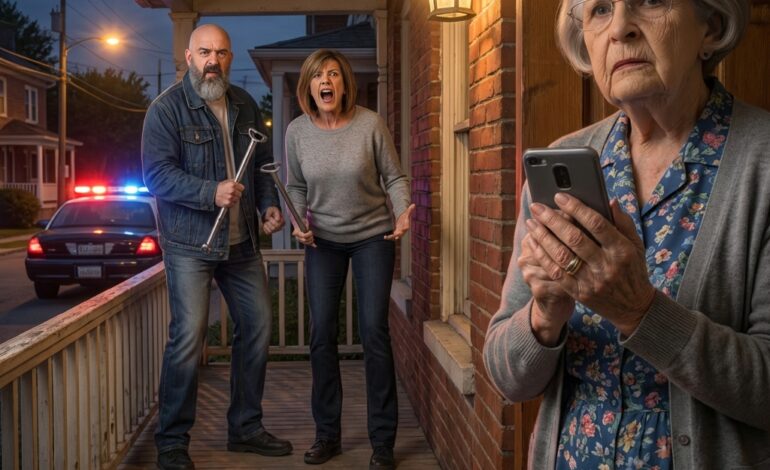
Outside, Tiffany’s voice cut through the quiet like broken glass.
“Open this door right now, Miriam!”
She said my name the way people say insults, stretching it just enough to make it sting. I didn’t answer. I couldn’t trust my voice if I did.
Something slammed into the door—her fist, I guessed—and the frame shuddered, a living thing recoiling from pain. The new brass deadbolt I’d installed just three days earlier gleamed when the porch light flared, then vanished again when it dimmed, blinking like a lighthouse warning ships away from rocks they couldn’t see.
“You old dead weight!” Tiffany screamed. “You think you can just lock us out?”
For two years, she had lived under my roof and called me family. For two years, she had slept in the back room I used to call my sewing room, stacked her shoes by my door, rearranged my cabinets, and spoken to me like I was an inconvenience she tolerated out of obligation. My son Jamal had followed behind her, quieter, heavier somehow, as if guilt had weight.
When they moved in, Jamal told me it would be temporary. “Just until we get back on our feet, Mom,” he’d said, his voice soft, familiar. I believed him. A mother always wants to believe her child.
Temporary turned into months. Months turned into two years. And somewhere along the way, the house stopped being mine.
“You don’t need the living room, Mom,” Tiffany had said once, smiling sweetly while her fingers tightened around her coffee mug. “You’ve got your room.”
Another time, when I’d asked her not to throw away my old cookbooks, she’d leaned in close and whispered, “You should be grateful we let you stay here at all.”
That was the first day I started recording.
My phone was warm in my hand now, the screen glowing faintly in the dark hallway. Fifty-three voice notes sat in a neat little folder, each labeled with a date, a time, and sometimes a name. I’d never planned to use them. I just needed proof—proof that I wasn’t imagining things, proof that cruelty could hide behind smiles.
Outside, tires crunched on gravel.
I knew the sound of Jamal’s car as well as I knew my own heartbeat. The engine cut off too close to the house, and through the peephole I saw him step out, tall and broad, his shoulders tense. He reached back into the car and pulled out a crowbar.
The whole cul-de-sac went quiet.
Mrs. Alvarez’s wind chimes across the street stopped ringing. The Jenkins’ dog, who barked at everything, fell silent. Even the cicadas seemed to hold their breath.
Jamal walked up the steps like he owned them.
“Mom,” he called, his voice low but sharp, “open the door before you make this worse.”
I leaned my forehead against the wood, feeling the vibration of his presence on the other side. “You don’t live here anymore,” I said, surprised at how steady my voice sounded.
There was a pause. Just a beat. Then his tone changed.
“You can’t lock us out like we’re strangers.”
Tiffany laughed, high and brittle. “I’m recording,” she announced loudly, turning toward the street. “Everyone’s going to see what kind of woman you are.”
Metal scraped against the door—Jamal testing it with the crowbar, just enough to remind me he could. My stomach twisted the way it used to when my husband raised his voice, back before I learned the difference between love and fear.
I tightened my grip on the phone.
Across the street, a screen door creaked open. Mrs. Alvarez stepped onto her porch, robe pulled tight, eyes sharp behind her glasses. Down the block, the Jenkins’ living room lights flicked on. Curtains shifted. Phones lifted.
“Ma’am,” Jamal called again, louder now, “this is ridiculous.”
“Yeah,” Tiffany chimed in, her voice suddenly shaky. “She’s lost it. She locked her own family out.”
Family.
The word tasted bitter.
I thought of the manila folder on my side table, thick with papers—bank statements, property records, a copy of the deed with my name and my late husband’s name printed clearly at the top. I’d prepared it quietly, methodically, the way women my age learn to do things when no one is watching.
Sirens wailed in the distance, growing louder by the second.
Tiffany’s anger evaporated, replaced by tears so fast it was almost impressive. She clutched Jamal’s arm. “Oh my God,” she sobbed. “She’s calling the police on us.”
I hadn’t. Someone else had.
The squad cars rolled in with lights blazing, red and blue washing over the driveway and the cracked concrete like judgment. An officer stepped out and immediately zeroed in on the crowbar.
“Sir,” he said calmly, “put it down.”
Jamal hesitated, then dropped it. The metal clanged against the pavement, loud in the sudden hush.
Another officer approached my door and knocked—firm, professional. “Ma’am, could you open up so we can talk?”
I looked down at my hands, at the faint tremor in my fingers, at the phone that held two years of my life in fragments of sound. I thought of Jamal as a little boy, pressing his ear to my bedroom door when he had nightmares. I thought of Tiffany the first day she’d called me “Mom” and smiled like it meant something.
What do you do when the people who know your softest places choose to hit them anyway?
I unlocked the deadbolt.
The door opened just enough for the officer to see my face. He was young, freckles across his nose, eyes kind but tired.
“Are you safe, ma’am?” he asked.
“Yes,” I said. “I am now.”
Tiffany’s tears stopped instantly. “She’s lying,” she snapped. “She’s been abusive for years.”
The officer glanced at Jamal, then at the crowbar on the ground. “We’re going to need everyone to calm down.”
“I have proof,” I said quietly.
They all turned to look at me.
Inside, the house smelled like lemon cleaner and old wood. I led them to the living room, where the manila folder waited. Mrs. Alvarez had crossed the street by then, standing awkwardly near the doorway, pretending not to listen while hearing everything.
I pressed play.
Tiffany’s voice filled the room, sharp and unmistakable. You’re useless, you know that? Dead weight.
Another clip. Jamal’s sigh. Just ignore her, Mom. Don’t make a big deal.
Another. Tiffany again, laughing. Where would you even go? This isn’t your house anymore.
The room went very still.
The officers exchanged a look. One of them flipped through the folder, nodding as he read. “This property is legally yours,” he said, looking at Jamal. “They have no claim.”
Jamal’s face crumpled. “Mom, I didn’t mean—”
“I know,” I said. And I did. That was the worst part.
Tiffany exploded. “This is insane! You’re choosing recordings over your own son?”
I met her eyes, steady. “I’m choosing myself.”
In the end, Jamal and Tiffany left with nothing but what they could carry. A restraining order followed. The cul-de-sac slowly returned to its usual quiet, though Mrs. Alvarez brought me soup the next day and squeezed my hand a little longer than necessary.
Weeks passed. The porch light got fixed. The house felt lighter.
Jamal called once, voice small. We talked. We cried. Healing, I learned, doesn’t mean forgetting—it means finally being heard.
Sometimes, late at night, I still touch the deadbolt, cool and solid beneath my fingers. It isn’t just a lock.
It’s a line.
And this time, I don’t plan on letting anyone cross it again.

