“They Labeled Him ‘The Useless Old Man’—At His Own Grandson’s Wedding”
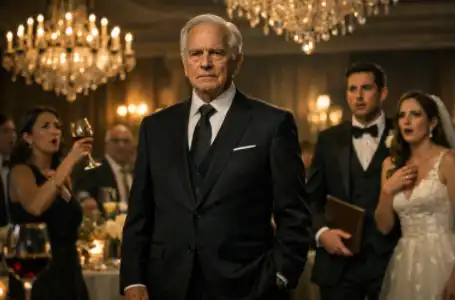
They Thought the Old Man Was Harmless
By the time I stood up from my chair, no one expected anything from me.
That was the mistake.
I had spent most of my life learning when to speak and—more importantly—when not to. Power, I learned early, doesn’t arrive loudly. It arrives prepared.
The ballroom of the Hawthorne Estate glowed under warm chandeliers, filled with crystal glasses, linen-draped tables, and people who believed the night belonged to them. My grandson Oliver laughed near the dance floor, one arm around his new wife, Vanessa. Cameras flashed. Applause rippled.
I remained seated.
To them, I was already finished.
The place card hadn’t been a joke.
It was deliberate.
I knew that the moment I noticed how confidently everyone laughed afterward—how relaxed they were, as if nothing truly bad could happen. People only behave that way when they believe they’re untouchable.
Vanessa’s friends were the first to treat me like furniture. They walked past my table without eye contact, setting purses on empty chairs, speaking over my head.
“Is he still with us?” one of them whispered, not quietly enough.
Another replied, “Does it matter?”
My son Matthew avoided my gaze entirely. When I caught his eye, he smiled thinly—tight, rehearsed—then turned away. That smile told me everything I needed to know.
They had already decided who I was.
In their version of events, I was a relic.
A man who had made money once, long ago. A man whose wife had handled the details. A man who signed documents without reading them anymore.
What they never asked was why the trust still required my approval.
Or why the board votes were still tied to my name.
They assumed the answer was tradition.
They never considered caution.
When Charles Whitman sat beside me, he didn’t touch his drink.
That alone told me something was wrong.
“They never disclosed the amendment,” he said quietly, his voice steady, professional.
“Which amendment?” I asked.
He slid the envelope across the table, careful not to draw attention. Inside was a single page—thin, unremarkable, deadly.
I remembered signing it after my wife’s funeral.
I had been calm that day too.
The clause was simple:
Any beneficiary who publicly humiliates or degrades the grantor forfeits all current and future rights under the family trust.
No dramatic language. No emotion. Just consequence.
I folded the paper and placed it in my jacket pocket.
Charles looked at me. “Do you want me to intervene?”
I shook my head.
“Not yet.”
The best man clinked his glass.
“To legacy,” he said, smiling wide. “To the people who built something once… and the people who will finally take it forward.”
Laughter followed. The groom laughed too.
That was when I stood.
No tapping glass. No raised voice.
I waited until the room quieted naturally—curiosity doing the work for me.
“I won’t make a speech,” I said gently. “I only need one minute.”
Matthew stiffened. Vanessa’s smile faltered.
I looked at them—not with anger, not with disappointment—but with the same calm I used when signing contracts that moved millions.
“I’ve been introduced tonight in many ways,” I continued. “Some of them… creative.”
A ripple of uneasy laughter.
“I want to clarify something before the night ends.”
I nodded to Charles.
He stood.
Charles spoke clearly, loudly enough for every table.
“As legal counsel for the Hawthorne Family Trust, I am required to notify all present beneficiaries of an immediate suspension of access.”
The room froze.
“Effective immediately,” he continued, “all voting privileges, distributions, and authority previously granted to Matthew Hawthorne and Oliver Hawthorne are revoked, pending review.”
Vanessa whispered, “What is this?”
Matthew stood. “This is a misunderstanding.”
I met his eyes for the first time all night.
“No,” I said softly. “This is accountability.”
No one applauded.
No one spoke.
People stared at their glasses, at the floor, anywhere but at me.
I turned toward Oliver.
“I loved you,” I said. “That’s why I protected you. But love does not excuse cruelty.”
Vanessa’s face drained of color.
Matthew opened his mouth, then closed it. He knew—finally—that there would be no argument, no negotiation.
This wasn’t emotion.
It was structure.
I left before the cake was cut.
The next morning, headlines didn’t matter. Messages poured in. Apologies arrived late and hollow.
The trust remained intact.
But the seats around it changed.
I returned to my quiet house on the edge of town—the same one where my wife and I once planned a future no one else was entitled to.
I poured myself a drink.
And for the first time that night, I smiled.
Not because I had won.
But because I had reminded them of something they forgot:
Never mistake silence for surrender.

