He Hit His Wife in Public — And Thought She’d Stay Silent
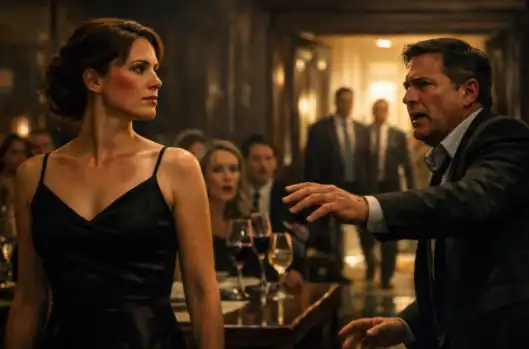
He Hit His Wife in Public — And Lost Everything Before Dessert
The slap echoed louder than the music.
It wasn’t dramatic. It wasn’t cinematic. It was fast, efficient, practiced.
My name is Rachel Moore, and in that moment, the entire restaurant learned something I had known for eleven years:
Violence doesn’t need rage. It needs permission.
Thomas didn’t look angry when he hit me. He looked annoyed. Like I’d spilled wine on his jacket. Like I’d broken a rule I was supposed to remember.
The room froze.
A waiter stood motionless, wine still pouring onto white linen. A woman at the next table gasped, then immediately looked away, embarrassed for me. Someone chuckled under their breath, the nervous laugh people use when they’re desperate for normal to return.
Thomas leaned in, his voice low.
“Sit down,” he said. “You’re making this worse.”
I touched my cheek. It burned. Not from the pain—from the certainty.
For years, this was how it worked. Correction. Compliance. Silence.
The Marriage Everyone Envied
From the outside, our life was flawless.
Thomas Moore. Tech founder. Visionary. Investor favorite. Rachel Moore. His wife. Former attorney who “chose family.”
That’s what he liked people to say.
At parties, he’d wrap an arm around my shoulders and tell strangers, “She could’ve been anything. She chose me.”
They smiled. I smiled. The lie settled deeper.
At home, rules replaced affection.
Don’t contradict me in public. Don’t ask about the accounts. Don’t make me look weak.
If I did, his hand found my wrist. Not enough to bruise. Just enough to remind.
And when I finally did bruise?
My mother said, “You know how men under pressure are.” My father said nothing at all. Friends changed the subject.
Silence became a shared project.
The Night He Miscalculated
The anniversary dinner was his idea.
“Ten years deserves witnesses,” he said.
Fifty guests. Private room. A restaurant so expensive even the chairs felt judgmental. Investors, board members, old friends—people whose opinions fed his sense of self.
I was seated seven chairs away. Spouse section.
“To loyalty,” Thomas toasted. “To knowing your role,” he added, smiling.
Laughter rippled across the table.
I excused myself between courses. Needed air. Needed distance from the way he looked at me when he was being admired.
In the hallway, I ran into Evan Carter, a senior partner from another firm.
“Rachel, right? I always wondered why you disappeared,” he said.
“We don’t disappear,” I replied. “We get redirected.”
We talked for maybe three minutes.
That’s all it took.
Thomas appeared behind me, fingers already tightening around my arm.
“Enjoying yourself?” he asked loudly.
“We were discussing work.”
He smiled. The smile he used when he’d already decided.
The slap came without warning.
The Moment the Room Chose Sides
Gasps. Silence. Shock.
I didn’t cry.
Instead, I turned back to the table.
“Did everyone see that?” I asked. “Or should he repeat it for clarity?”
Thomas laughed. A few others followed. Relief laughter. Permission laughter.
My parents stood.
For a moment, hope flared.
My mother reached for me—then turned to Thomas.
“I’m so sorry,” she said. “She’s been emotional lately.”
My father nodded at Thomas. Two men acknowledging inconvenience.
They left.
Thomas raised his glass. “Marriage,” he said. “It’s complicated.”
People relaxed. Plates resumed clinking. The system restored itself.
Except I didn’t sit down.
Under the table, I pressed one word into my phone.
Now.
When “No” Finally Meant Something
“Sit,” Thomas said again. Sharper this time.
“No.”
His smile collapsed.
“What did you say?”
“I said no.”
He stood so fast his chair scraped loudly across marble. He reached for me the way he always did—confident, entitled, certain.
And then—
Footsteps.
Measured. Unhurried. Certain.
Not one pair. Several.
The doors to the private room opened.
The maître d’ straightened like he’d been waiting for this moment all night.
Three men in tailored suits entered. One woman. A camera held steady. A leather folio under one arm.
Thomas’s hand fell away from my sleeve.
“Thomas Moore,” one of the men said calmly. “Please keep your hands visible.”
The room stopped breathing.
Everything He Thought Was Hidden
“I don’t know what this is,” Thomas said, laughing too quickly. “But you’re interrupting a private event.”
The woman opened the folio.
“Emergency restraining order,” she said. “Filed this afternoon. Effective immediately.”
She looked at me. “Ms. Moore, are you hurt?”
“Yes,” I said. “And documented.”
Phones came out. Whispers spread.
One of the men turned to the table.
“This incident,” he said, gesturing to my face, “occurred in public. There are witnesses. Recordings. Prior reports.”
Thomas looked around, searching for allies.
None stood.
His board chair avoided his eyes.
His lead investor leaned back slowly, calculating.
“What prior reports?” Thomas demanded.
I stepped forward.
“The photos,” I said. “The voicemails. The medical records. The account transfers you never noticed.”
I met his eyes for the first time without fear.
“You controlled the narrative,” I said. “I controlled the evidence.”
The End of Ownership
Security escorted Thomas out.
Not arrested. Not yet.
But stripped.
Stripped of authority. Of admiration. Of the room.
As he passed me, he hissed, “You’ll regret this.”
I smiled.
“No,” I said softly. “You already are.”
The Morning After
By morning, the story was everywhere.
Investor pulls funding. Board launches investigation. Founder placed on indefinite leave.
Friends didn’t call. Apologies arrived instead. Carefully worded. Late.
My mother left a voicemail.
“I didn’t know it was that bad.”
I deleted it.
Six months later, I walked into a courtroom alone.
I walked out free.
The settlement was quiet. The consequences weren’t.
Thomas lost the company. The board. The image. He kept the belief that he’d been wronged.
That belief is a prison of its own.
I took my maiden name back. I took my career back. I took my voice.
And sometimes, when people ask me how it ended, I tell them the truth:
It didn’t end when he hit me. It ended when he realized I no longer needed his permission to stand.

