My husband divorced me to marry my own mother. Everyone told me to move on, but instead… I showed up at their wedding. And when she said, “I do”, they had no idea what I had already done.
The invitation arrived in a white envelope, thick as a coffin lid. My husband’s name was printed beside my mother’s in gold letters.
Evan Hale and Vivienne Hart request the honor of your presence…
I read it once. Then twice. Then I laughed so hard the sound broke into something ugly.
Three weeks earlier, Evan had sat across from me in our kitchen, wearing the blue tie I bought him after his first promotion.
“Clara,” he said, not meeting my eyes, “I’m filing for divorce.”
I remember the rain tapping the windows. I remember my coffee going cold. I remember my mother standing behind him with one hand on his shoulder, her red nails resting there like a claim.
“You’re young,” she said softly. “You’ll recover.”
Recover.
As if she hadn’t carried me for nine months only to gut me thirty-two years later.
Evan slid papers across the table. “It’s better this way.”
“For who?”
He finally looked at me then, and there was no guilt in his face. Only relief.
“For everyone.”
My mother gave me that practiced sad smile she used at funerals.
“Don’t make this vulgar, Clara.”
That was the word she chose. Vulgar. Not betrayal. Not adultery. Not monstrous.
I signed nothing that day.
But Evan didn’t worry. He thought he knew me. Quiet Clara. Polite Clara. The daughter who apologized when her mother hurt her. The wife who handled the finances, the contracts, the taxes, the ugly little details no one praised because everyone assumed they magically solved themselves.
At first, people called me.
“Move on.”
“Don’t embarrass yourself.”
“You can’t fight love.”
Love.
My mother had loved my father’s insurance money. Evan had loved my trust fund, though he never knew the real size of it. They had loved the house in my name, the company shares I kept out of sight, and the contacts I never mentioned at dinner.
They thought I was broken.
I let them.
I cried in public once, outside a bakery, where my mother’s friends could see. By evening, half the city knew poor Clara had fallen apart.
Good.
Let them think grief had made me stupid.
On the night the wedding invitation arrived, my lawyer called.
“Everything is ready,” Nadia said.
I looked at the gold letters again.
“When?”
“The moment you give the word.”
Through the window, I could see my reflection: pale, still, smiling.
“Not yet,” I said. “I want them to say ‘I do’ first.
My mother wanted a cathedral wedding.
Of course she did.
Vivienne Hart did not enter rooms. She staged arrivals. She wanted marble floors, white roses, a string quartet, photographers, champagne towers, and an audience big enough to witness her victory.
She called me two days before the ceremony.
I answered on speaker while Nadia sat across from me, arranging documents into neat black folders.
“Clara,” my mother purred, “I hope you received the invitation.”
“I did.”
“I debated sending it. Evan thought it might be cruel.”
“How thoughtful of him.”
She laughed lightly. “Don’t be bitter. Men like Evan need women with fire. You were always so… careful.”
Nadia’s pen stopped moving.
My mother continued, drunk on herself. “You should come. Closure is healthy.”
“Are you sure you want me there?”
“Oh, darling. Everyone already knows.”
There it was. The knife wrapped in silk.
“Knows what?”
“That you couldn’t keep your husband.”
I looked at the first folder on the table. Bank transfers. Seventy-three pages. Money siphoned from Evan’s consulting firm into accounts under my mother’s old charity.
I looked at the second folder. Emails. Hotel receipts. Messages where Evan called me “the obstacle.”
The third folder was my favorite.
It contained the prenuptial agreement Evan had signed seven years ago without reading because he was too busy laughing with his groomsmen.
Adultery clause. Fraud clause. Asset forfeiture clause.
My mother sighed into the phone. “Say something, Clara.”
“I’ll be there.”
“Good girl.”
She hung up.
Nadia raised an eyebrow. “Good girl?”
“She likes hearing herself die slowly.”
The next morning, Evan came to collect the last of his clothes. He brought two movers and no shame.
“You changed the locks,” he snapped.
“Yes.”
“This is still my house.”
“No,” I said. “It was never your house.”
His smile twitched. “You’re being dramatic.”
He stepped closer, lowering his voice. “Listen carefully. After the divorce, Vivienne and I are contesting the trust. She says your father meant for the family to share it.”
My pulse stayed calm.
“My father hated her.”
“He’s dead,” Evan said. “Dead men don’t argue.”
I almost admired the stupidity.
The movers carried out his suits, his golf clubs, the espresso machine he swore he bought, though it appeared on my card statement.
At the door, Evan turned back.
“You should sell this place before you can’t afford it.”
I smiled.
He didn’t like that.
“What?”
“Nothing,” I said. “You just always look smaller when you threaten me.”
His face darkened.
“You’ll regret humiliating us.”
“No, Evan. I’m attending your wedding. I wouldn’t miss it.”
He left angry, which meant reckless. Reckless men make calls. Reckless men send messages. Reckless men confess in writing.
By sunset, my investigator had another recording.
Evan’s voice, clear as glass: “Once I marry Vivienne, Clara loses her mind, we push incompetence, take the trust, sell the house, and disappear.”
My mother laughed in the background.
“She was born useful,” she said. “That was her only talent.”
I listened once.
Then I gave Nadia the word.
The cathedral smelled of lilies and expensive lies.
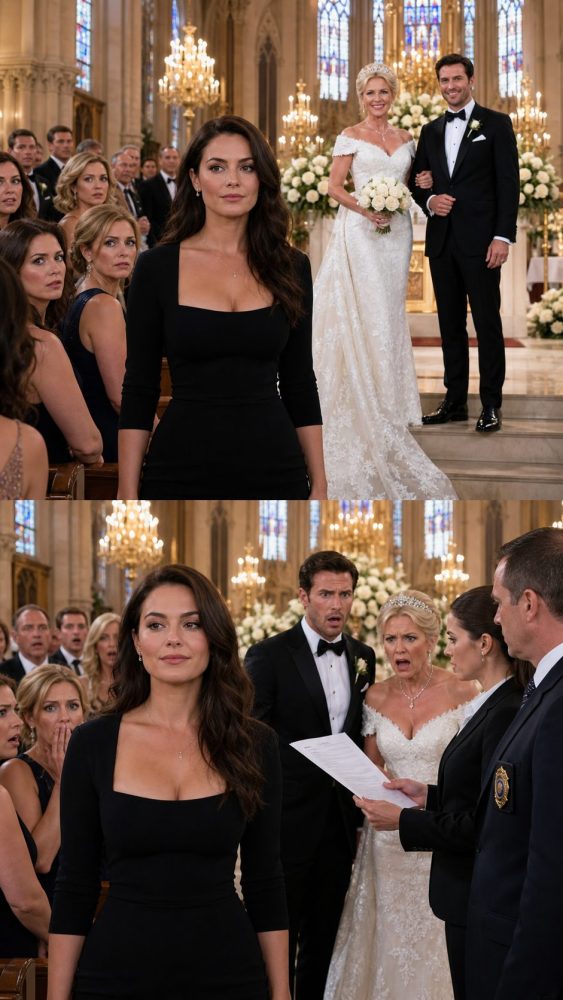
I arrived ten minutes late, wearing black.
Every head turned. Whispers moved through the pews like wind through dry leaves.
My mother stood at the altar in ivory silk, glowing with triumph. Evan beside her looked polished, handsome, and doomed.
He saw me and smirked.
My mother’s smile widened.
She thought I had come to suffer.
The priest began again.
I sat in the front row, crossed my legs, and waited.
Vows were exchanged. Rings slid onto fingers. Cameras flashed.
Then the priest turned to my mother.
“Do you, Vivienne Hart, take Evan Hale—”
Her eyes found mine.
I gave her nothing.
She lifted her chin. “I do.”
Perfect.
The cathedral doors opened behind me.
Not dramatically. Not loudly.
Just enough for four people to enter: Nadia, two federal investigators, and a court officer carrying a sealed injunction.
Evan frowned first.
My mother saw the badge and went white beneath her makeup.
Nadia walked down the aisle in heels sharp enough to draw blood.
“Apologies for the interruption,” she said, voice calm. “Mrs. Hart. Mr. Hale. You’ve both been served.”
The priest froze.
Guests rose halfway from their seats, hungry for scandal.
Evan barked, “What is this?”
I stood.
“This,” I said, “is the part where dead men argue.”
My mother’s mouth opened.
I turned to the crowd.
“My father’s trust has a morality and fraud provision. Anyone who attempts to coerce, defraud, or legally incapacitate me forfeits all claims connected to his estate.”
Evan lunged forward. “Clara, shut up.”
One investigator stepped between us.
I kept going.
“For six months, Evan and Vivienne transferred company funds into a fake charity, discussed having me declared incompetent, and planned to take control of assets they never owned.”
My mother hissed, “You pathetic little—”
Nadia pressed play.
Evan’s voice filled the cathedral.
“Once I marry Vivienne, Clara loses her mind, we push incompetence, take the trust…”
Gasps erupted.
Then my mother’s laugh followed.
“She was born useful.”
Silence hit harder than screaming.
My mother staggered back as if the words had slapped her.
I looked at Evan.
“You signed the prenup. Adultery, fraud, and conspiracy void your settlement. The house remains mine. Your firm shares revert to me. Your accounts are frozen pending investigation.”
His face collapsed piece by piece.
“You can’t do this.”
“I didn’t,” I said. “You did.”
My mother grabbed his arm. “Fix this.”
Evan looked at her, finally seeing not a queen, but a liability.
The court officer handed him papers. The investigators asked them both to step outside.
No one moved to help them.
As my mother passed me, she whispered, “You’ll be alone forever.”
I leaned close.
“No. I was alone when I had you.”
Six months later, I sold Evan’s firm for twice what he thought it was worth and used part of the money to fund legal aid for women trapped by charming men with greedy hands.
Evan pleaded guilty to fraud and avoided prison by testifying against my mother.
Vivienne fought everything. She lost everything. The house, the friends, the charity, the name she had polished like silver.
On quiet mornings, I drink coffee by the windows of the home she tried to steal.
The silence no longer feels empty.
It feels clean.

