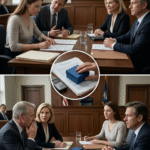
My husband’s mistress was sitting in my chair when he handed her a seven-hundred-and-fifty-thousand-dollar Christmas bonus.
Not a chair that happened to be empty.
My chair.
The high-backed walnut chair at the center of the Whitmore Vale family office dining room, beneath the oil portrait of my late mother, Catherine Vale.
Sloane Mercer sat there in ivory silk, one hand resting beside my crystal champagne glass and the other extended toward the cream-colored envelope in my husband’s hand.
She was wearing the diamond rivière necklace Grant had told me was being held by our insurance company for reappraisal.
Behind them, snow drifted past the forty-second-floor windows, turning Manhattan into something hushed and expensive.
Inside the room, two dozen executives, trustees, attorneys, and members of the Whitmore family watched my husband reward the woman he had been sleeping with for fourteen months.
Grant smiled as if he were performing an act of generosity instead of theft.
“Sloane supported me through the most difficult year of my life,” he said.
His voice carried beneath the crystal chandeliers.
Difficult meant cheating.
Difficult meant lying.
Difficult meant draining accounts he did not own and buying his mistress a three-bedroom apartment overlooking Central Park.
Sloane accepted the envelope with a small, triumphant smile.
She did not look embarrassed.
She looked promoted.
Grant’s mother, Beatrice, lifted her champagne glass as though she had practiced not seeing adultery whenever it wore couture.
His father, Harrison Whitmore, stared at the tablecloth.
Nobody looked at me.
That was the mistake.
I did not look at Grant either.
I looked at Daniel Brooks, our chief financial officer.
He was standing near the fireplace with a glass of untouched bourbon in one hand.
When our eyes met, he gave me the slightest nod.
The audit team was ready.
The accounts had already been secured.
The board documents were waiting in the conference room.
Sloane slid one manicured finger beneath the flap of the envelope.
I placed my champagne glass on the table.
The sound was soft.
It silenced the room.
“Return the envelope,” I said.
Grant’s smile disappeared.
I kept my eyes on Daniel.
“Then audit every one before it.”
PART ONE
THE WOMAN IN MY CHAIR
May you like
For three seconds, nobody moved.
The string quartet in the reception gallery continued playing “Have Yourself a Merry Little Christmas,” unaware that a marriage and a financial empire were about to collapse twenty feet away.
Sloane’s fingers tightened around the envelope.
Grant gave a short laugh.
It was the laugh he used when a junior employee challenged him during a meeting.
“Evelyn,” he said, “this is neither the time nor the place.”
“You chose the time.”
I turned toward him.
“And you placed her in my place.”
Sloane rose slowly from the chair.
She was thirty-one, beautiful in a sharp, deliberate way, with pale blond hair swept into a polished knot and a face that always seemed to be waiting for a camera.
She had joined Whitmore Vale Holdings three years earlier as Grant’s executive assistant.
Within eighteen months, she had become his chief of staff.
By the following spring, she had begun accompanying him to conferences where spouses were specifically not invited.
That evening, she wore winter-white silk and the expression of a woman who believed the wife had arrived too late.
“The envelope was approved compensation,” she said.
Her voice was calm, but the pulse in her throat had begun to jump.
“Approved by whom?” I asked.
Grant stepped between us.
“By me.”
Daniel set down his bourbon.
Naomi Chen, the company’s general counsel, closed the dining room doors.
The heavy brass latch clicked into place.
Several people turned toward her.
Grant’s younger brother, Owen, lowered his phone.
Beatrice Whitmore looked offended.
“What is the meaning of this?” she demanded.
Naomi crossed the room with a leather folder tucked beneath her arm.
“Effective at six thirty-two this evening, extraordinary distributions from the executive reserve were suspended pending a forensic review.”
Grant stared at her.
“You had no authority to do that.”
“I acted under written direction from the controlling trust.”
Grant’s face did not change immediately.
That was one of the things I had once admired about him.
He could receive bad news without showing pain.
Unfortunately, he had confused that ability with mine.
“There must be some misunderstanding,” Harrison said.
“There is,” I replied.
“Grant misunderstood whose money he was spending.”
A quiet shock moved through the room.
The Whitmore family had spent decades allowing people to believe the family office existed because of them.
Their name appeared first on the brass doors.
Their photographs filled the hallways.
Their ancestors had owned rail depots, textile mills, and enough Connecticut land to make their failures look like legacy.
But the modern company had not been built with Whitmore money.
It had been built with Vale money.
My mother’s money.
Grant turned toward me.
His eyes were cold now.
“You need to stop.”
“No.”
“You are upset.”
“I am informed.”
“This is a personal matter.”
“You used company accounts to finance it.”
Sloane placed the envelope on the table.
Her smile had vanished.
Grant looked toward Daniel.
“You report to me.”
Daniel’s expression was almost apologetic.
“I report to the board.”
“I am chairman of the board.”
“Not as of six forty-five.”
This time, Grant’s composure cracked.
Only slightly.
A small muscle moved along his jaw.
Naomi opened the leather folder.
“Under Section Nine of the Restoration Agreement, a certified breach involving concealed related-party transactions triggers the temporary suspension of the managing member.”
Beatrice rose from her chair.
“This is Christmas.”
Naomi looked at her.
“The calendar does not suspend fiduciary duties.”
I almost admired her for that sentence.
Grant came closer to me.
He lowered his voice, but the room was too quiet for privacy.
“You have no idea what you’re doing.”
“I know about the apartment on Central Park West.”
Sloane’s face whitened.
“I know about the Bellwether Strategies invoices.”
Grant did not blink.
“I know the company paid for this necklace.”
My gaze dropped to the diamonds around Sloane’s throat.
Her hand rose instinctively toward them.
“I know you pledged part of Claire’s education trust as collateral for a credit line.”
The sound Grant made was not quite a breath.
Behind him, Harrison closed his eyes.
Our daughter’s name changed the air in the room.
Infidelity could be dismissed as weakness.
Stealing from a child required a different vocabulary.
“You’re making accusations you cannot prove,” Grant said.
Daniel reached inside his jacket and removed a small flash drive.
“We can prove them.”
Grant looked at the drive.
For the first time that evening, I saw fear.
Not regret.
Not shame.
Fear.
Sloane glanced toward the door.
Naomi noticed.
“Nobody is being detained,” she said.
“However, all company devices and financial documents must remain on the premises.”
Sloane’s hand moved toward the silver clutch on the table.
Naomi’s gaze followed it.
“That includes the laptop in your bag.”
Sloane looked at Grant.
He did not look back at her.
That was the first moment she understood the truth about men like my husband.
They made women feel chosen until choosing them became expensive.
Then they called those women mistakes.
Grant took my elbow.
His fingers closed hard enough to bruise.
“We are going home.”
I looked at his hand until he released me.
“You are not going to my home.”
His expression changed again.
Our guests remained frozen around the long mahogany table, surrounded by white roses, antique silver, and candles that smelled faintly of cedar.
The room was designed to communicate permanence.
Grant had believed that permanence belonged to him.
“The Greenwich house is marital property,” he said.
His voice dropped.
“Do not do this here.”
“You brought your mistress into my seat, wearing jewelry bought with my company’s money, and gave her an envelope funded by a trust established by my mother.”
I stepped closer.
“You did this here.”
Sloane removed the diamond necklace.
Her hands shook as she placed it beside the envelope.
Beatrice stared at the diamonds as though they had become dirty.
I turned to Naomi.
“Have security inventory both items.”
Grant laughed again, but there was nothing controlled about it now.
“You think you can humiliate me in front of my family?”
“No, Grant.”
I looked around the room.
“You managed that without assistance.”
I left before anyone could answer.
The elevator doors opened onto a mirrored interior lined with brass.
My reflection stared back at me in a black velvet gown, my hair smooth, my shoulders straight, and my face almost unnaturally calm.
Only my hands betrayed me.
They were trembling.
I pressed them together until they stopped.
For fourteen months, I had imagined how it might feel to expose him.
I had expected satisfaction.
Instead, there was only a clean, cutting grief.
Grant had not merely slept with another woman.
He had rewritten our marriage in secret and expected me to keep living inside the false version.
As the elevator descended through forty-two floors of steel and glass, my phone lit up.
It was a message from our fifteen-year-old daughter, Claire.
Are you coming home soon?
I typed carefully.
Yes.
Then another message appeared.
Dad said he might not be home tonight.
I stared at the screen.
Grant had told our daughter he might not come home before he had told his wife the marriage was over.
I wrote the only answer Claire needed.
I will be there.
Outside, the company car waited beneath a cold silver sky.
Snow collected on the black roof.
The driver opened the door, but I paused beside the curb and looked up at the tower.
My mother’s portrait hung near the windows on the top floor.
She had died six years earlier, before the affair, before Sloane, and before Grant began mistaking access for ownership.
On the morning she transferred control of the Vale Continuity Trust to me, she had held my hand in a private hospital room at Mount Sinai.
“Power is not the loudest person in the room,” she had whispered.
“Power is knowing which doors will lock when you leave.”
That night, for the first time, I understood exactly what she meant.
PART TWO
THE MONEY BENEATH THE MARRIAGE
I met Grant Whitmore when I was twenty-six years old.
He was thirty-one, handsome, ambitious, and still young enough to make confidence look like courage.
We met at a benefit for the New York Public Library, where he spent twenty minutes explaining municipal bonds to a donor who owned a bond-trading firm.
I should have recognized the pattern.
Grant never cared how much someone knew.
He cared whether they allowed him to feel like the smartest person at the table.
At the time, I found him charming.
My mother did not.
“He enjoys your inheritance more than your opinions,” she told me after our third date.
I accused her of being suspicious.
She replied that wealthy women did not have the luxury of confusing suspicion with cruelty.
Still, Grant made me laugh.
He remembered how I took my coffee.
He sent handwritten notes instead of texts.