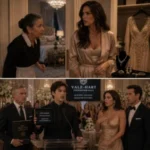
The Door They Thought Would Hold Me
“She just walked into the gala wearing your gown, your diamonds, and your name, Mrs. Hart.”
Mrs. Alvarez whispered it through the locked bedroom door of my Bel-Air estate while two unfamiliar security guards patrolled my terrace below and my husband stood thirty minutes away beneath a chandelier, presenting another woman to Los Angeles as his wife.
My phone had been taken three days earlier.
The internet router had vanished from the office closet.
The house line had been disconnected under the careful explanation that I needed privacy, rest, and protection after what Adrian Vale had begun calling my “grief-related instability.”
I was being held prisoner inside a house titled in my name.
Mrs. Alvarez slipped into the room with an old service key she had kept since my father’s time. She was seventy-two, barely five feet tall, and trembling with the kind of fury that makes loyal women more dangerous than men with radios.
“She is wearing the champagne gown,” she said. “The one from Paris.”
I turned toward my dressing room.
The door stood open.
The champagne silk gown I had chosen for the Vale-Hart Foundation gala was gone. So were the diamond earrings my grandmother wore at her fiftieth anniversary dinner, the gold bracelet my father gave me when I joined the Hartline board, my wedding ring, and the invitation printed with my full legal name.
Vivian Hart Vale.
For a moment, I felt nothing.
That was how my body handled danger. It did not flood. It cooled.
“What time is it?”
“Eight o’clock, ma’am. The gala started half an hour ago at the Meridian.”
Downstairs, one of the guards spoke into a radio. Mrs. Alvarez flinched as if the sound itself could bruise her.
“Mr. Vale told them no one was to let you leave this room,” she whispered. “He told the press you were resting after a private health crisis. Then he left with Celeste Marrow in your car.”
Celeste Marrow.
My closest friend from Wellesley. The woman I had brought into my home after her boutique agency collapsed. The woman I hired as communications director at Hartline Capital because she sat at my kitchen island and cried into a linen napkin, saying she only needed one person to believe she was not finished.
I had believed her.
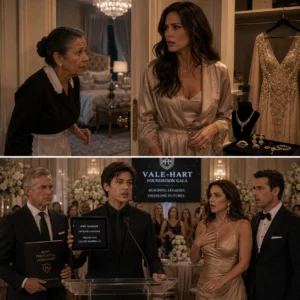
I gave her an office, a title, a salary, introductions in New York, a seat at foundation dinners, and the kind of access women in trouble call friendship before they learn how to weaponize it.
She borrowed a handbag first.
Then my perfume.
Then my table at charity breakfasts.
Then my speaking slot at a women’s finance luncheon because she said her confidence needed rebuilding.
Then she borrowed my husband.
A stolen identity rarely begins with the crown. It begins with a woman asking to try on your gloves.
I crossed to the window. Below, the terrace lights glowed along the hedges, trapping the garden in gold. The new security guards stood where my roses met the stone steps, broad-shouldered and bored, as if my own home had become a border checkpoint.
“They said you were unstable,” Mrs. Alvarez whispered. “They said if you tried to leave, they should call a private medical team.”
I looked at the guards.
Then at the empty space in my jewelry drawer.
“They used my grief as a lock.”
My father had died six months earlier. Arthur Hart, founder of Hartline Capital, the man who could silence a boardroom by removing his glasses, had become ashes in a black urn on the library shelf. While I planned memorial luncheons and wrote thank-you notes to men who owed him fortunes, Adrian moved quietly through the company like mildew under marble.
He shifted meeting authority.
Replaced security vendors.
Rescheduled board briefings.
Forwarded press requests to Celeste.
Whispered concern about my “fragile state” to directors who had known me since I was twenty-four.
I mistook exhaustion for weakness.
He mistook mourning for vacancy.
The soft click from the balcony came before Mrs. Alvarez could answer. A figure climbed over the railing with calm precision, swung one leg over the stone edge, and stepped into my bedroom as if breaking into a guarded estate were simply another scheduling inconvenience.
My son, Sebastian, stood in front of me wearing a black jacket, dark sneakers, and the expression he had inherited from my father when a negotiation was already over.
He was eighteen.
Adrian called him strange because Sebastian preferred financial models to parties and wrote code the way other boys wrote late-night texts. At sixteen, he had built an investment account inside a structure my father pretended not to notice. At seventeen, he corrected a risk model in one of Hartline’s funds and saved the firm from an eight-figure loss Adrian never understood enough to thank him for.
Sebastian placed a tablet on the dressing table.
Beside it, he set a small black chess queen carved from ebony wood.
“Mom,” he said, “they are onstage now.”
His hand lingered on the queen for one second too long.
That was when I saw it.
Not fear.
Not exactly.
The faintest tremor in his fingers.
For one breath, he was not the prodigy everyone whispered about. He was my son, eighteen years old, climbing balconies because the adults around him had turned his mother’s grief into a cage.
I touched his wrist.
“I’m here,” I said.
His jaw tightened.
“I know,” he replied. “That’s why tonight works.”
The Woman in My Gown
The tablet showed a live feed from the Meridian Hotel ballroom.