My husband brought his mistress to the Silvermere Regatta wearing my diamonds.
Not copies.
Not something merely similar.
The actual pale-blue diamond earrings my father had given me on my twenty-first birthday—the last birthday we celebrated before cancer began eating him alive.
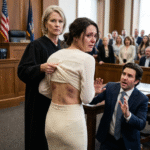
Sloane Mercer stood at the end of the yacht club’s white marble pier in a backless cream dress, one manicured hand resting on the polished mahogany wheel of *Aurelia*, my father’s legendary racing boat.
Behind her, the lake glittered beneath the August sun like a field of broken glass.
Around her, two hundred members of Connecticut’s oldest private yacht club drank champagne and pretended not to stare.
Adrian stood beside her.
My husband of seven years.
His hand rested low on her bare back with the careless intimacy of a man who believed he had already won.
“Ladies and gentlemen,” he announced, raising his crystal flute, “I’m honored to introduce the new captain of *Aurelia*.”
There was a pause.
Not silence exactly.
Silence is clean.
This was the softer, uglier sound of wealthy people swallowing scandal so they could taste it later.
Sloane smiled.
She had the kind of beauty designed for cameras—glossy black hair, sculpted cheekbones, pale skin untouched by weather, grief, or honest work.
She turned toward me as Adrian spoke.
Not because she was surprised to see me.
Because she wanted to watch the moment land.
“My wife,” Adrian continued, smiling with affectionate cruelty, “has never cared for rough water. Eleanor always preferred watching from shore.”
A few people laughed.
Most looked down.
One woman lifted her champagne glass to hide her expression.
I stood beneath the blue-and-white awning in a silver silk dress Adrian had chosen for me, carrying a clutch that contained a flash drive, three notarized affidavits, a temporary injunction, and enough evidence to end his career before sunset.
I did not cry.
I had done all my crying three months earlier, alone in the bathroom of our Manhattan penthouse, while Adrian slept in our bed after coming home smelling like Sloane’s perfume.
I had cried when I discovered the hotel receipts.
I had cried when I found the shell companies.
May you like
I had cried when I learned he had used my signature to collateralize properties he did not own.
I had cried when I realized my father had not died believing Adrian would protect me.
He had died knowing Adrian would eventually try to destroy me.
That morning, however, I had applied red lipstick, fastened my grandmother’s pearls around my throat, and instructed my driver to take the lakeside road slowly.
Revenge should never arrive breathless.
Sloane curled her fingers around the wheel.
Adrian leaned toward her.
“Show them what *Aurelia* can do.”
The race official stepped onto the boat before she could start the engine.
Martin Cole had supervised the Silvermere Regatta for nearly thirty years. He was lean, gray-haired, and famously unimpressed by money. His navy blazer carried the embroidered crest of the National Vintage Racing Association.
“Routine inspection,” he said.
Adrian’s smile tightened.
“Of course.”
Martin checked the engine seal, the safety equipment, the insurance certificate, and finally the vessel license.
I watched him read the name printed on the registration.
Then I watched him read it again.
His eyes lifted toward Adrian.
“Mr. Vale,” he said, “there appears to be a problem.”
Adrian gave a short laugh. “There’s no problem.”
Martin held up the document.
“This vessel is not registered to you.”
The air changed.
Sloane’s hand loosened on the wheel.
Adrian looked at me.
For the first time that afternoon, he truly saw me.
I stepped out from beneath the awning.
My heels clicked once against the white stone.
Then again.
Each sound carried across the pier.
Martin turned in my direction.
“The registered owner is Mrs. Eleanor Whitmore Vale.”
Adrian’s jaw hardened.
He came toward me, lowering his voice.
“Don’t do this here.”
I met his gaze.
His eyes were the same cold gray that had once made me feel safe.
Now they looked like the windows of a house after the owners had fled.
“Here?” I asked softly. “You mean in front of the people you invited to watch?”
His fingers closed around my elbow.
I looked down at his hand.
He released me immediately.
The cameras were already recording.
Good.
Sloane climbed down from the captain’s platform, but I raised one hand.
“No,” I said. “Stay where you are.”
She froze.
The crowd leaned closer without moving.
I walked onto *Aurelia*.
The boat smelled of varnished wood, warm leather, and the faint mineral scent of the lake. My father had taught me to navigate from that deck when I was nine. He had stood behind me, his enormous hands covering mine, laughing as I fought the wheel through a summer storm.
*Never fear the water, Ellie,* he had said.
*Fear the person who tells you not to look beneath it.*
I stopped beside Sloane.
Up close, I could see the panic beneath her makeup.
The earrings trembled against her neck.
“My father gave those to me,” I said.
She touched one instinctively.
“Adrian said—”
“I know what Adrian said.”
I removed the earrings slowly.
She did not stop me.
Then I turned to Martin.
“My husband is correct about one thing,” I said. “There will be a new captain today.”
Adrian’s face relaxed for half a second.
He thought I was surrendering.
He still believed silence meant weakness.
It was the most expensive mistake he had ever made.
I took the wheel from Sloane’s hands.
“Only the registered owner,” I said, looking directly at Adrian, “can appoint a captain.”
Then the engines behind us roared.
Not one engine.
Six.
Across the water, six black patrol boats emerged from behind the eastern point, followed by a white federal launch carrying agents from the Financial Crimes Enforcement Network, the Coast Guard Investigative Service, and the Connecticut Attorney General’s Office.
Phones rose throughout the crowd.
Adrian’s face went blank.
Sloane whispered, “What did you do?”
I looked at the lake my family had owned in pieces for four generations.
At the club my husband thought he controlled.
At the man who had mistaken my patience for permission.
Then I smiled.
“I looked beneath the water.”
## CHAPTER ONE
## THE WOMAN EVERYONE THOUGHT WAS DECORATIVE
Three months before the regatta, I learned that my husband had been stealing from me because he sent flowers to the wrong woman.
The arrangement arrived at our penthouse on a rainy Thursday afternoon.
White peonies.
Black calla lilies.
A handwritten card.
The doorman delivered them while I was in the library reviewing plans for the Whitmore Foundation’s winter housing initiative. I almost asked him to leave the flowers in the foyer. Adrian sent extravagant arrangements often enough that I had stopped treating them as evidence of affection.
Flowers, in my marriage, usually meant one of three things.
He had missed dinner.
He had insulted me in public.
Or he wanted me to sign something.
I opened the envelope.
The card read:
*For the woman brave enough to take the wheel. Soon, all of it will be yours.*
There was no name.
Only the initial A.
For several seconds, I simply stood there.
Rain slid down the thirty-foot windows beyond the library. Manhattan blurred into silver streaks below me. The apartment was quiet except for the low ticking of a French carriage clock that had belonged to Adrian’s grandfather.
I told myself the card was for me.
Adrian often called me cautious.
Once, in the first year of our marriage, he had called me brave.
But the sentence felt wrong.
Not merely unfamiliar.
Misaddressed.
I carried the card to Adrian’s study.
His desk was locked.
That was unusual.
Adrian liked to give the impression that nothing in our home needed to be hidden. He left his phone on counters, his laptop open, his cuff links scattered beside the bed. The performance of transparency had always been one of his more effective talents.
I had loved him for it.
Or perhaps I had loved the woman I believed I was when I stood beside him.
Elegant.
Chosen.
Safe.
I found the duplicate key where I knew he kept it: taped beneath the bottom drawer of an antique side table. Adrian thought I had never noticed him retrieve it.
Men like Adrian rarely imagine that women observe them when they are not performing.
Inside the desk, I found no love letters.
No photographs.
No lipstick-stained hotel stationery.
I found something worse.
A folder labeled W-LAKE DEVELOPMENT HOLDINGS.
Inside were loan documents secured against three parcels of Silvermere shoreline, two commercial buildings in Boston, and a vineyard in Sonoma County.
All belonged to the Whitmore Family Trust.
My trust.
My signature appeared on every page.
The signature was excellent.
It curved precisely the way mine did, including the upward hook at the end of the W. Whoever had copied it had studied more than my handwriting. They had studied my hesitation.
I sat down in Adrian’s leather chair.
At the bottom of the folder was a transfer schedule.
Twelve million dollars had moved from a holding company called North Crown Ventures into a second company called Mercer Maritime Consulting.
Mercer.
Sloane Mercer had been introduced to me six months earlier as a branding consultant helping Adrian modernize Vale Capital’s hospitality portfolio.
She had shaken my hand at a charity dinner in Palm Beach and told me she admired how quietly I carried my family name.
At the time, I thought it was a compliment.
Now I understood it had been an assessment.
I did not confront Adrian.
That is what everyone expected me to do later when the story became public.
They imagined I must have thrown crystal, screamed in the elevator, slapped him beneath the gold chandelier in our foyer.
People enjoy female rage when it can be dismissed as loss of control.
I gave them nothing so convenient.
Instead, I photographed every page.
Then I returned the folder to the exact angle at which I had found it.
I placed the key beneath the table.
I carried the flowers into the guest bedroom and set them beside the window.
At seven forty-five, Adrian came home.
He kissed my forehead while answering an email.
“You smell like rain,” he said.
“You smell like sandalwood.”
His hand paused on his tie.
Sloane wore sandalwood perfume.
I knew because she had once leaned across me at dinner to reach the salt, leaving the scent on my sleeve.
“New cologne,” he said.
“I like it.”
He smiled.
That was the moment something inside me changed.
Not when I found the forged signatures.
Not when I saw her name.
When I lied smoothly, and he believed me.
Until then, I had imagined deceit belonged to him.
That evening, I discovered I could wear it too.
At dinner, Adrian spoke about the regatta.
The Silvermere Regatta had begun in 1928, when my great-grandfather organized a race between seven custom-built mahogany speedboats. Over the decades, the event became less a sporting competition than a pageant of American old money.
Governors attended.
Film stars attended.
People who owned islands attended.
*Aurelia* remained the centerpiece.
My grandfather had raced her.
My father had restored her after a marina fire.
I had learned to drive her before I was old enough to obtain a license on land.
Adrian had never understood my attachment to the boat.
To him, heritage was useful only if it could be leveraged.
“This year could be transformative,” he said, cutting into his steak. “Sloane has arranged streaming coverage, luxury sponsors, a lifestyle partnership.”
“How ambitious.”
“You say that as though ambition is vulgar.”
“Only when it wears too much perfume.”
His knife stopped.
I sipped my wine.
He studied me, but my expression remained calm.
Finally, he laughed.
“You’ve been sharp lately.”
“Have I?”
“You need a project.”
“I have the foundation.”
“I mean something exciting.”
“The foundation housed six hundred families last winter.”
“That’s admirable, Eleanor. It isn’t exciting.”
He leaned back.
In the candlelight, he looked almost exactly as he had the night I met him at a museum gala in Boston.
Adrian Vale had not been born poor, but he had been born adjacent to wealth rather than inside it. His father managed money for men like mine. His mother collected invitations with the discipline of a military strategist.
Adrian grew up close enough to privilege to understand its codes and far enough away to hunger for it.
When we met, he was thirty-two, brilliant, attentive, and relentlessly alive.
I was twenty-eight and grieving my mother.
He knew when to make me laugh.
He knew when not to speak.
He remembered the names of my horses, my favorite pianist, the way I hated lilies but loved peonies.
My father distrusted him.
Not openly.
Daniel Whitmore was too polished for open disapproval.
But six weeks before our wedding, he asked me to walk with him beside the lake.
“Does he love you,” my father said, “or does he love being seen beside you?”
I was furious.
“How can you ask me that?”
“Because one day you may need to.”
I did not speak to him for two days.
He apologized.
I never did.
Now, across the table, Adrian swirled his wine and said, “I’ve decided Sloane should captain *Aurelia* this year.”
I thought I had misheard him.
“What?”
“She raced offshore in college. She understands media. She has the right energy.”
“The right energy.”
“Don’t make this difficult.”
I placed my fork down.
“My father’s boat is not a marketing prop.”
“It’s sitting in a private marina costing more to maintain than most people earn in a decade.”
“It belongs to the trust.”
“It belongs to us.”
“No. It belongs to me.”
The sentence hung between us.
Adrian’s gaze sharpened.
Marriage had taught me the difference between his smiles. There was the public smile, generous and warm. The seduction smile, lower and slower. The investor smile, full of certainty.
Then there was this one.
The smile he used when deciding how much punishment a person required.
“We are married,” he said.
“That does not erase ownership.”
“I manage our financial life because you asked me to.”
“I asked you to advise me.”
“And you signed the authority.”
“Limited authority.”
He leaned forward.
“Do you even know where half your assets are held?”
I met his eyes.
At that moment, I did not.
He knew it.
I had trusted him.
More shamefully, I had trusted the architecture around him: the accountants, attorneys, family offices, assistants, and polished conference rooms. I had believed betrayal would announce itself with disorder.
Instead, it had arrived in audited statements and navy-blue folders.
“I know enough,” I said.
“No, Eleanor. You know how to inherit. I know how to build.”
The cruelty was quiet.
That made it more precise.
He continued eating.
I looked at the man I had slept beside for seven years and understood that he had been waiting to say those words for a very long time.
After dinner, I went upstairs and called Miriam Shaw.
Miriam had been my father’s personal attorney for twenty-six years. She was seventy-one, silver-haired, and incapable of being intimidated by anyone who wore custom suits.
She answered on the second ring.
“Eleanor?”
“I need to know whether Adrian has authority to pledge trust assets.”
A pause.
“No.”
“He has documents with my signature.”
A longer pause.
“Do not say anything else on the phone.”
“Miriam—”
“Go to the guest bathroom. Turn on the shower. Then call me from the emergency handset your father gave you.”
I had forgotten about the phone.
My father had installed it inside a locked drawer after receiving a kidnapping threat during a merger dispute. It operated through an encrypted satellite network independent of the penthouse system.
I did as Miriam instructed.
When she answered again, her voice had changed.
“Your father created protections you do not know about,” she said.
“Why don’t I know?”
“Because he hoped you would never need them.”
The bathroom filled with steam.
I sat on the closed marble toilet, clutching the small black phone.
“How bad is it?”
“I don’t know yet.”
“He’s sleeping with Sloane Mercer.”
“Are you certain?”
“I found transfers to her company.”
“That proves money, not sex.”
“He came home smelling like her.”
“That proves bad taste.”
Despite everything, I almost laughed.
Miriam continued.
“Listen carefully. Do not confront him. Do not change your routine. Do not access any joint accounts from your usual devices.”
“What am I supposed to do?”
“You are going to learn exactly what your father left you.”
“I know what he left me.”
“No, Eleanor,” she said gently. “You know what was visible.”
The next morning, I told Adrian I was going to Newport to inspect a foundation property.
Instead, I drove to Silvermere.
The Whitmore boathouse stood on the lake’s northern shore, separated from the yacht club by two miles of cedar forest. Built in 1912, it resembled a chapel designed for water rather than worship.
Miriam waited inside.
Beside her stood a man I did not recognize.
He was in his early forties, tall, broad-shouldered, wearing a dark suit without a tie. A thin scar crossed his left eyebrow.
“Eleanor,” Miriam said, “this is Gabriel Cross.”
He offered his hand.
His grip was warm and brief.
“What does Mr. Cross do?” I asked.
“Officially?” Miriam said. “Forensic risk consulting.”
“And unofficially?”
Gabriel answered.
“I find what wealthy people bury.”
His voice was low, controlled, distinctly American but difficult to place. Not New England. Not quite Southern. There was a roughness at the edges that expensive tailoring had not erased.
I looked at Miriam.
“You brought a private investigator?”
“I brought the man your father hired six months before his death.”
The boathouse seemed to tilt around me.
“For what?”
Gabriel walked to a steel cabinet built into the far wall. He entered a code, pressed his thumb to a scanner, and opened it.
Inside were twelve black archival boxes.
Each bore my father’s handwriting.
VALE.
TRUST PROTECTIONS.
MARITIME HOLDINGS.
EMERGENCY SUCCESSION.
PERSONAL.
I could not move.
“My father investigated Adrian?”
“Yes,” Miriam said.
“Before the wedding?”
“No. During the final year of his life.”
“Why didn’t he tell me?”
Gabriel’s expression did not soften.
“He tried.”
The memory arrived instantly.
My father asking me to visit him alone.
My father requesting that Adrian not attend meetings about the trust.
My father telling me there were details we needed to discuss when he felt stronger.
I had postponed those conversations.
There was always another treatment.
Another event.
Another day.
Then there were no days left.
“What did he find?” I asked.
“Not enough,” Gabriel said. “At the time.”
“And now?”
“Now your husband is moving quickly.”
He removed a file.
Inside was a photograph of Adrian leaving a hotel in Washington, D.C. with Sloane.
Another showed him meeting a banker under investigation for laundering foreign money through luxury real estate.
A third showed Sloane entering a private clinic in Zurich.
I touched the edge of the photograph.
“What was she doing there?”
“We don’t know yet.”
Miriam opened another box.
“Your father’s principal concern was that Adrian would attempt to gain control of the Whitmore Family Trust by establishing your incapacity.”
I stared at her.
“My incapacity?”
“He documented conversations with Adrian in which Adrian repeatedly described you as fragile, emotionally unstable, and unable to manage complex assets.”
The words struck with the force of recognition.
Adrian telling friends I tired easily.
Adrian answering financial questions on my behalf.
Adrian joking that numbers overwhelmed me.
Adrian insisting I see a psychiatrist after my father’s death.
I had thought he was protective.
He had been building a narrative.
“What would he need?” I asked.