My husband introduced his mistress as the creator of my signature perfume while I was sitting three feet away.
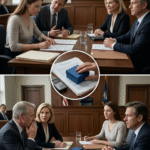
He did it beneath a Baccarat chandelier in a private arbitration room overlooking a rain-soaked Manhattan. Three intellectual-property arbitrators sat behind a black-walnut table. Twelve attorneys lined the walls. Outside the sealed doors, financial reporters waited beside photographers whom Adrian had discreetly invited.
He wanted witnesses.
He wanted an audience for my humiliation.
Most of all, he wanted the world to watch him erase me.
Celeste Hart rose from her chair in a white silk suit, the kind that looked innocent only because it cost more than most people’s rent. Her pale gold hair had been pinned into a flawless knot. Diamonds trembled at her ears whenever she moved.
She placed one manicured hand over her heart.
“Vesper No. 9 was born from a forbidden love,” she told the panel. “A love that could not survive in daylight.”
Across the room, my husband smiled at her.
Not a nervous smile.
Not an apologetic one.
It was the private smile of a man admiring the woman he had already chosen to replace his wife.
Cameras were prohibited inside the hearing, but Adrian had commissioned a court artist. He wanted an image of Celeste standing beneath the silver Vale & Cross crest, luminous and tragic, while I sat in the shadows looking bitter, discarded, and old.
I gave him nothing.
No tears.
No accusation.
No trembling hands.
I sat in a charcoal-gray dress with my wedding ring still on my finger and listened as Celeste described the fragrance I had spent four years creating.
She spoke of bergamot at midnight.
Black iris crushed between the pages of a secret letter.
Smoked vanilla lingering on forbidden skin.
A single drop of amber, warm as the memory of a lover who could never be named.
Every phrase had been stolen from my private laboratory journal.
Every pause had been rehearsed.
Every lie had been polished until it glittered.
Adrian leaned toward his attorney and whispered something that made both men laugh.
That was when Naomi Brooks, my lawyer, rested her hand on the sealed black case beside her chair.
Inside it was the original formula notebook.
Adrian did not know it had survived.
Celeste did not know her testimony had already trapped her.
And neither of them knew that six months earlier, while they were sleeping together in a hotel suite purchased with my company’s money, I had quietly become the largest secured creditor of Adrian’s luxury empire.
May you like
I lowered my eyes to the rain sliding down the glass.
Then I smiled.
They thought the arbitration was where they would take my perfume.
It was actually where I had decided to take everything.
## Chapter 1: The Scent of a Beautiful Lie
There are marriages that break loudly.
Ours broke in perfect silence.
No shattered crystal.
No lipstick on a collar.
No dramatic confession in a crowded restaurant where strangers pretended not to listen.
Just a scent.
It was two in the morning when Adrian came home wearing a perfume I had never released.
I was standing barefoot in the kitchen of our Central Park West penthouse, stirring honey into tea because sleep had become an unreliable guest. Outside, Manhattan glowed in expensive fragments—headlights slipping along rain-dark avenues, windows burning in glass towers, Central Park below us like a black ocean of trees.
Adrian entered without turning on the lights.
He removed his cashmere coat, loosened his tie, and kissed my forehead.
“Board dinner ran late,” he said.
Then the fragrance reached me.
Black iris.
Smoked vanilla.
A metallic trace of violet leaf.
And beneath it all, the unfinished amber accord from Trial 118.
The formula had never left my private laboratory.
I had made only three samples.
One remained in the temperature-controlled vault beneath our Hudson Valley estate. One was locked in the Fifth Avenue flagship archive. The third had disappeared from my worktable eleven days earlier.
Adrian walked past me toward the bedroom.
I did not ask where he had been.
I did not need to.
Perfume is memory before language.
It enters the body faster than truth.
I stood alone in the dark and understood that my husband had given another woman something he had stolen from me.
Not jewelry.
Not money.
Not even his body.
He had given her my unfinished work.
That hurt more than the affair.
I had met Adrian Vale fourteen years earlier at a charity auction in Boston.
I was twenty-six, unknown outside a narrow circle of independent perfumers, and wearing a navy dress I had sewn myself because I could not afford the designers hanging from the shoulders of every other woman in the room.
Adrian was thirty-one and already being described in business magazines as the prince of American luxury.
His grandfather had founded Vale House in 1958 with a barbershop tonic and an instinct for making ordinary men feel expensive. Adrian’s father expanded it into skin care. Adrian inherited the company, acquired hotels, leather ateliers, watchmakers, and vineyards, then transformed the family business into a glittering multinational empire.
He found me near the service corridor, where I had escaped the ballroom to breathe.
“You’re wearing something I don’t recognize,” he said.
“I made it.”
He stepped closer without touching me.
“Cedar,” he guessed. “Pepper. Rain.”
“And burnt sugar.”
“I don’t smell sugar.”
“You will when I leave.”
That made him laugh.
Three months later, he offered to fund my laboratory.
Six months after that, he asked me to marry him.
For years, I believed those things had happened because he loved me.
Much later, I understood that Adrian had always confused love with acquisition.
He did not fall for beautiful things.
He collected them.
At first, being collected by him felt like being chosen by the sun.
He gave me a laboratory in a converted carriage house overlooking the Hudson River. He installed antique French cabinets, Italian marble worktables, copper distillation equipment, and a climate-controlled vault with biometric access.
He learned the vocabulary of my world.
Top notes.
Heart notes.
Fixatives.
Maceration.
Sillage.
He would sit on the floor while I worked, his jacket discarded and his sleeves rolled to his elbows, smelling blotters and telling me what each formula made him remember.
“You create invisible architecture,” he once said.
It was the most beautiful thing anyone had ever told me.
Together, we launched Vale & Cross.
His name opened doors.
Mine filled the rooms behind them.
Our first fragrance sold out in forty-eight hours. Our second won awards in Paris and New York. By our tenth anniversary, Vale & Cross had become the most profitable division of Vale House.
The public called us a power couple.
Adrian handled the empire.
I created its soul.
For a long time, I mistook that arrangement for equality.
The morning after he came home smelling of Trial 118, I arrived at the Fifth Avenue office at seven.
The flagship occupied a limestone building across from Central Park. Customers entered through bronze doors into a cathedral of pale marble, black orchids, and soft amber light. On the fourth floor, behind frosted glass, my creative laboratory remained closed to everyone except me and my senior perfumer, Malcolm Reed.
I took the private elevator upstairs.
Malcolm was already there, weighing jasmine absolute on a brass scale.
He was sixty-eight, silver-haired, sharp-eyed, and incapable of pretending not to know something.
“You look like you buried someone,” he said.
“Not yet.”
His hands stopped moving.
I placed my purse on the worktable and opened the locked drawer where I kept the sample log.
Trial 118 had been removed on October 14 at 6:42 p.m.
The biometric system listed my fingerprint.
I had been in Connecticut that evening, attending the funeral of Naomi Brooks’s mother.
Someone had duplicated my access.
“Who maintains the security system?” I asked.
“Vale Corporate.”
“Who authorized the last software update?”
Malcolm studied my face.
“Adrian’s office.”
I nodded.
“Say nothing.”
“Evelyn.”
“Nothing, Malcolm.”
He set down the glass pipette.
“I warned your husband six months ago that Celeste Hart had no reason to attend formula reviews.”
That was the first time anyone had said her name to me.
Celeste had joined Vale House eighteen months earlier as global director of brand storytelling.
She was thirty-two, camera-ready, and famous enough on social media to make investors believe she understood younger customers. She spoke in seductive fragments about desire, legacy, and disruption. She wore archival couture to strategy meetings and called every ordinary idea “an emotional universe.”
Adrian praised her instincts.
I had thought she was decorative but harmless.
That was my first mistake.
“What exactly did you warn him about?” I asked.
“She photographed your blotter board during the spring review.”
“Did you see her?”
“I saw the reflection of her phone in the cabinet glass.”
“And Adrian?”
“He told me I was being territorial.”
A cold stillness settled inside me.
Not rage.
Rage is hot and careless.
This was different.
This was the moment water becomes ice.
“Do we still have the internal security footage?”
“Vale Corporate deletes it after thirty days.”
“Officially.”
Malcolm’s mouth tightened.
“You taught me never to trust an official copy.”
He walked to an antique apothecary cabinet, removed three bottles of vetiver, and pressed the carved wooden panel behind them.
A narrow compartment opened.
Inside sat a small encrypted drive.
“I began backing up the laboratory cameras after Celeste’s visit,” he said. “I didn’t know what I was looking for. I only knew I disliked the way she watched your hands.”
I stared at the drive.
“How much did you save?”
“Everything.”
I almost cried then.
Not because my husband was cheating.
Because someone had believed my work was worth protecting before I understood it needed protection.
I closed my fingers around the drive.
“Thank you.”
“Don’t thank me yet.”
Malcolm glanced toward the locked formula vault.
“Trial 118 was never ready. The amber collapsed after six hours.”
“I know.”
“Whoever wears it will smell expensive at first and desperate by morning.”
I looked at him.
For the first time since Adrian came home, I laughed.
It was not a pleasant sound.
Three days later, Adrian invited me to dinner at Aurelia, the private dining room inside the Vale Crown Hotel.
He chose the corner table where he had proposed to me.
That should have warned him.
Men like Adrian believed locations belonged to the memory in which they had looked most powerful. He could return to the site of an old tenderness and feel no ghost of the person he had been.
He ordered Château Margaux without asking me.
“We need to discuss Vesper,” he said.
That was the first time he used the name.
I had written it on a single page in my private notebook.
Vesper No. 9.
A fragrance about the hour between light and darkness.
A fragrance about what remains when beauty can no longer hide from night.
“What about it?” I asked.
“Celeste believes the launch needs a more personal narrative.”
“Celeste is not part of product development.”
“She’s part of global strategy.”
“She writes captions, Adrian.”
His eyes cooled.
“She understands the modern customer.”
“I understand the formula.”
“This is exactly the problem.”
He leaned back while a server placed truffle risotto between us.
“What problem?”
“You’ve become possessive.”
“Of my work?”
“Of the brand.”
I let the silence sharpen.
“Vale & Cross has my name on it.”
“And mine.”
“Your name was on hotels and belts before I arrived. Mine is the reason customers spray your empire on their skin.”
His jaw flexed.
I had not spoken to him like that in years.
Marriage teaches women to soften truths until men can swallow them. I had done it so often that Adrian mistook my restraint for weakness.
He sipped his wine.
“We’re considering positioning Celeste as the creative voice behind Vesper.”
There it was.
Not the affair.
The theft.
The thing he had brought me to our old table to announce as though it were a reasonable adjustment to a marketing plan.
“Creative voice,” I repeated.
“She has a compelling story.”
“Does she?”
“She understands forbidden desire.”
“I’m sure she does.”
A flicker passed across his face.
He knew I knew.
For one second, I saw fear.
Then arrogance covered it.
“Evelyn, don’t make this vulgar.”
I smiled.
“You slept with an employee and stole a perfume from your wife’s laboratory, but you’re worried I’ll make it vulgar?”
His hand tightened around the wineglass.
No one around us looked over. The room was too wealthy for visible curiosity.
“You have no proof.”
It was an extraordinary sentence.
Not a denial.
A legal assessment.
That was the moment my marriage ended.
Not when I smelled another woman on his skin.
Not when he gave her my formula.
When he looked into my eyes and calculated whether I could prove it.
I placed my napkin beside my untouched plate.
“Is that what Celeste tells you?”
“She tells me you’re exhausted. That you’ve lost perspective.”
“How compassionate of her.”
“You haven’t produced a major launch in three years.”
“I spent those years repairing the formulas your acquisition team ruined with cheaper materials.”
“The board doesn’t see it that way.”
“The board sees whatever you put in its reports.”
He exhaled slowly.
“I’m trying to protect your dignity.”
“No. You’re trying to price it.”
“Think carefully before you turn a private marital issue into a public corporate disaster.”
I stood.
“So should you.”
He looked almost amused.
That expression stayed with me.
He believed I would cry in private, negotiate for money, and disappear into one of the beautiful houses he had purchased in both our names but always called his.
He believed I would protect the Vale reputation because I had spent fourteen years building it.
He believed my love for the company would make me obedient to the man who controlled it.
He did not understand that I had never loved the company.
I had loved what I created inside it.
And those were not the same thing.
I left Aurelia and walked six blocks through the cold without calling a driver.
At Fifty-Seventh Street, I entered an old stone building with no sign above the door.
Naomi Brooks was waiting in a seventh-floor conference room.
She had been my closest friend since college and one of the most feared intellectual-property attorneys in New York. Her mother had been buried three weeks earlier. She wore grief like armor—quietly, elegantly, without allowing anyone to mistake it for fragility.
On the table lay three folders.
DIVORCE.
INTELLECTUAL PROPERTY.
CORPORATE CONTROL.
“Which one?” she asked.
“All of them.”
Naomi looked at me for a long moment.
Then she opened the first folder.
“How cruel are you prepared to be?”
I removed my wedding ring and placed it on the table between us.
“As cruel as the truth.”
## Chapter 2: The Wife Who Learned to Own the Knife
Naomi did not begin with comfort.
That was why I trusted her.
Comfort is often the first luxury stolen from women who need to act quickly. It invites confession when strategy requires silence. It makes pain feel productive even when nothing has changed.
Naomi gave me facts.
Our prenuptial agreement protected my premarital creations but classified formulas developed with Vale House resources as corporate assets.
The language had been drafted fourteen years earlier, when I still believed love made precision unnecessary.
“If Vesper was created in the company laboratory, Adrian will argue Vale House owns it,” Naomi said.
“I began the base formula before the marriage.”
“Can you prove that?”
“My original notebooks are in the Hudson vault.”
“Does Adrian have access?”
“Administrative access.”
“Then assume they’re gone.”
I remembered Trial 118 disappearing under a duplicated fingerprint.
“They’re not the only copies.”
Naomi’s eyes lifted.
“My mother taught me to maintain mirror notebooks. One working copy. One sealed copy stored away from the laboratory.”
“Where?”
“I mailed each completed notebook to Malcolm. He signed the envelope, placed it inside a numbered evidence sleeve, and deposited it with his attorney.”
Naomi leaned back.
“You’ve been creating your own chain of custody for fourteen years?”
“My mother lost her first formula to a manufacturer who claimed she had invented it. She never recovered.”
A small smile touched Naomi’s mouth.
“Remind me never to play chess with a perfumer.”
“Chess is loud. Perfume is quieter.”
She opened the corporate-control folder.
The financial picture was worse than I knew.
Vale House looked invincible from the outside. Its hotels hosted senators, movie stars, and foreign royalty. Its flagship stores gleamed in New York, Los Angeles, London, and Tokyo. Its annual gala raised millions for arts education while placing Adrian’s face in every society column.
Underneath the polished surface, the company was bleeding.
Adrian had borrowed heavily to acquire a chain of luxury resorts in the Caribbean. Construction delays, insurance disputes, and declining occupancy had pushed the project toward default. He had pledged shares, trademarks, and several properties as collateral.
The board knew some of it.
They did not know all of it.
“He’s moved money through at least six subsidiaries,” Naomi said. “Some payments went to a consulting firm called Hartwell Narrative.”
“Celeste.”
“Registered through a Delaware agent. Paid eleven million dollars over eighteen months.”
“For what?”
“The invoices say global brand development.”
“She writes captions.”
“Very expensive captions.”
I turned the pages.
Hotel suites.
Private aircraft.
Jewelry purchased through a corporate concierge.
A villa in St. Barts listed as a creative retreat.
They had not only betrayed me.
They had billed me for it.
“Can we prove misuse of funds?” I asked.
“Not yet. These are preliminary records from public filings and documents you legally possess as a director. We need internal ledgers.”
“I’m not a director anymore.”
Naomi went still.
“What?”
“Adrian told me last year that the board structure had been simplified. He said my creative role made formal governance unnecessary.”