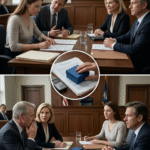
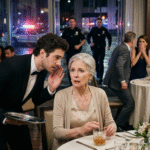
My husband brought his mistress to the co-op hearing in my home and introduced her as the woman who would be replacing me.
Not replacing me in his bed.
That part had happened months ago.
Replacing me as a resident.
The boardroom occupied the library of our Upper East Side penthouse, a room wrapped in midnight-blue silk walls and shelves of first editions my mother had spent thirty years collecting. Beyond the arched windows, Manhattan glittered beneath freezing rain. Inside, beneath a chandelier cut from Venetian glass, Adrian Vale stood with one hand resting possessively at the small of Sloane Mercer’s back.
Sloane wore winter white.
Of course she did.
Her coat was cashmere, her diamond studs were discreet, and her expression had been practiced in expensive mirrors. She looked less like a mistress than a woman arriving early to claim an inheritance.
On the table before her lay architectural drawings for the apartment she apparently believed would soon belong to her.
“Our intention,” she told the board, “is to open the east gallery, remove the old library cabinetry, and convert the smaller bedroom into a private wellness suite.”
The old library cabinetry.
My mother’s shelves.
The smaller bedroom.
The room where I had slept beside her during the final weeks of her life.
Adrian did not look at me when he said, “Evelyn has become increasingly unstable since her mother passed. She hasn’t truly lived as my wife in some time. At this point, she is essentially an unwanted guest.”
There are humiliations so large that the body refuses to react to them.
I did not gasp.
I did not cry.
I did not throw the crystal water glass at his beautiful, faithless face.
I simply folded my hands in my lap and waited.
Around the table, the board members avoided my eyes. Some were embarrassed for me. Others were fascinated. One or two had already been promised something by Adrian. He had always understood the cheapest way to purchase loyalty.
A favor.
An invitation.
A whispered assurance that when he controlled the penthouse, their own renovation applications would move more quickly.
At the far end of the table, the co-op’s attorney, Nathaniel Cross, opened a black leather folder.
He had arrived late, carrying the cold with him.
May you like
Tall, composed, and dressed in a charcoal suit that looked cut from shadow, Nathaniel had the severe elegance of a man who never raised his voice because he had never needed to. Silver touched his temples now. His eyes were the same dark gray I remembered from another life.
Before Adrian.
Before the wedding.
Before my mother taught me that love without legal protection was merely a beautifully decorated risk.
Nathaniel reviewed the first page.
Then the second.
The room fell quiet enough for us to hear the rain against the glass.
Adrian smiled as though the verdict had already been delivered.
Sloane reached for his hand.
Nathaniel looked up.
“Mr. Vale,” he said calmly, “there appears to be a fundamental problem with your petition.”
Adrian’s smile tightened.
“What problem?”
Nathaniel turned the folder so the board president could see the embossed share certificate inside.
“You cannot remove Mrs. Vale from this residence.”
Adrian gave a short laugh.
“I am the primary shareholder.”
“No,” Nathaniel said. “You are not a shareholder at all.”
The silence changed.
It sharpened.
Nathaniel’s gaze moved to me.
“The proprietary lease and all corresponding shares are held by E.A. Holdings.”
Sloane’s manicured fingers slipped from Adrian’s.
The board president frowned.
“And who controls E.A. Holdings?”
I rose slowly from my mother’s chair.
“I do.”
Adrian stared at me.
I let him.
Then Nathaniel turned another page.
“And Mrs. Vale’s company controls eleven additional units in the building through legacy sponsor shares, giving her the voting block required to reject any residency application submitted by Mr. Vale.”
For the first time in twelve years, my husband looked at me as though he had never seen me before.
He had tried to evict his wife.
I was about to remove his name from everything.
## Chapter One: The Woman He Mistook for Decoration
Three months before the hearing, Adrian came home smelling like another woman’s perfume and asked whether I had remembered to approve the florist for our anniversary gala.
The question was so ordinary that it almost impressed me.
He stood in the entrance hall beneath an Agnes Martin painting, removing his leather gloves finger by finger. Snow gleamed on the shoulders of his coat. His expression was composed, charming, faintly impatient.
Anyone watching us would have seen a successful husband returning to a beautiful wife in a sixteen-room penthouse overlooking Central Park.
They would not have noticed the trace of coral lipstick on the inside edge of his scarf.
“I approved the white orchids,” I said.
“Good.”
He kissed the air beside my cheek.
Adrian had not truly kissed me in eight months.
“Dinner?” I asked.
“I ate at the club.”
“With Sloane Mercer?”
His eyes met mine in the mirror.
It was a tiny moment, no longer than a breath, but after twelve years of marriage, I knew every shift in his face. I saw calculation replace surprise. Then calculation softened into concern.
Concern was Adrian’s favorite weapon.
“Evelyn,” he said gently, “you’ve been under enormous stress.”
There it was.
Not denial.
Diagnosis.
“My mother died eleven months ago,” I said. “Not yesterday.”
“Grief doesn’t follow a schedule.”
“Neither does adultery, apparently.”
He exhaled, slow and wounded, as though I had disappointed him.
“Sloane is advising us on the Vale House renovation.”
Vale House was the boutique hotel Adrian had spent four years pretending to build.
The project occupied a limestone mansion on East Sixty-Seventh Street, though occupied was perhaps too generous a word. Adrian’s company had purchased the building using bank loans, private investors, and twelve million dollars from my family trust.
He called the project our legacy.
In reality, Vale House was a marble-lined furnace into which Adrian fed money, reputation, and lies.
“Sloane is an interior designer,” he continued.
“Sloane sells furniture to newly divorced men.”
“That’s cruel.”
“It’s accurate.”
His jaw moved.
Adrian was beautiful when angry. That had once been part of the danger.
He had the kind of face magazines described as patrician: straight nose, dark hair, pale blue eyes, and a mouth capable of suggesting intimacy to an entire ballroom. He was the son of a Connecticut senator and a woman who wore pearls to breakfast. He knew which fork to use, which names to mention, and how long to hold eye contact before a person felt chosen.
When we met, I had mistaken his attention for devotion.
I was twenty-seven and mourning my father. Adrian had arrived at a museum benefit in a tuxedo and asked me why I was hiding behind a Roman statue.
“I’m not hiding,” I told him.
“You’ve been standing beside a headless emperor for twenty minutes.”
“He has better conversation than most of the room.”
Adrian laughed.
Three weeks later, he sent a handwritten note to my office.
Six months later, he proposed in the sculpture garden at the Metropolitan Museum of Art.
My mother, Eleanor Ashcroft, did not approve.
“He is in love with access,” she said.
“You don’t know him.”
“I know men who confuse admiration with appetite.”
At the time, I thought she was being cruel.
Years later, I understood she had been trying to save me in the only language she trusted: precision.
In the entrance hall, Adrian loosened his scarf.
“You should be careful,” he said. “Accusations can become embarrassing.”
“For whom?”
His eyes hardened.
Then he smiled.
“For everyone.”
He walked past me toward his dressing room, leaving the faint scent of coral lipstick in the air.
That was the last night I asked Adrian for the truth.
The following morning, I began collecting proof.
My mother had taught me that panic was expensive.
When markets collapsed, when partnerships failed, when men lied across polished conference tables, Eleanor Ashcroft became quieter.
“Noise is what people make when they have no leverage,” she once told me. “Never announce what you know until you understand what it can buy.”
So I did not confront Adrian again.
I made coffee.
I attended committee luncheons.
I wore camel coats and pearl earrings.
At night, I slept in the east bedroom beneath my mother’s embroidered quilt while Adrian occupied the master suite and texted Sloane behind a locked door.
During the day, I visited the offices of Ashcroft Capital.
The firm occupied four floors of a tower on Madison Avenue. My grandfather had founded it after the Second World War with one borrowed desk and a talent for buying buildings everyone else considered unfashionable. My father expanded it. My mother protected it. By the time it reached me, the family portfolio included hotels, apartment houses, commercial properties, and quiet ownership interests hidden inside companies whose names appeared nowhere in society columns.
For most of my marriage, Adrian referred to my work as managing family things.
He never asked what those things were.
That was his first mistake.
His second was believing my grief had made me weak.
In truth, my mother’s death had made me attentive.
Her final months had stripped life of decorative illusions. After watching the most formidable person I knew disappear one breath at a time, I no longer feared loneliness, gossip, or the social death Adrian had always used to control me.
I feared only wasting what remained of my life.
My office had been preserved exactly as I left it after taking compassionate leave: pale oak desk, cream walls, black-and-white photographs of Manhattan construction sites, and a vase my assistant, June Park, filled every Monday with white ranunculus.
June closed the door behind me.
She was thirty-four, relentlessly competent, and possessed the rare ability to deliver catastrophic news without changing the rhythm of her breathing.
“You were right,” she said.
She placed a tablet on my desk.
On the screen were photographs taken outside a townhouse on Bank Street.
Adrian entered at 9:14 p.m.
Sloane arrived eleven minutes later.
At 1:36 a.m., they left together.
The next photograph showed them kissing beside a black SUV.
Adrian’s hand was inside her coat.
I studied the image without touching the screen.
“How long?” I asked.
“We can confirm seven months. Possibly ten.”
My mother had been alive ten months ago.
The thought entered my chest like cold water.
I looked at the next photograph.
Sloane wore a bracelet I recognized.
A narrow band of diamonds surrounding an emerald.
It had belonged to my grandmother.
I had last seen it in the safe behind the dressing room panel.
“Did he give her that?” June asked.
“He must have.”
“Do you want security to inventory the apartment?”
“Not yet.”
June watched me carefully.
Most people expected betrayal to look dramatic. Broken glass. Screaming. A woman collapsing into someone’s arms.
But heartbreak was rarely one clean wound.
It was administrative.
It required passwords, bank statements, insurance records, phone logs, and the humiliating reconsideration of every memory you once believed was sacred.
“Pull every transfer connected to Adrian, Vale Development, Vale House, and Mercer Studio,” I said. “Go back five years.”
June made a note.
“And contact Mara Levin.”
Mara was a forensic accountant whose smile could make a guilty executive confess to expenses she had not yet discovered.
June looked up.
“Quietly?”
“Completely.”
“What about Nathaniel Cross?”
The name caught against something old inside me.
Nathaniel had been my mother’s attorney for nearly a decade. Before that, he had been a young associate at a firm representing Ashcroft Capital.
Before that, he had been the man I almost loved.
I had not spoken to him privately since my wedding.
“Not yet,” I said.
June hesitated.
“There’s something else.”
She opened a second file.
A scanned invoice appeared on the screen. Mercer Studio had billed Vale House $480,000 for imported stone. The receiving address belonged to a warehouse in New Jersey.
“There was no stone,” June said. “The vendor was incorporated six months ago. Its registered agent is a lawyer in Delaware.”
“Who owns it?”
“We’re tracing that.”
A pulse began behind my eyes.
“How much has Vale House paid Mercer Studio?”
“Directly? Just over two million.”
“And indirectly?”
“We don’t know yet.”
I looked toward the window.
Thirty floors below, yellow cabs moved through the city like bright blood cells.
Adrian had not merely betrayed me.
He had taken money from a company funded by my family trust and paid it to his mistress through fabricated contracts.
It was vulgar.
Almost disappointing.
I had once believed his cruelty would at least be sophisticated.
“Find everything,” I said.
June nodded.
As she reached the door, I spoke again.
“June.”
She turned.
“Do not protect me from the details.”
Her expression softened.
“I never would.”
That afternoon, I returned to the penthouse and found Sloane in my library.
She stood before my mother’s shelves, photographing the room on her phone.
For one absurd second, I wondered whether Adrian had finally abandoned caution. Then I saw the leather portfolio in her hand and the measuring tape stretched across the carpet.
She turned with a smile.
“Evelyn. I hope you don’t mind.”
“I usually reserve that judgment until I know what someone is doing in my home.”
She tilted her head.
“Adrian asked me to look at the space.”
“Why?”
“He thinks it needs air.”
“The windows open.”
Her smile thinned.
Up close, Sloane was striking rather than beautiful. Her face was angular, her hair a polished dark blond, and her eyes an unusual shade of green that made people mistake alertness for warmth.
She wore my grandmother’s bracelet.
The emerald flashed at her wrist.
I looked at it long enough for her to notice.
Her fingers moved over the stones.
“Beautiful, isn’t it?” she said. “Adrian gave it to me as a thank-you.”
“For what?”
“Transforming Vale House.”
“Nothing has been transformed. It is still a construction site.”
“Great work takes time.”
“So does theft.”
The word remained between us.
Sloane’s expression did not change, but her pupils narrowed.
Then she laughed softly.
“I understand why Adrian worries about you.”
I closed the library door.
“Does he?”
“He says you’ve become isolated.”
“Adrian says whatever serves the room he is standing in.”
“He cares about you.”
“No, Sloane. He cares about appearing kind while he is being cruel. There is a difference.”
For the first time, irritation broke through her composure.
She placed the portfolio on the desk and opened it.
Inside were floor plans for the penthouse.
Walls had been removed.
Bedrooms had been reassigned.
The library was labeled ENTERTAINMENT LOUNGE.
My mother’s room was labeled INFRARED SPA.
The master bedroom bore a handwritten note in Sloane’s clean architectural script:
EXPANDED WARDROBE FOR S.M.
She wanted me to see it.
That was the point.
Mistresses did not enter wives’ homes with renovation plans unless the humiliation itself had become part of the pleasure.
“You’ve been busy,” I said.
Sloane folded her arms.
“Adrian believes the apartment should reflect the next chapter of his life.”
“Does he also believe the shares belong to him?”
She blinked.
Only once.
It was enough.
“He said the penthouse was acquired during your marriage.”
“It was.”
“Then I assume it is marital property.”
“Assumptions are charming until attorneys become involved.”
Her confidence faltered at the edges.
I walked toward her.
The rain had begun outside, turning the windows silver.
“Take off the bracelet.”
Sloane looked down at her wrist.
“Adrian gave it to me.”
“It was not his to give.”
“Then discuss it with your husband.”
“I am discussing it with the person wearing stolen property.”
Her face flushed.
For a moment, I thought she might refuse.
Then she unclasped the bracelet and placed it on the desk.
The emerald touched the wood with a small, precise sound.
I picked it up.
My grandmother had worn it in Paris after the war. My mother had worn it to my college graduation. I had worn it once, on my wedding day, as something borrowed.
Sloane gathered her plans.
At the door, she paused.
“You may own the jewelry, Evelyn. But you can’t make a man love you.”
I fastened the bracelet around my wrist.
“No,” I said. “But I can make him account for what he steals.”
After she left, I stood alone in the library.
My hands were steady.
My heart was not.
There had been a time when I would have begged Adrian to choose me.
I would have changed my hair, my body, my schedule, my silence. I would have analyzed every dinner, every argument, every night I worked too late, looking for the moment I had failed to remain lovable.
That was the private violence of betrayal.
It convinced the wounded person to interrogate herself.
But Sloane had made a mistake by wearing the bracelet.
She had turned pain into evidence.
And evidence, unlike love, could be organized.
That evening, I opened the hidden panel behind my mother’s old desk.
Inside was a safe Adrian did not know existed.
The shelves concealed more than first editions. Behind the velvet backing lay original co-op documents, trust agreements, corporate records, and letters my mother had instructed me not to destroy.
At the top rested an envelope in her handwriting.
FOR EVELYN, WHEN ADRIAN FINALLY SHOWS YOU WHO HE IS.
I stared at the words until the room blurred.
My mother had known.
Or feared.
Perhaps, in the end, there was little difference.
I opened the envelope.
Inside was a single page.
My darling girl,
You have spent too much of your life believing that endurance is the highest form of love. It is not. Sometimes endurance is only fear wearing a noble dress.
The apartment is yours through E.A. Holdings. Adrian’s name appears on household records for convenience, but he has no ownership interest and no proprietary rights beyond those granted by your consent.
The additional sponsor shares remain protected through the Eleanor Ashcroft Residential Trust. They carry voting power. Use it only if necessary.
I hope it is never necessary.
But hope is not a plan.
Remember who you were before anyone taught you to become smaller.