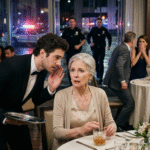
My brother told a room full of lawyers, bankers, cousins, and champagne-holding strangers that I “never cared about the cabin until money was involved.”
My mother lowered her eyes like she agreed.
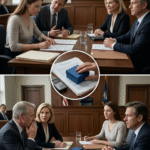
My father slid the sale contract toward me and said, quietly enough to sound civilized, “Don’t embarrass this family again, Emma.”
Then the surveyor walked in pale-faced, holding a sealed metal urn box pulled from beneath the firepit I had built with Grandpa the summer before he died.
And for the first time in my life, my brother Grant Whitaker stopped smiling.
Chapter 1: The Daughter Who Was Asked to Sign Away a Memory
The dinner was held at the Willowmere Club, one of those old private places outside Seattle where the carpets were thicker than most people’s mattresses and every chandelier looked like it had inherited money.
My mother had chosen the Cascade Room because it overlooked Lake Washington. She said the view made hard conversations feel “less unpleasant.” That was how Patricia Whitaker spoke about breaking hearts. She made pain sound like a scheduling issue.
There were thirty-two people in the room.
Family friends. Attorneys. A title company officer. Two representatives from Tahoma Ridge Resorts. My father’s golf partners. Three cousins who had not stepped foot inside Grandpa’s cabin in fifteen years but had opinions about “maximizing family assets.”
And, of course, my brother Grant.
Grant stood at the head of the long walnut table in a navy suit that fit like a threat. He had always known how to look expensive, even when he was spending someone else’s money. His blond hair was brushed back, his cuff links flashed when he lifted his glass, and his smile was the same one our parents had rewarded since childhood.
The golden boy.
The heir.
The son who “understood business.”
The son who had wrecked two company trucks before twenty-five, lost a scholarship he claimed he had “outgrown,” and somehow still became the pride of the Whitaker family.
I sat halfway down the table, between my Aunt Marjorie and an empty chair nobody bothered to explain. The empty chair felt more honest than most of the people in the room.
In front of me sat a leather folder embossed with Whitaker Development Group’s silver logo. Inside was the sale agreement for Grandpa Henry’s cabin and the fourteen acres around it near Lake Chelan.
The cabin was not impressive to people like the ones at that table. It had cedar siding gone silver with age, a sagging porch, a hand pump near the woodpile, a kitchen with yellowed curtains, and a stone firepit behind the back slope where the pine trees opened toward the water.
May you like
But to me, it was the only place in my family where love had ever felt simple.
Grandpa Henry taught me how to split kindling there.
He let me drink coffee too young there.
He told me that silence was not the same as weakness there.
And during the last summer before his heart failed, when his hands shook too much to lift stone, I knelt beside him in the dirt and built that firepit from river rock while he sat in a folding chair and told me which pieces belonged where.
“Not that one,” he had said, squinting like we were constructing a cathedral. “Too smooth. Smooth stones roll when heat gets under them.”
I laughed. “Grandpa, it’s a firepit.”
He looked at me, eyes pale blue and completely serious. “Everything is something bigger if you love it right.”
That was Henry Hale. My mother’s father. The only person in our family who could make an ordinary sentence feel like inheritance.
Now Grant wanted to sell that place to a resort company that planned to flatten the cabin and build six luxury lake villas called The Henry Collection, which was a final insult so polished it almost looked like respect.
Grant tapped his glass with a butter knife.
Everyone quieted.
“Thank you all for being here,” he said. “Tonight is about moving forward. It’s about honoring legacy in a practical way.”
My stomach turned at the word honoring.
Grant continued, warm and confident. “Grandpa Henry loved that cabin. We all know that. But love doesn’t pay taxes, insurance, or maintenance. The place is falling apart. The land has become valuable, and frankly, holding onto it because of sentiment is irresponsible.”
He glanced at me.
The glance was quick. Surgical.
“Most of us understand that.”
A few people chuckled softly. Not because it was funny, but because wealthy families often laugh when cruelty wears a blazer.
My mother reached for her wine. Her diamond bracelet clicked against the glass. She did not look at me.
My father sat beside Grant with the stiff approval he reserved for boardrooms and Sunday church. Robert Whitaker had a face built for judgment: square jaw, silver hair, eyes that could make a child apologize for breathing too loudly.
Grant lifted the folder.
“The offer is four point eight million dollars. After fees, taxes, and distributions, everyone benefits. Mom gets security. Dad can clear old company obligations. The grandchildren’s education funds can be restored. We all win.”
We all win.
That was how Grant said I lose.
The cabin had never been in Whitaker Development’s portfolio. It had belonged to Grandpa Henry, then to my grandmother’s estate, then sat in a tangled family trust nobody wanted to untangle until the dirt under it became expensive.
For years, when property tax bills came due, everyone had “forgotten.” When the roof leaked, nobody answered. When Grandpa needed a wheelchair ramp during his last summer there, Grant was “buried in meetings,” my parents were “between accountants,” and my mother cried that seeing her father weak was too painful.
So I built the ramp.
I paid the taxes.
I patched the roof.
I drove Grandpa to cardiology appointments in Wenatchee and slept on a vinyl hospital chair when his blood pressure crashed.
But at the Willowmere Club, none of that mattered.
Because Grant had found a buyer.
And buyers make selfishness look respectable.
My father cleared his throat. “Emma, the title company needs all family signatures acknowledging no objections. We expected this done last month.”
“I had questions,” I said.
My voice was calm. It had taken me thirty-four years to learn how to keep my tone from shaking in front of my family. People mistake calm for absence of pain. It is not. Sometimes calm is pain wearing armor.
Grant laughed once. “You always have questions when you’re not in charge.”
I looked at him. “I asked for the trust documents.”
“You were sent the summary.”
“I asked for the full documents.”
My mother sighed, disappointed before I had even finished speaking. “Emma, please. Not tonight.”
Aunt Marjorie leaned close and whispered, “Your mother has had a hard year. Don’t make this about yourself.”
There it was.
The family prayer.
Don’t make this about yourself.
That meant: swallow what hurts you so nobody else has to feel uncomfortable.
Grant placed both hands on the table. “Let’s just say the quiet part out loud. Emma hasn’t cared about that cabin in years. She lives in Portland. She left the family company. She visits when she wants to feel morally superior, then disappears when real responsibilities come up.”
A heat moved through my chest, but my hands stayed folded in my lap.
Grant’s smile sharpened.
“And now that there’s a sale? Suddenly she’s Grandpa’s little guardian angel. Suddenly she needs documents. Suddenly she has feelings about acreage.”
The room shifted into the terrible stillness of people choosing entertainment over decency.
My father said, “Grant.”
But not as a warning.
As a performance.
Grant raised both hands. “No, Dad. I’m sorry, but we have all tiptoed around Emma’s drama for too long.”
I watched my mother’s face. She looked embarrassed, but not for me. For herself. For having a daughter who might make a scene.
So I didn’t.
I opened the folder, took out the pen, and held it above the signature line.
Grant’s shoulders relaxed. He thought he had won.
That was when the double doors opened.
A man in a brown work jacket stood there, rain on his shoulders, his face drained of color. Behind him was Meredith Sloane, Grandpa’s old estate attorney. She was seventy, elegant, and impossible to intimidate. I recognized her immediately, though I had not seen her since Grandpa’s funeral.
The man in the jacket was Ray Ellis, the surveyor Tahoma Ridge had hired.
He held a mud-streaked metal box with both hands.
“Mr. Whitaker,” Ray said, looking at my father first, then at Grant. “I’m sorry to interrupt, but we found something during the boundary inspection this afternoon.”
Grant frowned. “This can wait.”
“No,” Meredith said.
One word. Cold as cut glass.
The room went silent.
Ray swallowed. “It was under the firepit. The stone one behind the cabin.”
My fingers tightened around the pen.
Grant looked at me. “What firepit?”
My mother finally looked up.
I heard my own heartbeat.
Ray stepped farther into the room and placed the box on the table. Mud flaked onto the white linen.
“It was sealed,” he said. “There’s an urn inside.”
No one moved.
Meredith Sloane removed a folded envelope from her coat pocket. Her eyes landed on me, not with surprise, but with sorrow.
“There was also a note,” she said. “Written in Henry Hale’s hand.”
Grant’s face changed so quickly that it felt like watching a mask crack.
My father stood. “What the hell is this?”
Meredith’s gaze did not leave mine.
“It appears,” she said, “that Henry left final instructions in the one place he trusted only one person in this family to understand.”
And then, in front of everyone, she unfolded Grandpa’s note.
Chapter 2: The Firepit We Built Like a Secret
I was twelve the first time I understood that my brother could break something and I would be blamed for bleeding on it.
It happened in the south hallway of our house on Queen Anne Hill, a house my father called “the Whitaker residence” because even our home had to sound like a company asset. Grant had been racing a lacrosse ball against the wall while I sat on the floor labeling a science project. My mother had told him twice to stop.
He winked at me and threw harder.
The ball smashed a framed photograph of my parents at a charity gala. Glass fell everywhere. A shard cut my calf.
Grant stared at the frame, then at me, and before I could speak, he shouted, “Emma knocked it over!”
My mother ran in.
She saw the blood first.
Then the broken glass.
Then Grant’s wide innocent eyes.
And somehow, by the end of the conversation, I was apologizing.
Not because anyone believed Grant was perfect. That was the trick. They knew he lied. They knew he pushed. They knew he took. But he lied with charm, pushed with confidence, and took with the relaxed entitlement of someone who had never been asked to return anything.
My parents called it leadership.
When I questioned him, they called it jealousy.
When I withdrew, they called it coldness.
When I achieved something, they called it competition.
By the time I was sixteen, I had stopped bringing home good news unless Grandpa Henry was in the kitchen.
Grandpa lived in a small craftsman house in Ballard after Grandma died. He still drove a red Ford truck with manual windows and kept butterscotch candies in the glove compartment. He was not soft in the way people expect grandfathers to be. He could be gruff. Impatient. Practical. But he noticed things.