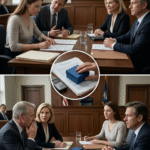
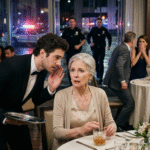
At my private bank’s client dinner, another woman sat with my husband as if she belonged to the account.
She had my chair, my place card, and one perfectly manicured hand resting on his sleeve.
The room was full of people who knew exactly who I was, and still, nobody breathed my name.
My husband saw me in the doorway and went pale.
The banker greeted me quietly near the entrance because Grant had told them I would not attend.
Chapter 1: The Chair That Was Mine
The dinner was being held in the private glass room of The Langham’s rooftop restaurant in Chicago, thirty-two floors above the cold shine of the river. Snow pressed softly against the windows, turning the city below into a blurred silver painting. Inside, everything glittered—crystal stemware, white orchids, candlelight on polished silver, diamond bracelets moving like small moons on elegant wrists.
It was the kind of room where people did not raise their voices.
They destroyed you politely.
Aster & Vale Private Bank hosted that client dinner every December for families with more money than they could spend and more secrets than they could afford. My husband, Grant Whitaker, loved those rooms. He loved handshakes with men twice his age, loved women saying his name with admiration, loved the little pause that came after someone found out he was the CEO of Whitaker Properties.
He loved being seen as powerful.
What he had forgotten was that power and ownership were not the same thing.
“Mrs. Whitaker,” Mariel DeVane said softly near the entrance.
She was our senior private banker, a woman in her early fifties with silver-blond hair, immaculate posture, and the kind of voice that could make a multimillion-dollar transfer sound like a tea order.
Her eyes flickered—not with surprise exactly, but with confirmation.
“You came,” she said.
“I was invited,” I replied.
Her lips tightened for half a second. “Of course.”
That half second told me everything.
Grant had told them I would not attend.
I looked past her.
At table six, beside the window, my husband sat beneath a chandelier with Vanessa Cole.
Vanessa wore ivory silk, the color brides wore when they wanted to look innocent and rich at the same time. Her dark hair was swept into a low twist. A thin diamond chain rested against her collarbone. She looked beautiful, expensive, and completely sure of herself.
In her hand was the menu.
My menu.
In front of her was the place card with my name: Evelyn Whitaker.
She had not moved it.
She had simply placed her clutch on top of it as if covering a grave.
May you like
Grant’s head turned slowly. The moment he saw me, the color drained from his face.
Vanessa followed his gaze. Her smile did not falter at first. Then her eyes swept over my black velvet dress, my wedding ring, the pearl pins in my hair, and the calmness on my face.
She leaned closer to Grant and whispered something.
He did not answer.
Around the table sat people who had known me for years. Richard Bell, Grant’s golf friend and a board member. Claudia Hawthorne, whose husband owned half the lakefront properties on the North Shore. Two partners from Whitaker Properties’ legal counsel. A retired judge. A hedge fund couple. And Grant’s mother, Patricia Whitaker, wearing emeralds and a smile sharp enough to cut glass.
Patricia saw me and lifted one eyebrow.
Not embarrassed.
Annoyed.
As if I had come to the wrong party and ruined the seating arrangement.
I walked toward the table.
The room was warm, but the silence that followed me felt cold.
Vanessa stood just enough to prove she had manners, not enough to show respect.
“Evelyn,” she said, my name sweetened like poison. “We didn’t expect you.”
“No,” I said. “I can see that.”
Grant rose abruptly, his chair scraping the floor. The sound cracked through the room. He hated making noise. He hated looking uncontrolled.
“Evelyn,” he said, forcing a smile. “I thought you were staying home with Lily.”
Our daughter’s name in his mouth made something inside me tighten, but my face did not change.
“Lily is with Mrs. Alvarez,” I said. “Her fever broke this afternoon.”
Vanessa tilted her head. “Poor thing. Grant was so worried.”
I looked at her hand on his sleeve.
“I’m sure he was.”
Mariel stepped beside me, holding a leather folder embossed with the bank’s crest.
“Mr. Whitaker,” she said carefully, “before the second course begins, we do need to confirm authorization for the revised liquidity agreement.”
Grant swallowed.
Vanessa smiled wider. “Oh, that.” She tapped her manicured nails on the menu. “Grant explained it to me. It’s just paperwork.”
Mariel’s eyes moved to Vanessa with professional stillness.
“It requires account authorization.”
Vanessa laughed lightly, the way women laugh when they want a room to know they are comfortable. “Of course. Grant can handle that.”
“No,” Mariel said.
The room went completely still.
Grant’s jaw tightened.
Mariel continued, “The Whitaker Family Reserve account requires primary authorization.”
Vanessa looked at Grant.
Grant looked at me.
I said nothing.
Patricia set down her wineglass. “This is hardly the time.”
Mariel did not blink. “The document cannot proceed without the authorized party’s consent.”
Vanessa’s smile thinned. “Then Evelyn can sign it, can’t she? Since she decided to join us.”
There it was.
Not fear.
Not shame.
A challenge.
She thought I was an inconvenience. A legal leftover. A wife in name, a woman whose seat could be taken if another woman arrived looking younger, softer, easier to impress.
I looked at my covered place card.
Then I looked at Grant.
“Is she sitting in my chair because you thought I wouldn’t come,” I asked, “or because you thought it no longer mattered?”
A few people lowered their eyes.
Grant’s mouth opened, then closed.
Vanessa answered for him.
“Evelyn, don’t make this awkward,” she said. “Grant is trying to move forward. Maybe it’s time everyone did.”
Move forward.
Such a delicate phrase for betrayal.
Grant did not correct her.
That was the first public truth of the night.
Not the affair. I had known about Vanessa for seven months.
Not the lies. I had lived inside them for longer.
The truth was this: my husband was willing to let another woman insult me in front of bankers, board members, lawyers, and his mother, as long as he did not have to feel uncomfortable.
So I smiled.
Not warmly.
Not cruelly.
Just enough for everyone to understand I had not come to cry.
“Mariel,” I said, “please bring another chair.”
Vanessa’s eyes flashed.
“For her?” Patricia asked.
“No,” I said. “For me.”
Then I turned to the waiter.
“I’ll take sparkling water with lemon. And please uncover my place card.”
The waiter froze.
Vanessa’s clutch still sat on my name.
Slowly, while every candle on the table trembled in the silence, she removed it.
My name appeared beneath her hand.
Evelyn Whitaker.
Not Mrs. Grant Whitaker.
Not guest.
Not dependent spouse.
My name.
I sat down beside Vanessa because the new chair had been placed between her and Grant.
It was petty only if you did not understand strategy.
Grant knew.
His knee bounced once under the table. I saw it because I had once loved him enough to know every movement he tried to hide.
Vanessa lifted her chin. “This is unnecessary.”
“No,” I said, unfolding my napkin. “Unnecessary was wearing ivory to another woman’s financial dinner.”
Someone choked softly into their water.
Vanessa went red, then smiled harder.
Grant leaned toward me. “Evelyn, please.”
I turned my head slightly. “Please what?”
His eyes pleaded with me, but not for forgiveness.
For silence.
That was the second public truth of the night.
He did not regret hurting me.
He regretted witnesses.
Chapter 2: The Woman Who Stayed Quiet
There had been a time when Grant’s silence felt like strength.
When I met him, I was twenty-six and working in acquisitions for Whitaker Properties. He was thirty-one, tall, polished, already carrying the heavy charm of a man raised to believe rooms should rearrange themselves around him.
I had not been born into rooms like that.
My mother was a nurse in Milwaukee. My father drove a delivery truck until his back gave out. I paid for Northwestern with scholarships, weekend shifts, and a stubbornness people mistook for calm. By the time I walked into Whitaker Properties, I owned two suits, one pair of decent heels, and no patience for men who confused inheritance with intelligence.
Grant was different then.
Or perhaps he was simply careful.
He asked for my opinion in meetings. He remembered my mother’s surgery. He sent soup to my apartment when I worked through the flu on the South Loop redevelopment proposal. When I found an error in a land valuation that saved his company eleven million dollars, he brought me coffee at midnight and said, “You see what everyone else misses.”
I believed him.
That was the danger of being seen by the right man at the wrong time.
We married two years later in a winter ceremony at the Drake Hotel. Patricia wore champagne and cried only when the photographer turned his lens toward her. Grant’s father, Howard, toasted me with surprising warmth. He said, “Evelyn didn’t marry into this family. She stabilized it.”
Everyone laughed.
Howard did not.
Six months after the wedding, he asked me to lunch at the Union League Club. He was already sick by then, though no one said the word cancer aloud. He looked thinner, but his eyes were bright.
“Grant is charming,” he told me over untouched salmon. “But charm is a door. It is not a foundation.”
I remember staring at him.
He slid a folder across the table.
Inside were preliminary documents for a restructuring of the Whitaker Family Reserve, the holding account tied to several properties, trust assets, and emergency liquidity for the company.
“I want you added as primary authorized controller,” Howard said.
I shook my head. “Grant should be.”
“Grant is already the heir,” he said. “That is enough damage for one young man’s ego.”
I almost laughed.
Howard didn’t.
“Evelyn,” he said, “I built this company from four apartment buildings and a loan my wife’s father never let me forget. Grant understands presentation. You understand consequence.”
I did not sign that day.
I told him I needed to speak to my husband.
Howard leaned back, tired and disappointed.
“Do you ask Grant before you breathe?” he asked.
I went home angry. I told Grant everything, expecting him to be offended. He was quiet for a long time. Then he kissed my forehead and said, “Dad trusts you. I trust you too.”
Maybe he meant it then.
Maybe love had made him generous.
The restructuring went through. After Howard died, I controlled the reserve account, not as owner of everything, but as the required authorization for major withdrawals, emergency liquidity, and trust-linked transfers above a certain threshold. I also inherited, through Howard’s final amendment, thirty-two percent of voting shares in Whitaker Properties, placed in my name alone.
Patricia never forgave him.
Grant pretended he had.
For years, we functioned like a balanced equation. He handled public leadership. I handled risk, financing, restructuring, quiet negotiations with banks, insurance carriers, pension trustees, and city officials who preferred competence over charm.
Then Lily was born.
Our daughter arrived three weeks early during a thunderstorm, furious at the world and beautiful enough to make Grant cry. He held her with both hands and whispered, “My girls.”
For a while, I believed our family was real enough to survive wealth.
That was another mistake.
Wealth does not create betrayal.
It only gives betrayal better lighting.