My husband ordered another garage door opener and labeled it with another woman’s name.
The shipping email came while I was parked outside my son’s private school, waiting behind a row of black Escalades and pearl-white Range Rovers, holding a half-finished juice box and wondering why my chest had suddenly gone cold.
By seven that evening, he told me, in front of our dinner guests, that it was “safer” if she had access to our house during emergencies.
And by midnight, the garage camera showed her leaving through my side door with two of my winter coats folded over her arm like they had always belonged to her.
Chapter 1: The Remote With Her Name On It
The email was ordinary at first.
A bright little notification from NorthLine Security Supply, cheerful and stupid in the way automated emails always were.
Your additional garage door opener has shipped.
I almost ignored it. Preston ordered things constantly. Smart locks. Car chargers. Wine refrigerators. Security panels. Things that made our Lake Forest house feel less like a home and more like a museum rich people could survive inside.
Then I saw the shipping label.
ATTN: SLOANE MERRITT
I sat in the driver’s seat of my Mercedes with my fingers wrapped around the steering wheel, staring at those two words until the honk behind me made me flinch.
Sloane Merritt.
Her name looked elegant even in an email. Sharp. Expensive. Like a signature written in black ink on cream stationery.
I knew her, of course. Everyone in Preston Caldwell’s world knew Sloane Merritt. She was thirty-two, polished, blonde in a way that seemed curated rather than genetic, and always dressed in shades of ivory, champagne, and cruelty. She worked for Caldwell Development as Preston’s “strategic brand consultant,” which was a ridiculous title for a woman who spent more time in private dining rooms than conference rooms.
I had seen her hand touch his sleeve at charity auctions.
I had seen her laugh before he finished a sentence.
I had seen her look at me with that soft, pitying smile women reserve for other women they believe have already lost.
But a garage door opener was different.
A woman could flirt in public and still be denied.
A woman could text late at night and still be explained away.
A woman could sit too close at a company dinner and still be called insecure if you noticed.
May you like
But a garage door opener had no flirtation in it.
It was access.
It was permission.
It was a key.
“Mom?”
My eight-year-old son, Noah, opened the back door with his backpack dragging behind him. His tie was crooked. One cheek was pink from the cold. He tossed his spelling folder onto the seat and climbed in, all knees and elbows and innocence.
“Hey, sweetheart.” My voice sounded normal. That was the first thing I noticed. My face could freeze while my voice stayed warm. “How was school?”
“Ethan said his dad is buying a helicopter.”
“Is Ethan’s dad also buying Ethan a math tutor?”
Noah laughed, and the sound saved me from doing something undignified, like crying in the school pickup line beneath the stone arch of Whitmore Academy, surrounded by women who knew each other’s handbag collections better than their own marriages.
I drove home slowly.
The Caldwell house sat at the end of a private road lined with bare oak trees and discreet security lights. It had gray stone walls, a heated driveway, and floor-to-ceiling windows that glowed gold at night like a promise. Preston loved to call it “the estate,” though my late grandmother had bought the land in 1987, before Preston had even learned how to order a steak without sounding impressed by himself.
He had moved into my world and spent twelve years teaching everyone to believe he built it.
At home, the new opener had not arrived yet, but the damage had.
Preston came in at six-thirty wearing a navy Tom Ford suit and the clean, controlled expression of a man who practiced looking innocent in elevator mirrors. He kissed Noah on the head. He kissed me beside the mouth.
Not on the mouth anymore.
Beside it.
A small geographical downgrade no one else would notice.
“We’re having dinner in the east room,” he said, removing his cuff links. “The Winthrops are coming. And Miles. Maybe Sloane, if she can get away.”
I folded the napkins more carefully than necessary.
“Sloane needs a garage opener now?”
His fingers paused at his wrist.
Only for half a second.
But in a marriage, half a second can be a confession.
He looked up. “You saw the email.”
“It was sent to me.”
“Well, it’s tied to the household account.”
“The household account,” I repeated. “For our house.”
He smiled lightly, as though I had misunderstood a weather report. “Evie, don’t make it strange.”
My full name was Evelyn Hart Caldwell, but he called me Evie when he wanted me small.
“Why does your consultant need access to our garage?”
Preston placed one cuff link into the marble tray. “Because she’s helping coordinate the foundation weekend. There are vendors. Deliveries. Floral setups. Auction items. You know how these things go.”
“I do. They generally don’t require your consultant to have a remote to my house.”
His expression cooled by one polite degree.
“Our house.”
I looked at him then.
He did not look away.
That was when I understood the next stage of betrayal. Not the cheating itself, but the revision of ownership. The slow erasing. The way a man could stand beneath a roof paid for by your family, in a house you made warm, beside a child you carried, and say
our
only when he meant
mine
.
“Fine,” I said.
That was all.
Fine.
Not because it was fine. Because anger is expensive, and I had learned not to spend it before I knew the full price of the war.
At dinner, he humiliated me with linen napkins and candlelight.
The Winthrops arrived first. Caroline Winthrop smelled like Chanel and social judgment. Her husband, Graham, was a banker whose smile never reached his eyes. Miles Caldwell, Preston’s younger brother, came late, already checking his phone. Sloane arrived last.
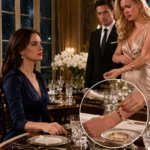
She wore white.
Of course she did.
Winter white wool coat. Cream silk blouse. Diamond studs. Nude heels despite the snow. Her hair fell in loose waves over one shoulder, and when Preston opened the door for her, she stepped inside like a woman entering a house she had already measured for new curtains.
“Evelyn,” she said warmly.
“Sloane.”
Her eyes traveled over me. Not obviously. Never obviously. She was too good for that. They touched my black cashmere sweater, my wedding ring, the pearl clips holding back my hair, and settled for one cruel second on the faint tiredness beneath my eyes.
“Your home is always so beautiful,” she said.
“Thank you.”
Preston took her coat.
He did not take mine anymore when we came home from parties.
During dinner, Sloane sat across from me and beside my husband. That seating arrangement had not been accidental. Preston poured her wine before Caroline’s. Sloane laughed at his story about Zurich as if she had been there, which perhaps she had. Noah was upstairs with Mrs. Alvarez, our housekeeper, doing homework, safe from the theater below.
Then Caroline mentioned the upcoming Caldwell Foundation gala.
“I hear Sloane has practically taken over,” she said. “Preston, you must be relieved.”
Preston smiled. “She’s extraordinary.”
Sloane lowered her lashes. “Hardly.”
“No,” he said, looking directly at her. “You are.”
The table shifted.
Not physically, but socially. A quiet rearrangement. Everyone noticed. Everyone pretended not to.
I lifted my water glass.
Then Graham said, “Big weekend. You’ll have people in and out of the house, I assume.”
Preston answered before I could.
“That’s actually why I ordered Sloane a garage opener. Emergency access. Deliveries, event materials, that kind of thing.”
There it was.
Publicly.
Casually.
Like I was the unreasonable one if I objected.
Caroline’s eyes flicked to me. Miles stopped scrolling. Sloane smiled into her wine.
“Emergency access,” I said softly.
Preston reached for the bread basket. “It’s safer.”
“Safer for whom?”
The question landed cleanly.
Preston’s jaw tightened.
Sloane set down her glass with a tiny click. “Evelyn, I promise I would never intrude. Preston is just being practical. He worries when things are disorganized.”
The insult was wrapped in silk, but it was still an insult.
Disorganized.
As though I had not run his household, raised his child, hosted his donors, remembered his mother’s medication schedule, handled his father’s memorial dinner, corrected his speeches, and made his life look effortless for over a decade.
“I’m sure he does,” I said.
I did not scream.
I did not throw wine.
I did not ask if she slept better knowing the wife still washed the sheets.
I only smiled, just enough to make Sloane wonder what I knew.
After everyone left, Preston found me in the kitchen, where I was rinsing plates we paid other people to rinse because I needed something solid in my hands.
“You embarrassed me,” he said.
I laughed once, quietly.
He blinked, offended by the wrongness of my reaction.
“I embarrassed you?”
“You made it awkward.”
“You gave another woman access to our garage in front of our friends.”
“She is not ‘another woman.’ She is part of my professional life.”
I turned off the water.
“Then she can enter through the professional front door of your professional office.”
His face hardened. “You’re tired. You’re being territorial.”
Territorial.
Another word men use when they are taking something that is not theirs.
I dried my hands slowly. “Is there anything you want to tell me, Preston?”
For a moment, a real emotion moved through his face. Not guilt, exactly. Irritation that guilt was expected of him.
“No,” he said. “And I would appreciate it if you didn’t punish Sloane for helping me.”
Helping him.
Yes.
By midnight, my phone buzzed.
Motion detected. Garage camera.
I was in bed alone. Preston was in his study, allegedly on a West Coast call. I opened the security app.
The garage lights flickered on.
Sloane Merritt stepped into frame wearing black leggings, a camel sweater, and my husband’s old Northwestern baseball cap. She moved easily, comfortably, as if she had done it before. She did not look nervous. She walked past Preston’s vintage Porsche, past Noah’s bicycle, past the cedar storage cabinets I had designed myself.
Then she opened the side door into the mudroom.
The camera switched.
Mudroom interior.
She disappeared for seven minutes.
When she came back, she carried my gray Max Mara coat and my white shearling jacket folded over her arm.
At the door, she paused and looked directly at the camera.
Then she smiled.
Not wide.
Just enough.
I watched her leave with my winter coats.
Then I saved the footage to three separate places.
Because pain makes some women fall apart.
It made me organized.
Chapter 2: The Woman Who Borrowed My Life
The next morning, I did not confront Preston.
That disappointed him.
I could tell.
He came downstairs freshly showered, smelling like bergamot and betrayal, braced for a scene. He expected tears, maybe accusations, maybe me blocking the door in my robe and demanding passwords. Men like Preston believed a wife’s pain should announce itself loudly enough to be dismissed as hysteria.
Instead, I was making Noah pancakes shaped like uneven stars.
“Dad, look,” Noah said. “Mom made a broken star.”
“It’s abstract,” I said.
Noah giggled.
Preston stood in the doorway, waiting for me to look at him.
I didn’t.
“Morning,” he said.
“Morning.”
He kissed Noah’s hair. He poured coffee. He glanced toward the mudroom.
I flipped a pancake.
He cleared his throat. “I may be late tonight.”