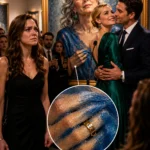
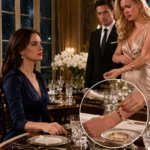
“Get out of this house, Claire,” my mother said, her diamond bracelet flashing beneath the chandelier.
My father stood beside her holding the shattered remains of Grandpa’s watch like evidence from a murder scene.
Across the dining room, my brother Owen pressed a napkin to his eyes and let everyone believe I had destroyed the only thing Grandpa had left me.
I did not scream. I did not defend myself.
I simply looked at the security monitor mounted above the butler’s pantry and asked, “Would you like to apologize before I turn on the hallway camera, or after?”
Chapter 1: The Watch on the Silver Tray
No one spoke.
Not my mother, Margaret Hartwell, who had spent thirty years perfecting the art of making cruelty sound like concern.
Not my father, Richard Hartwell, whose disappointment had been the background music of my childhood.
Not my brother Owen, the golden son of Lake Forest, Illinois, whose tears always arrived faster than the truth.
The dining room of my parents’ estate glittered like a magazine cover. Twelve-foot ceilings. Crystal chandelier. White orchids arranged down the center of a mahogany table long enough to make people at the opposite end feel like distant relatives. Beyond the tall windows, Lake Michigan was black and restless under the January sky.
It was supposed to be Sunday dinner.
But in the Hartwell family, Sunday dinner had always been less about food and more about performance.
That night, the audience was larger than usual.
My aunt Lydia sat frozen beside her husband, one hand covering her mouth. My cousin Parker stared at the floor as if eye contact might make him responsible. Reverend Collins from my parents’ church sat stiffly with his napkin in his lap. Two members of the Hartwell Homes board were present because my father had invited them to “celebrate Owen’s future.” Our family attorney, Evelyn Devereaux, sat near the fireplace with her leather briefcase beside her chair, her face unreadable.
And at the center of it all, on a silver serving tray like a dead thing prepared for inspection, lay Grandpa Walter’s watch.
The crystal was cracked.
The hour hand was bent.
The leather strap had torn away from one side.
The back casing, the part Grandpa used to tap gently whenever he told me time was the only inheritance people wasted on purpose, had split near the hinge.
It was a Patek Philippe, though Grandpa never cared about the brand. To him, it had not been a luxury object. It had been a memory. His father had bought it after coming home from the Korean War. Grandpa wore it through the founding of Hartwell Homes, through my grandmother’s funeral, through my high school graduation, through chemo appointments, through every quiet morning he spent teaching me how to read construction ledgers at his kitchen table.
When he died, it was the only personal thing he left directly to me.
Not because it was expensive.
Because I was the only one who knew how often he had checked the time while waiting for someone he loved to finally show up.
May you like
My mother pointed at me across the table.
“You couldn’t stand it, could you?” she said.
Her voice was cold, but not loud. Margaret Hartwell never yelled in public. She knew volume was for people without social control.
“You couldn’t stand that tonight was about your brother,” she continued. “You couldn’t stand that your grandfather’s legacy was going to Owen.”
Owen inhaled shakily.
Perfect timing.
He had always been beautiful when he cried. That was the worst part. Even as a child, he knew how to lower his lashes, tremble his mouth, and look wounded enough that adults stopped asking questions. He was twenty-seven now, but his face still had that same polished softness. Blond hair. Blue eyes. An expensive navy sweater my mother had probably chosen. He looked like a man born to be forgiven.
“Mom,” he said faintly, “don’t. Claire is already embarrassed.”
There it was.
The small, generous lie. The one that made him look merciful while placing the knife exactly where he wanted it.
My father’s jaw tightened. “Embarrassed? She should be ashamed.”
I looked down at my hands in my lap.
They were steady.
That seemed to make everyone angrier.
For years, they had mistaken my quiet for guilt. My restraint for weakness. My refusal to beg for an admission that I deserved whatever they gave me.
My father lifted the broken watch from the tray. “This belonged to my father.”
“No,” I said softly. “It belonged to Grandpa. Then he left it to me.”
My mother’s lips thinned.
That was the wound she never stopped pressing.
Grandpa had not left the watch to Richard, his only son. He had not left it to Owen, his adored grandson. He had left it to me, the daughter my parents described as “difficult,” “sensitive,” “dramatic,” and eventually, after I stopped asking them to love me fairly, “cold.”
Owen sniffed. “I only asked to wear it for one night.”
“You demanded it,” I said.
He gave me a wounded look. “I asked because Dad wanted a family photo after dinner. I thought Grandpa would have wanted me to wear it when they announced my promotion.”
My father turned to me sharply. “And instead of being happy for your brother, you threw a tantrum.”
“I didn’t touch the watch after I put it back in the hall safe.”
“Don’t lie,” my mother snapped.
Aunt Lydia flinched. Reverend Collins lowered his eyes.
My mother continued, softer now, because she remembered the room was full. “Claire, your jealousy has gone too far. First you refused to help with the foundation gala. Then you questioned Owen’s appointment at the company. Now this.”
I looked at the board members. Mr. Grayson, old money and older silence, stared into his wine. Mrs. Leavitt watched me with something like discomfort. Not sympathy. Not yet.
My father set the watch back on the silver tray. The sound was small, metallic, final.
“You are no longer welcome at Hartwell House,” he said. “Not tonight. Not at the foundation gala next month. Not at the board announcement.”
My mother added, “And until you apologize to your brother, you are not to contact this family.”
Owen whispered, “I don’t need an apology.”
Of course he did not.
He needed an audience.
My father looked almost proud of him.
That was when something inside me, something old and exhausted, finally stopped reaching.
I did not feel rage.
I felt clarity.
It was clean. Almost peaceful.
I took my linen napkin from my lap, folded it once, and placed it beside my untouched plate.
Then I stood.
The room braced itself for tears.
They had prepared for that version of me. The little girl who used to run upstairs after Owen blamed her for broken vases and missing cash. The teenager who used to write apology notes for arguments she had not started. The twenty-two-year-old who had skipped her own graduate school orientation because my mother said Owen was having anxiety and needed family support before his first finance internship.
But that girl was not in the dining room anymore.
I looked at Evelyn Devereaux.
She gave the faintest nod.
Then I turned back to my parents.
“I asked one question,” I said calmly. “Would you like to apologize before I turn on the hallway camera, or after?”
Owen stopped pretending to cry.
Just for one second.
It was so fast most people missed it.
But I saw.
His eyes sharpened. His mouth parted. His face changed from injured to calculating before he remembered who he was supposed to be.
“What camera?” my mother asked.
I looked toward the black glass dome set high in the corner above the butler’s pantry door.
My father frowned. “That camera hasn’t worked in years.”
“It does,” I said. “Grandpa had it replaced after his medication went missing last winter.”
The room shifted.
Not loudly.
Just enough.
Silverware. Chair legs. A soft inhale from my aunt.
Owen laughed once, too quickly. “This is insane. She’s trying to distract everyone.”
“No,” I said. “I’m done distracting everyone from you.”
His face flushed.
My mother stepped forward. “Claire, stop this right now.”
I met her eyes.
For the first time in my life, I let her see that her anger no longer owned me.
“No,” I said. “You asked for the truth in front of witnesses. So you’re going to receive it in front of witnesses.”
Then I walked to the cabinet beneath the security monitor and opened the drawer where Grandpa had always kept the remote.
My father said my name.
Not softly. Not kindly.
A warning.
“Claire.”
I paused with the remote in my hand.
For a moment, I remembered being eight years old, standing in the foyer while Owen sobbed over a smashed porcelain horse my grandmother had loved. He had broken it riding his scooter indoors. My parents had blamed me because I was older and should have been watching him. Grandpa had found me later in the greenhouse, sitting behind the lemon trees, holding my breath so no one would hear me cry.
He had sat beside me and placed his watch in my palm.
“Claire-Bear,” he said, “people who need lies to stay loved are poorer than they know.”
At the time, I did not understand.
That night, in the dining room, I finally did.
I pressed power.
The monitor glowed blue.
Owen stood so fast his chair scraped across the hardwood.
“Don’t,” he said.
The whole room heard him.
And the silence changed.
Chapter 2: The Child Who Paid the Bills
Before that night, everyone in Lake Forest knew the Hartwells as a family built from discipline, taste, and devotion.
That was the public story.
Hartwell Homes had begun with my grandfather, Walter Hartwell, and one borrowed truck in 1974. He built custom houses along the North Shore, then expanded into luxury restorations, lakefront estates, private clubs, and boutique developments with names like Willowmere and Ashgate Landing. By the time I was ten, our last name appeared on brass plaques, charity programs, hospital wings, and school athletic fields.
My father inherited the title of CEO.
My mother inherited the social crown.
Owen inherited their worship.
I inherited responsibility.
It happened gradually, the way winter enters a house through old windows.
At first, it was small.
Claire, let Owen choose the movie. He had a hard week.
Claire, don’t correct him in front of people. It embarrasses him.
Claire, give him the bigger room. Boys need space.
Claire, why are you so sensitive?
Claire, why can’t you just be happy for your brother?
When Owen wrecked the golf cart at fourteen, I was blamed for not hiding the keys. When he failed chemistry at Lake Forest Academy, I was blamed for making him feel “academically overshadowed.” When he stole my college essay about Grandpa and submitted it to a scholarship committee, my mother told me, “He admires you. Try to see it as a compliment.”
I learned early that in my family, Owen’s mistakes were weather. Mine were character flaws.
Grandpa noticed.
He noticed everything.
He was not a soft man. He did not rescue me in dramatic ways. He did not storm into rooms or shame my parents. Grandpa believed truth delivered too early was often wasted on people determined not to hear it.
Instead, he taught me.
At twelve, he taught me how to use a measuring tape properly. At thirteen, how to walk a job site without heels sinking into mud. At fifteen, how to read invoices. At sixteen, how to tell the difference between a contractor who made honest mistakes and one who expected a rich family not to check the numbers.
“You see the bones of things,” he told me once.
“I see what people leave lying around,” I said.
He laughed.
Owen hated that.
Not openly at first. Golden children do not always hate their scapegoats loudly. Sometimes they hate them through smiles. Through little jokes. Through private humiliations no one else hears.
“You know Grandpa only spends time with you because you’re lonely, right?” Owen told me when I was seventeen.
I said nothing.
He grinned. “Don’t worry. Mom says you’ll grow out of being intense.”
That was Owen’s gift. He could take someone else’s cruelty and make it sound like inside information.
When I got into Northwestern with a partial scholarship, my parents attended the admitted students’ brunch because people would notice if they did not. They smiled for photographs. My mother cried delicately in front of other mothers. My father clapped me on the shoulder and said, “Well done.”
That same night, at dinner, he announced Owen would be getting a new BMW for graduating high school.