The Dead Father’s Fingerprint Was Fresh. Then the K9 Heard the Men in Suits Before Anyone Saw Them.
The six-year-old girl came through the small-town police station doors during a Montana snowstorm with one boot missing, a torn photograph in her fist, and a German Shepherd between her and the world.
She did not cry.
She only looked up at Detective Sarah Klein, pointed to the man in the picture, and said, “I need my daddy.”
Sarah knew that face.
Everyone in Bear Hollow knew that face.
Richard Harper had died seven years ago in a burning car off Highway 12, and Sarah had stood in the snow beside the wreck herself.
But the photograph in the little girl’s hand was warm from her pocket, printed on fresh paper, and on the back was a fingerprint that should have been buried with him.
The German Shepherd growled before anyone else heard the black sedan outside.
Then the little girl whispered, “The men in suits found me.”
Part 1: The Child Who Asked for a Dead Man
The storm came down sideways over Bear Hollow, Montana, turning Main Street into a white tunnel of wind, headlights, and frozen silence.
By six o’clock, the diner across from the sheriff station had shut off its yellow sign.
The county clinic had gone to emergency power.
The plow trucks had quit pretending they could keep up.
Detective Sarah Klein stood alone at the front desk of the police station with a mug of burnt coffee in her hand and a headache behind her eyes.
The radio crackled with snow chatter, road closures, and a stranded cattle truck ten miles east.
Then the front door opened.
A blade of icy wind cut across the lobby.
Sarah turned, one hand already moving toward her sidearm out of habit.
A little girl stood in the doorway.
She was small enough to disappear inside the oversized gray coat hanging off her shoulders.
Her cheeks were red from the cold.
Her brown hair was tangled with snow.
One boot was missing.
Behind her stood a German Shepherd with a black saddle coat, frost on his whiskers, and eyes that did not blink.
The dog moved first.
He stepped in front of the girl and lowered his head, not attacking, not retreating, just making it clear that anyone who touched her would have to go through him.
May you like
Sarah set the coffee down slowly.
“Sweetheart,” she said, keeping her voice low, “are you hurt?”
The girl did not answer.
She looked past Sarah at the empty hallway, then at the holding-room glass, then at the front windows.
She was checking exits.
Sarah had seen grown witnesses do that after domestic calls, after robberies, after they had learned the hard way that safety could be temporary.
The girl raised a trembling hand.
In it was a folded photograph.
“I need my daddy,” she said.
Sarah came around the desk and crouched.
The German Shepherd shifted, blocking her path with one massive shoulder.
“Easy,” Sarah whispered.
The dog stared at her badge.
Then he sniffed the air, studied her face, and gave half a step.
Not permission.
A warning.
Sarah took the photograph.
The second she unfolded it, the warmth drained from her body.
The man in the picture stood on a snow-covered porch beside an old green pickup truck.
He had dark hair, tired eyes, and a half smile that looked like it had survived too much.
He wore a cracked leather jacket and held a little girl in his arms.
On the porch rail behind him was a red gas can, a rusted lantern, and a German Shepherd sitting at attention.
Sarah remembered that jacket.
She remembered that face.
She remembered the night Richard Harper’s car burned so hot the snow melted twenty feet in every direction.
She remembered his widow, Ava, screaming until her voice broke.
She remembered the county coroner’s report.
She remembered signing the paperwork that closed the case as a tragic accident.
“Where did you get this?” Sarah asked.
The little girl swallowed.
“He gave it to me.”
Sarah looked up.
“Who gave it to you?”
“My daddy.”
The room seemed to shrink.
“What’s your name?”
“Emily.”
Sarah looked at the photograph again.
Richard Harper had one child when he died.
A baby girl named Emily.
But Emily Harper would have been seven now.
This child looked six, maybe almost seven, but her eyes were older than the file.
“Emily Harper?” Sarah asked.
The little girl nodded once.
The German Shepherd pressed his body against her side.
Sarah saw the worn leather collar under his fur.
There was an old military-style tag on it, scratched nearly smooth.
KODA.
Sarah knew that name too, but from a different world.
Staff Sergeant Eli Ward had come back to Bear Hollow three years ago with that dog and a folded flag he never explained.
He lived outside town on a rural ranch near Wolf Creek Pass.
He fixed fences.
He helped stranded drivers.
He bought coffee at Miller’s Diner before sunrise and left before anyone could ask him too many questions.
People said he had been a Marine K9 handler in Afghanistan.
People said Koda had found buried explosives, missing men, and once a child trapped after a building collapse.
People said Eli Ward had lost his unit, his wife, or maybe both.
Nobody knew because Eli did not tell stories about pain.
He just carried it like weather.
Sarah looked at the child again.
“Where is Mr. Ward?”
Emily’s lips trembled for the first time.
“Koda brought me here.”
The dog lifted his head at his name.
Snow slid off his ears.
Sarah’s phone buzzed on the desk.
She ignored it.
“Emily,” she said gently, “where did Koda find you?”
The girl looked toward the windows.
“By the highway.”
“What highway?”
“The old one.”
“Were you with someone?”
Emily tightened her hand around the edge of her coat.
“I was in the black car.”
Sarah’s spine went cold.
“What black car?”
The German Shepherd growled.
It was low and quiet, a sound from deep in his chest.
Not at Sarah.
At the front windows.
Sarah turned.
Beyond the frosted glass, headlights moved slowly through the storm at the end of Main Street.
A black sedan rolled past Miller’s Diner with no headlights for two seconds, then clicked them on.
It stopped under a dead streetlamp across from the station.
The dog stepped fully in front of Emily.
Sarah reached for the radio on her shoulder.
“Dispatch, this is Klein,” she said. “I need Sheriff Logan back at the station now.”
Static answered.
Then a burst of broken words.
The storm was eating the signal.
Emily leaned close to Sarah.
Her voice was barely a breath.
“The men in suits found me.”
Sarah guided the girl behind the front desk.
The dog followed without being told.
A hard knock hit the station door.
Not desperate.
Not worried.
Polite.
Controlled.
Sarah saw two silhouettes through the glass.
Tall men.
Dark coats.
No hats in a Montana blizzard.
One of them held up a leather ID wallet.
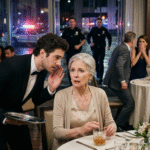
“Detective Klein,” he called through the door. “We’re with Child Services. We’re here for the girl.”
Emily’s face went white.
Koda bared his teeth.
Then Emily pointed at the men and said the words that made Sarah’s blood turn to ice.
“Those are the bad men.”
Part 2: The Man Who Lived Past the War
Eli Ward heard the storm before he heard the phone.
It rattled the windows of his cabin and pushed snow through the gaps around the old porch door.
The wood stove glowed red in the corner.
His boots were still muddy from checking fence lines.
An untouched bowl of stew sat on the table beside a folded photograph he had not meant to take out.
A woman smiled from the faded picture.
Ava Harper.
She had been younger then, standing under summer cottonwoods with a camera strap around her neck and sunlight in her hair.
Eli had kept that picture hidden in an ammunition box for seven years.
Some grief could live in daylight.
Some had to stay locked away.
His phone buzzed again.
Unknown number.
He nearly let it go.
Then the cabin radio crackled on the counter, catching a fragment from town.
“Girl at station… Harper… dog… black sedan…”
Eli was already moving.
He grabbed his cracked leather jacket, the one with the torn cuff from Kandahar, and looked toward the empty rug by the stove.
“Koda?” he called.
Nothing.
That was wrong.
Koda did not wander in a storm.
Koda did not leave Eli unless he had a reason.
Eli opened the door and stepped onto the snow-covered porch.
The wind slapped him across the face.
A set of paw prints cut across the yard, deep and urgent, heading toward the old highway.
Beside them were tiny footprints.
One bare.
One booted.
Eli’s breath stopped.
He ran to the barn.
The old pickup coughed twice before the engine turned over.
He backed out hard, tires slipping over ice, headlights catching the white ribs of the fence.
At the gate, he stopped.
Something hung from the latch.
A child’s purple mitten.
Koda had left it where Eli would see it.
Eli took the mitten, pressed it to his palm, and looked toward town.
“Good boy,” he whispered.
Then he drove into the storm.
At the police station, Sarah did not open the door.
The man outside smiled through the glass like he had practiced compassion in a mirror.
He had pale hair, a clean shave, and a suit too expensive for Bear Hollow.
His companion stood half a step behind him with his hands in his coat pockets.
“Detective,” the pale man called, “we received an emergency placement notice regarding Emily Harper.”
Sarah kept one hand low behind the desk.
“Funny,” she said. “I don’t remember calling Child Services.”
“The call came through county dispatch.”
“County dispatch is down.”
His smile did not move.
“That is why we came directly.”
Emily crawled under the desk and hugged her knees.