She Named Her Baby After My Dead Father. Then I Read the Clause He Left Behind.
My husband’s mistress named her unborn baby after my dead father.
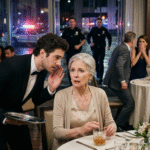
She did it while sitting in my chair, wearing my mother’s pearls, with my husband’s hand resting on her stomach.
The dining room went silent for half a breath, the kind of silence rich people use when they are deciding whether a cruelty is elegant enough to applaud.
Then Grant Archer smiled.
His mother lifted her champagne flute.
And I looked across the candlelit table at the woman carrying the child my husband had made with her, and felt something inside me go perfectly still.
Part 1: The Chair at the End of the Table
Sloane Mercer had chosen my chair on purpose.
Everyone at that table knew it.
At Archer House, the seat to Grant’s right belonged to his wife.
It had belonged to me for nine years, through Easter brunches with imported tulips, Christmas dinners under crystal chandeliers, and summer fundraisers where senators laughed too loudly at jokes they did not understand.
That night, I stood in the arched doorway of the dining room and watched my husband’s mistress turn her face toward me with the soft, smug confidence of a woman who believed she had already won.
She was twenty-eight, blond in that expensive Connecticut way that required money but pretended to be natural, with a cashmere maternity dress the color of cream and my mother’s pearl choker resting against her throat.
My pearls.
Grant had told me they were locked in the safe.
Apparently, he had meant a different kind of safe.
“Evelyn,” he said, as if my name were an inconvenience.
He did not stand.
No one stood.
Not his mother, Lucille Archer, whose diamond bracelet flashed like a blade when she reached for her wine.
Not his brother Pierce, who watched the table with the lazy amusement of a man who had never paid for anything he broke.
Not his aunt Caroline, not the board members invited as “family friends,” not the priest from St. Bartholomew’s who blessed the roast and ignored the adultery.
Only Nora, my six-year-old daughter, began to slide down from her chair when she saw me.
Lucille’s hand closed over Nora’s shoulder before my child could move.
“Finish your soup, darling,” Lucille said.
Nora looked at me with wide gray eyes.
My eyes.
My father’s eyes.
I smiled at her.
Not because anything was fine.
Because she was watching, and little girls learn what they are allowed to survive by studying their mothers.
“I see dinner started without me,” I said.
May you like
My voice sounded calm enough to belong to someone else.
Grant leaned back in his chair, his dark suit perfectly tailored, his wedding ring still on his hand.
“We waited twenty minutes.”
“You moved the time,” I said.
“Sloane gets nauseous late in the evening,” he replied.
He said it tenderly.
He had not spoken to me that softly since the night my father died.
Sloane placed one hand over her stomach, her nails pale pink and flawless.
“I told Grant not to make a fuss.”
Lucille smiled.
“Nonsense, dear. A mother must be protected.”
A mother.
The word slipped across the table and found me like a slap.
I had spent four years after Nora’s birth losing pregnancies in white hospital rooms with Grant checking his phone beside the bed.
I had signed discharge papers while bleeding through couture.
I had smiled through Lucille’s charity luncheons while women asked when I would “try again,” as if my body had been failing politely.
Now Sloane sat glowing beneath my chandelier, carrying a baby everyone at that table already loved because he was male, inconvenient, and useful.
Grant lifted his hand.
“There’s a place for you at the end.”
The end.
I looked down the table to the narrow chair between Aunt Caroline and the priest.
The widow’s seat, my father would have called it.
Except I was not a widow.
I was something more humiliating.
I was a wife being replaced while still breathing.
I crossed the room slowly, because the only gift a woman has in a public execution is pacing.
The candles reflected in the polished mahogany.
Outside the windows, Newport rain struck the black glass in silver lines.
Archer House sat above the Atlantic like a threat, all limestone and inherited arrogance, the kind of mansion built by men who called exploitation vision.
I sat at the end of the table.
The footman poured wine.
I did not drink it.
Grant cleared his throat halfway through the entrée.
“I asked everyone here tonight because our family needs clarity.”
Our family.
Sloane lowered her lashes.
Lucille arranged her face into sympathy.
I cut a small piece of lamb and waited.
Grant looked at me as if he expected a scene.
He had always hated that I did not give him one.
“I have filed a petition for dissolution,” he said.
Aunt Caroline inhaled sharply, for theater.
The priest stared into his potatoes.
“I thought it would be better for Nora if we handled this with dignity.”
“With your pregnant mistress at family dinner?” I asked.
Pierce coughed into his napkin.
Lucille’s eyes narrowed.
Grant’s mouth hardened.
“Sloane is not a mistress. She is the woman I love.”
There it was.
Not the affair.
Not the baby.
The sentence he had rehearsed in mirrors until it sounded brave instead of cheap.
Sloane reached for his hand.
He let her.
Nora’s spoon clattered against her bowl.
I saw Grant’s eyes flick toward her, not with guilt, but annoyance.
That was when the last soft thing inside me locked itself away.
“For Nora’s sake,” he continued, “I hope you won’t make this ugly.”
I looked at my daughter.
Her lips trembled, but she did not cry.
My brave girl.
My too-observant child.
Sloane sat a little straighter, like the cameras had arrived.
“We want Nora to feel included,” she said.
I turned to her.
She blinked once, surprised by the full force of my attention.
“How generous.”
Her cheeks colored, but she smiled.
“And we wanted you to hear our news from us.”
I glanced at her stomach.
“I believe I heard it from Page Six three weeks ago.”
Pierce laughed under his breath.
Lucille said, “Evelyn.”
That single word carried nine years of instructions.
Be pleasant.
Be quiet.
Be useful.
Be grateful we allowed your father’s money to sit at our table.
Grant’s jaw worked.
“Sloane and I found out the baby is a boy.”
Lucille’s face lit with something feral.
An heir.
In families like the Archers, they dressed the word in cashmere and called it legacy.
Sloane pressed both hands to her stomach.
“And we’ve chosen a name.”
I already knew before she said it.
Some humiliations cast shadows before they enter the room.
“We’re naming him August,” she said softly.
My knife stopped.
Sloane watched me.
Grant watched me.
Everyone watched me.
The candles hissed.
The rain kept falling.
August.
My father’s name.
August Whitaker, who built Whitaker Hotels from three bankrupt inns and an impossible loan.
August Whitaker, who taught me to read contracts before fairy tales.
August Whitaker, who told Grant Archer to his face that charm was what weak men used when they had no character.
August Whitaker, who died in a hospital room at Mass General with my hand in his and whispered, “Let them underestimate your grief.”
Lucille placed a hand over her heart.
“Oh, Evelyn. Your father would have been so honored if he were alive.”
That was when I almost laughed.
Not loudly.
Not wildly.
Just a small, startled breath at the absurdity of evil wearing etiquette.
My father had hated Grant before anyone else did.
He had hated the way Grant touched my back in public like a brand.
He had hated the way Grant called my inheritance “our opportunity.”
He had hated the Archer family’s smiling hunger.
Most of all, he had hated that I mistook control for devotion because Grant was beautiful when he wanted something.
Sloane tilted her head.
“I know it might be emotional for you.”
“I’m sure you do.”
Grant’s hand tightened around hers.
“We wanted to honor him.”
“No,” I said.
The room went very still.
“You wanted to use him.”
Lucille set down her glass.
“That is an ugly thing to say to an expectant mother.”
I folded my napkin and placed it beside my plate.
“You invited your son’s pregnant mistress to sit in my chair wearing my dead mother’s pearls, announced my divorce in front of my child, and named the affair baby after my father.”
I smiled faintly.
“Ugly arrived before I did.”
Sloane’s face flickered.
Grant pushed back his chair.
“Enough.”
There was the voice he used behind closed doors.
Not shouting.
Grant rarely shouted.
He preferred coldness, because coldness left fewer witnesses.
“You will not speak to her that way,” he said.
I stood.
The room followed my movement like a courtroom follows a verdict.
Nora slid from her chair and ran to me before Lucille could stop her.
I put one hand on her shoulder.
Grant’s eyes flashed.
“We agreed Nora would stay here tonight.”
“You don’t get to make unilateral decisions anymore.”
“You made this one easy.”
Sloane gave a small laugh.
It was a mistake.
I looked at her pearls again.
My mother had worn them in a black-and-white photograph taken outside the chapel at Yale, laughing into my father’s shoulder.
They were not the largest pearls in the Whitaker vault.
They were simply the only ones my father never had appraised.
That had made them priceless.
“You should take those off,” I said.
Sloane touched the choker.
“Grant gave them to me.”
“No. Grant stole them.”
Grant’s face flushed.
Lucille rose.
“This is beneath you, Evelyn.”
I gathered my coat from the footman, who would not meet my eyes.
“Almost everything in this room is.”
Grant stepped toward me.
“You walk out that door with Nora, and I’ll have my attorney file for emergency custody by morning.”
Nora’s fingers dug into my skirt.
I looked at my husband then.
Really looked at him.
The boyish face that had sold investors on dreams.
The mouth that once kissed my knuckles outside a church in Manhattan while photographers shouted our names.
The eyes that had gone empty the moment my father’s coffin hit the ground.
“You should,” I said.
His brows pulled together.
I turned to Lucille.
“And before you toast the baby named August, you may want to ask Grant if he read the clause attached to my father’s estate.”
No one moved.
Sloane’s smugness wavered.
Grant went pale in a way only I noticed, because I had studied his face for nine years and knew where fear lived.