The Bracelet in His Glovebox Was Not Mine.
The Baby Was Not His.
I found a maternity bracelet in my husband’s glovebox on the morning he told the world I was too broken to be a mother.
By sunset, his pregnant mistress was sitting in my seat at his family’s charity gala, wearing my diamond earrings and smiling like she had already inherited my life.
Grant Hale had always been careful.
Careful with his cufflinks, careful with his lies, careful with the way he touched my waist in public while twisting a knife between my ribs in private.
But that morning, in the parking garage beneath our penthouse on Park Avenue, he forgot to be careful.
His Bentley smelled like leather, cold coffee, and the expensive cologne I used to buy him every Christmas.
I had only opened the glovebox because I was looking for the valet card for St. Augustine’s Medical Center.
Grant had told me he was in meetings all day.
Grant had also told me Madison Bell was “just a foundation consultant.”
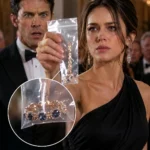
The first bracelet fell out with a soft plastic whisper.
White band.
Blue print.
Madison Bell.
Maternity triage.
St. Augustine’s Medical Center.
The date was three weeks ago.
I stared at it for exactly seven seconds.
Not because I did not understand what it meant.
Because I understood too much.
My fingers stayed steady when I lifted it from the floor mat.
Under it, tucked behind his silver cufflink case, was a second bracelet.
Smaller.
Folded twice.
No woman’s name.
Only a baby ID number and the initials W.H.
For a moment, the garage around me disappeared.
There was only that band, bright as bone in my palm, and the pulse in my throat beating like a warning.
W.H.
Willow Hale.
That was the name Grant’s mother had once whispered over dinner when she thought I was too far away to hear.
A girl would heal this family.
A Hale granddaughter would secure everything.
I took photographs of both bracelets.
Front, back, serial numbers, dates, barcodes.
Then I placed them exactly where I found them.
I closed the glovebox.
I smoothed my black silk dress over my knees.
And I went upstairs to finish getting ready for the gala where my husband would introduce his mistress as the future of the Hale family.
May you like
PART 1: THE WOMAN IN MY CHAIR
The Hale Foundation gala was held inside the ballroom of the Whitmore Hotel, which was the first insult.
My grandfather had built that hotel with coal money, war bonds, and a refusal to ever let a banker call him by his first name.
Grant’s family liked to pretend they owned the place because their name was engraved on the charity invitations.
They did not.
My family owned the marble, the chandeliers, the private elevators, the view of Central Park, and the suite where Grant had proposed to me seven years earlier with a diamond that had belonged to his grandmother.
At the time, I thought heirloom meant love.
Now I knew it meant inventory.
I arrived at eight sharp.
The ballroom was a cathedral of wealth.
Crystal chandeliers dripped light over white orchids, champagne towers, silver chargers, and women who had learned to smile without showing hunger.
A string quartet played near the stage.
Photographers lined the velvet rope.
The Hale name was projected in gold across the far wall.
Grant stood beneath it in a tuxedo, tall and polished and cruelly beautiful.
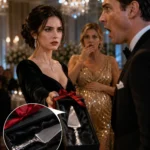
Beside him was Madison Bell.
She wore ivory.
Not white, exactly, because she was smart enough to pretend innocence.
Ivory silk, off the shoulder, one hand resting on the curve of her pregnant stomach.
My earrings glittered at her ears.
They were emerald drops from Van Cleef, a gift from my mother before she died.
I had kept them in the safe in our dressing room.
Madison turned when she saw me.
Her smile was small.
Private.
Triumphant.
Grant’s mother, Celeste Hale, stood behind them with a hand pressed to her pearls.
Celeste was the kind of woman who could make a funeral feel like a board meeting.
She looked at me like I was late to my own replacement.
I crossed the ballroom without rushing.
Every face turned.
That was the thing about old money rooms.
They loved blood as long as it did not splash on the linen.
Grant met me halfway.
His expression did not change, but his jaw tightened.
“Claire,” he said quietly.
Not sweetheart.
Not darling.
Claire.
The name he used when lawyers were nearby or when he wanted me to remember I was difficult.
“You should have called before coming,” he said.
I looked past him to Madison.
“She is wearing my earrings.”
His eyes did not move.
“She borrowed them.”
“No,” I said.
“She stole them.”
A waiter passed with champagne.
I took a glass, not because I wanted it, but because empty hands make women look vulnerable in rooms like that.
Grant leaned closer.
His voice lowered.
“Do not embarrass yourself tonight.”
I almost smiled.
He still thought humiliation belonged to whoever reacted first.
Madison came forward, all soft perfume and sharper teeth.
“Claire, I really hoped we could be civil.”
Her hand slid over her stomach.
The cameras caught it.
Of course they did.
Her pregnancy was not hidden anymore.
It was staged.
“How generous of you,” I said.
Her eyes flicked to the champagne in my hand.
“Grant said you were not drinking these days.”
Grant’s fingers tightened around his glass.
Madison’s smile widened by one careful inch.
There it was.
The little public cruelty.
The suggestion that I was unstable, medicated, barren, grieving, dramatic, whatever word could make my silence look like damage instead of discipline.
I lifted the glass.
“I am drinking tonight.”
The flash of cameras popped like lightning.
Grant’s brother, Theo, watched from near the bar.
His face had gone pale.
He knew.
Maybe not all of it, but enough.
Every rich family has one son who inherits the empire and one son who inherits the shame of seeing it clearly.
Theo had always been the second kind.
Grant touched my elbow.
To the cameras, it probably looked tender.
To me, it felt like a hand on the back of my neck.
“We need to talk privately.”
The word landed harder than a slap because I did not raise my voice.
Grant stared at me.
He was not used to being denied in public.
Neither was Celeste.
She glided over in a silver gown that made her look embalmed by money.
“Claire,” she said, kissing the air beside my cheek.
“You look thin.”
“And you look prepared,” I said.
Her smile paused.
Madison lowered her lashes like a woman trying not to laugh in church.
Grant’s father, Archer Hale, took the stage five minutes later.
He was seventy-two, broad-shouldered, white-haired, and adored by men who confused cruelty with leadership.
He welcomed donors.
He thanked the mayor.
He praised Grant for expanding the Hale Foundation’s maternal health initiative.
Then he looked down at Madison.
“And tonight, we celebrate the next generation,” Archer said.
The ballroom inhaled.
Grant held out his hand.
Madison placed hers in it.
He guided her onto the stage.
There are moments when betrayal does not feel like fire.
It feels like ice water poured slowly down your spine.
Grant took the microphone.
“My family has always believed in legacy,” he said.
He did not look at me.
“Legacy is not just what we build, but who we build it for.”
Madison lowered her head in practiced modesty.
Celeste dabbed one eye.
A woman near me whispered, “Oh my God.”
Grant continued.
“Madison and I are expecting a daughter.”
The room erupted.
Applause.
Gasps.
A few delighted little screams from women who would text the story before dessert.
I stood alone beside table one, where my place card had been removed.
Not moved.
Removed.
Madison looked directly at me from the stage.
She smiled with her whole face this time.
Grant finally looked at me.
There was no apology in his eyes.
Only warning.
He was telling me without words that the world had chosen the pregnant woman.
The world always wants a baby.
It forgives almost anything if there is a baby.
I set my untouched champagne on the tray of a passing waiter.
Then I walked to the stage.
The room quieted in pieces.
One table first.
Then another.
Then the whole glittering machine went still.
Grant turned slightly.
“Claire,” he said under his breath.
I took the microphone from his hand.
He was too shocked to stop me.
I looked at Madison, then at Celeste, then at the donors who had eaten from my family’s plates for twenty years.
“My husband is right,” I said.
“Legacy matters.”
A nervous laugh moved through the room.
I let it die.
“It matters so much that families have been known to lie for it.”
Grant’s face changed.
Just slightly.
Enough.
Madison’s hand froze over her stomach.
I smiled at the crowd.
“So tonight, I would like to raise a toast.”
No one moved.
“To truth,” I said.
“It always comes with a wristband.”
Then I placed the microphone back into Grant’s hand and walked out.
No tears.
No shaking.
No scene.
Just the sound of my heels crossing marble while five hundred people tried to decide whether they had witnessed a collapse or an execution.
Outside, the December air hit my face like glass.
My driver opened the car door.
Before I got in, my phone buzzed.
It was Grant.
Do not do this.
A second message arrived.
You will lose everything.
I looked at the glowing screen.
For six years, I had loved a man who thought love meant access.
To my bed.
To my name.
To my company.
To my silence.
I sent one message back.
You already did.
Then I forwarded the bracelet photos to Amelia Keene, my attorney.
Two days later, Amelia called me from her office downtown.
Her voice was calm, but it had a blade inside it.
“Claire,” she said.
“We confirmed the paternity lab attached to the baby ID.”
I stood in my kitchen, watching snow fall over the city.
“And?”
There was a pause.
“W.H. is not Grant’s child.”
PART 2: THE PRENUP HE LAUGHED AT
When Amelia Keene laughed, powerful men usually stopped laughing.
She was forty-eight, sharp as a paper cut, and wore navy suits that made judges sit straighter.
Her office overlooked Bryant Park.
No family photographs.
No inspirational quotes.
Just law degrees, sealed case files, and a silver bowl of peppermint candies no one ever touched.
I sat across from her the next morning while the city moved gray and fast behind the glass.
Amelia placed three folders on the table.
One was labeled DIVORCE.
One was labeled WHITMORE TRUST.