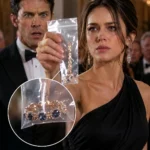
HE SMILED THROUGH HIS VOWS.
THEN MY LAWYER OPENED THE CHAPEL DOORS.
My ex smiled at me during his vows because he thought my baby’s future was already signed away.
He stood under twenty thousand white roses in the Montgomery family chapel, his hand wrapped around Camille Hart’s waist, his mouth curved like a man who had already won.
Camille wore my mother’s diamonds.
Not replicas.
Not borrowed pieces.
The actual pear-shaped diamond collar my mother had worn to her last charity gala before cancer folded her into silk sheets and morphine.
Camille had fastened it around her throat like a trophy.
She held her stomach with both hands, gently and smugly, as if the child inside her was a crown prince and the child inside me was evidence to be erased.
Every pew in the chapel was full.
Bankers, judges, cousins, senators, board members, women with perfect blowouts, and men who knew how to destroy families without raising their voices.
My name was Alexandra Montgomery Whitaker, and everyone in that room had watched my husband leave me six months pregnant.
No one had watched me beg.
Because I never did.
I sat in the third pew in a black silk dress, one hand resting over my own swollen stomach, my ankles crossed, my face still enough to be mistaken for peace.
Wells looked at me when the minister asked if he took Camille to be his wife.
He smiled.
That was his mistake.
He thought silence was surrender.
He thought the divorce papers gave him control of my family company, my trust, my son’s inheritance, and the future of every Montgomery woman who had ever refused to disappear quietly.
I stayed seated until the chapel doors opened.
And my attorney walked in with the court order before the bride could say “I do.”
PART 1: THE BRIDE WORE MY MOTHER’S DIAMONDS
The first thing people noticed was the necklace.
Not Camille’s dress, though it was custom Vera Wang and white enough to look almost blue beneath the chapel lights.
Not Wells, though he looked carved from old money in his black tuxedo, his gold cufflinks catching the candlelight every time he touched her.
They noticed the diamonds because Montgomery diamonds had history.
My grandmother had worn them to the White House.
My mother had worn them the night she announced the Montgomery Foundation’s first pediatric hospital wing in Boston.
I had worn them once, on my wedding day to Wells, back when I still believed betrayal arrived with warning signs.
May you like
Now they sat against Camille Hart’s collarbone.
She lifted her chin every few seconds so the stones could flash.
She wanted me to look.
So I did.
I looked without blinking.
Camille had been my personal stylist before she became my husband’s mistress.
She had steamed my dresses, approved my gala gowns, organized my closets by designer and season, and told me once that my life felt like a movie.
I remembered smiling and telling her movies usually needed better villains.
She had laughed too hard.
Now I knew why.
Wells had chosen the Montgomery Chapel for his second wedding because humiliation was a language he spoke fluently.
The chapel sat behind my family’s Newport mansion, a small limestone jewel box with ivy climbing the walls and stained-glass angels watching over generations of Montgomery brides.
My parents had renewed their vows there on their twenty-fifth anniversary.
My sister’s funeral had been held there after a winter car accident on Ocean Drive.
My own wedding portraits still existed somewhere in its archive room, wrapped in tissue and failure.
Wells had no right to marry anyone there.
Legally, emotionally, spiritually, historically, he had no right.
But Wells Whitaker had spent five years learning that rich families often confused confidence with ownership.
He had walked into my world as a brilliant corporate attorney from Connecticut with a clean jaw, wounded eyes, and just enough ambition to look romantic instead of dangerous.
He told me he hated men who married for money.
He told me he loved that I carried my family name like armor.
He told me he did not want Montgomery Capital, Montgomery House, Montgomery anything.
He only wanted me.
That was before my father’s stroke.
Before Wells became interim chief legal officer of Montgomery Holdings.
Before my father began forgetting names and Wells began remembering passwords.
Before he learned where the voting shares were held, which board members drank too much, which cousins could be bought with foundation seats, and which signatures mattered.
Before Camille started staying late.
Before I found a rose-gold bracelet in the passenger side of his Bentley and he told me it belonged to his assistant.
Before he came home smelling like her perfume and kissed my forehead like I was already dead.
By the time I was twenty-six weeks pregnant, Wells had perfected cruelty into etiquette.
He did not slam doors.
He closed them quietly.
He did not call me ugly.
He told me pregnancy had made me emotionally unreliable.
He did not say Camille was younger.
He said she was less complicated.
He did not say he wanted my company.
He said a smooth transition would protect the Montgomery legacy from scandal.
The divorce papers arrived while I was in a private hospital suite at Massachusetts General, hooked to monitors because stress had pushed my blood pressure into dangerous territory.
Wells placed the leather folder on my tray beside a glass of melting ice chips.
His wedding ring was already gone.
Camille stood behind him holding a latte.
Her nails were pale pink.
Her smile was patient, the way women smile when they believe they have been chosen permanently.
“Alexandra,” Wells said, using my full name because he knew I hated it from him now.
I looked at the folder.
Then I looked at him.
“Is there a reason your mistress is in my hospital room?”
Camille’s smile twitched.
Wells sighed like I had embarrassed him.
“Camille is part of my life now.”
“Then your life can wait in the hallway.”
His eyes hardened.
That was the first time I saw the real Wells without polish.
Just for one second, the mask slipped, and there he was.
Cold.
Annoyed.
Hungry.
Then he recovered.
“The papers are generous,” he said.
“Generous people don’t deliver divorce terms to a pregnant woman in a hospital bed.”
“You have always had a flair for drama.”
“I learned from your affair.”
Camille touched her stomach.
At the time, she was not showing.
She wanted me to notice anyway.
Wells glanced at her hand, and his expression softened so deliberately it felt staged.
“Camille is pregnant,” he said.
There are sentences that make sound vanish.
Not because they are surprising.
Because they confirm what your body already knew before your mind could survive it.
I heard the heart monitor.
I heard the air conditioner.
I heard my son’s heartbeat galloping from the fetal monitor strapped across my belly.
I did not hear myself breathe.
Wells watched me carefully.
He wanted collapse.
He wanted tears.
He wanted the kind of scene that would let him say I was unstable.
I gave him nothing.
“How far along?” I asked.
Camille blinked.
Wells smiled faintly.
“Twelve weeks.”
“So you were sleeping with her while we were trying for this baby.”
His jaw flexed.
“We were broken long before that.”
“No,” I said.
“You were bored long before that.”
The nurse stepped into the room then, saw the folder, saw Camille, saw me, and froze.
I remember loving her for the tiny flash of disgust she could not hide.
Wells opened the folder himself.
He explained the terms as if reading weather.
Temporary transfer of voting control in Montgomery Holdings to Wells Whitaker until delivery and mental health clearance.
Full spousal waiver of claims against assets acquired during marriage.
Mutual confidentiality agreement.
Custody arbitration to be revisited after paternity confirmation.
A clause preventing my unborn child from receiving Montgomery Trust distributions until legal parentage and fitness conditions were satisfied.
And at the bottom, in language so clean it felt surgical, a statement that my refusal to sign could result in an emergency petition questioning my competency.
He had built a cage and called it paperwork.
Camille stared at my stomach.
“Wells just wants stability,” she said.
I looked at her necklaceless throat.
“Women who sleep with married men should avoid the word stability.”
She flushed.
Wells placed a pen on the tray.
“Sign, Alex.”
“No.”
His voice lowered.
“You’re tired.”
“I’m pregnant.”
“You’re emotional.”
“I’m betrayed.”
“You’re alone.”
That one he delivered softly.
Almost kindly.
Cruel men love soft voices.
They think it makes the knife elegant.
I reached for the pen.
Wells relaxed.
Camille’s mouth lifted.
I uncapped it, leaned over the final page, and wrote three words in the signature line.
Go to hell.
Then I handed the folder back.
Wells stared at it for a long time.
When he looked up, the polish was gone again.
“You will regret making me your enemy.”
I smiled.
“No, Wells.”
“You became my enemy when you forgot I was raised by one.”
PART 2: THE PRENUP HE NEVER READ
My father, Conrad Montgomery, had always said love was wonderful, but paperwork was more reliable.
He was not a warm man.
He was a man who could make a room full of hedge fund managers sweat by taking off his reading glasses.
He played chess with billionaires, donated hospital wings without attending ribbon cuttings, and taught me to read contracts before fairy tales.
When I told him I wanted to marry Wells Whitaker, he asked one question.
“Has he asked what happens to the company if you die?”
I was twenty-eight then, drunk on love and offended by realism.
“No, Dad.”
“Good.”
Then he slid a prenup across his mahogany desk.
It was four inches thick.
I cried in the car afterward.
Wells held me all the way home and said he would sign anything because he loved me, not my money.
He even joked that my father had probably hidden a clause requiring him to name our firstborn Montgomery or lose access to oxygen.
I laughed.
He signed.
He signed every page.
He did not read closely because pride is a narcotic.
He believed reading it would make him look greedy.
My father knew he would believe that.
The prenup had standard protections, of course.
Separate property.
Trust restrictions.
Infidelity penalties.
Confidentiality provisions.
But my father had buried three clauses so deep inside the document that even some lawyers would have missed them on a first pass.
Clause 14.8 stated that any spouse found to have engaged in adultery while the Montgomery heir was pregnant forfeited all claims to marital appreciation of Montgomery assets.
Clause 17.2 stated that any attempt to interfere with the heir’s medical autonomy, voting shares, or inheritance rights would trigger automatic revocation of spousal proxy authority.
Clause 21.6 was my father’s favorite.
It stated that any unborn child of the Montgomery line would be protected as a contingent beneficiary from the moment of medically confirmed pregnancy, regardless of divorce status, provided maternal parentage was established.
In plain English, my son had rights before he had a crib.
And Wells had signed away the ability to touch them.
The problem was not that the prenup did not protect me.
The problem was Wells thought he could bury it.
He had spent years cultivating the appearance of a grieving, overburdened son-in-law trying to protect a vulnerable pregnant wife and an ailing patriarch.
He had charmed board members over scotch.
He had comforted my father in front of nurses.
He had called me fragile in rooms where I was not present to object.
By the time Camille’s pregnancy became public, half of Newport was ready to believe I had been difficult enough to drive a saint into another woman’s bed.
That is the ugly little secret of polite society.
It rarely asks whether a woman was harmed.
It asks whether she was inconvenient while bleeding.
The first article appeared in a Boston society newsletter the morning after Wells delivered the divorce papers.
WHITAKER-MONTGOMERY MARRIAGE IN CRISIS AMID HEALTH CONCERNS.
The second was worse.
INSIDERS WORRY FOR ALEXANDRA MONTGOMERY AS FAMILY EMPIRE FACES UNCERTAIN FUTURE.
No one signed their name.
Everyone knew who had whispered.
My phone filled with messages.
Some were gentle.
Some were hungry.
My aunt Patricia asked whether I needed rest at a “private facility.”
My cousin Blake offered to help Wells with the board transition because “the company comes first.”
A woman from the Newport Preservation Society sent a prayer emoji and asked whether I still planned to sponsor the summer gala.
I answered none of them.
I called my mother’s attorney.
Her name was Vivian Shaw, and she had the kind of voice that made expensive men sit straighter.
Vivian had handled my mother’s estate, my father’s trusts, my sister’s probate, and every threat ever aimed at Montgomery Holdings since 1998.