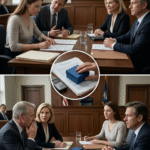
My husband’s mistress was standing on my mother’s antique ladder when I found her removing the blessing plaque from my front door.
She wore cream cashmere, six-inch Louboutins, and the satisfied smile of a woman who believed she had already inherited my life.
The old plaque lay facedown on the Italian marble beneath her.
In its place, she had hung a sleek slab of white porcelain stamped with two gold initials.
S.M.
Sloane Mercer.
My husband’s mistress.
My husband, Grant Ashford, stood beneath the chandelier with one hand in his pocket and the other wrapped around a glass of my father’s bourbon.
He did not look embarrassed.
He looked inconvenienced that I had come home early.
“Sloane thought the old one made the entrance feel dated,” he said.
Sloane stepped down slowly, letting her diamond bracelet catch the afternoon light.
“Old blessings expire,” she said.
I looked at the plaque my mother had hung there thirty-two years earlier.
It had watched over births, funerals, hurricanes, Christmas mornings, and the marriage I should have ended long before that day.
Then I looked at the woman wearing my bathrobe beneath her cashmere coat.
I lifted her new plaque from the wall.
PART ONE: THE WOMAN ON MY LADDER
Hawthorne House had nineteen bedrooms, fourteen fireplaces, a ballroom built before women had the right to vote, and exactly one object I considered priceless.
The blessing plaque was not impressive.
It was a narrow piece of dark walnut carved with a magnolia branch and seven simple words.
MAY ONLY LOVE CROSS THIS THRESHOLD.
My mother, Evelyn Vale, had purchased it from a woodworker in Savannah the summer I turned twelve.
She hung it above the front entrance herself because she did not trust anyone else with the placement.
“A home remembers how people behave inside it,” she told me.
I had laughed because I was twelve and believed houses were made of stone, wiring, and furniture.
My mother believed they were made of memory.
She died ten years later, and Hawthorne House became mine.
At least, that was what the deed said.
The Ashfords preferred a more flattering version.
According to the society pages, Hawthorne House was the ancestral seat of the Ashford family.
May you like
Grant’s mother, Lenora, repeated that phrase so often that even Grant seemed to forget the house had never belonged to them.
The Ashfords had rented it for one summer in 1989, when their own estate was being sold by a bankruptcy court.
My mother bought Hawthorne House six years later.
She restored every limestone arch, replaced every damaged slate tile, and paid off the liens no one in the Ashford family liked to discuss.
When I married Grant, I allowed him to move in.
Somewhere along the way, permission became possession in his mind.
That afternoon, he stood in my entrance hall as though I were the trespasser.
“You weren’t supposed to be back until tomorrow,” he said.
“My meeting ended early.”
“You could have called.”
“I used to believe I didn’t need an appointment to enter my own home.”
Sloane’s smile tightened.
Grant set down his drink.
There had been a time when the sight of his face could make me forget the rest of the room.
He had been beautiful at thirty.
He was still handsome at forty-three, but wealth and entitlement had sharpened him into something colder.
His dark suit had been tailored on Savile Row.
His silver cuff links bore the Ashford crest.
I had paid for both.
“Sloane is helping with the Founders’ Gala,” he said.
“The gala is at the Ashford Grand Hotel.”
“The board wants to host the private dinner here.”
“The board asked me last month, and I declined.”
Grant’s jaw moved slightly.
That was the first indication that my early arrival had disrupted more than an afternoon affair.
Sloane crossed her arms.
“Plans changed.”
“They often do when people make them without authority.”
Her eyes flicked toward Grant.
He gave her a subtle look that said he would handle me.
That look hurt more than I expected.
Not because he was defending her.
Because it was familiar.
He had once used it when strangers insulted me at dinner parties.
He had once used it when his mother called me “useful” instead of beautiful.
He had once used it in a hospital room after my emergency surgery, when he promised that no one would ever make me feel alone again.
Now that private language belonged to Sloane.
“Claire,” he said, lowering his voice as though soothing an unstable employee, “we need to have a grown-up conversation.”
“I agree.”
His expression relaxed too quickly.
He thought I was going to ask how long the affair had been going on.
He thought I would demand details, cry, throw something, or make a scene dramatic enough to help him justify leaving me.
Men like Grant expected a betrayed wife to perform her pain for them.
They needed tears because tears made them feel powerful.
They needed rage because rage allowed them to call her irrational.
I gave him neither.
I took off my leather gloves one finger at a time.
“Why is she wearing my robe?”
Sloane glanced down.
The robe was midnight-blue silk embroidered with my initials.
C.V.A.
“It was cold upstairs,” she said.
“There are blankets in the guest rooms.”
Grant exhaled.
“This is exactly why I wanted to talk tomorrow.”
“Why?”
“Because you turn everything into an interrogation.”
“I asked one question.”
“You know what I mean.”
I did know.
Grant meant that my composure made lying difficult.
Sloane walked to the console table and picked up a champagne flute.
The crystal was part of a Baccarat set my mother had given me on my wedding day.
She raised it to her lips without asking.
“I think honesty would be kinder at this point,” she said.
The nerve of her almost impressed me.
“Then please be honest.”
She looked at Grant again.
He nodded.
Sloane’s smile returned.
“Grant and I are together.”
“I know.”
The smile disappeared.
Grant stared at me.
“What do you mean, you know?”
“I mean the sentence was not complicated.”
“How long have you known?”
I looked at the faint lipstick mark on his shirt collar.
“Long enough.”
That was true.
I had known for eighty-three days.
I discovered the affair through a florist’s invoice sent to the wrong family office account.
Three dozen white roses had been delivered to a suite at the Carlyle Hotel.
The card read, SOON, EVERY ROOM WILL BE OURS.
Grant had been in Boston that week, according to his calendar.
Sloane had posted photographs from Manhattan.
I did not confront him.
I asked our family accountant to begin copying every transaction connected to Grant’s personal accounts.
I asked our security company to preserve the entrance logs at Hawthorne House.
I asked Miriam Cole, my mother’s attorney and now mine, to review the prenuptial agreement Grant had signed fourteen years earlier.
Then I waited.
Not because I was weak.
Because angry people reveal only what they have already done.
Confident people reveal what they plan to do next.
Grant stepped toward me.
“You’ve been spying on me?”
“No.”
“You went through my accounts.”
“I reviewed accounts attached to the Vale family office.”
His face changed.
Only slightly, but I saw it.
Grant had always underestimated the difference between access and ownership.
“Sloane and I didn’t intend for you to find out like this,” he said.
“How did you intend for me to find out?”
“We were going to sit down after the gala.”
“With lawyers?”
“With dignity.”
The word almost made me smile.
Sloane leaned against my mother’s console table.
“We hoped you would understand that some marriages reach their natural conclusion.”
“Did mine conclude before or after you started sleeping in my bed?”
Grant’s eyes hardened.
“Don’t be vulgar.”
“I asked a geographical question.”
Sloane laughed softly.
It was meant to humiliate me.
Instead, it told me how safe she felt.
That was useful.
Grant straightened his jacket.
“The marriage has been empty for years.”
“Then why are you still here?”
“This is my home.”
The word landed quietly.
He blinked.
I continued.
“This is the home where you live.”
His mouth tightened.
“Claire, don’t start playing games with technicalities.”
“A deed is not a technicality.”
Sloane set down her glass.
For the first time, uncertainty moved across her face.
Grant covered it with anger.
“You’re really going to hide behind paperwork after fourteen years of marriage?”
“I have never hidden behind paperwork.”
I looked around the entrance hall my mother had rebuilt after a fire damaged the eastern wing.
“I built walls with it.”
Silence stretched between us.
Outside, rain began tapping against the leaded-glass windows.
Sloane glanced toward the old plaque on the floor.
“This is becoming unnecessarily hostile.”
“You entered my home without my permission.”
“Grant invited me.”
“Grant does not have the authority to invite overnight guests while I am absent.”
He laughed once.
“You cannot be serious.”
“I am rarely more serious than when someone mistakes my silence for consent.”
Grant picked up his bourbon.
His hand was steady, but his eyes were not.
“You’re upset.”
“I am informed.”
“Take tonight to calm down.”
“That will not be necessary.”
I turned toward the front windows.
Two black SUVs were coming up the drive.
Grant followed my gaze.
“Who is that?”
“Security.”
His face went still.
Sloane pushed away from the table.
“You called security?”
“I texted them while you were explaining the natural conclusion of my marriage.”
Grant stepped closer.
“You’re not throwing me out of my own house.”
I looked at him.
“The west cottage has been prepared for you.”
“You prepared a cottage?”
“Eighty-three days is enough time to change sheets.”
The front doors opened.
Daniel Reyes, the head of Hawthorne House security, entered with two members of his team.
Daniel had protected my mother for seventeen years.
He had carried me through a kitchen after I broke my ankle at sixteen.
He had also been a federal investigator before entering private security.
Grant had always dismissed him as “the help.”
Daniel looked at me.
“Mrs. Ashford.”
“Mr. Ashford will be relocating to the west cottage until further notice.”
Grant’s voice dropped.
“Daniel, do not involve yourself in a marital disagreement.”
Daniel did not look at him.
“The cottage is ready, ma’am.”
“Sloane Mercer is not permitted to remain anywhere on the property.”
Sloane reached for her handbag.
“This is insane.”
“Her belongings are in the primary bedroom, the east dressing room, and the guest bath,” I said.
Grant’s face reddened.
“You went through her things?”
“The housekeeping inventory was completed before I entered the house.”
Sloane stared at him.
“You told me she wouldn’t make a scene.”
I folded my gloves and placed them on the console.
“I am not making a scene.”
I looked toward the open doors.
“I am ending one.”
PART TWO: THE HOUSE THAT NEVER BELONGED TO HIM
Grant moved to the west cottage that evening.
He did not go quietly.
He called his mother.
He called two board members.
He called our pastor, our publicist, and a judge he had met at a charity golf tournament.
He called everyone except an attorney who had actually read the Hawthorne House deed.
By nine o’clock, Lenora Ashford arrived in a sable coat and enough diamonds to finance a small hospital.