My husband’s mistress arrived at my mother-in-law’s mansion wearing my dead mother’s gloves.
Not gloves that resembled them.
Not gloves from the same designer.
My mother’s ivory kid-leather gloves, hand-stitched in Paris in 1987, with three pearl buttons at each wrist and a faint crescent-shaped stain inside the left thumb.
I knew that stain because I had made it when I was eight years old.
I had borrowed the gloves without permission, climbed the iron fence behind our house in Boston, and cut my palm on a rusted finial.
My mother had found me hiding beneath the hydrangeas with blood on my dress and terror in my eyes.
She had not scolded me.
She had wrapped my hand in her silk scarf, carried me inside, and told me that beautiful things were meant to collect stories.
Those gloves had warmed her hands at my first piano recital, my college graduation, and the winter funeral where I buried her beneath frozen New England soil.
Now they were wrapped around the fingers of the woman sleeping with my husband.
And she was using them to shake hands with his family.
PART ONE
THE WOMAN AT THE DOOR
Blackthorne House had been built to make visitors feel small.
The Whitmore family mansion stood on fourteen acres in Greenwich, Connecticut, all gray stone, black shutters, and windows tall enough to reflect an entire winter sky.
Inside, the ceilings rose thirty feet above antique Persian rugs, oil portraits, and generations of inherited certainty.
Every room seemed designed to remind people that the Whitmores had been rich before their grandparents were born.
That Sunday, the dining room glowed with candlelight and polished silver.
A fire burned beneath the carved limestone mantel, and white roses floated in crystal bowls along the table.
My mother-in-law, Margaret Whitmore, had invited twenty-two people to celebrate what she called “a new era for the family.”
The new era was supposed to be my husband’s promotion.
Adrian Whitmore had recently been named chief executive of Whitmore & Vale Hospitality, the luxury hotel company our families had spent fifteen years building together.
At least, that was the story he had been telling.
The truth was waiting inside the leather portfolio beside my chair.
I stood near the fireplace in a black silk dress, greeting senators, donors, board members, and women whose diamond bracelets could have paid off a stranger’s mortgage.
May you like
No one knew I had not slept beside my husband in six weeks.
No one knew I had heard his voice through a hotel suite door in Manhattan, murmuring promises to another woman.
No one knew I had spent the last forty-three days gathering evidence instead of tears.
Adrian stood across the room in a midnight-blue tuxedo, smiling as if betrayal had improved his posture.
He was forty-two, handsome in the polished, expensive way that made magazines describe men as commanding.
His dark hair was silvering at the temples.
His cuff links had belonged to his grandfather.
His confidence belonged mostly to me.
I had spent fourteen years standing beside him in ballrooms, boardrooms, and hospital corridors.
I had rewritten his speeches, rescued his acquisitions, negotiated his debt, and taught him which fork to use when European investors came to dinner.
He had mistaken my discretion for dependence.
That was his first mistake.
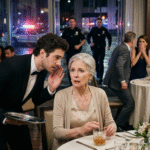
The front doors opened at seven seventeen.
Cold air swept through the marble foyer.
Sloane Mercer stepped inside.
She was thirty-one, blonde, delicate, and very aware of the effect of her own entrance.
She wore a pale blue cashmere coat over a cream dress, diamond drops at her ears, and my mother’s gloves on her hands.
For one second, the room disappeared.
I saw only the gloves.
The pearl buttons.
The soft crease at the knuckles.
The small repair my mother had sewn near the right index finger after our old terrier mistook one glove for a toy.
My breath did not catch.
My glass did not fall.
I did not give Adrian the satisfaction of seeing me break.
I looked at him.
He was already watching me.
His expression changed for less than a heartbeat.
Recognition.
Fear.
Then calculation.
He knew exactly what Sloane was wearing.
He had watched me open the cedar-lined drawer where I kept my mother’s belongings.
He had seen me touch those gloves every year on the anniversary of her death.
Once, during the first winter of our marriage, he had placed them in my lap and told me that grief was love with nowhere to go.
Now he lifted his champagne and smiled.
That was his second mistake.
Margaret crossed the foyer to welcome Sloane.
My mother-in-law wore emerald velvet and a necklace that had survived three wars, two divorces, and one federal investigation.
She kissed Sloane’s cheek as though the young woman were a favored niece.
“Sloane, darling,” Margaret said.
“You look exquisite.”
Sloane lowered her eyes with practiced modesty.
“I wanted to make a respectful impression.”
Then Margaret noticed the gloves.
“Oh, those are lovely.”
Her voice carried easily through the room.
“Vintage?”
Sloane turned one hand beneath the chandelier.
The pearls caught the light.
“They belonged to someone important.”
Her gaze moved to me.
She touched each finger slowly, smoothing the leather as if enjoying the warmth of a private joke.
Adrian took a sip of champagne.
He did not look away.
I walked toward them.
My heels made almost no sound on the marble, but conversations softened as I approached.
Sloane smiled.
“Evelyn.”
She said my name with the intimacy of someone who had spent months hearing it in my husband’s bed.
I stopped in front of her.
Up close, I could smell my own perfume on her coat.
Not the fragrance I wore now.
The discontinued rose-and-sandalwood scent Adrian had bought me for our tenth anniversary.
She had not only been inside my marriage.
She had been inside my dressing room.
Margaret glanced between us.
“You two have met?”
“Briefly,” I said.
Sloane’s smile sharpened.
“We’ve crossed paths.”
We had crossed paths forty-three days earlier at the Whitmore Grand in Manhattan.
She had been leaving the presidential suite at two in the morning wearing Adrian’s shirt beneath her coat.
I had been arriving with signed documents that would save his company from a hostile lender.
Adrian had told me she was a branding consultant.
Sloane had looked me in the eye and agreed.
That night, I had handed my husband the documents.
Then I had gone home and called my attorney.
Now Sloane extended her gloved hand.
“I’ve heard so much about you.”
I looked at the hand but did not take it.
“I’m sure you have.”
The smile around her mouth tightened.
Adrian stepped closer.
“Evelyn, don’t make this uncomfortable.”
He said it quietly.
Not because he cared about my dignity.
Because powerful people were watching.
I turned toward him.
“You brought your employee to a family dinner.”
“Sloane is no longer an employee.”
“Of course not.”
His jaw flexed.
Sloane moved her hand to his sleeve.
The gesture was small, possessive, and deliberately public.
Several guests looked away.
Others leaned closer without appearing to move.
Margaret placed one jeweled hand on my arm.
“This is not the evening for unpleasantness.”
I studied her face.
She knew.
Perhaps not about the gloves, but about the affair.
The new seating arrangement made sense.
Sloane’s name card had been placed beside Adrian’s.
Mine had been moved to the opposite end of the table.
They had planned a presentation.
Not merely of a mistress.
Of a replacement.
I looked toward the dining room.
The silver gleamed.
The candles burned.
The legal portfolio waited beside my plate.
“On the contrary,” I said.
“I think this is the perfect evening.”
Dinner began at seven thirty.
Margaret sat at the head of the table beneath a portrait of her late husband, Charles Whitmore.
Adrian sat on her right.
Sloane sat beside him.
I sat twelve feet away between a retired federal judge and Thomas Bell, the company’s longest-serving board member.
Adrian had placed me there to isolate me.
He had forgotten that power did not always sit beside the man making the speech.
Sometimes it sat quietly near the witnesses.
The first course was lobster consommé served in porcelain bowls edged with gold.
Margaret asked Sloane about her work.
Sloane explained that she was developing a wellness brand for luxury hotels.
She spoke about private retreats, feminine energy, and “redefining legacy for a younger generation.”
Adrian watched her with the indulgent smile he had once reserved for me.
“And how did you and Adrian begin working together?” Margaret asked.
Sloane looked at him.
“At the Miami property.”
My fingers rested lightly beside my spoon.
The Miami property had reported unexplained consulting expenses of six hundred and eighty thousand dollars.
I had already traced four payments to an LLC registered at Sloane’s apartment.
“He believed in my vision,” she continued.
Adrian reached for his wine.
“I believe in exceptional people.”
Thomas Bell looked down at his soup.
The retired judge beside me stopped eating.
Everyone at the table understood the sentence.
Only Adrian believed they admired him for saying it.
Margaret smiled tightly.
“Evelyn has always had an eye for talent as well.”
“I have an eye for patterns,” I said.
Adrian looked at me.
The second course arrived.
Sea bass, fennel, and saffron.
Sloane removed one glove to lift her wineglass.
She placed the glove beside her plate as casually as if it belonged there.
My mother’s initials were visible near the wrist.
C.A.V.
Cecilia Ashford Vale.
Thomas saw them.
His gaze moved to mine.
He had known my mother for twenty years.
His expression hardened.
Sloane noticed.
She slowly laid her bare hand over the initials.
“How beautiful,” Margaret said.
“Were they a gift?”
Sloane’s eyes stayed on me.
“Adrian gave them to me.”
The room became completely still.
Adrian’s face changed.
He had not expected her to say it aloud.
That was the problem with mistresses who believed themselves promoted.
They stopped protecting the men who had taught them to lie.
Margaret set down her fork.
“Adrian?”
He smiled, but the smile had begun to fracture.
“They were in a drawer at the city apartment.”
“The locked drawer,” I said.
His eyes met mine.
Sloane slid the second glove off.
“I hope you don’t mind.”
She folded them together with exaggerated care.
“Adrian said you never wore them.”
I looked at the gloves.
Then I looked at my husband.