## PART ONE — THE GIFT THAT WASN’T HIS
My mother’s slap did not hurt nearly as much as the look on my sister’s face when she held out her hand for the keys.
**“The penthouse, Elena.”**
Chloe spoke with the calm impatience of someone waiting for a valet to return her car.
She did not look at the blood warming my torn earlobe.
She did not look at our mother’s trembling hand.
She did not look at the two hundred wedding guests who had just watched our family split open beneath three crystal chandeliers.
She simply extended her palm.
**“Give me the keys.”**
Until that moment, I had believed there were certain humiliations a family would reserve for private rooms.
I was fifty-two years old, yet my parents had somehow managed to turn me into a disobedient child in the middle of the Grand Meridian ballroom.
My father still stood beside the wedding cake with his champagne glass raised.
A minute earlier, he had announced that my home would be his wedding present to Chloe and her new husband, Mason.
He had spoken in the warm, confident voice he used at charity dinners and bank meetings.
“Family takes care of family,” he had declared.
Several guests had applauded before they understood what he meant.
My father smiled toward the cameras.
Then he turned to me.
**“Elena, bring the keys.”**
A white satin box waited beside the seven-tiered cake.
Inside lay a silver key ring attached to a crystal tag engraved with the words **OUR NEW BEGINNING**.
The keys were decorative.
They did not belong to my building.
Nevertheless, Chloe had displayed them as though the deed had already been signed.
Mason had spent the cocktail hour telling guests that they would move into my penthouse after their honeymoon in Tuscany.
He had described my terrace, my library, and even the view from my bedroom.
He knew details I had never shared with him.
I remained seated at Table One, my hands folded over my clutch.
“That penthouse is not yours to give,” I said.
My father’s smile tightened.
He was seventy-six, silver-haired and handsome in the polished way of men who had never been required to apologize sincerely.
May you like
“Please do not embarrass the family.”
**“You announced a theft in front of two hundred witnesses.”**
I rose slowly.
**“You embarrassed yourselves.”**
A murmur traveled across the ballroom.
The string quartet stopped playing.
Chloe’s expression changed beneath her veil.
For one brief second, something that looked like fear passed through her eyes.
Then it disappeared.
“Stop being jealous,” she said.
Her voice carried farther than she intended.
“You live alone in an apartment with four bedrooms, and Mason and I are starting a family.”
The words found the oldest wound in me with surgical precision.
I had never married.
I had never raised a child.
My parents had reminded me of both failures at every Christmas dinner for thirty years.
“You are welcome to start a family wherever you can afford to live,” I replied.
My mother crossed the dance floor so quickly that the sequins on her gown flashed like warning lights.
Vivian Hart was seventy-three, but anger made her move with the speed of a much younger woman.
She stopped inches from me.
Champagne sweetened her breath.
“We paid for your education,” she whispered.
“We gave you every opportunity.”
“We made you.”
Her fingernails pressed into my wrist.
**“Hand over the keys.”**
The ballroom seemed to shrink around us.
I looked into the face that had taught me love was something earned through obedience.
“No.”
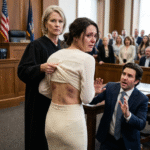
Her palm struck my cheek with a crack that silenced the room.
My head snapped sideways.
One diamond earring tore through my earlobe and skittered across the marble floor.
It stopped beneath Mason’s polished black shoe.
Someone gasped.
Near the dance floor, a woman raised her phone and began recording.
My mother straightened her shoulders as though she had merely corrected a child in church.
“Now give them to me.”
I crouched beside Mason.
He shifted his shoe, allowing me to retrieve the earring.
His face was pale.
His jaw was clenched.
For the first time that evening, he did not look like a triumphant groom.
He looked like a man waiting for something terrible to happen.
I picked up the diamond and slipped it into my clutch.
Blood ran down the side of my neck.
**“You should not have done that publicly,”** I told my mother.
My father laughed.
“What are you going to do, Elena?”
He spread his hands toward the guests.
“Are you going to sue your own mother?”
I looked at Chloe.
I searched her face for shame, concern, or even the smallest memory of the little girl who once crawled into my bed during thunderstorms.
She extended her hand again.
“The keys, Elena.”
Something inside me became very still.
I turned away from all of them.
No one tried to stop me as I walked through the ballroom.
Guests lowered their eyes.
Some moved aside with sympathy.
Others stared with the fascinated horror people reserve for house fires and public divorces.
Behind me, my father told the quartet to keep playing.
The musicians obeyed.
The first notes of a waltz followed me through the doors.
Outside, rain glazed the hotel steps.
Cold water touched the burning side of my face.
I stood beneath the awning and opened my clutch.
The torn earring rested beside my phone like a drop of frozen blood.
For three years, I had carried a telephone number I had been instructed to use only under one specific condition.
The number had arrived in an unmarked envelope shortly after my grandmother’s death.
Inside had been a single sentence written in her familiar blue ink.
**When they try to take your home, call Adrian Reed.**
I had assumed it was the warning of a dying woman whose mind had begun to fail.
Then a second envelope arrived six months later.
It contained a copy of a clause from an old family trust.
The legal language was dense, but one sentence had been underlined.
**Any attempt to obtain Elena Hart’s property through coercion, intimidation, fraud, or physical force shall immediately terminate the offenders’ beneficial interests and authorize the release of Schedule Seven.**
I had telephoned the number once.
A man answered but refused to explain Schedule Seven.
“Not yet,” he had said.
“When the clause is triggered, call me again.”
Now I pressed the number.
He answered on the first ring.
“Mr. Reed,” I said.
Across the hotel windows, camera flashes illuminated my family’s celebration.
**“They triggered the clause.”**
There was a brief silence.
Then I heard the scrape of a chair.
“Was the demand made in front of witnesses?”
“Approximately two hundred.”
“Was there physical force?”
“My mother slapped me.”
His breathing changed.
“Was it recorded?”
“Yes.”
His voice became cold.
“Preserve every photograph and video.”
“Do not delete messages.”
“Do not surrender your keys to anyone.”
“I will be there within the hour.”
I looked through the rain at the ballroom.
My father was dancing with Chloe while guests pretended nothing had happened.
“Mr. Reed?”
“My mother believes you are dead, doesn’t she?”
Another silence followed.
This one lasted longer.
**“She has believed that for seventeen years.”**
The call ended.
For the first time that evening, I smiled.
Inside, the orchestra swelled.
My family mistook the music for victory.
They were still dancing when the black car arrived fifty-three minutes later.
A tall man stepped onto the hotel pavement carrying a leather briefcase.
He appeared to be in his late sixties.
One side of his face was marked by a pale scar that disappeared beneath his collar.
He paused beside me.
“Elena Hart?”
He studied the blood on my neck.
“Your grandmother said your mother would eventually become careless.”
He opened the ballroom doors.
The music faltered as we entered.
My father stopped dancing.
Chloe lowered her bouquet.
My mother stared at the scarred man beside me.
The color drained from her face.
Her champagne glass slipped from her fingers and shattered.
For several seconds, Vivian Hart could not speak.
Then she screamed.
**“You’re dead!”**
Adrian Reed placed his briefcase on the nearest table.
“No, Vivian.”
His voice carried across the ballroom.
**“But after tonight, everything you stole may finally be returned to the people you stole it from.”**
## PART TWO — SCHEDULE SEVEN
My mother backed away from Adrian Reed as though he had emerged from a grave.
“You died on Route Nine,” she said.
Adrian removed his wet overcoat.
His movements were unhurried.
“My car went over an embankment.”
“It burned.”
“You were inside.”
“I was thrown through the windshield before the fire reached the cabin.”
He touched the scar beside his jaw.
“A fisherman found me before your people did.”
My father stepped between them.
“Who is this man?”
“You know exactly who I am, Richard.”
Adrian opened his briefcase.
He removed three thick envelopes and placed them on the table.
One bore my father’s name.