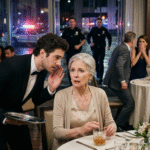
My husband’s mistress lifted a crystal flute on the most exclusive veranda in Charleston and toasted “the woman who taught Grant exactly what he didn’t want.”
She was sitting in my chair.
My husband laughed so loudly that every face beneath the striped silk awning turned toward us.
Sloane Avery touched his cheek with one manicured hand and smiled at me as if she had already chosen the wallpaper for my bedroom.
“He deserves peace after surviving you,” she said.
The humiliation struck me cleanly, like cold water thrown against marble.
Then it passed through me without landing.
I looked at my husband, at the woman wearing the diamond bracelet he had once told me was delayed in Paris, and finally at the waiter standing beside our table with the leather bill folder trembling in his hand.
I smiled.
“Peace can pay for itself.”
PART ONE — THE WOMAN AT MY TABLE
The brunch was supposed to celebrate the tenth anniversary of Mercer House Hospitality.
Grant had sent me a text that morning telling me to wear ivory because photographers would be there.
I wore a cream Carolina Herrera dress, my grandmother’s pearl earrings, and the face of a woman who had not slept in thirty-six hours.
At 2:13 the previous morning, an email had arrived from an address I did not recognize.
The subject line contained only three words.
YOU SHOULD KNOW.
Inside were hotel receipts, private flight manifests, photographs, restaurant reservations, and six months of messages between my husband and Sloane.
There was also an audio file.
I had listened to it once in the darkness of our bedroom while Grant slept beside me.
His voice came through first, low and amused.
“Evelyn still believes the company is hers because her family started it.”
Sloane laughed.
“What happens when she finally understands?”
“She won’t.”
There was the sound of ice moving in a glass.
“My name is on everything that matters now,” Grant continued.
“She can keep the old portraits and the tragic Southern-wife routine.”
Sloane asked whether I would fight him.
Grant’s answer was immediate.
“Evelyn doesn’t fight.”
He had been right about one thing.
May you like
I did not fight.
Fighting was loud, emotional, and uncertain.
I preferred documents.
By sunrise, I had copied every attachment to three encrypted drives.
At seven, I called Miriam Vale, the attorney who had written my grandfather’s estate plan and later drafted my prenup.
At eight, I met her in the private conference room above the old Citizens Bank building on Broad Street.
At nine-thirty, I signed nothing.
That was the part Grant never understood about power.
Power was not always the moment a woman signed her name.
Sometimes it was the moment she refused.
When I arrived at the Mariner’s Veranda shortly after eleven, the maître d’ avoided my eyes.
That told me Grant had planned the seating before I stepped out of the car.
Our anniversary table stood at the center of the veranda beneath white roses and a banner bearing the Mercer House crest.
There were board members, investors, local politicians, society editors, and women who had attended my wedding at St. Michael’s Church ten years earlier.
My place card had been removed.
Sloane sat beside Grant in the chair reserved for the founder’s family.
She wore pale blue silk and the diamond bracelet.
My husband’s mother, Charlotte Mercer, occupied the seat across from them.
She watched me approach with the expression of a woman witnessing a servant carry the wrong tray.
“There you are,” Grant said.
He did not stand.
No one moved to make room.
The photographer near the railing slowly lowered his camera.
Sloane tilted her head.
“Oh, Evelyn, I hope this isn’t awkward.”
Her voice was sweet enough to disguise the blade.
I looked at the empty chair at the far end of the table.
It had been placed near the service station, half behind a potted palm.
Grant gestured toward it.
“We saved you a seat.”
A few people looked down.
A few looked directly at me because cruelty becomes entertainment when the room is expensive enough.
I walked past the chair.
The waiter met my eyes.
His name was Daniel, and he had worked at the Mariner’s Veranda since before Grant and I were married.
I had paid for his mother’s heart surgery through the employee relief fund two years earlier.
He looked ashamed.
“Mrs. Mercer,” he whispered.
“It’s all right, Daniel.”
It was not all right.
That was why I could afford to be calm.
I took the unused chair from the neighboring table and placed it at the head.
The scrape of its legs against limestone silenced the veranda.
Grant’s jaw tightened.
“That seat is for the chairman.”
“I know.”
At the time, Grant believed he was chairman.
He had believed it for three years.
I sat.
Lunch began badly and deteriorated with precision.
Grant spoke about expansion, legacy, and the future of Mercer House Hospitality.
He announced a new flagship property in Napa, though the land had not closed and the financing had not been approved.
He thanked Charlotte for “raising him to recognize loyalty.”
He thanked Sloane, introduced as Mercer House’s new creative strategy consultant, for bringing “fresh energy” to the brand.
He did not thank me.
No one mentioned that the first Mercer House had belonged to my great-grandmother.
No one mentioned that the company’s original capital came from my family trust.
No one mentioned that Grant had joined the business five years after our wedding with one polished résumé and several impressive debts.
Sloane kept touching him beneath the table where she thought I could not see.
I watched her fingers settle against his wrist.
There had been a time when that small intimacy would have broken me.
There had been a time when I believed marriage was protected by memory.
I had been twenty-eight when I met Grant at a charity auction in Savannah.
He was charming without appearing eager, ambitious without appearing hungry, and attentive in the specific way lonely women mistake for devotion.
My father had died that spring.
My mother was already fading from early-onset Alzheimer’s.
Grant arrived when grief had emptied rooms inside me.
He filled them quickly.
He remembered how I took my coffee.
He read books because I mentioned them.
He drove three hours to bring my mother gardenias at the memory-care residence.
When he proposed beneath the live oaks at Magnolia Plantation, I thought the universe had returned something it had taken.
At our wedding, my grandfather held my hand before walking me down the aisle.
“Never hand someone the keys simply because they promise to protect the house,” he told me.
I had laughed and kissed his cheek.
“I’m marrying him, Granddad, not merging with him.”
My grandfather did not laugh.
Two months later, he made me sign the prenup.
Grant had signed too, smiling as though the document were ceremonial.
He had not read the schedule of inherited assets.
He had not asked why the company shares were held through three separate trusts.
He had only cared that I loved him enough to appoint him chief operating officer after our honeymoon.
By our fifth anniversary, he was chief executive.
By our seventh, he had convinced the board to call him chairman in press releases.
By our tenth, he had forgotten that a title printed on stationery was not the same as legal control.
The champagne arrived before noon.
Grant stood for the official anniversary toast.
“To endurance,” he said.
Everyone lifted a glass.
Then Sloane rose.
She was not nervous.
Mistresses are often most confident in the hours before they receive the full invoice.
“I hope you’ll forgive me for adding something personal,” she began.
Grant smiled up at her.
Charlotte Mercer’s eyes gleamed.
Sloane turned toward me.
“To the woman who taught Grant exactly what he didn’t want.”
The veranda went still.
Sloane continued.
“Some relationships show us love, and others show us what surviving without love feels like.”
Grant laughed.
It was a huge, careless sound.
That laugh ended our marriage more completely than the photographs had.
Sloane touched his cheek.
“He deserves peace after surviving you.”
The toast hung in the warm coastal air.
Beyond the railing, the harbor flashed silver beneath the sun.
A violinist near the fountain stopped playing.
I felt every eye on my face.
They were waiting for tears.
Grant was waiting for anger.
Sloane was waiting for collapse.
Charlotte was waiting for proof that I had always been too fragile to belong at the table my family built.
Instead, I noticed the waiter holding the bill.
I held out my hand.
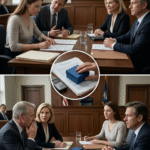
Daniel placed the folder in front of me.
The total was twelve thousand, eight hundred and forty-six dollars.
Grant had ordered three bottles of vintage Krug, two seafood towers, imported caviar, and personalized gift boxes for every guest.
The reservation had been secured using my private club account.
The card on file was mine.
I removed it.
Grant’s smile faded.
“What are you doing?”
I handed the folder back to Daniel.
“Please divide the bill among Mr. Mercer and his guests.”
Sloane blinked.
Grant stared at me.
I stood, smoothed my dress, and picked up my handbag.
“Evelyn,” he said quietly.
The warning in his voice would once have worked.
It sounded small now.
I looked at him.
“You wanted peace.”
My gaze moved to Sloane.
Then I walked away from the table.
No one laughed.
I crossed the veranda while the city’s most important people pretended not to watch.
At the entrance, the maître d’ hurried toward me.
“Mrs. Mercer, there seems to be some confusion.”
“There isn’t.”
He lowered his voice.
“Mr. Mercer said the event was being charged to the owner’s account.”
“It was.”
I took a folded letter from my bag.
The hotel’s embossed seal appeared at the top.
“Effective this morning, no expense authorized by Grant Mercer is to be charged to the owner’s account without my written consent.”
The maître d’ read the first line.
His face changed.
“Yes, Ms. Hart.”
He used my maiden name.
That was how I knew Miriam had already called.
Outside, my driver opened the door of the black sedan.
I climbed in without looking back.
Only after we turned onto East Bay Street did I let myself breathe.
My hands were shaking.
I pressed them against my knees until they stopped.
Strength is often described as not feeling pain.
That is a lie told by people who have never been required to remain elegant while their heart is publicly dismantled.