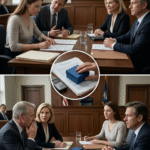
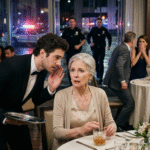
The woman sleeping with my husband sat in my chair at my family’s private jewelry appraisal and asked which heirlooms would best suit her skin tone.
The appraiser stopped breathing.
My husband merely adjusted his cuff links and said, “Celeste is only curious.”
Celeste Vaughn leaned over the velvet table as if the women in my bloodline had spent three generations collecting diamonds for her convenience.
Her manicured finger hovered above my grandmother’s sapphire collar.
Twenty-seven Ceylon sapphires rested in a river of old European-cut diamonds, each stone dark and luminous beneath the chandelier.
“Blue makes me look expensive,” she said.
I looked at the appraisal ledger.
Then I looked at the woman trying to shop through my bloodline.
“Expensive does not mean available.”
PART ONE
THE WOMAN IN MY SEAT
The appraisal was being held in the winter salon of Ashford House, my family’s limestone mansion on East Seventy-Third Street.
The room had been designed for silence.
Cream silk walls absorbed every whisper, and the tall windows framed Central Park beneath a layer of February snow.
My grandmother used to say that real wealth never needed to raise its voice.
That morning, I finally understood what she meant.
Celeste withdrew her hand from the sapphire collar and smiled at me.
It was not an embarrassed smile.
It was the soft, polished smile of a woman who believed she had already won.
She wore winter white, though it was not her color.
The dress was cashmere, the bag was Hermès, and the diamond studs in her ears had been purchased from an account my husband thought I never checked.
I had checked it.
I had checked everything.
Grant stood behind her with one hand resting on the back of my chair.
He had not touched me like that in eleven months.
“Vivian,” he said, using the patient tone people reserve for children and unstable women, “there’s no need to make this uncomfortable.”
I almost admired him.
It takes a particular kind of arrogance to bring your mistress into your wife’s ancestral home and complain about the atmosphere.
Nathaniel Cole, the appraiser from Sotheby’s, kept his eyes on the velvet tray.
He had known my family for thirty years.
May you like
He appraised my mother’s wedding tiara after her death, and he cataloged my grandmother’s collection before the Metropolitan Museum borrowed six pieces for an exhibition.
He understood exactly what Celeste did not.
These jewels were not decorations.
They were records.
Each one carried a marriage, a funeral, a betrayal, or a survival.
The ruby brooch had crossed the Atlantic inside my great-grandmother’s coat during the winter of 1941.
The pearl rivière had paid the legal fees that saved Ashford Steel from a hostile takeover in 1978.
The sapphire collar had been commissioned for my grandmother, Beatrice Ashford, after she became the first woman to chair the Ashford Foundation.
She wore it the night she removed her own brother from the board.
I had always thought that story was unnecessarily cold.
That morning, I found it comforting.
Grant walked toward the drinks cabinet.
“It’s just jewelry,” he said.
Nathaniel’s head lifted.
Grant did not notice.
Men like my husband rarely notice the moment respect leaves a room.
Celeste crossed her legs.
“I told him I didn’t want to intrude,” she said.
Her voice was sweet enough to poison tea.
“Did you?”
“Of course.”
“Then why are you here?”
Grant poured himself bourbon at ten in the morning.
“We have a charity gala next month,” he said.
I looked at him.
He did not blink.
“The Heritage Atlantic Centennial Gala,” he continued, “and Celeste is overseeing the event.”
Celeste gave me a small, victorious tilt of her chin.
That explained the white dress.
She wanted to look like a bride without the inconvenience of a wedding.
Grant returned to the table.
“The sapphire collar would photograph beautifully,” he said.
Nathaniel closed the appraisal ledger.
The click of the leather cover sounded like a gun being cocked.
“It is not available for commercial use,” he said.
Grant laughed.
“It belongs to my wife.”
“No,” Nathaniel replied.
The room became very still.
Grant’s smile remained, but something underneath it changed.
Nathaniel turned toward me.
“Mrs. Reed, would you like me to continue?”
“Yes.”
Grant stepped closer.
“What do you mean, no?”
Nathaniel’s expression was professionally blank.
“The Ashford Collection is held by the Beatrice Vale Ashford Irrevocable Trust.”
Grant looked at me.
I let him.
“Vivian is the beneficiary,” he said.
“She is the sole beneficiary and acting trustee,” Nathaniel replied.
Celeste’s eyes moved from the necklace to me.
Grant set his glass down too hard.
“I’m her husband.”
Nathaniel offered the faintest smile.
“I am an appraiser, Mr. Reed, not a marriage counselor.”
For one beautiful second, no one spoke.
Then Grant laughed as if the entire thing amused him.
“Fine,” he said.
He placed his hand on Celeste’s shoulder.
“We’ll discuss it privately.”
“There’s nothing to discuss.”
His eyes sharpened.
I had seen that look in boardrooms, restaurants, and the private elevator of our penthouse.
It was the look he used when charm failed and control had to take its place.
“We’ll discuss it at home.”
“We are home.”
He glanced around the salon.
Ashford House had been empty for four years, but it had never stopped being mine.
Grant hated the mansion.
He said it was too formal, too old, and too full of dead women.
He preferred our glass penthouse downtown, where every surface reflected him.
Celeste stood.
“Grant, maybe I should leave.”
She made no move toward the door.
“Yes,” I said.
Her smile tightened.
She reached for her coat, and I noticed the bracelet on her wrist.
A thin diamond serpent with emerald eyes.
My mother’s bracelet.
The room blurred for half a heartbeat.
Grant saw me looking.
His hand instinctively covered Celeste’s wrist.
That movement hurt more than the bracelet.
Not because he had given it to her.
Because he knew exactly what he had taken.
My mother wore that bracelet every Christmas.
She let me fasten it around her wrist when I was six, though my fingers were clumsy and the clasp was delicate.
After she died, I placed it in the private safe at our penthouse.
Only Grant and I knew the code.
“Take it off,” I said.
Celeste looked down.
“This?”
Grant stepped between us.
“I gave it to her.”
“It wasn’t yours to give.”
“You never wore it.”
The sentence landed with such casual cruelty that Nathaniel looked away.
I remembered my mother’s hand resting against a hospital blanket.
I remembered the bracelet flashing beneath fluorescent light while she signed the final documents transferring her voting shares to me.
I remembered Grant standing beside the bed, holding my shoulders while I cried.
He had known what the bracelet meant.
He had taken it anyway.
Celeste slowly unfastened it.
She placed it on the velvet table beside the sapphires.
“Honestly,” she said, “I thought it was new.”
It was the kind of lie designed to insult both of us.
She wanted me to know she understood its history.
She wanted me to know Grant had told her.
I picked up the bracelet and closed my fingers around it.
“Now you know.”
Grant’s jaw flexed.
“We’re leaving.”
He guided Celeste toward the door with his palm against her lower back.
At the threshold, she looked over her shoulder.
“For what it’s worth, Vivian, I never wanted to hurt you.”
Women like Celeste always say that after entering through a door they knew was locked.
I met her eyes.
“For what it’s worth, you haven’t.”
The lie was smooth.
It sounded expensive.
She believed it.
Grant did not.
After they left, Nathaniel poured me the bourbon Grant had abandoned.
I did not drink it.
“How long have you known?” he asked.
“About her?”
He nodded.
“Seven weeks.”
“And the bracelet?”
“Seven seconds.”
His face softened.
I hated pity, especially from kind men.
“Mrs. Reed—”
“Vivian.”
“Vivian, should I postpone the appraisal?”
“No.”
Outside, snow drifted past the windows.
Inside, my grandmother’s jewels waited beneath white light.
“Appraise everything,” I said.
Nathaniel opened the ledger again.
He began with the emerald tiara.
I sat in the chair Celeste had warmed and listened as he described carat weights, provenance, insurance value, and market conditions.
My marriage ended quietly between an emerald tiara and a pair of diamond mourning combs.
There were no screams.
No broken glasses.
No mascara running down my face.
Only numbers.
Nine hundred thousand.
One point four million.
Three point eight million.
By noon, the full Ashford Collection had been valued at forty-two million dollars.
Grant believed that was the most important number in the room.
He was wrong.
The most important number was fifty-four.
Fifty-four percent was the share of Heritage Atlantic Holdings controlled by the Ashford Family Trust.
Grant had spent fourteen years introducing himself as the founder and chief executive of a luxury real estate empire.
What he never mentioned was that my family’s money had saved his first development from bankruptcy.
He also never mentioned that my grandmother had demanded equity in return.
Grant called the agreement symbolic.
Grandmother called it insurance.
For years, I allowed him to vote the trust’s shares by proxy.
I told myself it was partnership.
He told himself it was ownership.
Both of us had been lying.
When Nathaniel finished, I signed the appraisal report.
Then I called my attorney.
Maya Whitcomb answered on the first ring.
“Tell me you’re ready,” she said.
I looked at the sapphire collar.
“I’m ready.”
PART TWO
THE SIGNATURE HE FORGED
Maya arrived at Ashford House forty-three minutes later wearing a camel coat over a navy suit.
She was five feet three inches tall and had once made a federal prosecutor apologize to her in open court.
My grandmother adored her.
Grant feared her enough to call her aggressive, which was the word powerful men used when a woman understood paperwork better than they did.
Maya placed two leather folders on the salon table.
“The first is your marriage,” she said.
“And the second?”
“His funeral.”
I looked at her.
“Metaphorically.”
“I assumed.”
“Mostly.”
She opened the first folder.
Our prenuptial agreement lay inside.
Grant and I signed it three days before our wedding at Saint James Church.
I had been twenty-eight, in love, and embarrassed by the wealth attached to my name.
Grant had been thirty-two, charming, ambitious, and offended that anyone might question his intentions.
He kissed my forehead after signing.
“I’ll never give you a reason to use this,” he said.
Fourteen years later, Maya tapped Section Eleven with one crimson fingernail.
“The infidelity clause is straightforward,” she said.
“No claim to Ashford assets, no continued residence in trust-owned property, no spousal support, and forfeiture of any unvested financial interests derived from your family.”