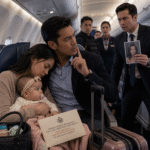
Before I could respond, his phone vibrated.
He read the message.
The warmth left his face.
“What is it?” I asked.
He looked toward Emilia first, then back at me.
“Someone is waiting inside the airport with your photograph.”
The Man in the Gray Suit
The plane touched the runway while my pulse climbed into my throat.
“Who?” I whispered.
Gabriel turned his phone toward me. On the screen was a still image from an airport security camera. A man in a gray suit stood near baggage claim, holding up a photograph of me with Emilia in my arms.
Tomás.
He wore the same silver watch I had given him after Emilia was born. The photograph on his phone had been taken outside our pediatrician’s office less than three weeks earlier.
“How did he know?” I said.
Gabriel’s voice remained calm. “Who knew about your flight?”
“My cousin. One old friend.”
“Anyone connected to him?”
I thought of Camila Ortega, who had sent me three sympathetic messages after the separation. She had asked where I was going, whether I was safe, what time my flight left.
My stomach turned.
“He must have someone watching me.”
The cabin door opened, but Gabriel lifted one hand before I could stand.
“Stay seated.”
Passengers filed out slowly, many glancing back. When the cabin was nearly empty, three men in dark suits entered. The first was broad-shouldered with a scar near his left eyebrow.
“Señor Villaseñor,” he said.
“Report.”
“The man has spoken to two airline employees and one private driver. He has also contacted airport police claiming his daughter was abducted.”
My hands went cold.
“That’s a lie.”
The security chief looked at me. “Do you have custody documents?”
“The divorce isn’t final. We have no temporary order yet.”
Gabriel’s jaw tightened. “Then he came prepared to create confusion.”
The security chief handed him a tablet. “There is more. He has a woman monitoring passenger exit points. We identified her as Renata Solís.”
The name hit like a second blow.
Tomás had brought his mistress.
Not for love.
For strategy.
“He took everything,” I said before I could stop myself. “The apartment. The accounts. My jewelry. What else could he possibly want?”
Gabriel looked at Emilia.
“He did not take everything.”
I followed his gaze.
“No.”
His voice lowered.
“He came for her.”
The words entered the air quietly and changed everything.
Emilia stirred against me, one hand closing around the collar of my blouse. I had spent weeks thinking Tomás wanted to erase us.
Now I understood.
He wanted to keep the part of us that still had value.
The security team moved us through the aircraft galley and down a private stairway to the tarmac. Three black SUVs waited beyond a secured gate, engines running. There were no photographers, no crowds, only men with earpieces scanning the perimeter.
Gabriel opened the rear door himself.
“You and Emilia ride with me.”
“I can’t involve you in this.”
He looked back toward the terminal.
“You were involved before we met.”
I hesitated.
Three hours earlier, I had not known his last name.
Now armed men were shielding my child from her father.
“Why are you helping me?”
Gabriel’s expression softened, but only slightly.
“Because someone once helped me when I had nowhere safe to go.”
I got into the SUV.
As the convoy left the airport, I watched the terminal shrink behind us and wondered whether I had escaped danger or simply entered a more expensive version of it.
The Trust Hidden in a White Envelope
Tomás did not love Emilia enough to search airports.
That realization hurt in a place betrayal had not yet reached.
I sat beside Gabriel while the city spread around us in ribbons of traffic and glass towers. Emilia slept with her rabbit pressed beneath her chin. The security chief, Andrés Leal, sat in the front passenger seat speaking quietly into a headset.
Gabriel studied me for several minutes before asking, “Do you know of any inheritance connected to your daughter?”
“No.”
“A trust?”
I almost said no again.
Then I remembered the white envelope.
It was inside my carry-on beneath Emilia’s vaccination records. My late grandfather, Joaquín Navarro, had handed it to me during his final birthday dinner. He had kissed Emilia’s forehead and told me to keep the envelope somewhere Tomás could not reach.
I had opened it once.
The language was legal and dense. Tomás laughed when I showed him.
“Your grandfather liked theatrical paperwork,” he said. “The trust is symbolic. It cannot be touched until she is thirty.”
I believed him.
I had been trained to believe him.
I pulled the envelope from my bag.
Gabriel read the first page, then stopped.
“Isabela, this is not symbolic.”
My skin prickled.
“What does it mean?”
He handed the document to Andrés, who scanned it quickly.
“Your grandfather placed forty-eight million pesos into a protected trust for his first great-grandchild,” Gabriel said. “The principal remains locked, but annual distributions may be authorized for healthcare, education, housing, and welfare.”
“That’s impossible.”
“It also says both legal parents must approve any change of trustee while the child is a minor.”
I stared at him.
“Tomás told me the money couldn’t be used.”
“He lied.”
The SUV seemed to narrow around me.
Gabriel continued, “If he gains physical custody and persuades a court that you abandoned the child, he may try to replace you as co-controller or pressure the appointed trustee.”
“For forty-eight million pesos.”
“For access to it.”
I looked down at Emilia.
Tomás had changed her diapers twice in ten months. He complained when she cried during football matches. He told me babies became interesting after they learned to speak.
And now he was hunting her through an airport.
Not because she was his daughter.
Because she had an account number.
I pressed my lips against her hair.
“He is not taking her.”
Gabriel’s gaze held mine.
That was the first moment he saw something in me other than fear.
“Good,” he said. “Then we begin there.”
The House Behind the Iron Gates
My cousin’s apartment in Santa Paloma was no longer safe.
Lucía documented her entire life online. Her breakfast, her commute, the shoes she wore to work, the street outside her building. Tomás would find me within hours.
Gabriel offered me a guest suite at his residence in Lomas del Encino until his legal team could contact a family attorney.
I refused twice.
The third time, he said, “You do not owe me trust. But your daughter deserves security while you decide whom to trust.”
That was harder to argue with.
The Villaseñor residence stood behind iron gates and jacaranda trees on a private road above the city. It was built of pale stone and dark glass, with long terraces overlooking the valley. Water moved silently through a narrow reflecting pool near the entrance.
The house was enormous.
But it did not feel alive.
No music drifted through the halls. No family photographs covered the walls. There were no shoes near the doors, no half-finished cups on side tables, no evidence that anyone ever entered a room without permission.