By noon, Elena had secured an emergency temporary custody order. Tomás was prohibited from removing Emilia from the city or approaching the residence without authorization. A judge also ordered both parties to preserve financial and electronic records.
It was not victory.
But it was the first locked door Tomás could not replace.
While Elena worked, I searched through Emilia’s things. My grandfather had given her the white rabbit doll the week before he died. He had sewn the missing ear back on himself after our dog tore it.
The stitching felt thicker than I remembered.
I opened the seam carefully.
Inside was a folded strip of paper wrapped in plastic.
Twelve digits.
A date.
And one sentence in my grandfather’s handwriting.
When they tell you the money is gone, begin here.
I carried it to Gabriel’s study.
Andrés entered the number into a secure banking database. The screen returned a dormant custodial account at Meridian Crown Bank, opened in my grandfather’s name and linked to the trust.
Balance: 8.4 million pesos.
No withdrawals.
No listed beneficiary.
Only a restricted note requiring presentation of the original trust instrument and proof of lineage.
Elena stared at the screen.
“This is separate from the forty-eight million.”
“Why hide it in a toy?” I asked.
Gabriel’s face was unreadable.
“Because he believed someone would search his files.”
Andrés opened another record. “There was an attempted access request eleven months ago.”
“By whom?”
He enlarged the authorization signature.
Tomás Cárdenas.
My former husband had known about the hidden account before I did.
He had forged my consent.
The room became very quiet.
She got the photographs.
I got the account number.
The Company Behind the Marriage
The forensic review moved quickly after that.
The dormant account connected to Orbe Norte Consultores. Orbe Norte connected to a real estate fund called Aurelius Crest. Aurelius Crest had once been co-owned by Joaquín Navarro and Gabriel’s father, Esteban Villaseñor.
Twenty years earlier, the company collapsed after forty million pesos disappeared during a land acquisition. Joaquín took public blame. Esteban avoided prosecution but ended the partnership.
My grandfather spent the rest of his life rebuilding what he lost.
Gabriel spent his childhood hearing that Joaquín had betrayed his family.
The records told a different story.
Esteban Villaseñor had authorized the transfer.
Joaquín had hidden copies of the original ledgers.
Tomás found them after marrying me.
“He did not marry you because of the trust,” Andrés said during a meeting three days later. “Not at first.”
I looked up.
“He married you because your grandfather still possessed evidence capable of reopening claims against Aurelius Crest.”
My stomach tightened.
“And when my grandfather died?”
“Tomás gained access to the house, the archives, and eventually the trust documents.”
Gabriel stood near the window, one hand in his pocket.
“My father died believing Joaquín stole from him.”
“Did he?”
“No.”
The word cost him something.
He turned toward me. “My father stole from yours.”
No one moved.
The truth sat between us with the weight of inheritance.
I had entered Gabriel’s life by sleeping on his shoulder.
Now our families were tied by fraud, shame, and money older than both of us.
“I’m sorry,” he said.
“You didn’t do it.”
“No. But I benefited from the company built afterward.”
I understood then why power exhausted him. He had inherited an empire and the ghosts hidden beneath it.
“What will you do?” I asked.
“Open the records.”
Andrés looked sharply at him. “That could trigger claims against Villaseñor Capital.”
“I know.”
“Publicly?”
Gabriel looked at me.
“Truth that only survives in private is still being held hostage.”
That was the first time I understood why strangers feared his name.
Not because he was rich.
Because once he made a decision, even his own empire had to move around it.
The Hearing Where Tomás Smiled
Tomás entered family court wearing a charcoal suit, a burgundy tie, and the expression of a man who believed charm was admissible evidence.
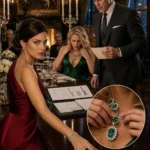
Renata sat behind him in a cream dress with my emerald earrings at her throat.
She had worn them deliberately.
Public humiliation only works when the victim still accepts the role.
I did not look away.
Elena sat beside me with three folders arranged in precise order. Gabriel was not in the courtroom. He had stayed away because Tomás’s attorney intended to argue that I had been manipulated by a powerful stranger.
Tomás looked at me across the aisle and smiled.
“You look rested,” he murmured.
“I finally am.”
The hearing began with his attorney accusing me of fleeing the marital residence, concealing our daughter, and accepting inappropriate assistance from an unrelated man.
Elena listened without interrupting.
Then she stood.
“Your Honor, my client did not flee. Mr. Cárdenas changed the locks, restricted her access to marital funds, and placed her belongings outside the home. He then tracked her flight, appeared at the airport with a photograph of the minor child, and falsely alleged abduction before any custody order existed.”
She submitted the airport footage.
Tomás’s smile faded slightly.
Elena continued.
“We also have evidence that Mr. Cárdenas attempted to access two trusts created for the child, using a forged signature attributed to my client.”
His attorney rose. “Objection. Financial matters are outside the scope of temporary custody.”
“They become relevant when a parent’s motive for seeking custody is financial.”
The judge looked over her glasses. “Proceed carefully.”
Elena opened the second folder.
Bank requests.
Forged authorizations.
Shell company transfers.
The hidden account number.
Tomás’s face changed page by page.
Then came the photograph from the notary’s office.
Me signing documents while smiling at him.
He had kept his hand on my shoulder that day.
I remembered thinking it was affection.
Now I knew he was holding me in place.
Elena turned toward him.
“Mr. Cárdenas, did you tell your wife these documents concerned health insurance?”
His attorney whispered urgently.
Tomás answered anyway.
“I don’t remember.”
“You remembered well enough to submit her signature eleven months later.”
“I acted for my daughter.”
“No. You acted for liquidity.”
A murmur moved through the courtroom.
Renata lowered her eyes.
Elena placed the final document on the display screen: Tomás’s debt schedule.
Sixty-three million pesos owed to private lenders.
One payment due in twelve days.
The judge studied him.
“Mr. Cárdenas, did you disclose these liabilities in your custody petition?”
“No, Your Honor.”
“Did you attempt to access a trust established for the child?”
“I was exploring options.”
The judge’s expression hardened.
“Your daughter is not an option.”
The sentence landed harder than any shout.
Temporary sole physical custody remained with me. Tomás received supervised visitation pending financial and psychological review. His passport was flagged in relation to Emilia’s travel. The court referred the forged authorization to prosecutors.
Renata left before the hearing ended.
She did not take the earrings off.
But she did not wait for him either.
The Gate He Could Not Cross
That evening, Tomás came to the Villaseñor residence despite the order.