The room went silent.
Not quiet.
Silent.
The kind of silence that has weight.
Vanessa’s lips parted. “That’s illegal.”
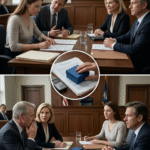
Dana answered immediately. “Illinois is a two-party consent state in many circumstances. This recording was captured through Mr. Whitaker’s active call on the Whitaker home office system after both parties were notified on the device that calls may be recorded for security and business archival purposes. We can discuss admissibility later. Tonight, it is relevant to authorization risk.”
The retired judge leaned back slowly, saying nothing.
But his expression said plenty.
Vanessa looked around the table, searching for sympathy.
She found none.
Not even from Patricia.
Grant whispered, “I didn’t know she said that.”
I stared at him.
“You were on the call.”
“I didn’t remember.”
“That isn’t better.”
His face folded slightly.
For the first time all evening, I saw the man I had married under the man he had become. Not innocent. Not redeemable in that moment. Just smaller than I remembered.
And terribly late.
Mariel cleared her throat.
“Mrs. Whitaker,” she said, “given the dispute, Aster & Vale requires your decision regarding the liquidity authorization.”
All eyes turned to me.
Vanessa’s hands clenched in her lap.
Grant leaned forward. “Evelyn, please. The Palm Beach deal is time-sensitive. If we lose it, the board will panic.”
Richard Bell’s voice was cold. “The board is already panicking.”
Grant ignored him.
“Ev,” he said, using the name he had whispered when Lily was born, when my mother died, when we moved into the Lake Forest house and painted the nursery yellow. “Don’t let our personal issues destroy everything.”
Personal issues.
I thought of Vanessa in my seat.
I thought of Lily’s fever.
I thought of Howard asking whether I needed permission to breathe.
I thought of every woman at every table who had ever been told to swallow humiliation so a man’s reputation could stay clean.
Then I picked up the liquidity release.
Grant’s eyes filled with desperate hope.
Vanessa saw it too.
And hated me for it.
I read the first page slowly, although I already knew every line.
Then I set it down.
“I do not authorize the release.”
Grant went white.
Vanessa shot to her feet. “You vindictive—”
“Careful,” Dana said.
Vanessa turned on her. “No, I’m done being careful. She’s jealous. That’s all this is. She lost her husband and now she’s trying to ruin him.”
I looked up at her.
“I didn’t lose him,” I said. “He left. There’s a difference.”
Her mouth twisted. “He loves me.”
“Maybe,” I said. “But love won’t unlock the reserve.”
Mariel lifted the second document. “Mrs. Whitaker, there is also the matter of emergency control.”
Grant’s head snapped toward her.
“What emergency control?” Patricia asked.
Dana answered, “Under the 2016 postnuptial amendment and Howard Whitaker’s trust structure, verified misuse of company funds for undisclosed personal benefit triggers temporary suspension of Mr. Whitaker’s unilateral executive access to reserve-backed facilities pending board review.”
Richard Bell stared at Grant.
Patricia whispered, “Howard did this?”
“No,” I said. “Grant did this. Howard merely anticipated it.”
That was the line that finally broke him.
Grant sat down as if his knees had failed.
Vanessa looked between us, furious and confused. “What does that mean?”
Mariel closed the folder.
“It means Mr. Whitaker cannot access the reserve, cannot pledge reserve-backed assets, and cannot proceed with the Palm Beach acquisition through Aster & Vale without Mrs. Whitaker’s authorization and board clearance.”
Vanessa blinked.
“But the launch,” she said.
Not Grant.
Not his daughter.
Not the marriage she had helped destroy.
The launch.
The property. The title. The future she had pictured herself stepping into wearing ivory silk.
Mark Ellison added quietly, “There will also be an internal review of all vendor payments connected to Ms. Cole.”
Vanessa grabbed her clutch.
“This is defamation.”
Dana gave her a business card. “Have your attorney contact me.”
Vanessa slapped it away.
It landed beside her wineglass.
No one moved to pick it up.
Grant looked at me with wet eyes.
“I’m sorry,” he said.
That surprised me.
Not because apologies fix things.
Because sometimes people are genuinely sorry for a fire only after they feel heat.
“I know,” I said.
He reached toward my hand.
I moved it gently out of reach.
His face crumpled.
That was the first time I had ever seen Grant Whitaker look truly humiliated.
Not because he had been exposed.
Because he finally understood he had no access to the woman who used to save him.
Chapter 5: The Woman Who Owned Her Seat
The story did not end at the dinner.
Stories like mine never do.
Public humiliation is a match. Legal consequence is the fire that follows.
By morning, the board of Whitaker Properties had received Dana’s notice, Mark’s forensic summary, and my formal request for an emergency governance meeting. By noon, Vanessa’s consulting contract had been frozen pending review. By three o’clock, Grant’s assistant resigned after giving a statement confirming he had instructed her to remove my name from several dinner communications.
At four, Patricia called me.
I almost did not answer.
But I had spent too many years being polite to stop one day too early.
“Evelyn,” she said, voice tight, “we need to talk.”
“About what?”
“About protecting the family.”
I stood in my kitchen, watching Lily build a gingerbread house at the island with Mrs. Alvarez. The house leaned dramatically to one side. Lily had named it “The Candy Mansion of Justice.”
I liked it.
“The family,” I said, “or the image?”
Patricia inhaled. “You’re angry.”
“I’m clear.”
“Grant made mistakes.”
“Yes.”
“Vanessa manipulated him.”
I looked out at the snow covering the patio furniture.
“Patricia, your son is forty-three. He can run a company, sign debt instruments, hire attorneys, and lie in full sentences. He can also be responsible for his choices.”
Silence.
Then, softer, “Howard should have left control with blood.”
The old wound.
Not Vanessa.
Me.
“I gave this family thirteen years,” I said. “I gave it my work, my loyalty, my name, my daughter, my grief, my holidays, my body after childbirth, my mind during crises, and my silence when your son made me look foolish. If blood was the only thing you valued, you should have told me before I saved your company.”
Her breath shook.
For one second, I thought she might apologize.
Instead she said, “What do you want?”
I watched Lily press gumdrops into icing with fierce concentration.
“Peace,” I said.
Patricia made a bitter sound. “Peace is expensive.”
“So was Grant.”
I hung up.
The divorce filing became public six days later because rich men can hide affairs, but they cannot hide court calendars forever.
The petition was clean. No drama. No insults.
Dissolution of marriage.
Temporary parenting plan.
Financial restraining order preventing disposal of marital assets.
Emergency motion preserving evidence related to company funds.
Dana had written it like a scalpel.
Grant responded with a request to settle privately.
I agreed to mediation, not reconciliation.
There is a difference women learn the hard way.
He came to the first session looking destroyed. His suit was wrinkled. His eyes were red. He had lost weight in the theatrical way men do when they discover consequences burn calories.
Across the conference table, he looked at me like I was both home and courthouse.
“Ev,” he said before the mediator began, “can we talk alone?”
His mouth tightened.
Dana opened her notebook.
The mediator, a retired family court judge named Helen Morris, looked from him to me.
“Mr. Whitaker,” she said, “we’ll proceed together.”
Grant nodded, humiliated by procedure.
He slid an envelope across the table.
I did not touch it.
“What is that?” I asked.
“A letter,” he said. “Please. Just read it.”
“I’ll read it later.”
His eyes filled. “I ended it with Vanessa.”
Dana’s pen paused.
I felt nothing dramatic.
No victory.
No ache.
Only a tired understanding.
“That was wise,” I said.
He flinched.
“I don’t love her,” he said.
“That is no longer my responsibility.”
His face broke open then.
“I was stupid. I was vain. I liked how she made me feel. She didn’t know me like you do.”
“No,” I said. “She knew the version of you that you fed her. That was enough.”
He covered his face with one hand. “I ruined everything.”
I looked at the man I had loved for more than a decade. I remembered him barefoot in the nursery, trying to assemble a crib. I remembered him crying when Lily said “Dada.” I remembered dancing with him in the kitchen during a thunderstorm, laughing because the power had gone out and the pasta was half-cooked.
Those memories were real.
So was what he did.
That is the hardest part of betrayal. The villain is not always imaginary. Sometimes he is the same man who held your hand in hospitals. Sometimes the knife has fingerprints you once kissed.
“You ruined our marriage,” I said quietly. “You did not ruin me.”
Grant lowered his hand.
Something like awe passed across his face.
Maybe he had expected anger. Maybe tears. Maybe bargaining.
He had not expected the woman he abandoned to arrive already gone.
The custody discussion came first.
I asked for primary residential custody, joint decision-making only after Grant completed parenting counseling, and a morality clause preventing romantic partners from being introduced to Lily for twelve months.
Grant objected to the wording until Dana placed the custody memo on the table.
He withdrew the objection.
Then came finances.
I requested the Lake Forest house until Lily turned eighteen or graduated high school, whichever came first. Grant could keep the downtown condo he had barely used except when pretending he was working late. Marital accounts would be divided after forensic review. Any funds misused for Vanessa would be charged against Grant’s share.
He stared at the numbers.
“This leaves me with less liquidity than expected,” he said.
Dana looked at him. “Yes.”
Almost a smile.
Finally, the company.
The board had already placed Grant on temporary leave pending review. Patricia had tried to rally old family allies, but Mark’s packet did what truth often does when organized properly: it made loyalty expensive.
Richard Bell called me two days before Christmas.
“I owe you an apology,” he said.
“For what?”
“For believing Grant was the engine.”
I stood in Lily’s school hallway, holding a paper snowflake she had made.
“He was an engine,” I said. “Just not the brakes.”
Richard was quiet.
Then he said, “Would you consider interim executive chair?”
I closed my eyes.
Not because I was shocked.
Because somewhere, Howard Whitaker was probably laughing into his bourbon.
“I’ll consider it,” I said.
Grant heard about the offer during mediation.
He looked stunned.
Then ashamed.
“You’ll take my company?” he asked.
I met his eyes.
“No. I’ll protect Lily’s inheritance, employee pensions, and the assets your father trusted me to safeguard. You confused those things with yourself.”
He had no answer.
Vanessa did not disappear quietly.
Women like her rarely do.
For two weeks she posted vague quotes online about betrayal, jealousy, and “older women weaponizing money.” She was photographed leaving a restaurant with mascara under her eyes and no diamond chain. Then the vendor investigation became formal, and her attorney advised silence.
The silence lasted four days.
On New Year’s Eve, she arrived at the Whitaker Properties lobby in a camel coat and sunglasses, demanding to see Grant. Unfortunately for her, Grant was no longer working out of the building, and the lobby was full of employees returning from lunch.
I had just stepped out of the elevator with Richard and two board members.
Vanessa saw me.
Her face transformed.