The insistent buzzing of my phone broke the deathly silence of my apartment. It was 2:00 a.m. I looked at the screen and saw “Mom” blinking in the darkness. A knot formed instantly in my stomach; at this hour, nothing good could be happening. I answered, my voice hoarse with sleep, bracing myself for the worst, but I never imagined the level of manipulation I was about to hear.
“Lucas! Lucas, you have to help us!” my mother screamed on the other end of the line, her voice trembling with hysteria. “Your brother is in the hospital! It’s serious!”
I sat up in bed, rubbing my eyes. “What happened? Is Mateo okay?” I asked, feeling a rush of adrenaline.
“There’s no time for explanations!” my father interjected, snatching the phone from my mother. “Send $15,000 right now or he’ll suffer all night and we’ll be stuck with all the bills!” “If we don’t pay now, they won’t treat him!”
The figure hit me like a ton of bricks. Fifteen thousand dollars? No explanation? In the middle of the night? Suddenly, worry turned into a cold suspicion. I’d been this family’s ATM for years. I was the one who had studied, worked overtime, sacrificed my youth to build a solid career. Meanwhile, Mateo, my younger brother, went from party to party, “finding himself,” and Elena, my older sister, was Mom and Dad’s “darling girl,” the one who could never do anything wrong and who always got everything bought for her, even when they didn’t have any money.
I remembered the last time I sent “urgent” money: it ended up being for Elena’s down payment on a new car, not for a medical emergency for my grandmother like they’d told me.
“Dad,” I said, trying to stay calm, “I don’t have 15,000 dollars in cash right now.” Besides, a hospital doesn’t deny you emergency care for lack of immediate payment. That’s illegal. What’s really going on?
“Don’t be selfish!” my mother yelled in the background. “Your brother is dying and you’re thinking about money! You’re heartless!”
The word “heartless” echoed in my head. Me, who paid their mortgage last year. Me, who paid Mateo’s bail two years ago. Enough was enough. The emotional manipulation had reached its limit. If they really needed that much money instantly, it was surely to cover up another colossal mistake of Mateo’s or one of Elena’s whims.
I took a deep breath and let out the words that had been stuck in my throat for years. “Call your precious daughter,” I said in a firm, cold voice. “She’s the favorite, isn’t she? Let her sort it out.”
I hung up. I turned off my phone. I lay back down, my heart pounding. Part of me felt guilty; the old “family first” programming was trying to sabotage me. But another part, the logical part, knew it was just another lie. I forced myself to sleep, convinced that the next day they would call and insult me for not falling for it.
However, sleep didn’t last long. The sunlight was barely filtering through the window when my home phone—the landline that almost no one had—started ringing. I got up, confused. Hardly anyone called that line. When I answered, a deep, professional voice chilled me to the bone.
“Mr. Lucas Méndez?” “Yes, this is he.” “I’m calling from the central police station. We need you to come immediately.
” “Is it about my brother?” I asked, feeling like the ground was opening up beneath my feet. “Yes, sir. And about your parents too. There was a serious incident early this morning…”
The drive to the police station was a blur. My mind was a whirlwind of guilt and confusion. Had I made a fatal mistake? Was Mateo really dying and I’d turned my back on him? When I arrived, a police officer took me to a private room. His face was expressionless, which only heightened my anxiety.
“Mr. Mendez, please take a seat,” the officer said. “Last night we received a call from your parents’ neighbors reporting a disturbance. Upon arrival, we found a complicated situation.”
“Where is my brother?” I interrupted, desperate.
“Your brother Mateo is in intensive care, but he’s stable,” the officer said, raising a hand to reassure me. “He was brutally beaten.”
I felt a momentary relief followed by a new wave of horror. “Beatted? My parents said I was in the hospital and they needed money for bills…”
The officer sighed and opened a folder on the table. “That’s the thing, sir. Your brother wasn’t at the hospital when your parents called you at 2 a.m. Mateo was at your parents’ house, bleeding on the sofa.”
“According to the statement we took and the messages on the confiscated phones, Mateo owed a large sum of money to illegal loan sharks because of sports betting. These men went to his house, beat him, and threatened to return if he didn’t receive $15,000 by dawn. His parents didn’t call him to pay for hospital care. They called him to demand payment of the extortion money to the criminals.”
I felt nauseous. It wasn’t a medical emergency they were trying to cover up; it was a crime. They had blatantly lied to me to make me complicit in a payment to criminals, putting my own financial and legal security at risk.
“But that’s not all,” the officer continued, his tone hardening. “The reason your parents are being held in pretrial detention isn’t just for obstruction of justice. It’s for negligence. Instead of calling an ambulance after the criminals left, they spent two hours trying to convince you and other family members to send money. They were afraid that if you called 911, the police would get involved and discover the source of the debt. They prioritized money and secrecy over their son’s life.”
I stood up from my chair, feeling a mixture of volcanic fury and profound sadness. My parents were willing to let Mateo bleed to death rather than tarnish the family’s image or face legal consequences.
“And Elena?” I asked, almost in a whisper. “I told them to call her.”
The officer gave me a strange look. “Oh, yes. The sister. She was in the house when it all happened.”
“Was he there?” I shouted, incredulous.
—Yes. She hid in her room. When we questioned her, she admitted that she had the money. She has a joint savings account with her fiancé for their wedding next year. She had the $15,000. But she refused to give it to her parents because, and I quote, “I wasn’t going to ruin my wedding because of Mateo’s mistakes.”
I had to lean against the wall to keep from falling. The “precious daughter” had the means to save her brother or pay the extortionists (even though it was illegal), but she chose to protect her party. And my parents, instead of demanding the money from her, who was in the next room, decided to call me at 2 a.m., lie to me, and blame me for my brother’s possible death.
I left the police station and headed to the hospital where Mateo had been taken. I needed to see with my own eyes the damage this toxic family had caused. When I arrived at the waiting room, I saw Elena sitting, looking at her phone, as if she were waiting for an Uber. There was no trace of tears, only annoyance.
When he saw me, he stood up. “You’re finally here!” he snapped. “Dad and Mom are in jail because of you. If you had sent the money, none of this would have happened. The guys would have left, and Mateo would be quietly recovering at home.”
The audacity of her words took my breath away for a second. I approached her slowly, invading her personal space until she backed away in fear.
“My fault?” I said with terrifying calm. “You had the money, Elena. The policeman told me so. You were there. You could have called an ambulance. You could have paid. But you did nothing.”
“It’s my wedding, Lucas!” she shrieked, drawing the nurses’ attention. “You have a good job, it’ll be easier for you to get the money back! You’re the older brother, it’s your duty!”
At that moment, something inside me broke completely. The last thread of loyalty that bound me to these people disintegrated. They weren’t my family. They were parasites who fed off my efforts and now tried to devour my conscience.
I entered Mateo’s room. He was connected to several monitors, his face was covered in bruises, and he had broken ribs, but he was conscious. He looked at me with the one eye he could open. There was no hatred in his gaze, only shame and pain.
“Forgive me, Lucas,” she whispered with difficulty. “I didn’t want them to call you. I told them not to. I told them to call the police, but Mom wouldn’t…”
I sat down beside him and took his hand. For the first time in years, I saw my brother not as the family’s disaster, but as another victim of our parents’ madness and Elena’s selfishness. He was the scapegoat; I was the bank; Elena was untouchable.
“Rest, Mateo,” I told him. “I’ll make sure you recover.”
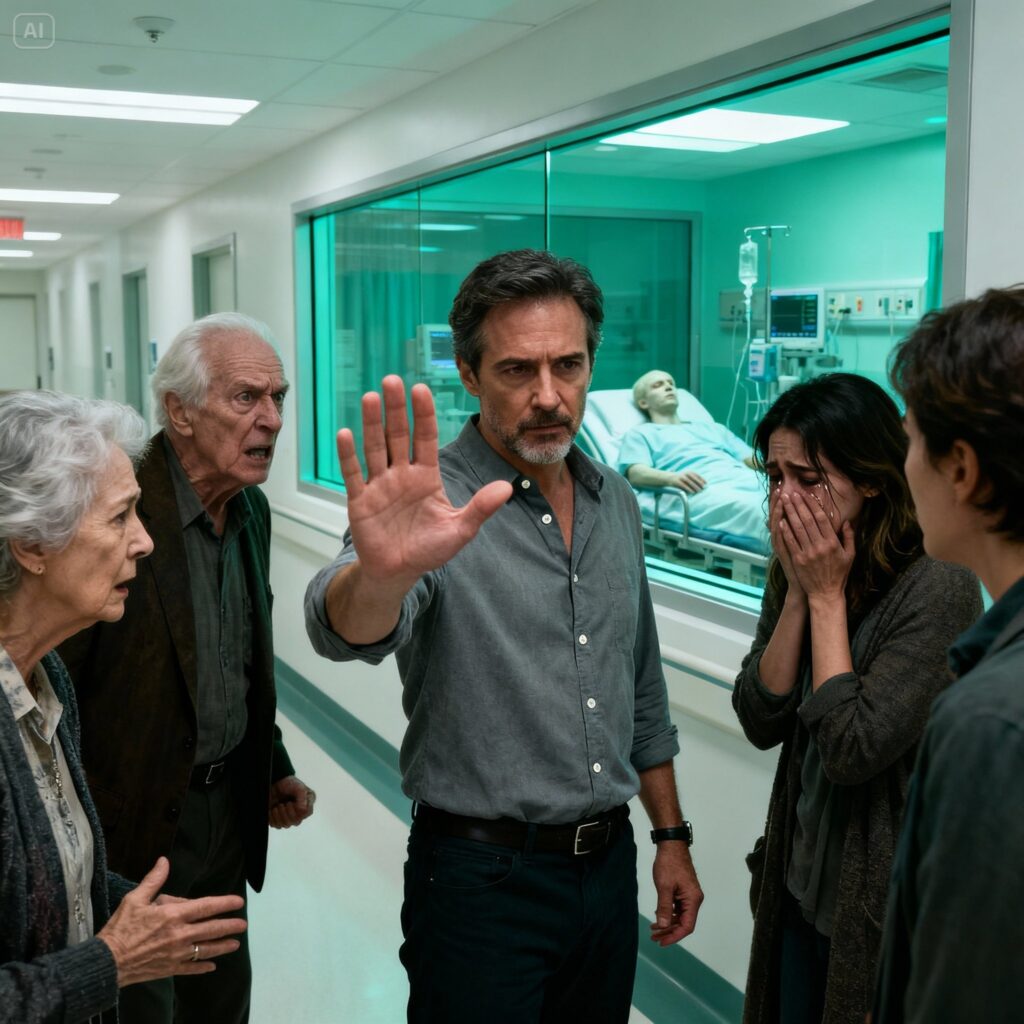
I left the room and met up with a lawyer I’d contacted on the way. My parents had just been released on bail and were on their way to the hospital. I saw them walk down the hall, with that characteristic arrogance, ready to blame me and play the victim. My mother was already shedding crocodile tears, and my father was coming with his finger raised, ready to lecture me.
But this time, I was ready.
“Don’t even think about coming near me,” I said, stepping in their path.
“How dare you?” my father roared. “We’re your parents! You abandoned us!”
“That’s it,” I said, taking out an envelope the lawyer had prepared for me. “I’ve paid Mateo’s actual medical expenses directly to the hospital. I won’t give you a single penny. And as for Mateo, I’ve offered to pay for him to go to a rehabilitation center far from here, in another city, on the condition that he cuts off all contact with you and Elena.”
“You can’t do that!” Elena shouted, joining the group. “You’re breaking up the family!”
“You broke up the family last night,” I replied, looking them in the eye one by one. “When you decided that Elena’s wedding money was more important than Mateo’s life. When you decided to lie to me to implicate me in a crime. When you chose to protect your reputation rather than call an ambulance.”
I turned to my parents. “I have police recordings and Mateo’s testimony. If they ask me for money again, or if they try to contact me or my work, I’ll get a restraining order and go public with the whole story, including how their ‘precious daughter’ let her brother get beaten up so she wouldn’t have to spend money on her party.”
The color drained from my mother’s face. Elena gasped. My father lowered his hand. For the first time in my life, they were afraid of me. Afraid of the truth.
I turned around and walked toward the hospital exit. The sun was shining outside, and the air had never felt so fresh. I had lost my parents and my sister that day, yes, but I had saved my life and, perhaps, given Mateo a second chance. The weight I had carried for decades had vanished.
As I walked to my car, I pulled out my phone and blocked their numbers. One by one. Mom. Dad. Elena. “Block contact.” “Block contact.” “Block contact.”
I had never felt so free.
Sometimes, setting boundaries is the hardest act of self-love there is. We’re taught that family is sacred and that we should forgive everything, but there are lines that, once crossed, are irreversible. I decided that my peace of mind and my dignity were worth more than maintaining the appearance of a “united” family.