I was relaxing at my mountain cabin when, at 5 a.m., the security alarm went off. The guard called, nervous. “Mrs. Harland… your daughter-in-law is here with movers. She says you need to leave. She says the place belongs to her now.” I took a slow sip of tea and smiled. “Let her in,” I said. “She’s about to find out what I did yesterday.”
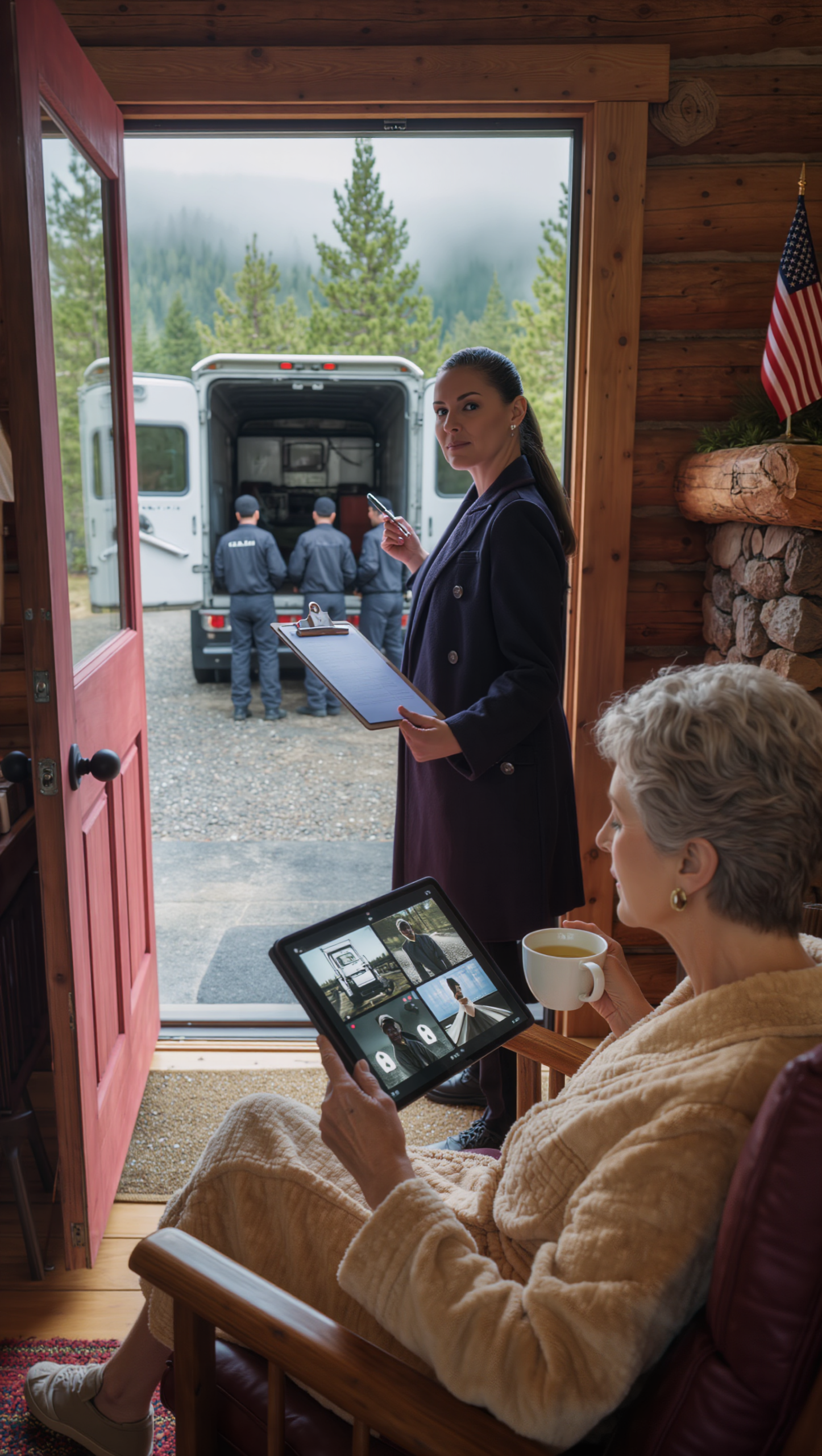
I was relaxing at my mountain cabin when, at 5 a.m., the security alarm went off. The guard called, nervous. “Mrs. Harland… your daughter-in-law is here with movers. She says you need to leave. She says the place belongs to her now.” I took a slow sip of tea and smiled. “Let her in,” I said. “She’s about to find out what I did yesterday.”
The alarm had shattered the stillness at exactly five in the morning—one sharp tone cutting through the mountain quiet—followed by the buzz of my phone on the nightstand. I didn’t jump. I didn’t panic. I simply opened my eyes and stared up at the wooden beams above me, watching the faint gray of dawn seep through the window.
The phone buzzed again. I reached for it slowly, my fingers wrapping around the cool glass, and brought it to my ear.
“Mrs. Harland,” a shaky voice said.
Young Mike—my security guard, the one I’d hired three weeks ago. He sounded like he’d been holding his breath.
“I’m so sorry to wake you,” he continued, words tumbling out fast. “But your daughter-in-law just pulled up to the gate. She’s got a moving truck with her. Three men. She’s saying… she’s saying she owns the property now.”
I let the words sit in the air for a moment, feeling their weight without giving them any power.
My tea sat cold on the bedside table, untouched since midnight, when I’d finally turned off the lamp and laid my head down.
“Let her in,” I said, voice steady.
“But, ma’am—she’s waving papers around,” Mike insisted. “She’s telling me you don’t live here anymore. Should I call the police?”
“No,” I replied. “Let her in, Mike. And make sure she signs the visitor log. Full name. Time of arrival. Reason for the visit. Everything.”
There was a pause on the other end. I could hear his confusion in the way he breathed.
“Are you sure?”
“I’m sure.”
I ended the call and set the phone back down, listening as the silence returned—thin and tense, like a held note.
Outside, the low rumble of an engine echoed up the driveway. Tires on gravel. Doors slamming. Then her voice—sharp, confident, unmistakable.
Melissa.
I sat up slowly, pulled my robe around my shoulders, and tied it at the waist. My hands didn’t shake. My heart didn’t race.
I’d been preparing for this moment for weeks.
Before I go any further, let me pause here for just a second. I know you’re listening to this story—maybe while you’re folding laundry, or driving to work, or lying in bed wondering if you’ll ever fall back asleep. Wherever you are right now, I’d love to know. Drop a comment and tell me where you’re watching from and what time it is in your part of the world. And if this already has your attention, go ahead and hit that like button. Share it with someone who needs to hear it, and subscribe so you don’t miss what happens next—because trust me, you’re going to want to see how this plays out.
All right. Back to that cold morning in my cabin.
I stood and walked to the window, pulling the curtain back just enough to see the driveway below. The moving truck was parked at an angle, blocking the path to the garden shed. Three men in work jackets stood near the back, looking uncomfortable. And there she was—Melissa—wrapped in a long wool coat, hair pulled into a sleek ponytail, face lit by the glow of her phone as she tapped furiously.
She looked victorious. Radiant, even. Like she’d already won.
I watched her gesture toward my front door, pointing and giving instructions to the movers like she was directing a stage production. One of the men nodded, grabbed a dolly, and started toward the porch.
She thought this was her house now.
She thought I’d be gone—confused, powerless, humiliated.
She thought she’d outmaneuvered me.
I let the curtain fall back into place and turned toward the mirror above my dresser. My reflection stared back, calm and unbothered—gray hair still pinned neatly from the night before, eyes clear. No tears. No fear. Just patience.
I picked up my tablet from the desk and unlocked it, pulling up the camera feeds. Six angles: living room, kitchen, front porch, driveway, hallway. Every corner of this place was being recorded, time-stamped, saved.
And she had no idea.
I watched her step onto the porch, heels clicking against the wood. She knocked twice—hard, demanding. I didn’t answer. She knocked again, louder, and her voice pushed through the door in a muffled snarl.
“I know you’re in there. Open up. This is my property now.”
I smiled faintly, set the tablet down, and lifted my cold tea. I took a slow sip, savoring the bitterness—and the quiet power of knowing exactly what was about to happen.
Melissa had no idea what I did yesterday.
But she was about to find out.
I need to take you back—back to when my mornings were simple, when the only thing that woke me was birdsong instead of alarm bells.
Four months before that knock at my door, life looked entirely different. I had just retired from teaching biology at a high school in Denver—thirty years of educating teenagers about cellular respiration, photosynthesis, and the delicate balance of ecosystems. Thirty years of watching young minds bloom, stumble, and eventually find their way.
When I finally turned in my keys and packed up my classroom, I didn’t feel lost.
I felt free.
The cabin had been mine for over a decade—a refuge I’d purchased with money saved carefully over the years. It sat tucked into the Colorado mountains, surrounded by pines and wildflowers, with a view that stretched across valleys and peaks that turned gold under the setting sun.
It wasn’t large—two bedrooms, a kitchen with windows bright enough to grow herbs on the sill, and a living room with a stone fireplace I’d learned to tend myself. The kind of place where you could hear the wood creak when the temperature dropped and smell rain an hour before it arrived.
I filled my days with quiet routines. Mornings began with tea on the back porch, watching mist rise off the trees. Afternoons were spent in the garden coaxing tomatoes and basil to grow despite the altitude. Evenings, I read by the fire or worked on quilts I donated to a shelter in town.
I was alone, but I wasn’t lonely. There’s a difference.
Solitude, I’d learned, was a gift. It gave me space to think clearly, to move through my home without negotiating, to make decisions without compromise. After decades of managing classrooms full of energy and noise, the stillness felt earned.
But I’d be lying if I said there weren’t moments when the silence pressed a little too close—nights when I wished I could share a meal with someone, hear laughter that wasn’t just my own echoing off the walls.
That’s when I’d call Daniel—my son, my only child.
Daniel had always been sweet-natured, the kind of boy who brought home injured birds and insisted we nurse them back to health. As a man, he carried that same gentleness. He worked in tech consulting, spent his weekends hiking, and called me every Sunday without fail.
We were close—not in the way some mothers smother their sons, but in the way two people respect and genuinely enjoy each other’s company. He’d drive up to the cabin once a month, help me fix whatever had broken, and we’d sit by the fire talking about everything and nothing.
He was proud of the life he’d built. And I was proud of him.
But Daniel had one flaw—one I’d noticed since he was young.
He trusted too easily.
He saw the best in people, sometimes to the point of ignoring warning signs others might catch. As his mother, I’d always worried that someone would take advantage of that kindness.
I just never expected it to happen the way it did.
It was late April when he called. The snow had finally melted, and I was outside planting seeds in the raised beds near the shed. My phone rang, and I wiped dirt from my hands before answering.
“Mom,” he said, and I could hear the smile in his voice. “I have something to tell you.”
“You’re quitting your job and becoming a park ranger,” I teased.
He laughed. “Not quite. But… I did meet someone.”
I straightened, holding the phone closer. “Someone?”
“Her name’s Melissa. We’ve been seeing each other for a few months now. I wanted to wait to tell you until I was sure, you know. But, Mom, I’m sure. She’s incredible.”
There was a warmth in his voice I hadn’t heard in years—the kind of excitement that made my chest tighten with both joy and caution.
“Tell me about her,” I said gently.
He launched into descriptions. She was smart, he said. Ambitious. She worked in finance, managing portfolios for private clients. She’d grown up on the East Coast, moved to Denver for work, and loved hiking just as much as he did.
They’d met at a networking event, started talking about trail recommendations, and it had grown from there.
“She wants to meet you,” Daniel said. “I told her all about the cabin—about you. She’s really excited.”
I smiled, though something in my chest tightened just slightly. A mother’s instinct, perhaps. Or maybe just the fear that comes with knowing your child’s heart is now in someone else’s hands.
“I’d love to meet her,” I said. “Bring her up whenever you’d like. I’ll make dinner.”
“Really? That would be amazing. How about next weekend?”
“Next weekend is perfect.”
We talked a few more minutes, and when we hung up, I stood there in the garden with the phone still in my hand, staring at the mountains in the distance.
I told myself I was being overprotective. That every mother worries when her child falls in love. That I should be happy for him.
But somewhere deep inside—in a place I couldn’t quite name—I felt the first stirring of unease.
Daniel had always seen the best in people.
And I had always been the one who saw what lay beneath.
I went back to planting, pressing seeds into the soil with steady hands, whispering a quiet hope that I was wrong—that Melissa would be everything my son believed she was. That I wouldn’t have to protect him from the person he was learning to love.
But hope, I’d learned over the years, was not the same as certainty.
And certainty was something I would need to find for myself.
The following Saturday arrived with clear skies and temperatures warm enough to eat outside. I spent the morning preparing—not out of nerves, but out of respect. Meeting the woman my son loved deserved effort.
I made a roast with rosemary and garlic, the kind Daniel had loved since childhood. I set the table with linen napkins I’d ironed that morning and filled a vase with wildflowers I’d picked along the trail behind the house.
The cabin smelled of fresh bread and woodsmoke—warm, welcoming.
By the time their car pulled into the driveway, everything was ready.
I stepped onto the porch, wiping my hands on my apron, and watched Daniel climb out of the driver’s seat. He looked happy—lighter than I’d seen him in months. He waved, grinning, and moved to open the passenger door.
That’s when I saw her.
Melissa stepped out with the kind of grace that seemed rehearsed. She was striking—I’ll give her that. Tall, with dark hair that fell in perfect waves over her shoulders. She wore a cream-colored sweater and jeans that looked expensive, the kind that fit just right without trying too hard.
Her smile was wide, bright, practiced.
She walked toward me with her hand extended, and I noticed her nails—polished, immaculate—the hands of someone who didn’t garden or scrub floors or do much of anything that left marks.
“Mrs. Harland,” she said warmly, taking my hand in both of hers, “it’s such an honor to finally meet you. Daniel talks about you constantly.”
Her grip was firm, confident, but there was something about the way she held on just a fraction too long that made me aware she was measuring me—studying.
“Please call me Helen,” I said, returning the smile. “It’s wonderful to meet you, too.”
Daniel came up beside her, slipping an arm around her waist. “Mom, isn’t this place amazing? I was just telling Melissa about the view from the back porch.”
“It’s stunning,” Melissa agreed, eyes already drifting past me toward the open door. “Daniel wasn’t exaggerating. This house is absolutely beautiful. You must feel so lucky to have a place like this.”
There it was—that word.
Lucky.
Not proud. Not grateful.
Lucky, as if I’d stumbled into ownership rather than worked three decades to earn it.
I let it pass.
“Come in,” I said, stepping aside. “Dinner’s almost ready.”
The three of us moved inside, and I watched Melissa’s gaze sweep across the living room. She took it all in with the focus of someone cataloging details—the stone fireplace, the bookshelves lined with novels and field guides, the wooden furniture I’d refinished myself, the framed photos of Daniel as a child climbing trees and holding up fish he’d caught on summer trips.
“This is just charming,” she said, voice lilting with admiration. “It feels so cozy—like something out of a magazine.”
She walked to the mantle and ran her fingers along the edge, pausing at a photo of Daniel and me taken years ago at the peak of a mountain trail. We were both sunburned and grinning, arms slung over each other’s shoulders.
“You two look so happy here,” she said softly.
“We were,” I replied, watching her closely.
She turned and smiled again—that same polished warmth. “Daniel told me this property has been in your family for a while. It must be worth quite a bit now, with how the market’s been.”
I felt Daniel stiffen slightly beside her, but he said nothing.
“It’s worth whatever peace of mind is worth,” I said evenly. “I don’t think about it in those terms.”
Melissa nodded, though her eyes betrayed a flicker of something I couldn’t quite name—curiosity, maybe, or calculation.
“Of course,” she said smoothly. “I just meant it’s such a valuable space. A real retreat from the world.”
Dinner was pleasant on the surface. Melissa complimented everything—the roast, the bread, the wine. She asked thoughtful questions about my years teaching, laughed at the right moments, and touched Daniel’s arm with affection whenever he spoke.
But I noticed things.
The way her gaze drifted to corners of the room when she thought no one was watching. The way she straightened her napkin three times, like she couldn’t settle. The way her questions leaned just a degree too personal, wrapped in politeness.
“Do you ever think about moving closer to the city?” she asked over dessert. “It must be hard being up here alone, especially in winter.”
“I manage just fine,” I said. “I’ve always preferred solitude to crowds.”
“But don’t you worry about emergencies?” she pressed. “Medical things?”
Daniel chimed in, careful. “You’re getting to the age where those things matter.”
The age.
There it was again—another subtle jab dressed up as concern.
Daniel shifted uncomfortably. “Mom’s tougher than anyone I know. She doesn’t need to worry about that stuff yet.”
Melissa placed her hand over his and smiled. “Of course. I’m just thinking ahead. It’s what I do for work—planning for futures, making sure people are protected.”
She turned that smile back to me. “I’d love to help you organize things, Helen—just to make sure everything’s in order for Daniel’s sake, if nothing else.”
I set my fork down slowly and met her eyes.
“That’s kind of you, Melissa,” I said, “but I’ve always handled my own affairs. I’m very particular about how things are done.”
She didn’t flinch. She didn’t retreat. She simply nodded, still smiling, and took a sip of her wine.
“I understand completely,” she said.
But she didn’t.
I could see it in the way her jaw tightened just slightly. In the way her fingers tapped once against the stem of her glass. She wasn’t used to being told no.
After dinner, we moved onto the porch. The sun was setting, painting the mountains in shades of orange and pink. Daniel excused himself to take a call, leaving Melissa and me alone for the first time.
She leaned against the railing, gazing out at the view. For a moment she said nothing.
Then she spoke, voice quieter now—deliberate.
“Daniel’s lucky to have a mother who cares so much about him.”
“I’m the lucky one,” I said.
She glanced at me, and for just a second, the warmth flickered. Something cooler slipped through—something sharper.
“He deserves someone who can take care of him,” she said. “Someone who can make sure he’s not burdened by things he doesn’t need to carry.”
I met her gaze steadily. “He’s never been burdened by me.”
She smiled again, but this time it didn’t reach her eyes. “Of course not.”
Daniel returned moments later, and the rest of the evening passed without incident. They left as the stars began to emerge—Daniel hugging me tightly at the door while Melissa waved from the car.
I stood on the porch long after their taillights disappeared down the driveway, the night air settling cool around me, and I thought to myself a truth I couldn’t ignore:
This one smiles too much when she’s calculating.
Three weeks after that dinner, Daniel called to tell me they’d gotten engaged. His voice was breathless with excitement, the words tumbling out—an unexpected proposal at a restaurant overlooking the city, a ring he’d been saving for, her tears of joy.
I congratulated him. I told him I was happy.
I meant it mostly.
But when we hung up, I sat in the quiet of my kitchen, staring at the phone in my hand, and felt the first real tug of worry settle into my chest.
It wasn’t that I didn’t want him to be happy.
It was that I’d seen something in Melissa that he hadn’t—or maybe he had, and he’d chosen to ignore it, the way we all do when we’re in love.
The wedding happened quickly—too quickly, in my opinion. But I kept that thought to myself.
It was a small ceremony in Denver, tasteful and elegant, with only close family and a handful of friends. Melissa looked radiant in a simple white dress, and Daniel looked at her like she’d hung the moon.
I smiled through the vows. I toasted their future. I danced with my son and told him I loved him.
And when I drove back to the cabin that night, I felt the strange weight of knowing things would never quite be the same.
I was right.
Within a month, Daniel’s calls became less frequent. Where he used to phone every Sunday, now it was every other week. Then once a month. His texts grew shorter, less detailed, as if someone were editing them before he hit send.
When we did speak, I noticed something else.
His words didn’t sound like his anymore.
“Mom, Melissa thinks you should consider getting a medical alert system,” he said one evening. “Just in case something happens while you’re alone up there.”
I paused, setting down the book I’d been reading.
“Something like what?”
“You know… a fall. A health issue. She’s just worried about you.”
“I’m 62, Daniel,” I said. “Not 90. And I’m in excellent health.”
“I know, but still,” he insisted. “It wouldn’t hurt to have a safety net.”
I bit back the urge to remind him I’d lived independently for years without incident. Instead, I said gently, “I’ll think about it.”
But I didn’t—because I knew the suggestion hadn’t come from concern.
It had come from Melissa.
A week later, he called again.
“Melissa was wondering if you’ve thought about updating your estate plans,” he said. “She says it’s important to have everything organized, especially at your age.”
My age.
As if I were one strong breeze away from collapse.
“It’s fine,” I said, keeping my tone even. “I reviewed everything two years ago with my attorney.”
“Right,” Daniel said, and I heard him searching for the next line. “But Melissa says those things should be reviewed regularly. She works with this stuff all the time. If she could help…”
“I don’t need help, sweetheart,” I said. “But I appreciate the thought.”
There was a pause—long enough I could almost hear him struggling between loyalty to me and whatever Melissa had coached him to say.
“Okay,” he said finally. “Just let me know if you change your mind.”
We hung up, and I sat in the growing dusk feeling something cold settle into my bones.
This wasn’t my son speaking anymore.
These were her words filtered through his voice.
And then she started visiting.
The first time, she showed up unannounced on a Thursday afternoon. I heard the car before I saw it, the engine purring up the driveway. When I opened the door, she stood there holding a bakery box tied with string, smile polished as ever.
“Helen, I hope you don’t mind,” she said. “I was in the area and thought I’d stop by.”
In the area.
My cabin was forty minutes off the main highway down a road that led nowhere else.
“Of course,” I said, stepping aside. “Come in.”
She set the box on the kitchen counter and opened it to reveal pastries I hadn’t asked for—croissants, danishes, sugar-dusted things that would sit uneaten.
“I thought we could have tea,” she said, already moving toward the cupboard as if she knew where everything was kept.
I watched her pour water into the kettle, open drawers looking for spoons, touch things with a familiarity that didn’t belong to her.
“You have such a lovely setup,” she said, glancing around. “But don’t you find it overwhelming maintaining a place this size on your own?”
“I’ve managed for over a decade,” I replied.
“Of course,” she said smoothly. “But you’re not getting any younger. Daniel worries about you constantly.”
She said it with such practiced sympathy that someone else might have believed her.
But I’d spent thirty years reading teenagers. I knew when someone was performing.
The visits continued—every week or two. She arrived with excuses, dropping off groceries I hadn’t requested, checking on repairs I hadn’t mentioned needing. Each time, she moved through my home like she was taking inventory—touching picture frames, opening cabinets, commenting on how much space I had, how much upkeep it required.
And then came the folder.
It was late June when she arrived with a leather portfolio tucked under her arm. She set it on the kitchen table with a gentle thud, expression serious but kind.
“Helen,” she said, “I’ve been working on something that I think will make your life so much easier.”
I looked at the folder but didn’t reach for it.
She opened it anyway, pulling out printed pages with highlighted sections and sticky tabs marking where handwritten marks were needed.
“This is just a simple consolidation form,” she explained. “It lets Daniel help manage your monthly obligations and county fees, so you don’t have to worry about it. Everything stays tied to you, of course. It just makes things smoother.”
I scanned the first page—dense language, authorization clauses, lines for dates and initials.
“I don’t need help managing my money,” I said quietly.
Her smile tightened, almost imperceptibly. “I understand, but wouldn’t it be nice to have one less thing to think about? Daniel wants to make sure you’re taken care of. This is just a precaution.”
“A precaution for what?”
She tilted her head, voice soft. “Well… in case of an emergency. Or if your memory starts to slip. It happens to everyone eventually.”
I looked up at her then—really looked at her—and saw it clearly.
The calculation behind the concern. The agenda wrapped in kindness.
She wasn’t helping.
She was positioning.
“I’ll need time to review this with my attorney,” I said, closing the folder and sliding it back toward her.
Her jaw tightened for a heartbeat. Then the smile returned, softer now, patient.
“Of course,” she said. “Take all the time you need. I’ll leave it here for you.”
She stood, smoothed her blouse, gathered her purse. “I’ll check in next week. Let me know if you have questions.”
After she left, I sat at that table a long time, staring at the folder she’d left behind.
I didn’t open it again.
I already knew what was inside.
This wasn’t about making my life easier.
This was about control.
And as the sun sank behind the mountains, casting long shadows across the cabin floor, I thought, with absolute certainty:
She’s not helping. She’s inventorying.
July brought heat to the mountains—the kind that made the air shimmer above the rocks and turned wildflowers brittle by afternoon. I spent most mornings watering the garden before the sun climbed too high, watching tomatoes ripen and herbs grow thick and fragrant.
It was during one of those mornings that I first noticed something had changed.
My neighbor Margaret lived about half a mile down the road. We weren’t close friends, but we were friendly—neighbors who waved, who borrowed eggs, who shared surplus vegetables when the garden produced more than one person could use.
She always stopped to chat. Always asked how I was doing.
But that morning, when I saw her truck coming up the road and raised my hand to wave, she looked right at me, hesitated, and kept driving.
No wave. No smile.
Just a quick glance—then eyes forward like she hadn’t seen me at all.
Two days later, I drove into town for groceries. The store was small, the kind where everyone knew everyone, and I’d shopped there since I bought the cabin.
The cashier, a young woman named Beth, always asked about my garden and told me about her kids. But when I approached the register that afternoon, her greeting was different—polite, distant.
She scanned my items without making eye contact. When I tried to make conversation, she gave one-word answers and kept glancing toward the back of the store.
“Is everything all right?” I asked gently.
She looked up, startled. “Oh—yes. Just busy today.”
But the store was nearly empty.
I paid and left, carrying my bags to the car with a growing sense that something was off—something I couldn’t name yet.
It wasn’t until the following week that I understood.
I was at the post office mailing a package to an old teaching colleague when I overheard two women talking near the bulletin board. I didn’t recognize them, but they spoke just loud enough for their voices to carry.
“I heard she’s getting forgetful,” one of them said. “Her daughter-in-law mentioned it when she stopped by last week. Said the poor woman forgets to lock her doors, leaves the stove on. It’s sad, really.”
“How old is she?” the other asked.
“I don’t know, but old enough that she probably shouldn’t be living alone anymore.”
I froze, package still in my hands.
They were talking about me.
I turned slowly, and both women glanced over, expressions shifting from casual gossip to awkward realization. One offered a tight smile before they hurried out the door.
I stood there, stunned, trying to process what I’d just heard.
Forgetful. Leaving the stove on. Forgetting to lock doors.
None of it was true.
Not a single word.
But Melissa had been here—talking to people, planting stories.
I drove home in a daze, gripping the steering wheel tighter than necessary, mind racing through every conversation I’d had with neighbors, every interaction in town. How many people had she spoken to? How many had she fed those lies?
And why?
That evening, I called Daniel. I tried to keep my voice steady, tried to explain what I’d heard without sounding paranoid or defensive.
“Sweetheart,” I said, “I think Melissa has been saying things about me in town—things that aren’t true.”
There was a pause. “What kind of things?”
“That I’m forgetful. That I leave the stove on. That I shouldn’t be living alone.”
Daniel sighed, and I heard exhaustion in it. “Mom, I’m sure it’s just a misunderstanding. Melissa cares about you. She’s probably just expressing concern and people are interpreting it wrong.”
“Daniel,” I said, “she’s telling people I’m losing my memory. I’m not.”
“I know you’re not,” he said, but his tone went careful—measured. The tone you use when you’re trying to soothe someone you think might be overreacting. “But maybe you’re reading too much into this. Melissa mentioned you seemed a little confused last time she visited.”
My chest tightened. “Confused about what?”
“She said you couldn’t remember where you put some papers she left for you,” he replied, “and that you asked her the same question twice.”
I sat in silence, replaying that visit.
I hadn’t been confused. I’d refused her folder and put it away deliberately. I hadn’t asked her anything twice.
She was lying to my son about me.
“That didn’t happen,” I said quietly.
“Mom, I’m not saying you’re lying,” Daniel said. “I’m just saying maybe you didn’t realize it. It’s not a big deal. Everyone forgets things sometimes.”
And there it was—the shift.
He was defending her. Believing her version of events over mine.
“I’m not forgetting things, Daniel.”
“Okay,” he said quickly. “I believe you. But maybe… just keep an eye on it for me.”
We hung up shortly after, and I sat in the growing darkness of my living room feeling something I hadn’t felt in years.
Betrayal.
Not the loud, explosive kind.
The quiet kind—the kind that seeps in slowly and makes you question whether you’re the one who’s wrong.
Was I being paranoid? Was I misinterpreting? Was I, in fact, forgetting details I should remember?
For days, I second-guessed everything—double-checking the locks, writing down conversations so I could prove to myself I wasn’t losing track.
But then I noticed something else.
Inconsistencies.
Melissa told Daniel I’d seemed confused about her folder, but I’d never taken those pages out, so how would I have “lost” them? She told people I forgot to lock my doors, but my security system logged every opening and closing. I checked the logs. Every door had been secured. Every single time.
She told women at the post office I left the stove on, but I had an electric stove with an automatic shutoff timer. It was impossible to leave it on for more than an hour.
The lies were small enough to sound believable, but specific enough that I could prove they weren’t true.
She wasn’t making mistakes.
She was building a narrative.
And the more I thought about it, the more I realized what she was doing. She was laying groundwork—creating a story that painted me as incompetent, forgetful, unable to care for myself—so that when the time came, no one would question her stepping in.
It was a Friday afternoon when I went to collect my mail and found the envelope.
It was addressed to Harland Family LLC.
The address listed was my cabin.
But I’d never heard of Harland Family LLC. I’d never registered any company. I’d never created anything by that name.
My pulse quickened.
I turned the envelope over in my hands. This wasn’t a mistake.
This was deliberate.
I opened it carefully and pulled out the contents. Inside was a letter from a property management firm in Denver, thanking Harland Family LLC for their inquiry about estate consolidation services.
My hands trembled as I read it again.
Someone had created a company using my family name—using my address.
And I had a sinking feeling I knew exactly who.
I walked back to the cabin slowly, envelope clutched in my hand, mind already turning over the implications.
Melissa wasn’t just spreading rumors.
She was building something—a structure, a legal entity that could be used to transfer ownership, consolidate assets, take control.
She was preparing to take everything.
And she thought I wouldn’t notice until it was too late.
I stood in my kitchen staring at that envelope, and felt something shift inside me.
The doubt was gone.
The second-guessing. The wondering if I was imagining things.
I wasn’t imagining anything.
She was coming for my home.
And I was going to stop her.
The next morning, I called Ruth Bennett.
Ruth had been my attorney for fifteen years—ever since I’d purchased the cabin and needed someone to handle the transfer properly. She was in her late fifties, sharp as a blade, with silver hair cut short and a no-nonsense approach to everything.
She didn’t waste words. She didn’t sugarcoat. She’d earned my trust by being direct, even when the truth was uncomfortable.
“Helen,” she answered on the second ring. “It’s been a while. What can I do for you?”
“I need to see you as soon as possible,” I said. “Something’s happening, and I need legal advice.”
There was a pause. Ruth knew me well enough to know I didn’t panic easily.
“Can you come to my office this afternoon?” she asked. “Two o’clock.”
“I’ll be there.”
I drove to Denver that morning, the envelope sitting on the passenger seat beside me. The city felt too loud after weeks in the mountains—all traffic and concrete and hurried people.
I parked near Ruth’s building, took the elevator to the fourth floor, and stepped into her small suite overlooking the street.
She met me at the door, took one look at my face, and nodded toward her desk.
“Sit,” she said. “Tell me everything.”
So I did.
I started with Melissa’s first visit after the wedding—the way she’d moved through my home like she was assessing it. I told Ruth about the consolidation folder, the rumors spreading through town, the way Daniel’s words had started sounding like hers.
Then I placed the envelope on her desk.
“This arrived yesterday,” I said. “I never created a company. I never signed off on any of this. But someone has.”
Ruth picked up the envelope, examined the letterhead, and read the pages inside. Her expression didn’t change, but I saw her jaw tighten.
“Tell me about your daughter-in-law,” she said, still scanning. “Her work, her background—everything you know.”
I told her what Daniel had shared: finance, private clients, the way she positioned herself as someone who understood estates and asset management.
Ruth set the letter down and folded her hands.
“Helen,” she said, “what you’re describing is a pattern. And it’s one I’ve seen before.”
“What kind of pattern?”
She leaned back, gaze steady. “Family financial exploitation. It usually starts with someone gaining trust, then slowly asserting control. They spread doubt about the person’s competency. They isolate them from others who might notice what’s happening. Then they begin moving assets—often through structures that look legitimate on the surface.”
My stomach tightened. “Like creating a company in my name.”
“Exactly,” Ruth said. “If she can get you to put your handwritten mark on the right pages, she can move the cabin into that company. Once it’s under the LLC, she can claim she’s ‘managing’ it on your behalf. And if you’re deemed incompetent—which is why she’s been spreading those rumors—a judge might allow her to keep managing it even without your consent.”
I sat there absorbing the weight of it.
It wasn’t just manipulation.
It wasn’t just gossip.
It was a calculated plan to take everything I owned.
“Can we stop her?” I asked.
Ruth’s expression shifted—something almost like a smile.
“We won’t stop her,” she said. “We’ll let her think she succeeded.”
I blinked. “What do you mean?”
“If we confront her now, she’ll retreat,” Ruth explained. “She’ll change tactics. She’ll get careful. But if we let her believe she’s winning, she’ll get overconfident. She’ll make mistakes. And when she does, we’ll have everything we need to prove what she’s been doing.”
“You want me to let her keep going?”
“Not exactly,” Ruth said. “I want you to appear compliant while we build a defense she’ll never see coming. We’ll protect your assets in ways she won’t notice. We’ll document every lie, every forged mark, every illegal move. When the time comes, we’ll have a case so airtight she won’t be able to talk her way out of it.”
Something stirred in my chest—not fear, not anger. Something colder. Focused.
“What do we need to do?” I asked.
Ruth pulled a legal pad toward her and uncapped a pen. “First, we transfer your cabin into a revocable living trust. You’ll remain in full control, but the property will no longer sit under your individual name. So any pages she tries to file claiming ownership will be meaningless.”
“Will she know?”
“Not if we file it correctly,” Ruth said. “We’ll request a quiet title action to seal the records temporarily. Anyone searching public databases will see the cabin in transition. It’ll look like it’s in limbo. That’s exactly what we want her to believe.”
I nodded slowly, following her logic.
“What else?”
“We document everything,” Ruth said. “Every conversation. Every visit. Every page she brings you. If she’s tracing your handwriting, we need originals to prove you didn’t. And I’ll run a check on this witness stamp she used. If the seal is fake, that’s fraud. We can press charges.”
My mind raced.
“And if she tries to force me out?” I asked.
Ruth’s eyes sharpened. “Then we’ll have her on trespass, attempted theft, and elder exploitation. But for this to work, you need to play along. If she brings more pages, don’t refuse outright. Stall. Tell her you need time. The longer she thinks she’s in control, the more evidence we gather.”
I exhaled slowly.
It wasn’t just protection.
It was a trap.
One Melissa would walk into willingly because she thought I was too old, too trusting, too easy to deceive.
“How long will this take?” I asked.
“A few weeks to finalize the trust and seal the title,” Ruth said. “After that, we wait. She’ll make her move eventually, and when she does, we’ll be ready.”
I stood and picked up my purse. “Thank you, Ruth.”
She stood too, extending her hand. “You’re not a victim, Helen. Don’t let her make you feel like one. You’re smarter than she is. You’ve just been playing defense.”
I shook her hand, feeling the strength in her grip.
“Now,” she said, “we go on offense.”
As I walked back to my car, the city noise faded into the background, and something settled into place inside me—a decision, a resolve.
Melissa thought she was playing a game I didn’t understand.
She thought I was a lonely old woman clinging to a house I couldn’t manage, too proud to accept help, too confused to see what was happening.
She was wrong.
I understood exactly what she was doing.
And I was going to let her think she’d won—right up until the moment she realized she’d lost.
I drove back to the mountains as the sun dipped behind the peaks, painting the sky in amber and rose. The envelope sat on the passenger seat—evidence of her intentions.
But now it felt different.
Not threatening.
Just proof.
By the time I pulled into my driveway, the plan was already forming in my mind.
Let her think she’s winning.
And when she finally makes her move, I’ll be ready.
The first step happened quietly—the way all effective plans do.
Two days after my meeting with Ruth, a courier arrived at her office with pages I’d initialed the evening before. The trust paperwork was thorough, written in language that left no room for interpretation. It named me as both grantor and trustee, which meant I maintained complete authority over the cabin while removing it from direct personal ownership.
That same afternoon, Ruth filed the documents with the county recorder along with a request for a quiet title action. The request cited privacy concerns and ongoing estate planning as reasons for sealing the records temporarily.
Within forty-eight hours, the filing was approved.
To anyone searching public databases, my cabin no longer appeared under my name—but it didn’t appear under anyone else’s either. It simply looked unresolved, pending.
Exactly what we wanted Melissa to see.
Ruth called me that Friday to confirm it.
“The property is protected,” she said. “Anything she tries to file claiming ownership will be rejected, and even if she somehow gets something recorded, it’ll be void. The trust supersedes everything.”
“What if she questions why the records changed?” I asked.
“She won’t see the trust filing,” Ruth said. “It’s sealed. All she’ll see is that the status looks uncertain. She’ll probably think you’re transferring it or there’s some bureaucratic delay. It’ll make her push harder—which is what we want.”
A flicker of satisfaction warmed my chest.
“What’s next?” I asked.
“Now we wait,” Ruth said. “And we document everything. Do you have a way to record conversations if she visits?”
I paused. “Not yet.”
“Get audio and video if possible,” Ruth instructed. “Colorado is a one-party consent state, which means you can legally record conversations you’re part of. If she brings forged pages or makes threats, we need proof.”
After we hung up, I sat at my kitchen table thinking through logistics. I wasn’t particularly tech-savvy, but I wasn’t helpless either. I’d managed classroom technology for years—projectors, interactive boards, all of it. Cameras couldn’t be that different.
The next morning, I drove into town and found a small electronics store tucked between a coffee shop and a hardware supplier. The young man behind the counter looked barely out of high school, but when I explained what I needed, he perked up.
“You want security cameras?” he asked. “Like inside your house?”
“Discreet ones,” I said. “Nothing obvious. I need to monitor a few rooms without anyone noticing.”
He didn’t ask why. He simply nodded and led me to a shelf of devices that looked more like smoke detectors than cameras.
“These are wireless,” he explained, holding up a compact unit about the size of a deck of cards. “They connect to your Wi-Fi and stream to an app on your phone or tablet. You can watch live or review footage later. Motion activation, night vision, audio recording.”
“How many would I need for three rooms?” I asked.
“Depends on the layout,” he said, “but probably four or five to cover all the angles. You want faces and voices clearly.”
I bought six.
Better to have extra coverage than miss something important.
He helped me set them up that afternoon, showing me how to position them for the best view and how to access the app. By evening, cameras were installed in the living room, kitchen, front porch, and hallway. One faced the mantle where Melissa always lingered. Another captured the kitchen table where she liked to lay out her folders. The porch camera covered the front door and driveway.
I tested them from my tablet, switching between feeds.
The quality was better than I expected—clear enough to read expressions, sharp enough to catch words.
I felt like a student again, learning something new, except this time the stakes were far more personal than any biology exam.
Over the next week, I prepared in other ways—small, methodical things. I made copies of every document Melissa had ever brought, including the ones I’d refused. I photographed the forged handwriting on the pages I’d found and compared it to my real one. The differences were subtle but present—the slant wrong, the pressure uneven.
Ruth mentioned checking the “witness seal” whose stamp appeared on the forged pages. I sent her photos of it, and she promised to follow up.
I also started keeping a journal—not a diary exactly, but a log. Every time Melissa visited, I wrote down the date, the time, what was said. Every time Daniel called with one of her “suggestions,” I recorded it. Every rumor I heard in town, I noted.
Patterns emerge when you write things down. Details you might otherwise forget become evidence.
One evening, as I reviewed my notes, I realized how much I’d learned from thirty years of teaching: patience, observation, the ability to see through performances.
Teenagers are experts at manipulation—testing boundaries, saying one thing while meaning another. Melissa wasn’t that different.
She was just older and more polished.
But I’d dealt with hundreds of kids who thought they were smarter than me, who thought they could cheat without getting caught or skip class without consequences.
They’d all learned eventually that I noticed everything.
Melissa was about to learn the same lesson.
By mid-August, everything was in place. The trust was filed and sealed. The cameras were recording. My documentation was thorough.
Now I just needed her to act.
I didn’t have to wait long.
She called on a Thursday morning, voice bright and insistent. “Helen, I’m coming by tomorrow. There are some new forms we need to finalize. Daniel’s really hoping you’ll cooperate this time. He’s worried about you.”
I kept my tone light, almost distracted. “Tomorrow. I suppose that’s fine. What time?”
“Around ten,” she said. “I’ll bring everything you need. It’ll only take a few minutes.”
After we hung up, I texted Ruth: She’s coming tomorrow. Bringing more paperwork.
Ruth replied immediately: Perfect. Let her talk. Record everything. Don’t sign anything.
That evening, I tidied the cabin—not because it needed it, but because I needed something to do with my hands. I checked the camera angles twice. I made sure my tablet was fully charged. I set out tea and cookies, the kind of hospitable touches that would make Melissa think I was being agreeable.
That night, I lay in bed staring at the ceiling beams, thinking about everything that had led to this moment. Part of me still couldn’t believe it had come to this—that my son’s wife, someone who was supposed to be family, was actively trying to steal from me.
But another part of me—the part that had spent decades watching people reveal themselves through small actions—wasn’t surprised at all. Melissa had shown me who she was from the very first visit.
I just needed time to see it clearly.
I reached over and turned off the lamp, letting darkness settle around me, and whispered into the quiet—maybe to the universe, maybe to myself.
“You’ve overplayed your hand, Melissa.”
Tomorrow, she’d walk into my home thinking she held all the power.
She had no idea I’d already taken it back.
Melissa arrived exactly at ten, stepping out of her car with a briefcase that looked expensive and unnecessary. She wore a cream blazer and dark pants, hair pulled into a sleek ponytail that made her look more like she was headed to a board meeting than visiting family.
I watched her approach through the kitchen window, then opened the door before she could knock.
“Good morning,” I said, smiling warmly. “Come in. I just put the kettle on.”
She hesitated for the briefest moment, surprised by my cheerfulness, then returned the smile.
“Thank you, Helen,” she said. “You’re always so welcoming.”
We settled at the kitchen table—the same place she’d presented folders before. I poured tea into delicate cups, offered cookies on a plate I’d arranged that morning, and let her lead the conversation.
She opened her briefcase and pulled out a stack of pages clipped together, each one marked with colored tabs where marks were required.
“I know we’ve talked about this before,” she began, tone gentle and patient, like she was speaking to a child, “but I really think this is the best option for you. It simplifies everything. You won’t have to worry about monthly obligations, county fees, or any of the administrative headaches that come with owning a home.”
I picked up the first page and scanned slowly. The language was dense—intimidating by design. Transfer of asset management. Irrevocable authorization. Control over financial decisions.
“What exactly does this do?” I asked, keeping my voice uncertain.
“It just gives Daniel and me the ability to help you,” she said smoothly. “Everything stays tied to you. Of course. We’re just handling day-to-day details so you don’t have to.”
I looked up at her, letting my expression show doubt mixed with fatigue.
“I don’t know, Melissa,” I said. “This feels like a lot.”
“I understand it’s overwhelming,” she soothed. “But trust me, Helen, this is what’s best. Daniel wants you taken care of. He worries about you constantly.”
She reached across the table and placed her hand over mine. The gesture meant to be comforting, but it felt like pressure.
“You trust Daniel, don’t you?” she asked.
“Of course I do.”
“Then trust that he’s looking out for you,” she said. “We both are.”
I let the silence sit for a moment, then sighed as if surrendering.
“Can I think about it for a day or two?” I asked.
Her jaw tightened, but she kept smiling. “Of course. But Helen—time is a factor. The longer we wait, the more complicated things get, especially if something were to happen to you.”
“Something like what?”
“An accident,” she said softly. “A health crisis. At your age, these things can happen suddenly. If we don’t have these documents in place, Daniel won’t be able to help you. Everything could get tied up in courts and processes. I’ve seen it happen to other families. It’s heartbreaking.”
I looked down at the pages again, then back at her.
“Can I keep these?” I asked. “I’d like to read through them more carefully.”
She hesitated, and I saw the calculation in her eyes. If she said no, she’d look controlling. If she said yes, she risked me showing them to someone who could explain what they actually meant.
“Of course,” she said finally. “Take all the time you need. Just… please don’t wait too long.”
She stood, smoothed her blazer, gathered her briefcase.
I walked her to the door, thanked her for coming, and watched as she drove away.
The moment her car disappeared down the driveway, I locked the door and returned to the kitchen. I checked the tablet to confirm the cameras had captured everything—her voice, her words, the pages she’d left behind.
Then I spent the next hour photographing every sheet from multiple angles and scanning them into digital files I sent to Ruth.
Her response came within twenty minutes: These are bad, Helen. Really bad. Do not sign anything. I’m reviewing them now.
That evening, Ruth called. Her voice was tight with controlled anger.
“Those documents are designed to strip you of all autonomy,” she said. “If you sign them, she’ll have complete control over your assets. She could sell your property, empty your accounts, and you’d have no legal recourse to stop her.”
“But she said everything would stay in my name,” I said.
“That’s a lie,” Ruth snapped. “Buried in the fine print is language that moves ownership into the LLC she created. Once it’s under that entity, she controls it. Not you. Not Daniel. Her.”
I sat down slowly, feeling the weight of how close I’d come to losing everything.
“What do I do now?” I asked.
“Wait,” Ruth said. “Don’t confront her. Don’t tell her you know. Keep stalling. Tell her you need more time. Meanwhile, I’ll keep building the case.”
Three days later, something arrived in the mail that made my blood run cold.
Another letter from the property management firm—this one addressed directly to me.
Inside was a welcome packet thanking me for enrolling in their services and confirming that ownership documents had been received and filed.
I called Ruth immediately.
“I never signed anything,” I said, voice shaking. “But they’re saying they have my handwriting. I didn’t do it.”
“Scan it,” Ruth said. “Send it to me right now.”
I did, hands trembling as I photographed the attached form. There at the bottom was my name in looping script.
Except it wasn’t mine.
The loops were wrong. The spacing off. Close, but not exact.
Ruth called back within the hour.
“She forged it,” she said. “And look at the witness seal. See that registration number? I ran it. That notary doesn’t exist. The stamp is fake.”
I stared at the page, feeling something cold settle into my chest.
This wasn’t just manipulation anymore.
This was fraud.
Criminal fraud.
“What do we do?” I asked.
“We document it,” Ruth said. “We keep the original and we wait for her to use it. When she does, we’ll have everything we need to press charges.”
That night, I stood on my porch in the darkness, looking out at the mountains—barely visible against the sky. The air was cool, carrying the scent of pine and earth.
I’d spent my entire adult life teaching students to think critically, to question what they were told, to look for evidence before drawing conclusions.
Now I was using those same skills to protect myself from someone who thought I was too old and too trusting to fight back.
I went inside, pulled a step ladder from the closet, and carried it to the front porch. I had one more camera left, still in its box.
I climbed carefully, positioned it above the porch light where it had a clear view of anyone approaching the door, and secured it in place. Then I climbed down, folded the ladder, and went back inside.
If Melissa came back—and I knew she would—every step she took would be recorded.
Every word.
Every lie.
I called Daniel the following Tuesday, voice casual, unhurried, as if the idea had just occurred to me.
“Sweetheart,” I said, “I’m thinking of spending a few days with Barbara. You remember her, don’t you? We taught together for years. She has that ranch outside Boulder.”
“That sounds nice, Mom,” Daniel said. “When are you going?”
“Tomorrow, probably,” I said. “Just for three or four days. I need a change of scenery.”
There was a pause—long enough I could almost hear him relaying the information to someone in the background.
Then he returned. “That’s great. You should get out more. Do you need help with anything before you go?”
“No,” I said. “I’m fine. I’ll call you when I get back.”
“Okay,” he said. “Have fun.”
We hung up, and I sat there staring at my phone, knowing exactly what would happen next.
Within an hour, Melissa would know I’d be gone.
And she’d see it as an opportunity.
I didn’t actually go to Barbara’s ranch. I’d thought about it, but decided against it. If something happened while I was truly away, I’d have no way to respond quickly.
Instead, I drove into town early the next morning, parked my car at a friend’s house a few streets over, and walked back through the woods to my cabin. I entered through the back door, locked it behind me, and moved quietly through the rooms, pulling curtains and shades.
From the outside, the house looked empty—dark, unoccupied.
Then I settled into the back bedroom, the one without a camera, and opened my tablet.
Six feeds glowed on the screen: living room, kitchen, front porch, hallway, driveway.
Everything was still. Silent. Waiting.
I made tea, kept the lights off, and watched.
The first day passed without incident. I read by the light of a small lamp, ate cold meals I’d prepared beforehand, and checked the feeds every hour.
Nothing.
The second day was the same—quiet, uneventful.
But on the third day, at precisely two in the afternoon, the motion sensor triggered.
I looked down at the tablet and felt my pulse quicken.
A car was coming up the driveway.
Her car.
Melissa parked near the front steps, got out, and looked around carefully.
She was alone.
No Daniel.
No witnesses.
She approached the front door and knocked twice, then waited. When no one answered, she knocked again—harder—and called out, “Helen, are you home?”
I stayed perfectly still in the back bedroom, barely breathing, watching the screen.
She tried the doorknob.
Locked.
Then she stepped back, pulled out her phone, and made a call. I couldn’t hear her words from where I sat, but I could see her mouth moving, her expression shifting from casual to focused.
After a moment, she ended the call and walked around the side of the house.
I switched camera views, following her.
She peered through windows, tried the side door, checked the garage.
Then she returned to her car, opened the trunk, and pulled something out.
A lock box—small, metal.
My stomach tightened.
She walked back to the front door, knelt, and opened the lock box.
Inside was a key.
My spare key—the one I kept hidden under a false rock near the garden shed.
She’d found it. Or more likely, she’d taken it weeks ago during one of her visits.
I watched as she slid the key into the lock, turned it, and pushed the door open.
She stepped inside.
The living room camera captured her perfectly. She stood in the doorway for a moment, looking around, then closed the door behind her and moved deeper into the house.
“Empty,” she muttered. “Good. Finally.”
She walked to the mantle, running her fingers over the framed photos like she had the first time—but now there was no pretense of admiration. She picked up the picture of Daniel and me, studied it, then set it face down.
“You’ve had long enough,” she said quietly, voice clear through the microphone. “This is mine now.”
She moved into the kitchen, opening drawers, checking cabinets. She wasn’t searching for anything specific.
She was familiarizing herself—learning the space like it already belonged to her.
Then she pulled out her phone and started taking photos: living room, kitchen, hallway.
Documentation.
I realized she was preparing to list the property or show it to someone—proof that she had access, control.
She paused at the kitchen table where I’d left a stack of mail sitting casually, as if I’d walked away mid-task. She picked up an envelope, opened it, read the contents, and smiled.
“Still paying like you own the place,” she said softly. “Not for much longer.”
She spent another twenty minutes inside—opening closets, moving through rooms, making notes on her phone.
At one point, she stood in the center of the living room and looked around with an expression of satisfaction.
“This is going to sell for a fortune,” she said to no one. “And she’ll never see a cent of it.”
Then she left, locking the door behind her and returning the key to the lock box.
She drove away as casually as she’d arrived, as if she’d simply stopped by to check on a property she had every right to enter.
I sat in the back bedroom, hands shaking, staring at the tablet screen.
I had it.
All of it.
Her breaking in.
Her claiming ownership.
Her saying out loud she planned to sell my home without my knowledge.
I sent the footage to Ruth immediately with a short message: She just broke in. Recorded everything.
Ruth’s response was swift: Don’t move. Don’t confront her. Stay where you are. I’m contacting the sheriff’s office now.
I waited.
The rest of that day and night passed slowly. I stayed hidden, replaying the footage to make sure every angle was clear—her face, her voice, her actions.
It was all there. Undeniable.
I tried to sleep, but couldn’t. Every sound made me alert. Every creak of the house settling made me check the feeds.
Nothing moved.
At four in the morning, my phone buzzed.
I looked down, expecting a message from Ruth.
Instead, it was a motion alert from the front porch camera.
I opened the app, heart pounding, and watched as headlights appeared at the end of the driveway.
Not one car.
Two.
And behind them—a moving truck.
I didn’t panic. I’d learned long ago that panic clouds judgment, and judgment was the only thing I had left.
The security alarm sounded—a single sharp tone cutting through the pre-dawn stillness.
My phone lit up on the nightstand. Mike’s name flashed across the screen.
I answered on the second ring.
“Mrs. Harland,” he said, voice tight with nerves, “I’m so sorry to wake you. Your daughter-in-law just arrived at the gate. She’s got a moving truck and three men with her. She’s saying she owns the property now and that you’re supposed to be gone.”
I pulled myself up in bed, tucked a pillow behind my back, and kept my voice calm.
“What exactly did she say?”
“She said you transferred the property to her yesterday,” Mike replied. “That she has the ownership papers, and you agreed to move out. She’s demanding I let her through.”
“Did you ask to see what she’s holding?” I asked.
“Yes, ma’am,” he said. “She showed me something, but I don’t know if it’s real. It looked official, but I’ve never seen anything like it.”
I closed my eyes briefly, centering myself.
This was it—the moment everything had been building toward.
“Let her in,” I said, “but make sure she signs the visitor log. Full name. Time of arrival. Have her write down the reason for the visit.”
“Ma’am, are you sure?” Mike asked. “If she doesn’t have permission, I should call the police.”
“The police are already aware of the situation,” I said calmly. “Let her in. I’ll handle it from here.”
“Okay,” he said, still uncertain. “If you’re sure.”
“I’m sure.”
I ended the call and reached for my tablet.
The screen glowed to life, showing all six feeds.
I switched to the driveway camera and watched Mike open the gate. The moving truck rumbled through first, followed by Melissa’s sleek sedan.
Behind them, a third vehicle.
A man I didn’t recognize climbed out and joined Melissa as she stepped onto my porch.
I switched to the porch camera and turned up the volume.
Melissa was dressed like she meant business—dark slacks, tailored jacket, heels clicking against the wooden steps. Her expression was confident, almost radiant.
She believed she’d won.
One of the movers approached her, clipboard in hand.
“Ma’am, we’re going to need to see some documentation before we start loading,” he said. “Standard procedure.”
Melissa waved dismissively. “I have everything. Ownership transferred yesterday. The previous owner is already gone.”
Previous owner.
The words sent a cold shiver through me, but I kept watching.
“Do you have keys?” another mover asked.
She pulled the stolen key from her purse and held it up like a trophy. “Right here. Now let’s get started. I want everything out by noon.”
They hesitated, exchanging uncertain glances, but she was already unlocking the door and stepping inside.
I switched to the living room feed and watched as she entered, flipping on lights without hesitation. She moved through the space like it belonged to her, pointing at furniture, giving orders.
“Start with the bedroom,” she said. “The bed, the dresser—all of it. Then the living room. I want the couch, the chairs, everything.”
“What about personal items?” one of the men asked. “Photos, books…”
“Box it all,” Melissa snapped. “I’ll sort through it later. Most of it’s probably worthless anyway.”
She walked to the mantle and picked up the photo of Daniel and me—the one she’d turned facedown days earlier. She stared at it a moment, expression unreadable, then set it aside.
“She should’ve just signed when I asked,” she muttered. “Would’ve been easier for everyone.”
One mover stepped into the room looking uncomfortable.
“Ma’am, I’m not sure about this,” he said. “If the previous owner didn’t authorize this, we could be liable.”
Melissa turned sharply. “The previous owner agreed. I have proof right here.”
She pulled a folder from her bag and opened it, showing him pages with official-looking seals and forged handwriting.
“See?” she said. “Everything’s legal now. Please get to work.”
The mover nodded reluctantly and headed toward the bedroom.
I checked the time.
4:58 a.m.
Ruth had assured me an officer would be patrolling this area at dawn—a routine check, nothing that would raise suspicion, timed perfectly to arrive as Melissa made her move.
I switched back to the driveway camera and waited.
Minutes crawled.
Melissa kept directing the movers, pointing at items, making notes on her phone—meticulous, organized, convinced this was going exactly as planned.
At 5:14, red and blue lights appeared at the end of the driveway.
I exhaled slowly, relief mixing with satisfaction.
A patrol car rolled up behind the moving truck and stopped. An officer stepped out—a woman in her forties with sharp eyes and a calm demeanor. She approached the porch just as one of the movers carried a box toward the truck.
“Morning,” she called. “Can I ask what’s going on here?”
Melissa emerged from the house, expression shifting from surprise to practiced charm.
“Good morning, officer,” she said brightly. “Just moving some furniture. Nothing to worry about.”
“This is private property,” the officer said. “Do you have authorization to be here?”
“I own the property,” Melissa replied, confidence unwavering. “Ownership transferred to me yesterday.”
“Can I see proof of that?” the officer asked.
Melissa handed over the folder, smile still in place.
“Everything’s here,” she said. “Signed and witnessed.”
The officer scanned the documents slowly, face neutral. Then she looked up.
“Ma’am,” she said, “according to county records, this property is currently held in trust under a sealed court order filed two weeks ago. Any transfer would require approval from the trustee. Do you have that approval?”
Melissa’s face went pale.
“That’s impossible,” she said. “I have the deed. She agreed—she transferred it.”
“When did she do that?” the officer asked.
“Yesterday,” Melissa said quickly. “She agreed to everything.”
The officer glanced at the pages again, then back at Melissa.
“These documents show a filing date of three days ago,” she said, “and the notary seal on this signature page doesn’t match any registered notary in the state. Ma’am, I’m going to need you to step outside and explain how you obtained these.”
Melissa’s voice rose, panic creeping in. “There must be a mistake. She’s confused. She doesn’t understand what she signed. I was helping her.”
“Helping her by forging her handwriting?” the officer asked.
“I didn’t forge anything,” Melissa snapped. “She’s an old woman. She doesn’t know what she’s doing anymore. Ask anyone in town—she’s been forgetting things, leaving doors unlocked. I was trying to protect her assets.”
The officer’s expression hardened. “Ma’am, you’re on private property without permission, in possession of forged documents, and directing the removal of items that don’t belong to you. That’s trespassing and attempted theft at minimum.”
“She gave me permission,” Melissa insisted.
“Then where is she?” the officer asked.
Melissa opened her mouth, then closed it—realizing she’d backed herself into a corner.
That was when I decided it was time.
I stood, pulled my robe on, tied it neatly at the waist, and walked through my house toward the front door. My hands were steady. My breathing calm.
I opened the door and stepped onto the porch with a teacup in hand, as if I’d just woken from a peaceful sleep.
“Good morning, Melissa,” I said quietly.
Every head turned.
The movers froze mid-step.
The officer looked between us.
Melissa stared at me like she’d seen a ghost.
“You’re supposed to be gone,” she whispered.
“Gone where?” I asked, tilting my head slightly. “This is my home. Why would I leave?”
Her mouth opened and closed, no words forming. Color drained from her face as the realization settled in.
She’d been caught.
“Mrs. Harland,” the officer said, stepping forward, “are you the owner of this property?”
“I am,” I said. “And I never gave this woman permission to enter my home or remove anything from it.”
The officer turned back to Melissa.
“Ma’am,” she said, “you are under investigation for trespassing, forgery, and attempted fraud. I’m going to need you to come with me.”
“No,” Melissa said, voice breaking. “You don’t understand. She’s confused. She doesn’t remember agreeing. I was trying to help.”
“I remember everything,” I said calmly. “Including the fact that I never signed anything you brought me—and that you traced my handwriting on documents you filed without my knowledge.”
Melissa’s eyes flashed with fury. She took a step toward me, and the officer immediately moved between us.
“You set me up,” Melissa hissed. “This whole thing was a trap.”
I met her gaze evenly, voice soft but clear.
“No, Melissa. You built your own trap. I just made sure someone was watching when you walked into it.”
The movers didn’t wait for permission to leave. Within minutes, they loaded their equipment back into the truck, apologized profusely for the misunderstanding, and drove away—tires kicking up gravel as they disappeared down the driveway.
They left only Melissa, the officer, and me on the porch in the growing light.
Melissa stood frozen—shock and rage twisting her face. Her hands trembled around her purse as her mind raced, searching for a way out.
“This isn’t over,” she said, voice shaking. “You can’t prove anything. Those documents are legitimate.”
The officer pulled out her radio. “I’m going to need backup,” she said, “and someone from fraud division. We have forged documents and an attempted property theft.”
“Forged?” Melissa’s voice climbed higher. “I didn’t forge anything. She agreed. She just doesn’t remember.”
I took a slow sip of tea, letting silence stretch before I spoke.
“I remember everything, Melissa,” I said. “Every conversation. Every document you brought. Every mark you traced without my permission.”
Her eyes widened. “Proof?”
I gestured toward the small camera mounted above the porch light.
“This property has been under surveillance for weeks,” I said. “Every visit you made. Every word you said. Including three days ago, when you broke in using a key you took from my garden shed.”
The color drained completely from her face.
“You recorded me?” she whispered.
“I recorded someone entering my property without permission and claiming ownership,” I said. “Yes.”
Another patrol car pulled up, followed moments later by a silver sedan I recognized immediately.
Ruth stepped out, briefcase in hand, expression calm and resolute. She approached the porch, nodded to the officer, then turned to me.
“Helen,” she asked, “are you all right?”
“I’m fine,” I said. “Just tired.”
Ruth opened her briefcase and pulled out a thick folder. She handed it to the officer.
“These are copies of the trust filing and the sealed court order protecting Mrs. Harland’s property,” Ruth said. “Any documents claiming a transfer of ownership are void. Additionally, we have evidence of forged handwriting, identity theft, and elder financial exploitation.”
The officer flipped through the pages, expression growing more serious with each one.
“This is extensive,” she said.
“We’ve been building the case for weeks,” Ruth replied. “Everything has been by the book.”
Melissa turned on Ruth, desperation seeping into her voice. “She’s a lonely old woman who doesn’t understand what she agreed to. I was helping her. Daniel wanted me to help her.”
“My son wanted no such thing,” I said quietly. “You manipulated him the same way you tried to manipulate me.”
Ruth pulled out another sheet.
“This is a copy of the notary seal used on the forged signature,” she said. “The registration number doesn’t exist. The person whose name appears on the documents denies ever meeting Mrs. Harland or witnessing any handwriting. We’ve already filed a report with the county prosecutor.”
The second officer stepped forward. “Ma’am,” he said to Melissa, “you need to come with us for questioning.”
Melissa’s composure shattered.
“You can’t do this,” she cried. “I have rights. I’ll call my lawyer. I’ll call Daniel.”
“You’re welcome to call anyone you’d like from the station,” the officer said, “but right now, you need to come with us.”
They escorted her to the patrol car. Melissa turned back one last time, eyes meeting mine.
The fury was still there.
But underneath it was something else.
Fear.
The realization that she’d lost.
“This is your fault,” she said, voice breaking. “You did this. You set me up.”
I stepped to the edge of the porch, voice steady and clear.
“I protected myself from someone who tried to steal everything I own,” I said. “You built this trap, Melissa. Every lie you told, every page you forged, every rumor you spread. All I did was make sure there were witnesses when you finally revealed who you really are.”
She opened her mouth to respond, but the officer guided her into the car. The door shut.
Moments later, they drove away.
The driveway fell silent except for birds beginning their morning songs.
Ruth stood beside me, watching the taillights disappear.
“You did well,” she said quietly. “Not everyone has the courage to fight back.”
“I’m a teacher,” I replied. “I’ve dealt with manipulation before—just never from family.”
Ruth placed a hand on my shoulder. “I’ll handle the legal proceedings from here. The prosecutor will likely charge her with fraud, forgery, and attempted theft. With the evidence we have, she’ll face serious consequences.”
“What about Daniel?” I asked.
Ruth’s expression softened. “That’s up to you. But he deserves to know the truth.”
I nodded, feeling the weight of what that conversation would require.
Ruth left shortly after, promising to call later with updates. I went back inside, locked the door, and finally allowed myself to breathe.
The cabin felt different—lighter, as if a shadow had been lifted.
I spent the rest of the morning reviewing the footage one last time, making sure everything was saved and backed up.
Then I called Daniel.
He answered on the third ring, voice groggy. “Mom, it’s barely seven. Is everything okay?”
“We need to talk,” I said gently. “Can you come to the cabin today?”
“What’s wrong?”
“Just come,” I said. “Please. It’s important.”
There was a pause. “Okay,” he said. “I’ll leave in an hour.”
He arrived around ten, parking in the driveway and walking to the door with concern written all over his face. I let him in, made coffee, and we sat at the kitchen table.
“Where’s Melissa?” he asked, looking around as if expecting her to appear.
“She won’t be coming,” I said.
Daniel frowned. “Mom, what happened?”
“Daniel,” I said carefully, “I need you to listen to everything I’m about to tell you—and I need you to hear it without defending her. Can you do that?”
His brow furrowed deeper. “Okay… What’s going on?”
So I told him everything—every forged page, every rumor, every attempt to take control, the cameras, the recordings, the police.
At first, he didn’t believe me. He shook his head, started to argue, insisted there had to be a misunderstanding.
But when I showed him the footage—when he heard her voice claiming the cabin as her own, when he saw the forged handwriting side by side with my real one—his face crumbled.
“I didn’t know,” he whispered. “Mom, I swear I didn’t know.”
“I know you didn’t,” I said, reaching across the table to take his hand. “She fooled both of us at first. But I saw through it before it was too late.”
Tears filled his eyes. “I should have listened to you. When you tried to tell me something was wrong, I brushed it off. I thought you were just being overprotective.”
“You loved her,” I said softly. “That’s not a crime. Trusting people is a good quality. She just took advantage of it.”
“What happens now?” he asked, voice breaking.
“She’ll face consequences,” I said. “And you’ll decide what comes next for you. But Daniel—you’re my son. Nothing she did changes that. You’re not responsible for her choices.”
He stayed for hours. We talked. He cried. He apologized until I finally told him to stop.
By the time he left, the sun was beginning its descent behind the mountains. He hugged me tightly at the door, promised to call every day, and drove away with red eyes—but a straighter posture than when he’d arrived.
I stood on the porch as the sky turned pink and gold, watching light paint the peaks in colors that never got old, no matter how many times I saw them.
The air was cool.
The mountains were still.
And for the first time in months, I felt truly at peace.
I’d won—not by being loud or cruel, not by shouting or humiliating her.
I’d won by being patient. Strategic. By using the same skills I’d honed over decades of teaching—observing, documenting, understanding human behavior.
Melissa underestimated me because of my age. She assumed I was weak, confused, easily manipulated.
She was wrong about all of it.
I went back inside, closed the door softly behind me, and smiled to myself in the quiet of my home.
Six weeks passed before the court proceedings concluded.
Melissa entered a plea agreement, admitting to forgery, attempted fraud, and trespassing in exchange for a reduced sentence. She received two years of probation, community service, and a permanent restraining order preventing her from contacting me or coming within five hundred feet of my property.
The fake notary she’d worked with faced separate charges. The investigation revealed she’d been running a small operation—producing counterfeit stamps and falsified pages for clients willing to pay. Melissa had found her through an online forum and paid $3,000 for the paperwork.
Daniel filed for divorce three weeks after that morning on the porch. The proceedings were quiet, handled through lawyers with minimal contact.
He called me once during that time, voice heavy with exhaustion.
“I keep thinking about all the signs I missed,” he said. “The way she isolated me from you. The way she always had an answer ready before I could even form the question.”
“You were in love,” I told him gently. “Love makes us see what we want to see. That’s not weakness. It’s human.”
“I’m sorry, Mom,” he whispered.
“I know,” I said. “And I forgive you. Now you need to forgive yourself.”
By early autumn, Daniel moved into a new apartment closer to the mountains. We began having dinner together once a week, slowly rebuilding the closeness we’d lost during those months when Melissa controlled the narrative.
He seemed lighter now. Freer. Like someone who’d been carrying weight they didn’t know was there until it finally lifted.
As for me, I made a decision that surprised even myself.
I kept thinking about women like me—women who lived alone, who owned property, who had assets they’d worked their entire lives to build. Women who could be targeted by people who saw vulnerability instead of strength.
So I started volunteering at a women’s resource center in town, teaching workshops on financial protection and recognizing manipulation. I called the sessions Safeguarding Your Future, and they filled up within days of being announced.
I taught them how to recognize elder exploitation, how to protect assets through trusts, how to document everything, how to trust their instincts when something felt wrong.
And every time I saw relief in their eyes—the gratitude in their voices—I knew I’d turned something painful into something meaningful.
Spring arrived early the following year. Snow melted from the roof in steady drips, and wildflowers began pushing through thawing ground. The mountains glowed gold under the morning sun, and the air smelled clean and new.
I sat on my back porch with tea, watching mist rise off the trees, feeling the warmth of sunrise on my face.
My phone buzzed with a text from Daniel. He was coming for dinner that weekend and wanted to bring fresh trout he’d caught.
I smiled and typed back a reply.
Life had returned to what it should have been all along—peaceful, simple, mine.
I thought about that morning Melissa stood on my porch, certain she’d won. The look on her face when she realized I’d been three steps ahead the entire time.
People often think revenge has to be loud—dramatic, explosive.
But I’d learned something different.
Revenge doesn’t always roar.
Sometimes it just puts the right protections in place.
One day earlier, I took another sip of tea, the mountains stretching endlessly before me, and felt nothing but gratitude for the quiet strength that had carried me through.