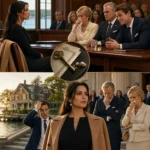
Sloane arrived five minutes later in winter white.
She took the chair beside him.
When I entered with Adrian, Grant stood.
He did not look surprised to see us together.
He looked offended.
“Is he representing you in the divorce?” Grant asked.
“Mr. Cross is here in his capacity as trust protector,” Elias March said.
“I was speaking to my wife.”
“And she is not required to answer,” Adrian replied.
Grant smiled without warmth.
“There he is. The family gargoyle.”
Adrian removed his gloves.
“Gargoyles protect buildings from water damage and evil spirits. I’ve always admired the efficiency.”
I sat across from Grant.
Elias began by explaining that the meeting would be recorded and that all statements could become part of the trust’s administrative record.
Grant agreed.
Sloane agreed.
I agreed.
Then Grant presented his proposal.
He described our marriage as functionally dissolved.
He described Sloane’s pregnancy as an unexpected blessing.
He described the family support account as a temporary, humane arrangement that would protect his unborn child from unnecessary conflict.
He spoke for twelve minutes.
Not once did he mention the eight million dollars missing through North Star.
When he finished, Elias asked whether Grant was requesting that sixty percent of my quarterly distribution be redirected.
“Until the divorce and support matters are resolved.”
“Who would control the account?”
“I would.”
“Would Mrs. Whitmore retain approval authority?”
“That would defeat the purpose.”
“What is the intended use of the funds?”
“Housing, medical care, security, education planning, and general family support.”
“For Ms. Mercer and the child?”
“Do you currently maintain an intimate relationship with Ms. Mercer?”
“Did that relationship begin while you were legally married?”
Grant shifted.
“Our marriage had ended privately.”
“That was not the question.”
Sloane looked down at the table.
Grant’s voice hardened.
Elias placed the declaration in front of him.
“This document confirms your request and the intended purpose. Please review it carefully.”
Grant skimmed the first page.
Adrian watched his hands.
I watched his face.
At the second page, Grant paused.
“What is this language about trust review?”
“Standard administrative authority,” Elias said.
“I don’t want this delayed.”
“Then you should read carefully.”
Grant flipped to the signature page.
That was his weakness.
Not arrogance alone.
Impatience with anything that refused to recognize him instantly.
He signed.
The pen made a soft scratching sound.
When he slid the paper toward Elias, Sloane’s mouth trembled.
Grant mistook it for excitement.
He touched her wrist.
“Almost done.”
Elias took the document.
Then he removed his glasses and read the Infidelity, Coercion, and Diversion Provision aloud.
By the time he finished, Grant’s face had gone white.
“You knew about this?” he demanded.
He turned toward his attorney, who had joined by video from another office.
“Did you know about this?”
The attorney looked stricken.
“The provision appeared in the participation agreement, but its application to this request may be disputable.”
“Disputable?” Adrian said. “Your client has just admitted every triggering element on a recorded line and signed the declaration beneath them.”
Grant pushed back from the table.
“This is entrapment.”
“No,” I said. “Entrapment requires government inducement. This is paperwork.”
“You set me up.”
“You scheduled the meeting.”
“You knew I didn’t understand the trust.”
“You had three law firms review it.”
“No one told me my wife’s family could punish me for falling in love.”
Adrian’s voice was quiet.
“The trust is not punishing you for falling in love. It is protecting itself because you attempted to divert trust assets into an extramarital household while concealing corporate losses.”
Grant froze.
The room changed.
“What corporate losses?”
Elias opened a second file.
“Blackthorne’s preliminary review identified eight million dollars transferred from a Vale-secured Whitmore Hospitality development account to North Star Advisory.”
Grant looked at Sloane.
She kept her face still.
“That transfer was authorized by finance,” he said.
“Under your digital credentials.”
“My credentials are used by assistants.”
“Your biometric confirmation was recorded.”
“You’ve been investigating me.”
“The trust monitors secured assets.”
“You had no right.”
“The trust owns the debt.”
“I run the company.”
“For the moment.”
His eyes narrowed.
“What does that mean?”
Adrian placed a document on the table.
“Under Section Fourteen of the Whitmore restructuring agreement, intentional misuse of corporate assets constitutes a material dishonesty event. Upon confirmation, the Vale Trust may convert its preferred equity into voting shares.”
Grant stared at the document.
“How many shares?”
“Enough for controlling interest.”
Sloane inhaled softly.
Grant looked at me as though the room had tilted.
“You’re trying to steal my company.”
“Your company was insolvent when my trust rescued it.”
“It has my name.”
“The trust owns the name.”
For the first time, he laughed.
It was an ugly sound.
“You expect anyone to believe that?”
Elias opened another schedule.
“The Whitmore trademarks, crest, licensing rights, and associated intellectual property are owned by W Imperial Holdings, a trust-controlled entity.”
Grant’s attorney closed his eyes on the video screen.
Grant looked between us.
“Yes,” Adrian said.
“My grandfather created that crest.”
“Your father pledged the rights as collateral in 1998. The debt was later acquired during the restructuring.”
Grant stood.
His chair hit the carpet behind him.
“This meeting is over.”
“No,” Elias said. “It is suspended pending forensic review. You are also advised that destruction of documents, interference with witnesses, or movement of secured assets may result in emergency injunctive relief.”
Grant turned to Sloane.
“Get your coat.”
She did not move.
“Sloane.”
Elias looked at her.
“Ms. Mercer has separate counsel.”
Grant’s face changed.
The conference room door opened.
Lillian Cho entered with a woman from her law firm.
Sloane folded her hands on the table.
“I’m cooperating with the investigation,” she said.
Grant stared at her.
The silence was absolute.
Then he looked at her stomach.
“You came here with her?”
Sloane’s eyes flicked toward me.
“Don’t lie to me.”
“I came here with you.”
“You gave them North Star.”
She said nothing.
His voice rose.
“You stupid, ungrateful—”
Adrian stood.
The movement was minimal, but Grant stopped.
Lillian Cho placed a protective notice on the table.
“Mr. Whitmore, direct communication with Ms. Mercer regarding her cooperation should occur through counsel.”
Grant looked around the room.
At Elias.
At Adrian.
At Lillian.
At Sloane.
Finally, at me.
“This is what you wanted?” he asked.
I thought of the ballroom.
The painted angels.
The cameras.
My lost child reduced to a publicity angle.
“I wanted the truth recorded accurately.”
“You think you’ve won?”
“I think you signed.”
He walked out without his coat.
The door slammed behind him.
Sloane closed her eyes.
Elias gathered the documents.
“As of eleven-oh-seven, Mr. Whitmore’s distributions are frozen. The trust will issue formal notice regarding the audit and conversion review.”
I looked at the empty chair Grant had left behind.
He had entered believing he could take sixty percent of my income.
He left without access to his monthly payments, corporate stipend, housing allowance, aircraft, or legal funding from trust-secured entities.
But that was only the beginning.
By noon, Grant’s attorneys filed an emergency petition in New York Supreme Court, alleging bad faith administration of the trust.
By two, Adrian’s team filed a response containing Grant’s signed declaration.
By four, the court denied Grant’s request for immediate access to the distributions and ordered preservation of all financial records.
By six, the Whitmore Hospitality board scheduled an emergency meeting.
By eight, three directors resigned.
The following morning, the financial press reported that an internal investigation had begun.
Whitmore shares dropped nineteen percent.
Grant blamed me publicly.
He released a statement accusing me of exploiting “an antiquated family instrument to retaliate against a man seeking happiness and fatherhood.”
I released nothing.
Silence no longer protected him.
It terrified him.
The forensic team worked from a secured floor at Blackthorne.
They traced North Star funds through casinos, luxury purchases, consulting entities, political donations, and a company that owned two apartments in Miami.
They found twelve million dollars in additional unauthorized transfers.
They found altered invoices.
They found emails Grant had deleted but failed to remove from archived servers.
They found payments to Camille Rhodes.
They found a draft agreement offering her three percent of a Dallas hotel development in exchange for “personal strategic services.”
They found that Thomas Redd had received two million dollars through a Cayman account.
Thomas began cooperating within forty-eight hours.
Grant’s coalition collapsed with astonishing speed.
Loyalty purchased through shared misconduct lasts only until the first subpoena.
One week after the bank meeting, the trust filed notice of a material dishonesty event.
Two weeks later, it exercised its conversion rights.
The Vale Trust became the controlling shareholder of Whitmore Hospitality.
I was appointed interim chair.
The board meeting took place in the Imperial’s library, three floors above the ballroom where Grant had announced Sloane’s pregnancy.
He arrived with four attorneys.
I arrived with Adrian.
When Grant entered, every director stood out of habit.
Then, one by one, they sat before he did.
He noticed.
I was seated at the head of the table.
My mother’s diamond earrings rested against my neck. I wore black.
Not mourning black.
Judicial black.
Grant remained near the door.
“You’re in my chair.”
“No,” I said. “You were in mine.”
His lawyers whispered to him.
He sat at the opposite end.
The general counsel read the resolutions.
Grant was removed as chief executive.
His authority over corporate accounts was terminated.
His company credit cards were canceled.
His access to executive offices and residences was revoked.
An independent committee was authorized to refer evidence to federal and state authorities.
The trust’s licensing company issued notice that continued use of the Whitmore name required compliance with governance reforms.
Grant said nothing until the final resolution.
The board proposed changing the corporate name from Whitmore Hospitality Group to Vale House International.
He laughed.
“You can’t erase one hundred years of history.”
I looked around the room.
“The employees built that history. The housekeepers who cleaned rooms during strikes. The chefs who kept kitchens running during blackouts. The doormen who remembered guests’ children twenty years later. The families who worked here for generations while the Whitmores borrowed against their labor.”
“You’re making a speech.”
“No. I’m correcting an attribution.”
He leaned forward.
“You think changing the name makes this yours?”
“No. The contracts made it mine. The work will make it worthy.”
The resolution passed nine votes to one.
Grant cast the only opposing vote.
Then the general counsel informed him that, due to the conversion of his pledged shares, he no longer possessed voting authority.
His vote was recorded as symbolic.
Something broke in his face.
Not grief.
Identity.
He had always believed that losing money would be survivable because he still had the name.
Now the name belonged to a company removing him.
After the meeting, he waited for me in the corridor.
Adrian stayed several yards away.
Grant looked thinner. The famous confidence had begun collapsing inward.
“You enjoyed that,” he said.
“Don’t lie.”
“I enjoyed clarity.”
“You humiliated me in front of my board.”
“You introduced your mistress in front of my foundation.”
“So this is revenge.”
“This is governance.”
“You always wanted the company.”
“I wanted the company solvent.”
“You wanted me dependent on you.”
“I wanted you accountable.”
“Do you love him?”
I glanced toward Adrian.
“That is no longer your concern.”
“It always was.”
“No. You only became interested in what I felt when it stopped belonging to you.”
Grant’s eyes moved over my face.
For one dangerous second, I saw the man I had married.
Not the executive.
Not the liar.
The man who had once waited outside a hospital bathroom because I was too proud to let him see me cry.
“Evelyn,” he said softly, “we can still stop this.”
“I made mistakes.”
“You made plans.”
“I was afraid.”
“So was I.”
“I thought you would leave me with nothing.”
“I would have given you more than you deserved.”
His expression twisted.
“That was the problem.”
I understood then.
My generosity had not reassured him.
It had humiliated him.
Every hotel my money rescued reminded him that the empire was no longer entirely his. Every room I redesigned, every lender I persuaded, every crisis I solved made his legend less believable.
He had not betrayed me because I was insufficient.
He had betrayed me because he could not bear the debt of being loved by someone stronger.
“You should have asked for a divorce,” I said.
“You would have kept the company.”
“I would have kept what my trust owned.”
“It was supposed to become mine.”
The oldest confession.
Not love.
Entitlement.
He had not believed I was his partner.
He believed I was the bridge between him and the fortune he deserved.
I stepped back.
“Your attorneys will receive the settlement proposal tomorrow.”
“I won’t sign it.”
“You may prefer the alternative.”
“What alternative?”
“Discovery.”
For the first time, he looked afraid.
I walked away.
Adrian followed me into the elevator.
Neither of us spoke until we reached the lobby.
Outside, a crowd of reporters waited behind barriers.
“What is in the settlement proposal?” Adrian asked.
“Grant keeps the Connecticut estate after the trust debt is satisfied.”
“That leaves very little equity.”
“He keeps his personal belongings.”
“Generous.”
“He receives no future trust participation. He resigns from all boards. He waives claims against the Vale entities and agrees to full financial cooperation.”
“And if he refuses?”
“We release the discovery schedule.”
Adrian looked almost pleased.
“Your mother would be proud.”
“My mother would ask why it took me twelve years.”
“She would ask privately. Then she would serve champagne.”
At the hotel doors, I stopped.
Reporters shouted my name beyond the glass.
“Adrian.”
“Thank you.”
“For what?”
“For not rescuing me.”
“You did not need rescue.”
“I needed the door unlocked.”
“That,” he said, “I can do.”
CHAPTER FIVE — THE LAST SIGNATURE
Grant refused the settlement.
For six days.
On the seventh, federal agents executed search warrants at Whitmore Hospitality’s former executive offices, Thomas Redd’s home, and North Star’s registered address.
By noon, Grant signed.
The divorce was finalized four months later.
He lost his position, his distributions, his claim to the penthouse, his access to the aircraft, and the public mythology that had protected him all his life.
He was not left penniless.
Real revenge rarely resembles fantasy.
Courts do not strip people naked because they deserve it. Contracts do not feel anger. Judges do not care about poetic balance.
Grant retained enough personal property to live comfortably.
What he lost was the machinery that allowed him to confuse comfort with power.
Without the company, the staff, the cars, the residences, the trust stipend, the private jet, and the Whitmore name licensed beneath him, he became merely a man facing consequences.
The criminal investigation continued.
Thomas Redd pleaded guilty to conspiracy and financial fraud.
Two former directors entered cooperation agreements.
Grant’s attorneys negotiated for months.
Sloane gave birth in August.
The baby was a girl.
Her name was Clara.
The paternity test showed that Thomas Redd was her biological father.
Grant learned through his attorney.
He sent Sloane one message.
YOU DESTROYED MY LIFE FOR A CHILD THAT ISN’T EVEN MINE.
Sloane forwarded it to Lillian Cho.
Then she replied through counsel.
YOU DESTROYED YOUR LIFE BEFORE SHE WAS BORN.