“I want the truth documented,” I said.
“For a divorce?”
“For whatever comes after the truth.”
He studied me across the candlelit table.
Time had sharpened him. There was silver beginning at his temples, and a pale scar near his right hand that I did not remember. He wore a charcoal suit that looked expensive because it fit, not because it advertised who made it.
“Do you want revenge?” he asked.
“No.”
It was not entirely honest.
His gaze did not leave mine.
“Revenge is emotional. Evidence is structural. Which one are you asking me to build?”
“Evidence.”
“Good.”
He opened a black notebook.
“Then from this moment forward, you do not accuse him. You do not threaten him. You do not change your routine unless we tell you to. You let him believe he is safe.”
“And if he humiliates me?”
“He probably will.”
“How comforting.”
“I did not say it to comfort you.”
That was the first reason I trusted him.
The second was that he never once called me fragile.
For ten months, I collected the life my husband thought I was too emotional to understand.
Hotel charges.
Private messages.
Altered board minutes.
Unauthorized loan documents.
Foundation invoices.
A forged approval bearing a digital signature I had never used.
Grant had pledged two Hart-owned properties as security for an acquisition called Aurelia Crown, a chain of failing luxury resorts he believed would make Vale Meridian untouchable.
The loan was enormous.
The collateral was not his.
When Naomi explained the structure, she placed a red folder in front of me.
“If the lender discovers this before we control the narrative, they could accelerate the debt.”
“How much?”
“Four hundred and eighty million.”
The number should have frightened me.
Instead, I felt something inside me become very calm.
Grant had not merely betrayed our marriage.
He had gambled the inheritance my mother built stitch by stitch.
“Can he fix it?” I asked.
“Not without your signature.”
“He has used my signature before.”
“Not successfully. The digital certificate on the loan approval was cloned from an inactive device. We can prove it.”
“And the board?”
“Three members knew something was wrong. Two looked away. One kept copies.”
The one who kept copies was Jonah Pierce, Vale Meridian’s deputy chief financial officer.
He came to see me on a rainy Thursday with the posture of a man who had not slept in weeks.
“Mr. Vale told us you approved the collateral package,” Jonah said.
“I didn’t.”
“I know.”
“How?”
“Because I watched you refuse it in the strategy meeting.”
Grant had removed that meeting from the official minutes.
Jonah had saved the recording.
“Why didn’t you come to me earlier?” I asked.
His eyes lowered.
“My daughter was in the hospital. Mr. Vale knew I couldn’t risk losing my insurance.”
There were betrayals committed by cruel people.
And there were silences purchased from frightened ones.
I did not forgive Jonah immediately.
But I understood him.
“Give the files to Adrian,” I said. “Your daughter’s treatment will continue through an independent medical trust. No conditions.”
Jonah looked at me as if kindness were more dangerous than anger.
“Why would you do that?”
“Because Grant taught me what power looks like when it enjoys fear.”
By the time Camille announced the winter charity auction, we had enough evidence to seek an injunction.
Adrian wanted to file immediately.
I asked him to wait.
The auction catalog had already been printed. Lot Twenty-Seven was described as “The Vale Wedding Gown, donated from the personal collection of Grant and Evelyn Vale.”
Personal collection.
A phrase designed to blur ownership.
Three days before the gala, Camille sent me a message.
I hope you don’t mind. It feels healthy to let go of symbols that no longer serve us.
I forwarded it to Adrian.
He called within minutes.
“She wants a reaction.”
“She wants the dress.”
“Why?”
“Because she thinks owning the symbol means she won.”
“Did you respond?”
I looked at the gown through the glass doors of the Hart Archive showroom.
My mother had spent four hundred hours on it.
Grant had spent seven years treating it like proof that I belonged to him.
“Let them proceed,” I said.
Adrian was silent.
“You understand they may damage it.”
“They won’t.”
“How can you be certain?”
“Camille wants the photograph more than she wants the fabric.”
“And Grant?”
“He wants me publicly powerless.”
Adrian’s voice lowered.
“Evelyn, this is not a small risk.”
“No. It’s a public acknowledgment of possession, intent, and authority they do not have. I need the auction house to ask for proof. I need Grant to receive notice. And then I need him to order them to continue.”
“You’re turning the gown into a legal trap.”
“They turned it into a weapon first.”
That night, I removed my mother’s note from the safe and read it again.
At the gala, Grant stopped applauding.
By midnight, he would learn I had never given him ownership at all.
## Chapter 2 — The Empire Hidden Behind Her Name
The morning after the auction, every major entertainment site carried a version of the same headline.
BILLIONAIRE’S WIFE STOPS MISTRESS FROM SELLING WEDDING DRESS.
The serious financial publications waited four hours longer.
Then they published the story that mattered.
VALE MERIDIAN FACES OWNERSHIP DISPUTE, EMERGENCY INJUNCTION, AND BOARD REVIEW.
Grant returned to our penthouse at 3:17 in the morning.
I was sitting in the library beneath the portrait he had commissioned for our fifth anniversary. In it, I wore white and stood behind him with one hand on his shoulder.
The artist had painted Grant larger.
I had always wondered whether that had been his instruction.
He entered without removing his coat.
“What did you do?”
I closed the book on my lap.
“Which part?”
“The restraining order. The lender notices. The board meeting.”
“You received all of them?”
His jaw tightened.
“Do you understand what you’ve triggered?”
“Yes.”
“You could destroy this company.”
“No. I can separate it from you.”
For a second, his face became unfamiliar.
Not because it changed.
Because it stopped pretending.
“You think a few antique dresses and design registrations give you control of Vale Meridian?”
I stood.
“The shareholder agreement does.”
Grant laughed, but no amusement reached his eyes.
“I control seventy percent of the voting shares.”
“You control a proxy attached to Hart Meridian Trust’s shares.”
“The proxy is irrevocable.”
“Section Twelve says otherwise.”
His silence was almost satisfying.
Almost.
“Fraud, unauthorized encumbrance, diversion of restricted charitable assets, or conduct creating material reputational harm,” I recited. “Any one of those events revokes the proxy automatically.”
“You’re not a lawyer.”
“No. That’s why I hired one.”
He walked toward the bar and poured whiskey with a hand that was not quite steady.
“This is Adrian Cross.”
It was not a question.
“He’s manipulating you.”
“Men always say that when a woman stops obeying the wrong one.”
Grant swallowed the whiskey.
“What do you want? An apology? Camille fired? A public statement?”
He believed everything could still be negotiated because he had not yet understood the scale of the evidence.
“I want you to leave.”
“This is my home.”
“The penthouse is owned by Hart Residential.”
“We bought it together.”
“My trust purchased it before the wedding. You selected the wine refrigerator.”
His mouth opened.
Then closed.
The smallness of the contribution seemed to wound him more than the eviction.
I had once believed Grant loved me despite my money.
Later, I understood that he loved being near it while pretending it was his.
“You can’t throw me out in the middle of the night.”
“The temporary order grants me exclusive occupancy due to the risk of document destruction. Your clothes have been moved to the Lowell.”
“You moved my clothes?”
“Only the ones you paid for yourself.”
That left fewer than he expected.
A sound escaped him, halfway between disbelief and rage.
He took one step toward me.
The library doors opened.
Adrian stood in the hallway.
He had removed his tie. His expression was calm, but there was nothing gentle in it.
Grant looked from him to me.
“You brought him into our home?”
“I brought counsel into my home.”
“This is obscene.”
“No,” I said. “Obscene was charging your mistress’s lingerie to a literacy foundation.”
Grant’s face flushed.
Adrian stepped into the room and placed a document on the table.
“Mr. Vale, all direct communication with Mrs. Vale regarding company assets, the foundation, or pending litigation should go through counsel.”
Grant ignored him.
“You’ve been planning this for months.”
“Ten months,” I said.
That hurt him.
Not the affair.
Not the theft.
The fact that I had known and remained composed while he mistook my silence for ignorance.
“What else?” he asked.
I looked toward the windows.
Manhattan glittered beneath us, cold and distant. Grant had once told me the view proved we had won.
I had never asked who he believed we had defeated.
“Your access to the family office has been suspended,” I said. “The foundation accounts are frozen pending review. The board will meet at nine. The Aurelia lenders received notice that the collateral approvals are disputed. The aircraft is grounded, and the St. Barts villa is under preservation order.”
“You froze the jet?”
“The jet belongs to a transportation trust.”
“My company pays for it.”
“Your company pays to use it.”
He stared at me.
One by one, the objects of his life were being returned to their proper definitions.
Not his plane.
Not his penthouse.
Not his hotels.
Not his wife.
“Camille said you were weak,” he whispered.
Adrian’s posture changed slightly.
I lifted one hand, and he remained where he was.
Grant wanted anger.
I gave him accuracy.
“Camille also believed my wedding gown belonged to a charity because you let her touch it. Her judgment is not a reliable asset.”
He placed the glass down hard enough to crack it.
“You’ll regret humiliating me.”
I looked at the whiskey spreading across the antique table.
“Take photographs before he leaves,” I told Adrian. “The table is part of the archive.”
Grant left at 3:42.
By 4:00, images of him entering the Lowell Hotel were online.
Camille did not join him.
She had gone to a townhouse on East Seventy-Third Street owned by Northstar Capital’s managing partner, Everett Sloan.
Naomi showed me the security photographs the next morning.
Camille wore a camel coat and carried a silver laptop case. She entered through the private garage and remained inside for two hours.
“Grant doesn’t know,” Naomi said.
We were in the Hart Archive’s conference room, surrounded by climate-controlled cabinets and rows of white garment boxes.
“What is she giving Sloan?”
“Internal projections, acquisition models, debt schedules. Maybe the lender correspondence.”
Naomi enlarged one photograph.
Camille’s face appeared in profile as she stepped from the car. She did not look frightened.
She looked pleased.
“Northstar has been buying Vale Meridian debt through intermediaries,” Naomi said. “If the Aurelia acquisition fails and the lenders accelerate, Northstar can force a restructuring.”
“And Camille gets what?”
“A seat. Equity. Possibly the foundation’s public portfolio.”
I leaned back.
Grant had risked everything for a woman who was preparing to sell him by the piece.
It should have felt like justice.
Instead, it felt ordinary.
Betrayers rarely reserve betrayal for one person.
“Do we warn him?” Naomi asked.
Her eyebrows rose.
“Is that legal strategy or personal preference?”
“Both.”
At nine, the Vale Meridian board assembled in the private council room of the Fifth Avenue flagship.
I entered through the main lobby.
Employees pretended not to stare.
The black rose pattern was everywhere: carved into marble, woven into rugs, etched into the elevator doors. I had drawn the first rose on a napkin during our honeymoon in Charleston.
Grant had trademarked it through Vale Meridian without telling me.
The registration was invalid.
We had included that in the complaint.
Adrian walked beside me carrying one slim folder.
“Are you nervous?” he asked.
“You press your thumb against your ring when you’re nervous.”
I looked at my hand.
He was right.
“I’m deciding when to remove it.”
“That is not a legal question.”
His eyes held mine for one second too long.
Then the elevator doors opened.
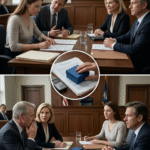
The boardroom had a table cut from a single piece of walnut. Grant sat at its head. Camille occupied a chair behind him, although she was not a director.
I took the seat at the opposite end.
Grant looked exhausted and expensive.
Camille looked immaculate.
“Evelyn,” she said softly, “this has gone far enough.”
I placed my bag beside the chair.
“You tried to sell my mother’s work.”
“For charity.”
“You used charitable funds to rent a villa where you slept with my husband.”
One of the directors coughed.
Camille’s expression tightened.
“This is exactly why personal grievances should remain outside corporate governance.”
Adrian opened the folder.
“Fortunately, fraud is a corporate matter.”
The meeting began.
For the next three hours, Naomi presented numbers.
Not accusations.
Numbers were colder.
They showed the private flights, the resort charges, the foundation transfers, the altered invoices, the consulting company registered to Camille’s brother in Delaware, and the unauthorized collateral package supporting the Aurelia loan.
Jonah played the recording of the strategy meeting.
My own voice filled the boardroom.
I do not authorize Hart assets to secure this transaction. The projections are inflated, and the environmental liabilities have not been disclosed.
Then Grant’s voice.
We’ll revisit the language after legal review.
They had not revisited it.
They had erased it.
Grant watched the directors absorb the truth.
“That recording was confidential,” he said.
“So was the board meeting you removed from the minutes,” Adrian replied.
Camille rose.
“I am not staying here to be slandered.”
Rebecca Shaw, the auction lawyer, stood near the door.
“You may want to remain,” she said. “Bellweather’s insurer has questions regarding the provenance declaration you signed.”
Camille sat down.
At noon, the board voted to place Grant on administrative leave.
He still believed he could reverse it.
“I founded this company.”
Harlan Vale had founded it.
I had rescued it.
Grant had branded himself as its creator so often that memory had become inconvenient.
The acting chairman adjusted his glasses.
“Pending the investigation, your executive authority is suspended.”
Grant turned toward me.
“This is what you wanted.”
I looked around the room I had designed.
The brass lights. The hand-stitched leather. The windows positioned to frame the city without making the people inside feel small.
“I wanted you to stop before this became necessary.”
He laughed bitterly.
“You expect anyone to believe that?”
“I stopped caring what people believe when I learned how cheaply belief can be purchased.”
Outside the hotel, reporters filled the sidewalk.
Adrian offered to take me through the service exit.
I refused.
For years, I had entered through kitchens so Grant could stand alone in the photographs.
I walked through the front doors.
Questions exploded.
“Mrs. Vale, are you seeking control of the company?”
“Did your husband steal charitable funds?”
“Is the marriage over?”
“Was the wedding gown auction a setup?”
I stopped at the top of the marble steps.
Snow touched my hair.
“The gown was not a setup,” I said. “It was property. The difference matters.”