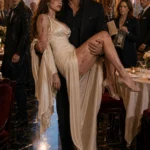
“You were not the sole founder.”
The screen behind us changed one final time.
MERCER AESTHETICS
ORIGINAL INCORPORATORS
ADRIAN MERCER
EVELYN VALE
My name appeared beside his.
Not beneath it.
Not in smaller letters.
Beside it.
The historical record had always known what Adrian spent twenty years teaching the world to forget.
I had founded the company too.
The chairman continued.
“The board has appointed Evelyn Vale interim executive chair, subject to shareholder confirmation.”
This time, the applause began.
It did not explode.
It rose.
First from Naomi.
Then from Martin Keller.
Then from the physicians who had attended the summit.
Then from the employees standing along the back wall.
Soon the entire hall was on its feet.
I looked out at them.
For years, I had believed applause was power.
It was not.
Power was knowing I would have done the same thing in an empty room.
Adrian remained seated at the glass table.
No one applauded him.
The man who had built his life around being watched was finally invisible.
I waited until the sound faded.
Then I stepped toward the microphone.
“This company will not be dismantled,” I said. “Its employees will not pay for the decisions of its former chief executive.”
Several people near the back began to cry.
“We will negotiate a new license for the Luminance Complex under independent oversight. Vale Orison’s medical patents will remain separate. Aevum will not be launched as a private fountain of youth for those wealthy enough to fear a wrinkle.”
Naomi joined me at the microphone.
Together, we unveiled the new structure.
The Lillian Vale Access Covenant.
A permanent portion of all cosmetic licensing revenue would fund treatment for burn survivors, pediatric dermatology patients, reconstructive surgery patients, and people living with severe scarring disorders.
No executive could dissolve the covenant.
No acquisition could remove it.
No luxury partner could delay medical applications to protect a campaign.
My mother had once said vanity could pay for medicine.
That night, I made it legally impossible for vanity to own it.
Reporters began shouting questions.
“Mrs. Mercer, was this revenge?”
“Ms. Vale, did you plan the gala reveal?”
“Will Adrian Mercer face criminal charges?”
“Are you and Sebastian Cross in a relationship?”
The last question almost made me smile.
I looked at Sebastian.
He stood beyond the stage lights, calm and watchful.
Not claiming me.
Not rescuing me.
Simply there.
I turned back to the cameras.
“My name is Evelyn Vale,” I said. “And tonight was not revenge.”
Adrian looked up.
“It was an audit.”
The clip reached thirty million views before sunrise.
By the following afternoon, the court froze Adrian’s nonexempt assets connected to the guarantee and marital fraud claims.
The Mercer special committee referred its findings to federal investigators and securities regulators.
Richard Bell resigned from every board he held.
The physician who had agreed to create a false cognitive assessment surrendered his hospital privileges before the medical board could begin its hearing.
Sloane amended her sworn testimony and accepted responsibility for her role in the unauthorized marketing scheme.
She did not escape consequence.
But she stopped lying.
Sometimes redemption does not begin when a person becomes innocent.
Sometimes it begins when they stop demanding to be seen that way.
Adrian left the gala through a service corridor.
The same kind of corridor I had used weeks earlier when I began gathering evidence.
No cameras saw him go.
That detail would have hurt him most.
Three days later, he asked to meet me at the townhouse.
Sebastian advised against it.
I agreed anyway.
Not because Adrian deserved a final conversation.
Because I did.
He arrived without an attorney.
His suit was immaculate, but exhaustion had altered his face.
Without the company, the entourage, or the certainty that everyone in the room wanted something from him, he looked older than fifty-three.
He entered the library and stopped beside the chair where Sloane had once sat.
The lipstick was gone.
The glass was gone.
The illusion was gone.
“You changed the locks,” he said.
“They belong to the house.”
He looked around.
“Are you keeping it?”
His eyebrows lifted.
“You fought for it.”
“I preserved it.”
“What’s the difference?”
“Preservation prevents a man from burning down what he cannot keep. It does not require me to live in the ashes.”
He poured himself a drink without asking.
The bottle was nearly empty.
“You always hated this whiskey,” he said.
“I hated who you became when you drank it.”
He stared into the glass.
“The board will beg me to return.”
“The company cannot survive without me.”
“It survived its first week.”
“You think a laboratory makes you a chief executive?”
“No. That is why I appointed one.”
His head lifted.
“Naomi Reyes will lead Vale Orison. Martin Keller will serve as interim chief executive of Mercer Aesthetics. I will remain executive chair until the license restructuring is complete.”
“You gave my company to employees.”
“I gave authority to people who know the work.”
“You’ll destroy everything.”
“The stock rose eighteen percent after the access covenant announcement.”
Facts were humiliating when they refused to respect his prophecy.
“You enjoyed it,” he said.
“The gala.”
“You expect me to believe that?”
“I enjoyed being free of you. I did not enjoy learning what freedom cost.”
He finished the whiskey.
For a moment, he seemed almost human.
Then he said, “I did love you.”
I looked at the man I had shared half my adult life with.
I believed him.
That was the tragedy.
“I think you did,” I said.
His expression softened.
“But you loved being chosen more.”
The softness disappeared.
“You chose him first.”
“You were never over him.”
“You forged his rejection.”
“I protected what we could become.”
“You stole my decision.”
“You would have married him.”
The word entered the room and closed a twenty-year argument.
Adrian stared at me.
I did not soften it.
I did not apologize.
He had built our marriage on the certainty that I would never be allowed to know the answer.
Now he had it.
“Yes,” I repeated. “I would have married him.”
His face tightened.
“Then our entire marriage was a mistake.”
The answer surprised him.
“Our marriage gave me years I will not pretend did not exist. We built a company. We created work that employed thousands of people. We laughed. We traveled. We held each other through funerals. Some of it was real.”
“Then why destroy me?”
“I didn’t.”
I moved closer.
“I stopped protecting you from the consequences of being yourself.”
He looked at me for a long time.
“What happens now?”
“The divorce is finalized.”
“The guarantee?”
“Enforced.”
“The shares?”
“Transferred according to the prenup and court order.”
“The house?”
“Sold.”
He swallowed.
“And my name?”
“Mercer Aesthetics will keep it temporarily.”
“Temporarily?”
“The board has approved a shareholder vote.”
“To rename the company.”
His hand tightened around the empty glass.
“What name?”
“Vale House.”
He closed his eyes.
That was the wound he had not anticipated.
Money could be rebuilt.
Reputation could be repackaged.
But his name—the word he had engraved into buildings, bottles, invitations, and other people’s obedience—would disappear from the empire he believed immortal.
When he opened his eyes, there were tears in them.
I had seen Adrian perform grief.
This was not performance.
For one dangerous second, pity moved inside me.
Then I remembered the forged letter.
The cognitive reports.
The one-dollar document.
The word decline spoken into a microphone.
Pity was not the same as permission.
“I’m sorry,” he said.
It was the first apology he had offered without an audience.
Perhaps he meant it.
Perhaps he was only sorry the ending had chosen him.
Either way, I accepted the sentence without accepting him.
“I know,” I said.
He placed the glass on the table.
At the doorway, he stopped.
“Did you ever love me more than him?”
Years earlier, the question would have shattered me.
Now it felt like a door I no longer needed to open.
“I loved you enough to trust you,” I said. “You spent twenty years proving that was more than you deserved.”
He left without another word.
The door closed.
I stood alone in the library.
Then I walked to the Venetian mirror in the hallway.
The woman reflected there was forty-eight.
There were faint lines beside her eyes.
Silver had begun to appear near her temples.
She did not look twenty-nine.
She did not look timeless.
She looked present.
For the first time in years, that was enough.
CONCLUSION
TOMORROW, WITH THE LIGHTS ON
The divorce became final eleven months later.
Adrian did not go to prison immediately.
Real consequences rarely arrive with the satisfying speed of fiction.
Investigations took time.
Depositions became hearings.
Hearings became indictments.
Eventually, he pleaded guilty to conspiracy to commit wire fraud, falsification of corporate records, and obstruction related to the fabricated cognitive evidence.
He surrendered most of his remaining Mercer shares and received a sentence that ensured he would spend several years in a federal facility where no one cared what his name had once meant on Fifth Avenue.
Richard Bell cooperated.
The physician lost his license.
Northstar Advisory dissolved.
FUTURE/FORM disappeared before selling a single bottle.
Sloane pleaded guilty to one count involving false marketing disclosures. She received probation, community service, and a permanent restriction from serving as an officer of a public company for several years.
She sold the clothes and personal jewelry that had not been purchased with Mercer funds.
Then she used the money to start a legal defense fund for young employees pressured into financial misconduct by senior executives.
It did not erase what she had done.
But erasure was Adrian’s language.
Accountability was mine.
Vale Orison’s first expanded-access program opened at Massachusetts General Hospital the following spring.
The first patient was not a model.
Not an influencer.
Not a billionaire frightened of turning fifty.
His name was Daniel Ortiz.
He was a thirty-six-year-old firefighter from Queens who had been burned while carrying two children from an apartment building.
The Aevum treatment did not restore the face he had before the fire.
That was never the promise.
It reduced the rigidity in his neck enough for him to turn his head without pain.
It softened the scar tissue around his mouth enough for him to smile without tearing the skin.
The morning he completed his first treatment cycle, his eight-year-old daughter ran into the examination room.
She looked at him.
Then she smiled.
“Daddy,” she whispered. “You look happy.”
Daniel began to cry.
So did Naomi.
So did half the nurses.
I stood behind the observation glass with Sebastian.
He did not speak.
He simply found my hand and held it.
That moment was worth more than the gala.
More than the headlines.
More than watching Adrian’s name disappear from the building.
Because revenge ends with the person who hurt you.
Purpose continues after they are gone.
Vale House became profitable within its first year.
We kept the luxury products.
My mother would have understood.
Vanity still paid for medicine.
But every gold-capped bottle carried a small line beneath the ingredients.
A portion of every purchase supports reconstructive treatment access.
Some customers bought the products because they believed in the mission.
Others bought them because the bottles looked beautiful on marble.
The patients did not care why the money arrived.
The Lillian Vale Access Covenant funded treatment at twelve hospitals.
Then twenty.
Then thirty-one.
Vale Orison rejected four acquisition offers.
We accepted research partnerships instead.
Naomi led the laboratory with a rule posted above the main conference table.
NO CLAIM WITHOUT DATA.
NO PROFIT WITHOUT ACCESS.
NO FUTURE BUILT BY ERASING THE PAST.
I sold the Manhattan townhouse.
The buyer planned to turn it into a private art residence.
Before the closing, I walked through the rooms one final time.
The library was empty.
Pale rectangles marked the walls where Adrian’s portraits had hung.
In the bedroom, sunlight touched the place where the hidden safe had been.
I expected grief.
Instead, I felt gratitude for the woman who had stood there in silence and made one phone call.
She had not known how the story would end.
She only knew she could not remain where it had begun.
I kept one thing from the house.
The Venetian mirror.
Not because it was valuable.
Because it had witnessed the exact moment I stopped breaking.
Sebastian helped me hang it in my new apartment overlooking the East River.
The apartment was smaller than the townhouse.
Warmer.
Books rested in uneven stacks. Scientific journals covered the dining table. Fresh flowers appeared without assistants arranging them.
Nothing matched perfectly.
Everything belonged.
Sebastian officially stopped being my attorney two days after the divorce became final.
At six that evening, he arrived carrying a bottle of wine and the original letter he had written from Washington.
“I believe this is yours,” he said.
I took the envelope.
The paper had yellowed slightly.
His handwriting had not changed.
“Do you expect an answer after twenty years?” I asked.
“I’m an attorney. I’m comfortable with delayed proceedings.”
I smiled.
He looked nervous.
Sebastian Cross, who had faced senators, billionaires, federal judges, and Adrian Mercer without blinking, looked nervous in my doorway.
It made me love him more than confidence ever could.
I opened the letter again.
Marry me in October. Marry me in a courthouse if you cannot wait. Marry me in the rain.
Outside, rain touched the windows.
“It isn’t October.”
“And I don’t want a courthouse tonight.”
“Reasonable.”
“But I am done mistaking distance for doubt.”
His face changed.
Hope is beautiful on a man who has learned not to demand it.
I stepped closer.
“This is not the answer I would have given at twenty-nine,” I said.
“I don’t want her answer.”
“I am not easy now.”
“You were never easy.”
“I have a company.”
“You have several.”
“I work too much.”
“I own books.”
“I don’t need rescuing.”
“I may never marry again.”
His eyes remained on mine.
“I know that too.”
The absence of pressure felt like a door opening.
I touched his face.
“What do you want, Sebastian?”
“You. Without ownership. Without urgency. Without pretending the years did not happen.”
“And if I need time?”
“I have evidence that I can wait.”
Then I kissed him.
This kiss was different from the one in his office.
There was no anger in it.
No stolen history.
No husband waiting to turn tenderness into an accusation.
Only two people standing in a room where every door was unlocked.
We did not marry that year.
Or the next.
We traveled.
We argued over books.
He attended clinical presentations and pretended to understand every graph.
I attended legal dinners and understood exactly how bored he was.
He learned to make coffee the way I liked it.
I learned that he woke before dawn and read court opinions in bed.
We did not try to recover the people we had been.
Love is not restoration.
It is new construction on honest ground.
On my fifty-first birthday, Sebastian took me to Boston.
Rain fell over the Charles River.
He led me to the courthouse steps where we had once planned to marry.
There were no photographers.
No board members.
No chandeliers.
Naomi stood beneath a black umbrella.
Daniel Ortiz and his daughter stood beside her.
Martin Keller held a small velvet box.
Sloane was not there.
Adrian was not there.
The day did not belong to them.
Sebastian looked at me.
“I am not asking you to correct the past,” he said. “I am asking whether you would like to share the future.”
I looked at the man who had never demanded I become smaller so he could feel chosen.
Then I looked at the people whose lives had entered mine because one betrayal forced every hidden truth into the light.
“Yes,” I said.
We married in the rain.
I kept my name.
He expected me to.
At the reception, held in the Waltham laboratory, Naomi unveiled a framed page from my mother’s notebook.
It contained the first drawing of the Aevum delivery system.
Beneath it, in Lillian Vale’s handwriting, was a sentence I had never seen.
Age is not decline. It is evidence that the body remembers how to survive.
I touched the glass.
For years, Adrian had treated age like an expiration date.
Sloane had treated it like a disease.
The market had treated it like fear waiting to be monetized.
My mother had understood something simpler.
Time did not make a woman less powerful.
It revealed what her power had survived.
That evening, after the guests left, I stood alone inside the laboratory.
Beyond the glass, the equipment glowed beneath soft white light.
On one wall hung photographs of patients from the access program.
Daniel smiling with his daughter.
A breast cancer survivor wearing a red dress after reconstructive treatment.
A twelve-year-old boy holding a baseball glove in a hand that no longer split painfully at the joints.
The city beyond the windows was quiet.
Sebastian came to stand beside me.
“Any regrets?” he asked.
“Several.”
“About today?”
He slipped his hand into mine.
On the far side of the laboratory, the original Vale Orison seal had been restored above the entrance.
No Mercer logo covered it.
No luxury campaign softened it.
No man stood beneath it claiming he had invented what women created before him.
I thought of the summit.
The chandelier.
The silver dress.
Adrian lifting his glass to younger minds, younger faces, and younger energy.
He had believed he was announcing my ending.
Instead, he gave me an audience for my return.
He had called Sloane the future because he thought the future was a beautiful object a powerful man could select, purchase, and display beside him.
He had been wrong.
The future was never a woman standing at his side.
It was the science he tried to steal.
The patients he wanted to hide.
The covenant he could not dissolve.
The company he never knew I controlled.
He mocked my age at a private dermatology research summit while his mistress smiled beside him.
He told the physicians she represented the future and I represented decline.
I waited until the lead scientist unveiled the investor behind their newest regenerative treatment.
The patent, the laboratory, and the future he praised belonged to my company.
CAPTION:
He called her old. She owned tomorrow.