“For the first seven years, I did.”
My chest tightened.
“You had pictures of me?”
“Birthdays.”
“Christmas mornings.”
“Your first day of school.”
“One photograph showed you holding a blue umbrella in the rain.”
I remembered that umbrella.
My mother had bought it at a museum gift shop.
It had yellow stars painted across the fabric.
“I wrote letters,” Vivian continued.
“I never sent them.”
“Why?”
“Because Richard said contact would confuse you.”
“When did you see me again?”
“At a hospital fundraiser when you were seventeen.”
“You were standing beside Helen.”
“You laughed exactly the way Thomas used to laugh.”
Her eyes filled.
“I went into a restroom and became sick.”
I felt no pity.
Not yet.
“Why did you let Ethan date me?”
“I told him you were unsuitable.”
“That was easier than telling him you had another child.”
“You called me common.”
“You criticized my clothes.”
“You made me feel small because you were afraid of the truth.”
Her voice broke.
“Cowardice often dresses itself as superiority.”
I stepped closer.
“And at the engagement party?”
“Richard called me that afternoon.”
“He said the wedding had to end.”
“He said he had already tried to persuade you to leave Ethan.”
I remembered small moments.
My father questioning whether Ethan respected my work.
My father arranging overseas trips whenever Ethan and I planned holidays.
My father suggesting that marriage into the Blackwood family would expose me to ridicule.
I had dismissed it as protectiveness.
“What did he threaten you with?” I asked.
“He said he would release the St. Agnes records.”
“He said Gerald would learn I had lied throughout our marriage.”
“Does Gerald know now?”
“Did he leave you?”
“He moved to the guesthouse.”
For the first time, Vivian seemed less like a villain in a silver gown and more like an aging woman standing amid the consequences of choices made over decades.
I did not forgive her.
But hatred became harder when its object became human.
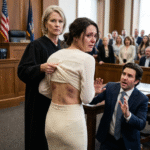
“Why did you slap me?” I asked.
She closed her eyes.
“Richard said the rejection had to be public.”
“He said if Ethan simply ended the engagement, you would demand answers.”
“He said you might forgive him.”
“So you agreed to humiliate me.”
“I agreed to end the wedding.”
“That is not what I asked.”
Vivian opened her eyes.
“The first slap was panic.”
“And the second?”
Her face crumpled.
“The second was a decision.”
The answer was so honest that it silenced me.
“I saw you look at Ethan,” she whispered.
“I saw how much you trusted him.”
“I knew he would defend you unless I told him.”
“So I whispered the truth.”
“Then you looked at him, and he could not move.”
“I understood that I had broken something precious.”
“And instead of stopping, I struck you again because anger was easier than shame.”
Tears slid down her face.
**“I chose my reputation over your dignity.”**
I wanted to hurt her.
I wanted to ask whether my cries as an infant had disturbed her sleep.
I wanted to know whether she had thought of me on my birthdays or only when I threatened the life she preferred.
Instead, I heard myself ask, “Did my mother know who I was?”
“Helen knew everything.”
“Did she know Ethan and I were dating?”
“She died long before you met him.”
“That is not what I mean.”
My voice lowered.
“Did she know Richard was hiding my identity?”
Vivian crossed the room and opened a small safe concealed behind a painting.
She removed a bundle of letters tied with blue ribbon.
“These are from Helen.”
The first letter was dated three months after my birth.
Vivian had given Helen permission to adopt me, though the language revealed both gratitude and sorrow.
The later letters were warmer.
Helen described my first words, my fear of thunder, my love of horses, and the way I insisted on sleeping with three books beneath my pillow.
Then the tone changed.
A letter written shortly before my tenth birthday contained a sentence underlined twice.
**Richard has begun to treat Lena’s history as property he alone controls.**
Another said:
**There are facts about Thomas’s estate that Richard refuses to explain, and I fear Lena’s adoption served a purpose beyond giving us a child.**
The final letter was dated six days before my mother died.
The handwriting was hurried.
**I have found the original probate reference.**
**If anything happens to me, tell Lena to look in the blue room.**
My hands began to shake.
“What is the blue room?”
“I do not know,” Vivian said.
“Our old family home had a blue room,” I replied.
Richard had sold the house after my mother’s death.
It stood near Middleburg, an hour west of Washington.
I had not entered it since I was nineteen.
Vivian touched the edge of the desk.
“Helen called me the morning she died.”
“What did she say?”
“She said Richard had lied about Thomas’s will.”
“Then she said something strange.”
“She said, ‘He did not take Lena because he loved her.’”
Vivian’s eyes held mine.
**“He took her because she belonged to Thomas.”**
The words settled heavily.
I looked at the letters.
“What happened to my mother’s car?”
“The police said she lost control on wet pavement.”
“I know what the police said.”
“What do you believe?”
Vivian’s face became guarded.
“I believe Helen was afraid during the final week of her life.”
“Of whom?”
“You know the answer.”
My phone rang.
Richard’s name appeared on the screen.
Vivian stepped back as though he had entered the room.
I answered.
“Where are you?” he asked.
“You already know.”
A pause followed.
“I asked a simple question.”
“And I gave you a simple answer.”
“You are at the Blackwood residence.”
It was not a question.
“Are you tracking my phone?”
“I am protecting you.”
I looked at Vivian.
“Those are not the same thing.”
“Come home.”
“I am not a child.”
His voice softened.
“You are a grieving woman being manipulated by people who assaulted you.”
“Did Vivian give birth to me?”
Silence.
My heart pounded.
“Did you arrange my adoption?”
More silence.
“Did Mom know about Thomas’s will?”
His tone changed.
“Leave that house immediately.”
“Because Vivian is unstable.”
“She says you forced her to end the engagement publicly.”
“She is trying to save herself.”
“I heard the recording.”
The line went quiet.
When Richard spoke again, every trace of warmth had vanished.
“Give the phone to Vivian.”
“I said no.”
“You have no idea what you are touching.”
“Then tell me.”
“This is not a conversation for the telephone.”
“Everything is always discussed later with you.”
“Every answer waits until I am calmer, older, stronger, or more obedient.”
“I am finished waiting.”
I ended the call.
My hands were trembling, but the fear beneath the trembling had changed.
It was no longer the fear of discovering that my father had lied.
**It was the fear that I had never known my father at all.**
Before I left, Vivian called my name.
“I do not expect forgiveness.”
“That is fortunate.”
“I need you to know one thing.”
I faced her.
“When Richard took you from St. Agnes, Helen held you as though she had been waiting her entire life.”
“She loved you immediately.”
I felt tears reach my eyes.
“Did you?”
Vivian’s answer came slowly.
“I loved you every day.”
“Just never enough to tell the truth.”
She bowed her head.
I walked out carrying Helen’s letters.
At the front door, I found Gerald Blackwood standing in the hall.
He looked exhausted.
“I owe you an apology,” he said.
“You did not hit me.”
“I spent thirty-eight years beside a woman who was terrified to tell me who she was.”
“I mistook her fear for loyalty.”
“That is between you and Vivian.”
He moved aside.
“But what Richard is doing to our company affects six hundred employees.”
“I am sorry.”
“Do not be sorry.”
His voice sharpened.
“Find out why he needed your engagement destroyed before your thirty-fifth birthday.”
I stopped.
“My birthday is next week.”
Gerald looked toward the closed library door.
“So does Richard.”
## **PART FOUR — THE BLUE ROOM**
The old Vale house stood empty behind iron gates, its stone walls streaked with rain and years of neglect.
Richard had sold it to a holding company after Helen’s death.
A search of public records revealed that the holding company was controlled by Vale Capital.
He had never truly let the property go.
He had merely moved it out of sight.
I drove there the following morning with Nora Chen.
She had called me at six and asked to meet without my father’s knowledge.
Nora had served as Vale Holdings’ chief financial officer for eleven years.
She was fifty-eight, precise, reserved, and famous within the company for remembering numbers no one else could locate.
She had also been in the SUV the night of the engagement party.
“Why are you helping me?” I asked as we stood before the gate.
Nora entered a code into the keypad.
“Because I prepared the Blackwood default notice.”
“You knew what he intended.”
“I knew he intended to call the loan.”
“Did you know Vivian would strike me?”
“Did you know he was waiting near the country club?”
Anger rose in me.
“You could have warned me.”
“I could have.”
She met my eyes.
“I have spent eleven years telling myself that obedience is not responsibility.”
“It is a comforting lie.”
The gate opened.
“What changed?”
“I saw your face when you realized the letter had been prepared in advance.”
Nora looked toward the house.
“And I remembered Helen.”
“You knew my mother?”
“She hired me as a junior accountant.”
“She told me numbers were stories people believed because they looked too dull to contain lies.”
We entered through a side door.
Dust covered the floors.
White sheets draped the furniture like shrouds.
Every footstep awakened memories.
I saw my mother kneeling beside the staircase to button my coat.
I heard her calling me in from the garden.
I remembered Richard carrying her through the front door after she twisted her ankle, both of them laughing.
That was the most painful part.
**My childhood had not been false.**
The love, the laughter, and the tenderness had existed.
They had simply existed beside secrets.
The blue room was on the second floor.
When I was young, it had served as my mother’s sewing room.
The wallpaper was patterned with pale birds.
A faded blue chaise stood beneath the window.
Nora examined the shelves.
I searched drawers, cabinets, and the old cedar chest where Helen had stored fabric.
We found nothing.
After two hours, frustration overwhelmed me.
I sat on the floor beside the chaise.
“What if there is no answer?”
Nora leaned against the desk.
“Then Richard would not have kept the house.”
I looked around.
My mother had called it the blue room, although almost nothing in it was blue anymore.
Then I remembered something.
When I was nine, Helen had painted the room white.
Richard had disliked the color.
He said it made the room resemble a hospital.
She had laughed and told him, “The blue is not on the walls.”
I stood.
Beneath the chaise lay a small woven rug.
I pulled it aside.
One floorboard had a faint blue line painted along its edge.
Nora knelt beside me.
We lifted the board with a fireplace tool.
Inside the narrow space lay a metal box.
My name was engraved on the lid.
The key was taped beneath it.
Inside were three cassette tapes, a sealed envelope, stock certificates, a copy of Thomas Vale’s will, and a handwritten letter addressed to me.
My vision blurred when I recognized Helen’s handwriting.
I opened the letter first.
**My dearest Lena,**
**If you are reading this, I failed to tell you the truth while I was alive.**
**That failure belongs to me, even though the fear belonged to Richard.**
Nora sat beside me.
“You do not have to continue now.”
“Yes, I do.”
I read aloud.
**Thomas Vale was your biological father, and Vivian Harrow was your biological mother.**
**Richard and I adopted you after Thomas died.**
**I believed we were rescuing you from scandal and giving you a stable home.**
**Years later, I discovered that Richard’s motives were not the same as mine.**
**Thomas’s will granted controlling ownership of Vale Freight to any biological child born within ten months of his death.**
**Richard concealed your birth from the probate court, transferred Thomas’s voting shares into a temporary trust, and appointed himself trustee.**
**He did not merely steal your name.**
**He stole the company Thomas left you.**
The paper shook in my hands.
Nora closed her eyes.
I continued.
**Richard has always loved you in the way he understands love.**
**That is what makes the truth dangerous.**
**He believes love gives him the right to decide who you become, what you know, and what belongs to you.**
**He will say every lie was told for your protection.**
**Remember this: protection that requires your ignorance is not protection.**
**It is ownership.**
I pressed my fist against my mouth.
There were pages of legal explanation.
Thomas’s original will had created a trust that would transfer voting control to his child upon the child’s thirty-fifth birthday.