My husband told the scholarship committee his mistress had raised our daughter’s ambitions.
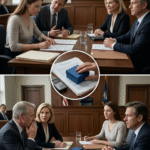
He said it beneath a ceiling painted with gold-leaf constellations, in a private salon overlooking Central Park, while twelve members of the Halston National Fellowship Committee watched him with the solemn attention reserved for senators, philanthropists, and men rich enough to mistake applause for absolution.
Beside him sat Sloane Hart.
She wore winter-white silk, a diamond bracelet I had once seen on my husband’s private jeweler account, and the expression of a woman already rehearsing where she would stand in the family portrait after I had been cut out of it.
Our daughter, Charlotte, sat between them.
Charlie was seventeen. Brilliant. Quiet when she was angry. Dangerous when she was disappointed.
She had designed an affordable modular housing system for flood-prone communities along the Gulf Coast. Her prototypes had won a national youth engineering prize. Her research had attracted interest from two universities and a nonprofit in New Orleans.
Adrian had never read the full proposal.
Sloane could not explain how the foundation joints worked.
But when the committee chair asked who had encouraged Charlie to believe she could change the world, my husband leaned back in his tailored charcoal suit and smiled at Sloane.
“This remarkable woman,” he said, resting his hand over hers, “taught Charlotte that ambition should never apologize for taking up space.”
The committee members turned toward Sloane.
Cameras flashed.
Someone near the back whispered, “How beautiful.”
I sat six feet away in a black dress with no jewelry except my wedding ring.
No one looked at me.
That was the moment Adrian believed he had finally replaced me.
He did not know I had already frozen the accounts.
He did not know the penthouse he had promised Sloane belonged to a trust he had never controlled.
He did not know the company carrying his name stood on land inherited from my mother.
He did not know that three floors below us, inside the private office of Halston’s general counsel, sat two federal subpoenas, a forensic accounting report, and a signed affidavit proving he had forged my signature on a forty-eight-million-dollar loan.
And he certainly did not know that Charlie had ignored the essay Sloane had written for her.
I waited until my daughter submitted her personal essay.
Then I began ending my husband’s life as he knew it.
## Chapter One: The Woman in Winter White
May you like
The final interview took place at Aster House, an old Manhattan mansion that had been converted into a private cultural foundation without sacrificing any of its aristocratic intimidation.
The marble staircase had been imported from Italy in 1911. The chandeliers had survived two bankrupt owners, one suspicious fire, and a society divorce so vicious that newspapers still referenced it whenever an heiress married badly.
It was exactly the kind of room Adrian loved.
Every surface reflected power.
Every person in it knew how much silence cost.
My husband had built his public identity in places like Aster House. He had learned to walk through rooms of inherited wealth as though he had been born expecting the doors to open. He remembered donors’ spouses, children, colleges, and preferred wines. He laughed half a second after powerful men laughed and half a second before everyone else.
People called him magnetic.
They did not understand that charm was simply the most expensive weapon he owned.
“Mrs. Vale,” a committee assistant whispered to me before the interview began, “we have a seat reserved for you beside your husband.”
I looked toward the front row.
Sloane was already in it.
“Apparently not,” I said.
The assistant flushed. “There may have been a misunderstanding.”
“There wasn’t.”
I took the seat at the end of the second row.
Across the salon, Adrian saw me. His expression did not change, but he touched his cuff link twice—the small nervous gesture that had survived twenty-one years of marriage.
He had expected me not to come.
Three nights earlier, he had stood in the dressing room of our Fifth Avenue apartment, knotting a midnight-blue tie in front of the mirror.
“This is an important opportunity for Charlie,” he had said.
“I’m aware.”
“The committee prefers a unified family presentation.”
“I’m also aware of that.”
His gaze had found mine in the mirror.
“Sloane has been helping Charlie prepare. She understands the narrative the foundation wants.”
“The narrative.”
“Impact. Resilience. Mentorship. These committees respond to emotional structure.”
“Our daughter is applying for an engineering fellowship, Adrian. Not auditioning for a perfume commercial.”
His jaw tightened.
“She needs polish.”
“She needs to be herself.”
“She needs to win.”
There it was.
Not Charlie’s dream.
Not Charlie’s work.
His victory.
Adrian had spent most of our marriage turning people into rooms he could enter.
My family had been his first door.
Our daughter was going to be his last.
“I think it would be better,” he had continued carefully, “if Sloane joined us for the final interview.”
“Better for whom?”
“For Charlie.”
The lie had been so clean I almost admired it.
Almost.
“And where would I sit?”
He had turned away from the mirror.
“I didn’t say you shouldn’t come.”
“No. You only invited your mistress to perform motherhood in public.”
His face had gone still.
For one suspended second, there had been no charm between us. No manners. No polished reputation. Only the cold recognition of a man discovering that the animal he had wounded was not asleep.
Then he smiled.
It was a small smile.
Private.
Cruel.
“You should be careful with words like that, Vivienne.”
“Why?”
“Because once you say something aloud, people may ask you to prove it.”
I had looked at the man I married and remembered the first rule my mother ever taught me about power.
Never reveal the evidence while your enemy still has the ability to destroy it.
So I lowered my eyes.
“You’re right,” I said.
Adrian relaxed.
He mistook restraint for surrender.
Men like him often did.
Now, inside Aster House, he rested one hand on the back of Charlie’s chair while Sloane answered a question about the importance of female mentorship.
“I’ve always told Charlotte that the world will try to make talented girls smaller,” Sloane said. “My role has been to remind her that she doesn’t need permission to be extraordinary.”
Charlie’s face remained composed.
Only I noticed her left thumb pressing against the side of her index finger.
Once.
Twice.
Three times.
A childhood habit. She did it when trying not to cry.
My fingernails cut into my palm.
Sloane continued.
“When I first met Charlotte, she had incredible technical instincts, but she was afraid to communicate her vision. We worked on confidence. Presence. Storytelling.”
The committee chair, Dr. Helena Price, smiled warmly.
“How long have you been mentoring Charlotte?”
Sloane hesitated.
Adrian answered for her.
“Almost two years.”
The affair had begun fourteen months earlier.
The mentoring had begun eleven weeks ago.
Charlie looked at her father.
Not dramatically. Not accusingly.
She simply turned her head and studied him as if he were a bridge whose structural failure she had finally calculated.
Dr. Price made a note.
“And Mrs. Vale?” she asked.
For the first time that morning, the room turned toward me.
Adrian’s shoulders tightened.
Sloane’s smile sharpened.
I crossed one leg over the other.
“My mother prefers to support me privately,” Charlie said before anyone else could speak.
Her voice was calm, but I heard the strain beneath it.
Dr. Price nodded. “That can be equally meaningful.”
“It is,” Charlie said.
Adrian leaned forward.
“Vivienne has always been devoted to creating a stable home. But Sloane is the one who really helped Charlotte see the scale of what was possible.”
Stable home.
It sounded almost respectful.
That was Adrian’s gift. He could reduce a woman’s life to a polite little box and make the audience grateful he had mentioned her at all.
I had financed the first seven years of his business.
I had negotiated the land leases that made the Vale Meridian hotel group possible.
I had designed the foundation that funded Charlie’s prototype.
I had slept on hospital chairs when our daughter had pneumonia, rewritten investor presentations at three in the morning, and sold my grandmother’s Connecticut house to keep Adrian’s first property from foreclosure.
A stable home.
Sloane reached across Charlie and touched Adrian’s wrist.
The intimacy lasted less than a second.
It was enough.
Three committee members noticed.
One photographer captured it.
Adrian let the moment remain visible before gently removing his hand.
A performance inside a performance.
He wanted rumors.
Rumors prepared society for replacements.
Dr. Price shifted her attention to Charlie.
“Your project is deeply personal. Why housing?”
Charlie inhaled.
This was the answer we had discussed months ago, in the kitchen at our house in Maine, while rain moved across the Atlantic and she sketched storm-resistant wall systems on butcher paper.
She had been ten when Hurricane Harvey flooded the Houston neighborhood where our former housekeeper’s sister lived. Charlie had watched footage of families wading through brown water with garbage bags full of clothes. She had asked why wealthy neighborhoods recovered faster.
I had answered honestly.
“Because disaster reveals what society was already willing to ignore.”
That sentence had stayed with her.
Now Sloane touched Charlie’s elbow.
Charlie moved her arm away.
“My project began,” Charlie said, “with a question about why safety is treated like a luxury product.”
A silence settled over the room.
Good, I thought.
That was Charlie.
Not polished.
Not packaged.
Precise.
She described the modular frames, the elevated utility systems, the low-cost composite materials, and the partnerships she hoped to build with local contractors. As she spoke, the artificial family tableau around her began to disappear.
Even Adrian stopped interrupting.
The committee listened.
Charlie did not look at Sloane.
She did not look at her father.
She looked directly at Dr. Price and spoke for nine uninterrupted minutes about storms, dignity, and the violence of rebuilding poor communities exactly as vulnerable as they had been before.
When she finished, no one moved.
Then Dr. Price closed the file in front of her.
“Thank you, Charlotte.”
The first part of the interview was over.
An assistant brought coffee and sparkling water while the committee prepared for the final essay submission. Parents and mentors were asked to wait near the windows.
Adrian crossed the room toward me.
“You came,” he said.
“I said I would.”
His gaze dropped to my wedding ring.
“You could have made a scene.”
“I still could.”
He studied my face.
“What do you want?”
“Today?”
“Don’t play games.”
I glanced over his shoulder.
Sloane was posing for a photograph with Charlie. My daughter stood rigidly beside her.
“I want Charlie to receive fair consideration for her own work.”
“She will.”
“Then why did you bring a woman who cannot describe the project?”
His eyes hardened.
“Sloane understands influence.”
“Sloane understands access.”
“You’re jealous.”
“No,” I said softly. “Jealousy is fear that someone can take what belongs to you.”
His mouth curved.
“And you’re not afraid?”
I looked around the salon.
At the donors.
The cameras.
The hand-cut crystal glasses.
The old New York money pretending not to listen.
“No, Adrian.”
For the first time that morning, I smiled.
“I’m not afraid of anything Sloane thinks she has.”
Before he could answer, a committee assistant called Charlie’s name.
My daughter walked to the submission table carrying a thin cream folder.
Sloane followed.
“You don’t need that version,” she whispered.
Charlie stopped.
The room was quiet enough that I could hear every word.
“I know,” Charlie said.
Sloane’s smile flickered.
“We finalized the essay last night.”
“You finalized an essay.”
“Charlotte,” Adrian warned.
Charlie turned to him.
She was wearing a navy dress and the pearl earrings my mother had given her before she died. For one painful instant, she looked older than seventeen.
“No,” she said. “You don’t get to use that voice with me today.”
Several heads turned.
Adrian’s face lost color.
Sloane stepped closer.
“We’re only trying to help.”
Charlie looked down at the cream folder.
Then she pulled out the essay Sloane had prepared.
I recognized the thick stationery. Vale Meridian letterhead had been trimmed from the top, but the watermark remained visible under the chandelier light.
Charlie tore it in half.
The sound was small.
In that room, it landed like a gunshot.
Then she tore it again.
She placed the pieces in a silver wastebasket and handed Dr. Price a different essay.
The committee chair accepted it without comment.
Adrian stared at our daughter.
“What did you submit?”
Charlie looked at me.
Not him.
Me.
For months, there had been a distance between us that I had not known how to cross. She had stopped asking why her father missed dinner. Stopped complaining when Sloane appeared at family events. Stopped telling me what she heard at school.
I had mistaken her silence for confusion.
Now I understood.
She had been gathering her own evidence.
“Something true,” she said.
Then she walked out of the salon.
I followed her.
Behind us, Adrian said my name.
“Vivienne.”
I did not turn around.
In the hallway, Charlie kept walking until we reached the marble staircase. She gripped the banister and lowered her head.
I stood beside her without touching her.
“You knew?” she asked.
“Yes.”
“For how long?”
“Long enough.”
“Why didn’t you tell me?”
“Because he’s your father.”
“That didn’t answer my question.”
“No,” I said. “It didn’t.”
She looked up.
Her eyes were bright with anger.
“Did you think I couldn’t handle it?”
“I thought you shouldn’t have to.”
“But I did have to. Every time she came to dinner. Every time he told people she understood me. Every time he made you sit somewhere else.”
Her voice broke on the final word.
I reached for her.
Charlie stepped back.
The rejection hurt more than anything Adrian had done upstairs.
“What happens now?” she asked.
It was the same question she had asked at seven years old when a storm knocked down three pines behind our house.
The same question she had asked at thirteen when my mother died.
What happens now?
Back then, I had answered with comfort.
This time, I gave her the truth.
“Now your father finds out what I did while he thought I was disappearing.”
A shadow shifted near the bottom of the staircase.
A man in a black overcoat stood beside the carved oak doors, watching us with gray eyes and an expression too controlled to be mistaken for curiosity.
Julian Cross.
Founding partner of Cross, Bell & Mercer.
The most feared corporate litigator in New York.
The man newspapers called when billionaires lost wars no one knew they were fighting.
The man I had not seen socially in nineteen years.
And the only person, besides me, who knew exactly how much of Adrian Vale’s empire belonged to his wife.
Julian glanced at his watch.
Then at me.
“It’s done,” he said.
Charlie turned toward him.
“What’s done?”
Julian removed a sealed document from his coat.
“The first lock.”
He handed it to me.
At 10:42 that morning, while Adrian sat beneath gold-leaf stars and credited his mistress with our daughter’s future, the Supreme Court of the State of New York had issued a temporary restraining order.
Adrian could not transfer company funds.
He could not sell our homes.
He could not borrow against the hotels.
He could not access the Mercer family trusts.
He could not destroy financial records.
He could not move one dollar from any account attached to Vale Meridian without court approval.
My husband had entered Aster House believing he owned a kingdom.
By the time he left, he could not legally touch the walls.
## Chapter Two: An Empire Built on Her Silence
I met Adrian Vale when I was twenty-four years old and still believed confidence was evidence of character.
He was standing in the lobby of the Palmer Hotel in Boston, arguing with a banker twice his age.
The Palmer was not yet ours. It was an exhausted brick property with leaking pipes, stained carpets, and a ballroom that smelled faintly of mildew. My mother owned the land beneath it through Mercer Holdings, but the hotel itself belonged to a regional operator drowning in debt.
Adrian wanted to buy it.
He had no money.
No investors.
No record of operating anything larger than a campus restaurant.
What he had was a vision.
He spoke about restoring the original brass elevators, opening the ballroom to local musicians, and turning the rooftop into a winter garden. He described luxury not as marble or champagne, but as the feeling of being anticipated.
I listened from a velvet chair while the banker told him no.
Adrian did not become embarrassed.
He became brilliant.
He changed the numbers. Reframed the risk. Offered a management structure that would reduce payroll. By the end of the conversation, the banker was still refusing him, but he was apologizing for it.
That interested me.
I introduced myself.
Adrian looked at me, then at the old portrait of my grandfather hanging behind the reception desk.
“Mercer,” he said.
“As in Mercer Holdings?”
His smile arrived slowly.
That should have warned me.
Instead, I fell in love with it.
We opened the Palmer eighteen months later.
My mother provided the land lease and part of the renovation capital. I convinced two family offices to invest. Adrian lived at the property during construction and charmed inspectors, union representatives, vendors, and journalists.
We were good together.
That was the dangerous truth.
I was not an innocent woman dragged blindly into a bad marriage. I chose Adrian with both eyes open to his ambition. I knew he loved attention. I knew he could enter a room and calculate its hierarchy before taking off his coat.
What I did not understand was that some people experience gratitude as humiliation.
Every year the company grew, Adrian became more determined to erase the fact that he had needed me.
At first, the erasure was subtle.
An interview described me as “Adrian Vale’s elegant wife and early supporter.”
A business magazine called him the sole visionary behind the Palmer restoration.
At a charity dinner, he thanked investors, designers, contractors, and “my beautiful family,” but did not mention that I had negotiated the acquisition that saved the company.
When I complained, he kissed my forehead.
“You hate publicity.”
“I hate being deleted.”
“No one could delete you.”
He said it tenderly.
That made the lie harder to see.
By our tenth anniversary, Vale Meridian operated nine luxury hotels across the United States.
By our fifteenth, there were seventeen.
By our twentieth, Adrian’s face appeared on magazine covers beside phrases like THE ARCHITECT OF MODERN AMERICAN LUXURY.
Mine appeared in society pages.
The photographs showed gowns, charity galas, museum benefits, and summer weekends in Maine.
They did not show land agreements, debt structures, zoning negotiations, crisis calls, or the nights I sat on hotel floors with exhausted staff during openings.