At the time, our attorney called it a morality trigger.
Adrian had called it melodramatic.
Again, he was no longer laughing.
“You have been researching me,” I said.
“I have been watching a company I may need to rescue.”
“Rescue?”
“Dismantle, if you prefer.”
“What do you get?”
“A chance to keep Blackwell’s medical and education divisions independent.”
“And the rest?”
“Sold or reorganized.”
“Thousands of jobs depend on those divisions.”
“Then this is not revenge.”
Julian’s expression was unreadable.
“This is surgery.”
The word lingered.
“You always did enjoy cutting things apart,” I said.
“Only to remove what is killing them.”
I looked at him.
For years, Adrian had described Julian as cold, predatory, and incapable of loyalty.
Standing in the old laboratory, I wondered how much of that description had been fear.
“Why help me?”
His gaze shifted toward the black writing on the wall.
“Because you built something worth saving.”
“That is not the whole answer.”
“Then give me the whole answer.”
He met my eyes.
“I should have told you not to marry him.”
The room seemed to contract.
“That was twenty years ago.”
“You had no right.”
“You disappeared.”
I folded my arms.
“And now you appear because my marriage is collapsing?”
His voice remained quiet.
“I appeared because your husband tried to erase your name. I know what it cost you to put that name on anything.”
My breath caught.
Very few people understood why I had kept Vale.
My father left when I was nine. My mother raised me alone, graded papers at the kitchen table, and taught me that a name did not need a man behind it to become honorable.
When Adrian asked me to become Eleanor Blackwell, I had compromised.
Eleanor Vale-Blackwell.
Half mine.
Half his.
For years, society pages shortened it to Mrs. Adrian Blackwell.
Julian had never done that.
“You cannot save me,” I said.
“I did not come to save you.”
“Then what did you come to do?”
“Stand beside you while you save yourself.”
It was an elegant sentence.
Perhaps too elegant.
But Julian did not move closer.
He did not touch me.
He did not ask for trust he had not earned.
He handed me a folder.
Inside was a draft financing structure, employee-protection provisions, and a voting agreement.
Every page had been designed to preserve the company’s research teams and remove Adrian’s control.
No personal benefit to me was hidden inside.
No romantic debt.
No trap.
“You prepared this overnight?” I asked.
“I have been preparing for Adrian to collapse for five years.”
“That sounds personal.”
“It is.”
“Why?”
Julian’s face changed.
Only slightly.
“Ask your husband what happened to Daniel Mercer.”
The name opened an old door in my memory.
Daniel had been one of our first engineers.
Brilliant.
Funny.
Restless.
He left Blackwell Systems after a dispute with Adrian and died two years later in what newspapers called an accidental overdose.
“What does Daniel have to do with this?”
“Everything.”
Julian walked toward the elevator.
“Do not sign anything Adrian sends you. Do not meet him alone. And do not assume Celeste is the only person he has betrayed.”
The elevator doors opened.
“Julian.”
He turned.
“What happened to Daniel?”
His expression became cold.
“Adrian stole his patent.”
Then the doors closed.
I stood alone in the laboratory, holding the folder.
Outside, the city moved beneath a pale autumn sky.
My phone vibrated.
A breaking-news alert filled the screen.
BLACKWELL CEO CLAIMS WIFE SUFFERS FROM “PROLONGED PSYCHOLOGICAL DISTRESS.”
Below it was a photograph of Adrian leaving our penthouse.
He looked grave.
Concerned.
Devastated by the instability of the woman he loved.
The trap had opened.
Exactly as we expected.
I called Vivienne.
“He used it,” I said.
Her answer was immediate.
“Then we bury him with it.”
# CHAPTER THREE
## A MARRIAGE BUILT ON SIGNATURES
Adrian’s press conference took place at noon.
He stood outside Blackwell Systems headquarters in a navy suit, surrounded by microphones, and performed sorrow with extraordinary discipline.
“My wife is a brilliant woman,” he said. “But she has endured years of unresolved grief and emotional strain. Last night’s events were deeply painful for our family. My first concern is Eleanor’s health.”
He never called me Dr. Vale-Blackwell.
Not once.
He called me my wife, Eleanor, and someone in distress.
Language is architecture.
He was building a room small enough to imprison me.
“I will not discuss private medical matters,” he continued, “but I hope the public will show compassion rather than reward a crisis with spectacle.”
A reporter asked whether I had fabricated the financial records.
Adrian lowered his eyes.
“I cannot comment on documents that may have been obtained or altered improperly.”
A second reporter asked about Celeste.
“She is a respected colleague who has been unfairly targeted.”
Another asked whether they were having an affair.
Adrian paused for exactly the right length of time.
“My marriage is private.”
Not a denial.
Not quite an admission.
Enough to keep every camera hungry.
By one o’clock, sympathetic commentators were discussing the danger of public breakdowns.
By one fifteen, an anonymous source told a business network that I had become “obsessed with controlling the foundation.”
By two, a photograph circulated of me leaving a psychiatric clinic.
The photograph was real.
The story was not.
I had visited the clinic three years earlier to meet a scholarship finalist receiving treatment for depression.
The image had been cropped to remove the girl and her mother.
By three, hashtags divided into camps.
Some called me brave.
Others called me bitter.
A famous relationship coach announced that powerful women often sabotage marriages when they cannot accept aging.
I turned off the television.
Vivienne stood near the hotel fireplace, reading Adrian’s emergency filing.
“He included an affidavit from Dr. Hart,” she said.
“He claims he formed a professional concern based on Adrian’s descriptions and selected communications.”
“What communications?”
“Emails you sent after your mother died.”
My stomach tightened.
I had written Adrian during the worst months of grief.
Some messages were desperate.
I cannot get out of bed.
I feel as though the future has closed.
I do not know who I am without her.
Private grief, removed from time, can be arranged to resemble permanent madness.
“He saved them,” I said.
“For eleven years.”
There are betrayals so intimate that anger cannot reach them at first.
I remembered Adrian holding me in our kitchen while I cried.
I remembered him telling me I did not need to be strong.
All the while, the words I had given him in trust remained stored somewhere, waiting to become a weapon.
Vivienne looked at me.
“Are you still certain you want the hearing public?”
“Your private medical history will be discussed.”
“The emails may be read aloud.”
“He will try to humiliate you.”
“He already has.”
I stood.
“Now let him do it under oath.”
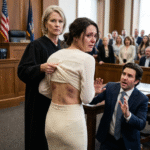
The hearing was scheduled for the following morning at the New York County Courthouse.
By eight, reporters crowded the steps.
I arrived in a cream coat over a dark brown dress. No dramatic black. No widow’s costume. No visible armor.
Julian waited inside the courthouse near the security checkpoint.
He wore a dark suit and held no umbrella, though rain shone on his shoulders.
“You should not be here,” I said.
“Probably not.”
“Adrian will say we planned this together.”
“He says that already.”
“Did we?”
His gaze settled on my face.
“Did you sleep?”
“That means no.”
“That means this is not the time.”
A faint smile touched his mouth.
“There she is.”
“Who?”
“The woman who once told a room of venture capitalists that their questions were intellectually lazy.”
“They were.”
“I invested ten million dollars thirty minutes later.”
“I remember.”
Vivienne approached.
“Mr. Ashford, unless you intend to testify, stop looking emotionally significant in a public hallway.”
Julian’s smile deepened.
“Yes, counsel.”
He stepped back.
As I entered the courtroom, I saw Celeste in the second row behind Adrian.
She wore ivory.
Of course she did.
Her hair was pulled into a low knot, her makeup minimal. She looked less like a mistress than a grieving diplomat.
When our eyes met, she gave me a sad, forgiving smile.
I almost admired her.
Then the judge entered.
Adrian’s attorney, Charles Wren, began by describing a marriage under extraordinary strain.
He spoke of my mother’s death.
My insomnia.
My devotion to Aurora.
My increasing suspicion.
He used the phrase obsessive attachment three times.
Then he called Dr. Samuel Hart.
Hart was handsome in the polished way television doctors often are. Silver glasses. Gentle voice. Concern arranged across his features.
He admitted he had never treated me.
He admitted he had never met me.
Yet he testified that Adrian’s descriptions raised legitimate concerns about delusional fixation and impaired judgment.
Vivienne stood for cross-examination.
“Dr. Hart, did you receive money from the Blackwell Foundation?”
“My institute received a research grant.”
“How much?”
“Five hundred thousand dollars.”
“When?”
“I would need to check.”
“Was it six days after your first email exchange with Mr. Blackwell regarding his wife?”
Hart shifted.
“I do not recall.”
Vivienne displayed the transfer.
“You do not need to.”
A murmur moved through the courtroom.
She continued.
“Did you tell Mr. Blackwell that a finding of incapacity could support the removal of Dr. Vale-Blackwell from the foundation board?”
“I discussed general governance considerations.”
“Did you advise him to document her emotional language?”
“I suggested he preserve relevant communications.”
“Emails from the week her mother died?”
“I did not choose the emails.”
“Did you review messages in which Dr. Vale-Blackwell discussed active plans to harm herself?”
“Did you review evidence of psychosis?”
“Hallucinations?”
“Threats?”
“Financial misconduct?”
“Any diagnosis from a treating physician?”
Vivienne paused.
“So your professional opinion is based entirely on descriptions provided by a man who donated half a million dollars to your institute and wanted his wife removed from a board.”
Wren objected.
The judge allowed the question.
Hart’s voice became quieter.
“I believed Mr. Blackwell was genuinely concerned.”
“Concerned enough to seek help?”
“Did he ask for a treatment referral?”
Hart hesitated.
“Did he ask how to support his wife emotionally?”
“Did he ask whether she posed a danger to herself?”
“What did he ask?”
Hart looked toward Adrian.
Adrian did not return his gaze.
“He asked how questions regarding capacity could affect governance authority.”
The courtroom went silent.
Vivienne sat down.
Adrian’s strategy had entered the record.
Now we could cut it open.
My testimony lasted ninety minutes.
Wren read my grief emails aloud.
The words were as painful as I had expected.
But pain spoken publicly does not always become shame.
Sometimes it becomes freedom.
“Yes,” I said when he asked whether I had written them. “My mother had died nineteen days earlier.”
“Were you unable to get out of bed?”
“For two mornings.”
“Did you feel the future had closed?”
“Would you describe that as rational?”
“I would describe it as grief.”
“Were you emotionally unstable?”
“I was bereaved.”
“Is that a distinction without a difference?”
“No. Grief is evidence that we loved someone. Instability is the label my husband selected when he needed my voting rights.”
Wren changed direction.
“Did you secretly investigate your husband?”
“I reviewed accounts for a foundation under my fiduciary supervision.”
“Without informing him.”
“I do not warn people before checking whether they stole money.”
Adrian stared straight ahead.
Wren displayed the bank transfer to Celeste’s company.
“Are you aware that Ms. Monroe performed consulting work?”
“Then the payment is not necessarily fraudulent.”
“The fraud is not that she was paid. The fraud is that restricted scholarship funds were used to pay her.”
“Do you have proof the funds were restricted?”
Vivienne handed the clerk a binder.
Donor agreements.
Annual reports.
Internal account designations.
Every dollar traced.
Wren’s expression changed.
The judge called a recess.
As I stepped into the hallway, Celeste followed me.
I continued walking.
“Please.”
I stopped.
She looked smaller without the stage behind her.
“I did not know about the psychiatric filing,” she said.
“That is an interesting boundary.”
“You were comfortable sleeping with my husband, accepting my work, spending scholarship funds, and living in a home guaranteed by my assets. But psychiatric fraud is where you draw the line?”
Her face tightened.
“Adrian told me your marriage had been over for years.”
“Did he tell you while sleeping in my bed or yours?”
“He said you lived separate lives.”
“We ate breakfast together the morning he took you to Geneva.”
Celeste looked away.
For the first time, I saw something unperformed in her face.
“What did he promise you?” I asked.
“That is none of your business.”
“He promised you the foundation.”
She said nothing.
“He promised to make you chief executive after I was removed.”
Her eyes flickered.
I had guessed correctly.
“He said Aurora needed new leadership,” she whispered.
“He said my grief made me incapable.”
“He said you did not want children and had turned the scholarship girls into substitutes.”
The cruelty of it landed slowly.
Adrian and I had tried for children.
Three rounds of fertility treatment.
Two miscarriages.
One surgery.
Then a quiet decision not to keep destroying my body for a dream that had become punishment.
Celeste saw my expression.
Her confidence collapsed.
“You did not know,” I said.
“He told you I never wanted them.”
I moved closer.
“Listen to me carefully. Adrian does not lie only to escape consequences. He lies to redesign reality until everyone inside it serves him. You are not his exception. You are simply his newest audience.”
Her chin lifted.
“You want me to turn against him.”
“No. I want you to understand what will happen when he needs someone else to blame.”
“He loves me.”
“He loved me too.”
The courtroom doors opened.
I walked away.
When the hearing resumed, Vivienne called one final witness.
Martin Sloane.
Our family-office attorney entered carrying a narrow briefcase.
Adrian turned in his seat.
For the first time that day, true alarm crossed his face.
Martin had served the Blackwell family for thirty-two years. He had drafted our prenuptial agreement, created our trusts, restructured our property holdings, and managed every confidential transfer Adrian believed would never reach daylight.
He took the oath.
“Mr. Sloane, did Adrian Blackwell ask you to prepare documents affecting his wife’s assets?”
“Beginning fourteen months ago.”
“What documents?”
“A revised marital-property agreement, foundation voting proxies, durable powers of attorney, and amendments to several trusts.”
“Did Dr. Vale-Blackwell authorize these changes?”
“Were her signatures required?”
“How did Mr. Blackwell propose obtaining them?”
Wren rose.
“Objection.”
The judge looked at Martin.
“You may answer.”
Martin removed his glasses.
“Mr. Blackwell asked whether electronic signatures from prior transactions could be adapted.”
The courtroom erupted.
Adrian stood.
“That is a lie.”
The judge ordered him to sit.
Martin continued.
“I refused. He later transferred several matters to outside counsel.”
“Did you preserve his requests?”
Emails appeared on the screen.
Adrian’s words.
Can prior signature files be reused?
Does Eleanor need to review the full document if only administrative provisions change?
What threshold of incapacity would allow spousal execution?
Each sentence stripped another layer from the man I had married.
But the final email was the worst.
If the medical narrative is established first, objections from Eleanor will appear symptomatic.
He had planned everything.
The affair.
The removal.
The theft of my work.
The theft of my signatures.
The destruction of my credibility.
He had not fallen in love and made mistakes.
He had designed a succession.
Celeste sat motionless behind him.
The judge denied Adrian’s request to freeze my assets.
She extended the restraining order against the foundation.
She referred the signature matter to the district attorney.
And she ordered an independent forensic review of all foundation and family-office transactions.
Outside the courthouse, rain had stopped.
Reporters shouted questions as we descended the steps.
“Dr. Vale-Blackwell, did your husband try to forge your signature?”
“Are you seeking a divorce?”
“Are you involved with Julian Ashford?”
That last question came from somewhere to my right.
Cameras surged.
Adrian had just been exposed in court for attempting to manufacture my incapacity, but the world still wanted to know which man might explain my actions.
I faced the microphones.
“My husband’s fraud does not become less fraudulent because another man is standing nearby.”
Then I walked toward my car.