“You want the only profitable division.”
“I built the only profitable division.”
“And the debt?”
“Ninth Hour will restructure it after your resignation and the sale of noncore assets.”
“You’re carving apart my family’s company.”
“You pledged your family’s company to hide your spending.”
“My grandfather would despise you.”
The voice came from the doorway.
Everyone turned.
Arthur Vale entered the boardroom.
Adrian’s father was seventy-nine and walked with a silver-headed cane. He had suffered a stroke three years earlier and rarely appeared in public. Adrian often described him as mentally diminished.
I had not seen Arthur since Christmas.
Two private nurses remained outside as he crossed the room.
Adrian stood.
“Dad, you shouldn’t be here.”
“That sentence,” Arthur said, “has been used by cowards throughout history.”
His speech was slower than before the stroke, but his eyes remained clear.
“Arthur.”
“I owe you an apology.”
Adrian moved toward him.
“This meeting involves confidential financial matters.”
Arthur placed a leather envelope on the table.
“I created most of them.”
Adrian stopped.
Arthur sat beside me.
Naomi had found him six weeks earlier through his private estate lawyer. He had agreed to attend only if the board refused to remove Adrian voluntarily.
Inside the envelope was a voting trust.
The final twist Adrian had never imagined.
When Arthur retired, he transferred twenty percent of Vale House voting shares to his son.
The remaining thirty-one percent did not pass to Adrian.
They went into the Vale Legacy Trust.
Adrian served as presumptive beneficiary, but Arthur retained the right to replace him in cases of fraud, criminal misconduct, or actions threatening the company’s survival.
Three years earlier, shortly after the stroke, Adrian had told the board the trust had distributed its shares to him.
It had not.
The trust still held thirty-one percent.
And one month earlier, Arthur had removed Adrian as beneficiary.
The successor was not me.
It was the Vale House Employee Stewardship Foundation.
A newly created trust representing long-term employees.
Adrian stared at his father.
“You gave my inheritance to employees?”
“I protected the company from you.”
“You’re not competent to make this decision.”
Arthur almost smiled.
“I completed evaluations with three neurologists before signing.”
“You told me you couldn’t remember the trust.”
“I told you many things while you were trying to have me declared incompetent.”
The board members looked at Adrian.
He had not disclosed that effort.
Arthur’s hand trembled as he rested it on the cane.
“My father believed a family name was a responsibility,” he said. “You treated it as a credit line.”
“I expanded everything he built.”
“You mortgaged it.”
“I made us global.”
“You made us hollow.”
Adrian’s face turned white.
“You always preferred her.”
Arthur looked at me.
“No. I respected her.”
The distinction landed harder.
“She created something,” Arthur continued. “You believed paying for the building meant you created what happened inside it.”
Adrian turned to me.
“You arranged this.”
“I asked Arthur to tell the truth.”
“You went behind my back to my father.”
“You went behind mine to steal my company.”
His voice rose.
“You were my wife.”
“You owed me loyalty.”
“I gave you fourteen years of it.”
“Then why are you doing this?”
Because you cheated.
Because you lied.
Because you used our child’s memory to sell perfume.
Because you forged my name while I was bleeding.
Every answer was true.
None was complete.
“I am doing this,” I said, “because you believed my love made me your property.”
The employee trust and my restored shares controlled eighty percent of the voting power.
The vote took less than six minutes.
Adrian Vale was removed as chairman and chief executive.
The company accepted Ninth Hour’s restructuring conditions.
The fragrance division transferred to Cross Atelier subject to final documentation.
The board authorized an independent investigation into Hartwell Narrative, the forged documents, and the Cayman trust.
When the meeting ended, everyone left except Adrian and me.
Rain streaked the windows behind his chair.
He looked small at the head of the enormous table.
Not physically.
Symbolically.
A king becomes ordinary very quickly after the room stops agreeing to pretend.
“Was any of it real?” he asked.
It would have been easier if he sounded angry.
Instead, he sounded tired.
“Our marriage?”
He nodded.
“My part was.”
He looked down at his hands.
“I did love you.”
“You loved how I made you feel.”
“What is the difference?”
“The difference is whether I was allowed to remain a person when I stopped making you feel powerful.”
He closed his eyes.
“I never meant for it to go this far.”
“You commissioned a campaign that erased my name.”
“I thought you would accept a settlement.”
“You thought I would accept a price.”
“Everyone has one.”
“Yours was applause.”
He looked toward the city.
“What happens now?”
“You cooperate with the investigation. You return company assets. You tell the truth about Celeste’s role.”
“And if I don’t?”
“Ninth Hour forecloses on your remaining collateral. Naomi pursues the fraud claims. The board refers every document to prosecutors.”
“You’d send me to prison?”
“I don’t sentence anyone.”
“But you’d provide the evidence.”
His mouth twisted.
“So cold.”
“No, Adrian.”
I walked toward the door.
“Cold would have been doing to you what you did to me. I am simply no longer protecting you from the consequences of your own decisions.”
He spoke before I left.
“Are you with Sterling?”
I turned.
Even then.
Even after the debt, the vote, the exposure, and the loss of his empire, he needed the story to contain another man.
It was easier than accepting that I had chosen myself.
“Noah did not take me from you,” I said. “You abandoned me long before he learned my name.”
I left Adrian alone beneath the Vale crest.
By evening, workers had covered it with a black cloth.
The investigations lasted eleven months.
Adrian avoided prison by cooperating with federal authorities, surrendering assets, and pleading guilty to charges related to false financial certifications and obstruction. He was sentenced to home confinement, probation, and a permanent ban from serving as an officer of a public company.
He lost the penthouse.
The yacht.
The private aircraft membership.
His controlling stake.
He retained a house in Connecticut and enough money to live comfortably for the rest of his life.
Some people called that mercy.
Others called it proof that wealthy men experience consequences differently.
Both were correct.
Celeste reached a civil settlement.
She returned jewelry, property, and funds purchased through Hartwell Narrative. She issued a public statement acknowledging that she had not created Vesper and had relied on materials supplied by Adrian.
Her pregnancy was real.
The child was his.
Three weeks after the arbitration, she gave birth to a daughter.
Adrian requested that the Cayman trust be preserved for the child. The independent monitor agreed after removing Adrian’s control.
I supported the decision.
The baby had stolen nothing from me.
Celeste disappeared from public life for almost a year.
Then, one morning, I received a handwritten letter.
It contained no excuses.
Only an apology.
She wrote that Adrian had told her I was finished, unstable, and incapable of creating again. He told her the journals were company property and the words about the unborn child referred to a fictional campaign concept.
She admitted that she had ignored contradictions because the lie offered her everything she wanted.
At the end, she wrote:
I thought being chosen meant I had won. I did not understand that a man who needs to erase one woman to love another has not chosen anyone.
I read the letter twice.
Then I placed it in a drawer.
I did not respond.
Forgiveness is not always a conversation.
Sometimes it is simply deciding that another person’s failure will no longer occupy space inside your body.
The Vale House Employee Stewardship Foundation appointed Margaret Ellis as interim chair. The company sold three hotels, the St. Barts villa, and the stalled Caribbean resorts.
Ninth Hour extended the debt.
Noah earned an excellent return.
The employees kept their jobs.
Vale House survived.
It became smaller.
Quieter.
More honest.
Arthur lived long enough to attend the first employee-shareholder meeting. He sat in the front row with his cane between his knees and cried when a warehouse supervisor from New Jersey cast the foundation’s first vote.
He died six months later.
His will left me one object.
The brass scale from his father’s original barbershop.
A note beneath it read:
A name should measure what it gives, not what it takes.
I placed the scale inside my new laboratory.
I did not call the company Vale & Cross.
I named it Cross Atelier.
The first flagship opened on Madison Avenue in a building with tall arched windows and no private elevator.
The laboratory occupied the center floor behind clear glass. Customers could watch perfumers work. Every bottle listed the names of the people who helped create it.
Chemists.
Evaluators.
Designers.
Technicians.
No invisible labor.
No stolen authorship.
No kings.
We did not relaunch Vesper immediately.
For months, I could not touch it.
The formula contained too much.
My marriage.
My miscarriage.
Celeste’s campaign.
The arbitration room.
The smell of rain against Manhattan glass.
Then, one winter evening, I opened the original notebook.
Malcolm sat beside me.
“You don’t have to finish it,” he said.
“Yes, I do.”
“Because he doesn’t get to own the ending.”
We worked through the night.
I removed the unstable amber from Trial 118.
I softened the black iris.
I deepened the base with cedar and the faintest trace of burnt sugar.
The scent I wore when I met Adrian.
Not because I wanted him inside the perfume.
Because I wanted the young woman I had been.
She deserved to survive the story too.
The final version did not smell like forbidden love.
It smelled like the moment after a storm when a city realizes it is still standing.
We named it Ninth Hour.
On the morning of the launch, a line stretched around the block.
No influencers had been paid to attend.
No mysterious lovers appeared in the campaign.
The advertisement showed a woman’s hand writing her own name in black ink.
Beneath it were seven words:
WHAT IS YOURS SHOULD NEVER REQUIRE PERMISSION.
The first bottle went to Naomi.
The second went to Malcolm.
The third remained on my desk beside my mother’s ring.
At sunset, Noah arrived carrying no flowers.
He had learned that I disliked bouquets severed from their roots.
Instead, he brought a small potted jasmine vine.
“For the terrace,” he said.
“You assume there will be a terrace.”
“I reviewed the building plans.”
“Of course you did.”
A year had passed since the board meeting.
He had never pressured me.
Never used the debt transaction to create intimacy.
Never treated patience as an investment that guaranteed a return.
We had shared dinners, long walks, arguments about art, and one nearly disastrous attempt to cook together in his Tribeca kitchen.
He knew I sometimes woke from dreams in which my formulas disappeared.
I knew he kept the faded scent strip from the Hudson laboratory inside a book in his office.
Neither of us called what existed between us love.
Love had once entered my life dressed as certainty.
Now I preferred questions.
Noah followed me through the new laboratory.
Employees had gone home. The city glowed beyond the arched windows.
He paused beside the bottle of Ninth Hour.
“May I?”
I handed him a scent strip.
He sprayed it once.
Bergamot rose first, bright and precise.
Then iris.
A whisper of burnt sugar.
“What does it make you remember?” I asked.
“The night we packed your laboratory.”
“That smelled like dust and snow.”
“It smelled like you deciding to leave.”
“I had already decided.”
He opened his eyes.
“You had decided to win. Leaving was different.”
The observation unsettled me because it was true.
I walked toward the window.
Below us, customers still gathered beneath the Cross Atelier sign.
“Do you think people ever stop expecting betrayal?” I asked.
His honesty made me turn.
He continued.
“I think they learn betrayal is not the only possible ending.”
“That sounds almost optimistic.”
“Don’t repeat it. I have a reputation.”
He came closer but stopped before touching me.
Always that small distance.
Always the question.
I closed it.
Our first kiss was not explosive.
There were no cameras, chandeliers, orchestras, or stolen words.
It was careful.
Warm.
Almost unbearably gentle.
For years, I had confused possession with passion.
Noah touched my face as though it belonged to me.
When we separated, the jasmine vine stirred in the air from the open terrace door.
“Stay for dinner,” I said.
“Is that a request or a debt covenant?”
“A request.”
“Then yes.”
We ate takeout on the laboratory floor.
Just as Adrian and I once had.
For a moment, the symmetry frightened me.
Then Noah asked before opening a bottle from my worktable.
Such a small thing.
Such an enormous difference.
The past did not repeat.
It only rhymed.
And I was no longer the woman who mistook familiar music for fate.
## Conclusion: What Remains After the Fire
One year after Ninth Hour launched, Cross Atelier funded a legal foundation for independent artists whose work had been stolen by employers, partners, or spouses.
We called it the Original Hand Initiative.
Naomi served as chair.
Malcolm trained young perfumers who could not afford private schools in Paris or Geneva.
Daniel Cho became chief financial officer of Cross Atelier and required every expense report to be approved by someone who did not attend the dinner.
Lila, the frightened receptionist from the Vale House lobby, joined our management program. Three years later, she became director of retail operations.
The employee trust at Vale House paid its first dividend the following spring.
Arthur’s brass scale remained in my laboratory beneath his handwritten note.
Adrian sent one final letter after completing home confinement.
He did not ask for forgiveness.
Perhaps his attorneys advised against it.
Perhaps he finally understood that forgiveness was no longer his to request.
He wrote:
I spent years believing the empire proved I was worthy of you. By the time I understood you were the empire, I had already burned every bridge back.
I folded the letter and returned it to its envelope.
Then I placed it beside Celeste’s apology.
Not as trophies.
As evidence of a life I had survived.
The public remembered the scandal differently depending on what they needed it to mean.
Some called me ruthless.
Some called me brilliant.
Some said I had planned the entire betrayal from the beginning, as though a woman could only win if she had never been wounded.
The truth was less glamorous.
I cried in locked bathrooms.
I forgot to eat.
I woke reaching for a husband who had become my enemy.
I stood outside my old laboratory and nearly begged him to undo what he had done.
Strength did not arrive as a feeling.
It arrived as the next document signed.
The next phone call answered.
The next morning I got out of bed without knowing whether the plan would work.
People imagine revenge as fire.
Mine was colder.
It was evidence preserved in numbered sleeves.
Dates compared against travel records.
Bank transfers followed across borders.
A chemical marker hidden inside an amber accord.
Shares recovered from a forged signature.
Debt purchased while the debtor smiled for cameras.
I did not destroy Adrian.
I stopped saving him.
That was enough.
On the fifth anniversary of Cross Atelier, we displayed the original Vesper materials in a private exhibition about authorship.
At the center of the room stood the black glass bottle Celeste had held at the gala.
Beside it sat her manufactured gold-edged journal.
The false pages had been opened beneath protective glass.
Across from them rested my weathered notebook.
No diamonds.
No cinematic campaign.
No declarations about forbidden love.
Only formulas, corrections, supplier receipts, and the slow architecture of a woman’s work.
Visitors often stood between the two books for a long time.
The beautiful lie.
The ordinary truth.
The lie looked more expensive.
The truth lasted longer.
Late that evening, after the final guests left, Noah found me alone beside the display.
We had married six months earlier in a small ceremony at the California coast, on the land Adrian had once dismissed as sentimental acreage.
Naomi signed as my witness.
Malcolm carried jasmine in his lapel.
No magazines were invited.
No brand partnership announced it.
I wore my mother’s ring and kept my own name.
Noah never asked me to change it.
He stood behind me now, his reflection joining mine in the exhibition glass.
“Ready to go home?” he asked.
Home.
The word no longer meant a penthouse selected for photographs.
It meant a kitchen where no one opened my notebooks without permission.
A terrace where jasmine survived winter.
A man who understood that love was not access.
A life in which my name remained attached to the things my hands had made.
“In a minute,” I said.
I looked one last time at the notebook that had survived my marriage, the theft, the gala, and the arbitration.
The original evidence sleeve remained beneath it.
Malcolm’s signature crossed the seal.
The date appeared in permanent blue ink.
Years before Celeste’s Miami balcony story.
Years before Adrian gave her my words.
Years before they stood together beneath a chandelier and expected me to disappear.
They had arrived at the arbitration carrying a performance.
I had arrived carrying time.
And time, unlike love, could be authenticated.
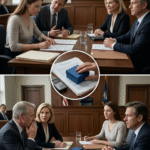
The master perfumer opened the sealed notebook before the panel.
Every page carried my handwriting and a date from before they met.
**Caption:** She claimed the scent. The wife owned the formula.