For months, he had hidden assets behind false corporations and insisted I was imagining missing money.
I could not prove he controlled those accounts.
But Daniel’s greed had done what no subpoena had yet accomplished.
He had signed a sworn statement claiming them as his property because he believed I was giving them to him.
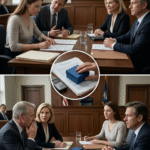
The courtroom door opened, and two investigators entered.
Vanessa rose so quickly that she struck her knee against the bench.
“Daniel told me the transfers were legal,” she said.
He turned toward her.
“Sit down.”
“I didn’t know about the brakes.”
“Vanessa.”
“I never knew about Rachel.”
Vanessa began backing away from him.
Daniel watched her with a look I recognized.
It was the look he gave me when he decided pain had become necessary.
“Everything she did,” he said, pointing at Vanessa, “was done without my knowledge.”
Her mouth fell open.
“You said we were leaving together.”
“You stole from my company.”
“You told me to move the money.”
“I have never seen those accounts.”
Judge Whitaker raised the signed settlement.
“Apparently, you have.”
Daniel looked at me.
For years, I had believed his anger was the most frightening thing in the world.
I was wrong.
What frightened me was the moment his anger disappeared.
His face became peaceful.
Almost tender.
“You think you won,” he said.
The deputy tightened his grip on Daniel’s shoulder.
“You think a recording and a list of numbers can protect you.”
My son moved beneath my hand.
Daniel’s eyes dropped to my stomach.
“**You will never leave with my child.**”
Lily slipped from her chair and ran to me.
I pulled her against my side as closely as my body allowed.
For the first time since entering that courtroom, she began to cry.
Not softly.
Not carefully.
She cried like a child who had been holding back an ocean.
Judge Whitaker ordered Daniel removed.
As the deputies led him toward the side door, he did not look at the judge, his attorney, or Vanessa.
He looked only at Lily.
“You betrayed your father,” he said.
Lily buried her face against me.
Before the door closed, she lifted her head.
Her voice trembled, but every person in the room heard her.
“**No, Daddy. I told the truth about him.**”
## PART TWO — THE MAN BEHIND THE SMILE
I met Daniel Mercer seven years earlier at a hospital fundraiser.
I was thirty-nine, recently widowed, and still wearing my wedding ring because taking it off felt like admitting my first husband, Thomas, had become a memory instead of a person.
Thomas had died from pancreatic cancer after eighteen months of pain that stripped him of nearly everything except kindness.
On his final night, he apologized for leaving me alone.
I told him he had given me enough love for two lifetimes.
At the time, I believed it.
Daniel approached me near the silent auction tables with three-year-old Lily asleep against his shoulder.
He said he had lost his wife in an automobile accident and had nearly canceled that evening because Lily refused to stay with a babysitter.
“She has decided I am the only trustworthy adult left on earth,” he said.
His smile held exhaustion and humility.
I recognized both.
Widowed people recognize one another by the careful way we speak about tomorrow.
Daniel did not flirt with me that night.
He asked about Thomas.
He listened when I spoke.
He remembered Thomas’s name.
Two days later, a handwritten note arrived at my office thanking me for making him feel less alone.
He included no telephone number.
That restraint impressed me more than flowers would have.
We met again at a grief-support luncheon.
Then at a museum event.
Later, I would learn Daniel had donated money to both organizations only weeks before appearing there.
At the time, I called it fate.
Lily loved me before I allowed myself to love her father.
She would reach for my hand while crossing parking lots and ask me to read the same picture book until I could recite it from memory.
The first time she fell asleep in my lap, Daniel stood in the doorway and covered his face.
“She hasn’t done that since Rachel died,” he said.
I mistook his tears for grief.
Perhaps some of them were.
A person can mourn the life he destroyed.
Daniel proposed after eleven months.
He took Lily and me to the small botanical garden where Thomas and I had once volunteered.
He knelt beneath an old magnolia tree while Lily held the ring box upside down.
I said yes because I thought love had returned in another form.
**What returned was loneliness wearing a beautiful face.**
The changes began so gently that I thanked him for them.
Daniel suggested I stop driving at night because my concentration had suffered since Thomas’s illness.
He offered to handle household bills because numbers exhausted me.
He encouraged me to reduce my hours at Calder Manufacturing so we could become a family.
When I resisted, he kissed my forehead.
“You have carried everyone for too long,” he said.
“Let me carry you.”
Within two years, Daniel had become chief financial officer of my family’s company.
He hired Vanessa Cole six months later.
She was efficient, polished, and skilled at presenting bad news as an inconvenience she had already solved.
At first, I admired her.
When veteran employees questioned unusual transfers, Vanessa called them resistant to modernization.
When my father’s old accountant resigned, she said he could no longer understand contemporary finance.
When I noticed that board reports had become increasingly difficult to follow, Daniel laughed.
“That is why you hired professionals.”
The first time Daniel struck me, he did not use his fist.
He slapped the side of my head with an open hand after I asked why a company account had paid for a weekend in Miami.
The blow knocked me against the pantry door.
For several seconds, neither of us spoke.
He looked as shocked as I felt.
Then he knelt beside me.
“I thought you were accusing me of sleeping with Vanessa.”
“You hit me.”
“I reacted.”
“My God, Grace, I am apologizing.”
He began to cry.
He said the pressure of supporting the company had become unbearable.
He said I had humiliated him.
He said Rachel used to provoke him with accusations too.
By the end of the conversation, I was comforting him.
That is how abuse enters a marriage.
It does not always kick down the door.
Sometimes it arrives crying, asks forgiveness, and convinces you that opening the door was your idea.
The next morning, Daniel brought me coffee and a bracelet.
For six weeks, he was the man I had married.
Then I questioned another transfer.
This time he shoved me against a wall.
The apologies became shorter after that.
The gifts became more expensive.
Lily witnessed more than I understood.
She began knocking before entering every room, even the kitchen.
She hid food in her dresser.
She stopped speaking whenever Daniel touched my shoulder.
One evening, I found her sitting inside my closet with Button pressed against her mouth.
“Why are you hiding?” I asked.
“I’m practicing.”
“For what?”
“For when Daddy gets the quiet face.”
I sat beside her on the floor.
“What is the quiet face?”
She looked toward the bedroom door.
“The face he made before Mommy went away.”
Daniel told me Lily invented stories because trauma had confused her memories.
He said Rachel’s accident had left the child obsessed with death.
I wanted to believe him because the alternative required me to admit I had brought a dangerous man into my father’s company, Thomas’s home, and Lily’s life.
Shame became Daniel’s strongest lock.
He did not need to keep me from leaving.
He only needed to convince me that everyone outside would ask why I had stayed.
Then I became pregnant.
The doctor called it improbable but not impossible.
At forty-six, after years of assuming motherhood had passed me by, I heard a heartbeat in a dark examination room.
I wept so hard that the technician had to stop the scan.
Daniel appeared overjoyed.
For three weeks, he treated me with reverence.
Then he began speaking of the baby as an asset.
“My son will inherit Calder Manufacturing,” he told people.
We did not know the baby’s sex.
When I reminded him, Daniel smiled.
“I know what I’m getting.”
He ordered a nursery in dark blue.
He had a silver plaque made with the initials D.M. Junior.
He began telling the board that pregnancy had impaired my judgment and that he needed temporary authority over my voting shares.
I refused.
That night, he gripped my arm hard enough to leave five oval bruises.
“You are not going to deny my child his future,” he said.
“This company was my father’s.”
“And your father is dead.”
The sentence changed something inside me.
Until then, I had imagined survival meant enduring Daniel without provoking him.
That night, I understood that endurance would eventually kill me.
Perhaps not dramatically.
Perhaps not with a broken railing or damaged brakes.
He might simply reduce me piece by piece until nothing remained capable of resisting.
The following morning, I photographed the bruises.
I sent the images to a new email account Daniel did not know existed.
Then I called Helen Price.
Helen had been my father’s attorney for twenty-six years.
She was sixty-eight, blunt, silver-haired, and unimpressed by expensive men.
When I finished telling her what had happened, she asked one question.
“Are you ready to leave, or are you asking me to make staying less dangerous?”
The words embarrassed me.
“I don’t know.”
“Then I will tell you what your father once told me.”
She leaned across her desk.
“**Confusion is sometimes fear that has not yet admitted what it knows.**”
I began to cry.
Helen handed me a box of tissues without softening her expression.
“You know what Daniel is,” she said.
“The question is whether you are willing to act before he learns how much you know.”
For the next four months, we built the appearance of surrender.
I stopped challenging financial reports.
I apologized to Daniel.
I told him the pregnancy had made me anxious and irrational.
He believed me because powerful men rarely question evidence that flatters them.
Helen hired a forensic accountant named Marcus Bell, a former federal investigator who wore inexpensive suits and noticed everything.
Marcus discovered shell companies connected to Daniel through addresses, passwords, and one careless utility payment.
He found evidence that employee retirement funds had been moved into short-term accounts, then transferred overseas.
He also discovered withdrawals from Lily’s trust.
Rachel’s parents had established the trust before their deaths.
It was supposed to pay for Lily’s education and provide her with financial security at twenty-five.
More than three million dollars had vanished.
Daniel, as Lily’s guardian, had approved every transfer.
The signatures beneath his were mine.
I had never seen the documents.
“The forgeries are excellent,” Marcus told me.
“Good enough to delay an investigation, but not good enough to survive one.”
“Can we stop him?”
“Eventually.”
“I may not have eventually.”
That was when Helen devised the settlement.
We prepared a complete list of every hidden account Marcus had located.
We placed them among legitimate marital assets and offered everything to Daniel.