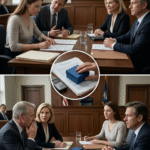
Lily absorbed that slowly.
“So it wasn’t my fault?”
“Or Mommy’s?”
“Or the baby’s?”
She leaned against me.
“Then it was all his.”
For the first time, the truth sounded simple.
## PART FOUR — THE TRIAL OF DANIEL MERCER
Daniel’s trial began ten months after the divorce hearing.
By then, Thomas was a healthy, laughing baby who reached for Lily whenever she entered the room.
Lily had lost two front teeth and gained enough courage to sleep with her bedroom door closed.
I had returned to Calder Manufacturing as acting president.
The company was damaged but alive.
Several longtime employees greeted me with warmth.
Others regarded me with guarded resentment.
Their retirement funds had been endangered while I remained unaware.
Being abused did not erase the consequences of what happened under my authority.
I began every staff meeting with the same promise.
“I will not ask you to trust me because of my name.”
“I will earn trust through what I do next.”
We sold the lake property, the luxury vehicles, and most of the artwork Daniel had purchased.
The recovered money restored the employee pension accounts before it restored anything to me.
Helen warned that I was giving up assets I might never recover.
“They lost money while I signed the reports,” I said.
“You did not know.”
“They did not know either.”
The trial drew national attention because of Daniel’s reputation.
Photographs showed the charming executive beside images of the bruises on my arm.
Reporters called it the Mercer Marriage Murder Case.
I hated the name.
Rachel had become a headline.
Lily had become “the child with the recording bear.”
I remained “the pregnant heiress who gave away eleven million dollars.”
Stories simplify women into symbols because symbols are easier to consume than people.
The real courtroom was slower and less dramatic.
Lawyers argued over dates, signatures, electronic records, and chains of custody.
Experts explained brake systems.
Accountants traced money through diagrams that resembled tangled plumbing.
Daniel sat at the defense table in gray suits and expressed sorrow at appropriate moments.
His attorneys claimed Vanessa had masterminded the financial crimes.
They described me as emotionally unstable, jealous, and vindictive.
They suggested Lily’s recording had been coached.
When the prosecutor played Daniel’s statement about Rachel’s brakes, his attorney argued it was dark humor taken out of context.
Daniel watched the jurors instead of the screen.
He searched their faces for weakness.
For years, I had mistaken that attention for empathy.
Now I understood that he studied people the way a locksmith studied doors.
Vanessa testified on the eighth day.
She entered wearing a plain black suit without jewelry.
The woman who once seemed carved from certainty now looked exhausted and human.
She admitted the affair.
She admitted altering financial statements.
She admitted helping Daniel forge my signature.
The prosecutor asked why.
Vanessa stared at the jury.
“Because he made me feel chosen.”
“What did that mean to you?”
“It meant he said Grace was incapable, that the company needed us, and that after the divorce we would run it together.”
“Did you believe him?”
“When did you stop?”
“When investigators showed me the file he prepared blaming everything on me.”
The prosecutor approached the witness stand.
“Did Mr. Mercer ever discuss Rachel Mercer’s death?”
Vanessa’s hands trembled.
“Not directly.”
“Did he make any statements concerning her?”
“What did he say?”
“He said his first wife confused marriage with permission to disobey.”
A low murmur moved through the courtroom.
“He told me Grace had the same defect.”
Daniel wrote something on a legal pad.
He did not look at Vanessa.
The defense attorney rose for cross-examination.
“Ms. Cole, you are facing a possible prison sentence, correct?”
“And the government has offered consideration in exchange for your testimony?”
“So your freedom depends upon making Mr. Mercer appear responsible.”
“My freedom disappeared the day I decided his attention was worth another woman’s pain.”
The attorney paused.
Vanessa looked toward me.
“I knew Grace existed.”
“I saw the bruises.”
“I watched him humiliate her and told myself she was weak because admitting the truth would have required me to recognize what I had become.”
Her voice broke.
“**Daniel did not force me to betray her, but he taught me how to excuse it.**”
I felt no forgiveness.
Not yet.
Perhaps not ever.
But for the first time, I understood that accountability did not require hatred.
Vanessa could be guilty without being beyond humanity.
She could be truthful without becoming innocent.
Lily did not testify in the open courtroom.
Her recorded interview with Dr. Patel was played for the jury.
On the screen, she sat in a small room with crayons and dolls arranged behind her.
Dr. Patel asked what happened the night Button recorded Daniel.
Lily explained that she heard Vanessa and her father speaking.
“Why did you leave your bedroom?”
“Daddy said Grace was going away.”
“What did you think that meant?”
“That he was going to make her dead.”
The prosecutor paused the video.
Several jurors wiped their eyes.
On the screen, Dr. Patel asked, “Did Grace tell you to record your father?”
“Did she tell you what to say?”
“Why did you bring Button to court?”
Lily looked directly into the camera.
“Because grown-ups kept asking Daddy questions, and he kept giving them the wrong answers.”
“What did you want the judge to know?”
“That Grace wasn’t crazy.”
She lowered her voice.
“And that Mommy didn’t forget how to drive.”
I left the courtroom before the recording ended.
In the hallway, I leaned against a marble column and tried to breathe.
Helen followed.
“I should have seen it sooner,” I said.
“You saw what Daniel permitted you to see.”
“I married him.”
“You also left him.”
“I let him become her father without anyone standing between them.”
“He already was her father.”
“I was supposed to protect her.”
Helen’s eyes hardened.
“Grace, regret is useful only when it teaches.”
“When it becomes a weapon you use against yourself, it is simply Daniel’s work continuing without him.”
The prosecution’s final witness was Marcus Bell.
He explained the hidden accounts and Daniel’s signed settlement.
The prosecutor displayed Schedule D on a large screen.
“Mr. Bell, why was this document significant?”
“Before signing, Mr. Mercer denied knowledge of these entities.”
“What changed?”
“He believed the agreement transferred the assets to him.”
“And what did he do?”
“He initialed every account, company, and trust.”
“In your professional opinion, what did that establish?”
Marcus looked toward Daniel.
“**That greed succeeded where ordinary discovery had failed.**”
Daniel chose to testify.
His attorneys advised against it, but Daniel had spent his life believing that no room could resist him indefinitely.
He described himself as a devoted father and overwhelmed executive.
He said Rachel had suffered from depression.
He said Vanessa had pursued him.
He said I used pregnancy to manipulate the court.
He said Lily possessed a vivid imagination.
Then the prosecutor stood.
“Mr. Mercer, did you love Rachel?”
“Did you love Grace?”
“I still do.”
“Did you love Vanessa?”
Daniel hesitated.
“In a complicated way.”
The prosecutor nodded.
“That is a remarkable amount of love.”
She approached him with three photographs.
Rachel’s wrecked car.
My bruised arm.
Lily holding Button.
“Which of these people benefited from your love?”
Daniel’s attorney objected.
The judge sustained the objection.
The prosecutor changed direction.
“Did you sign the settlement agreement?”
“Did you review Schedule D?”
“I relied upon counsel.”
Benson looked down.
“Did counsel force you to initial each asset?”
“Were the accounts yours?”
“Then why did you accept them?”
“I believed my wife wished to transfer any interest she possessed.”
“You had never heard of the accounts, yet you believed she owned them?”
Daniel paused.
The prosecutor moved closer.
“Did you forge Grace’s signature?”
“Did you take money from Lily’s trust?”
“Did you cut Rachel’s brake line?”
“Did you say Rachel should have checked her brakes?”
“The recording was altered.”
An audio expert had already testified that it was not.
The prosecutor lifted a second device.
Investigators had recovered it from Daniel’s study.
It contained voice notes he dictated for himself.
One recording had been created the morning of the divorce hearing.
The prosecutor pressed play.
Daniel’s voice filled the courtroom.
After court, transfer the Calder shares before Grace speaks to anyone.
Move Lily’s remaining trust balance through Cole Holdings.
If Vanessa becomes unstable, provide the fraud file to authorities.
Confirm infant custody petition before birth.
Destroy Rachel documents after settlement approval.
Daniel’s face did not change.
The prosecutor stopped the recording.
“Was that also dark humor?”
For the first time during the trial, Daniel had no answer.
The jury deliberated for eleven hours.
Lily stayed home with Helen and Thomas.
I sat in a courthouse conference room with Marcus.
Vanessa waited elsewhere under guard.
When the verdict arrived, my legs refused to support me.
Helen held my arm as we entered.
Daniel stood.
The clerk read each count.
Guilty of wire fraud.
Guilty of embezzlement.
Guilty of forgery.
Guilty of witness intimidation.
Guilty of aggravated domestic assault.
Guilty of the attempted murder of Rachel Mercer.
Then the final charge.
Murder in the first degree.
“Guilty.”
A sound escaped Daniel.
It was not a sob or a word.
It was the sound of a door closing inside a man who had always believed another exit would appear.
The judge ordered him remanded.
Before deputies approached, Daniel turned toward me.
“You think this changes what you are?”
I stood.
He wanted me to ask what he meant.
He wanted one more opening through which to enter my mind.
I gave him none.
Daniel smiled.
“You were nothing when I found you.”
My hands stopped trembling.
“Then you should have had no reason to fear me.”
His smile disappeared.
At sentencing, the judge imposed life imprisonment without the possibility of parole for Rachel’s murder, along with consecutive sentences for the financial and violent offenses.
Vanessa received six years after pleading guilty and cooperating.
She wrote me a letter of apology.
I placed it unopened in a drawer.
Forgiveness, I had learned, should never be confused with access.
The civil court restored the house, company shares, and remaining assets to me.
I sold the house.
Lily asked whether she could watch when the new owners carried away Daniel’s desk.
We stood across the street as movers loaded it into a truck.
“Where will it go?” she asked.
“Do you think Daddy hid anything else inside?”
“Probably.”
She slipped her hand into mine.
“Then it can be somebody else’s problem.”
## PART FIVE — THE SECRET RACHEL LEFT BEHIND
Nearly a year after the trial, Button’s left arm tore open.
Thomas had learned to crawl and considered every object in the house a personal challenge.
He grabbed the bear during breakfast and refused to release it until Lily offered him a wooden spoon.
When she lifted Button, a small plastic object fell onto the floor.
I assumed it was the recorder Helen had given me.
It was not.
That device had been removed and stored as evidence after the divorce hearing.
The object on the kitchen floor was older.
Its casing was scratched, and one corner had been wrapped in yellowing tape.
Lily stared at it.
“That was already inside Button.”
“What do you mean?”