Grant was charged six weeks later with wire fraud, conspiracy, aggravated identity theft, unlawful administration of controlled substances, obstruction of justice, and financial crimes connected to the diversion of Vale and Bennett trust assets.
His attorneys called the case an inheritance dispute.
The government called it a pattern.
Patterns are difficult to charm.
They do not care how handsome a man looks in a navy suit.
They do not remember anniversary dinners, private jokes, or the way he once held your hand through turbulence.
They remember dates.
Transfers.
Dosages.
Signatures.
The divorce took longer.
Grant challenged the prenuptial agreement, the trust structure, the Morrow enforcement, my medical evaluations, Sloane’s credibility, Julian’s conduct, my father’s capacity, and the authenticity of every document that did not serve him.
He lost each challenge.
Not quickly.
Not dramatically.
Justice rarely arrives with the timing of a film.
It arrives through continuances, affidavits, conference calls, expert reports, and mornings when you must sit across from someone who once knew where you kept your childhood photographs.
During my deposition, Grant’s attorney asked whether I had orchestrated the mausoleum dedication to humiliate my husband.
“No,” I answered.
“Did you know Mr. Whitmore intended to attend with Ms. Bennett?”
“And you allowed the ceremony to proceed?”
“Because the cemetery existed before his affair and would exist after it.”
The transcript went viral.
Grant hated that.
He hated every headline that turned his private cruelty into a public lesson.
He hated that women quoted me.
He hated that Morrow preserved Whitmore Capital under a new name while removing him entirely.
Most of all, he hated that the firm improved.
Under court supervision, we separated legitimate investments from fraudulent vehicles. Employees kept their jobs. Pension funds were protected. Outside investors received full disclosures and an opportunity to withdraw.
The company became Morrow Vale Partners.
I appointed Alana Brooks as chief compliance officer.
She celebrated by buying a used minivan because, in her words, “Luxury is not wondering whether juice boxes will destroy the seats.”
Sloane testified before the grand jury.
For months, we spoke only through attorneys.
Being sisters did not erase what she had done.
Pain explained her choices.
It did not excuse them.
She had entered my home.
She had worn my mother’s earrings.
She had helped Grant prepare public narratives portraying me as unstable.
Even if she had not known about the drugs, she had participated in the humiliation.
Forgiveness offered too quickly is often another form of dishonesty.
So we did not rush.
She moved to Boston and began working with the Marianne Bennett Fund. Not as director. Not as a public symbol.
As a consultant under independent supervision.
The first time she called me outside legal proceedings, it was March.
“I found a box of my mother’s letters,” she said.
I stood at the window of my father’s library, watching rain darken the lawn.
“To Conrad?”
“Do you want me to read them?”
“That is allowed.”
She was silent for a moment.
“Did your mother know about me?”
“One letter suggests she did.”
My hand tightened around the phone.
“What does it say?”
“That Claire visited my mother when I was three.”
“She brought money. Marianne refused it.”
“That sounds like both of them.”
Sloane gave a small, broken laugh.
“There is also a photograph.”
She sent it while we were speaking.
My mother stood outside a small Cape Cod house, younger than I remembered her, holding a little girl in a red coat.
Sloane.
On the back, Claire had written:
**None of this is your fault.**
I stared at the words until they blurred.
My mother had known.
My father had lied to both his daughters, and my mother had tried—quietly, imperfectly—to repair what he would not face.
“Evelyn?” Sloane said.
“I’m here.”
“I hated her too.”
“My mother?”
“Yes. I thought she was the reason he abandoned us.”
“She may have been the only person who tried to reach you.”
Grief moved between us, old and newly named.
“I want to visit her grave,” Sloane said.
My mother was buried near the lake at Vale House, beneath a magnolia tree she planted the year I was born.
“You may,” I said.
“With you?”
I looked at the rain.
Sloane inhaled shakily.
“But someday.”
That was the first promise I made her.
Julian kept his word.
He did not wait for me.
At least, not visibly.
He left his firm and spent three months in London advising an international restitution project. Then he traveled to Prague, Vienna, and Geneva, helping museums trace artwork stolen during war.
He sent no flowers.
No declarations.
No carefully timed messages designed to keep himself in my thoughts.
On my birthday, he mailed a book.
A first edition of **The Age of Innocence**.
Inside, he wrote only:
**Freedom is not loneliness.**
I placed it beside my bed.
In April, I flew to London for a Vale Industries meeting.
Julian and I had dinner in a small restaurant in Mayfair where no one knew my name.
He arrived late because the Underground had stopped between stations.
I laughed for nearly a minute at the thought of Julian Cross, who had spent his adult life stepping out of black cars, trapped beneath London beside a man eating tuna from a plastic container.
He watched me laugh as though the sound were a gift.
“What?” I asked.
“Nothing.”
“You are staring.”
“I missed that.”
“You being amused rather than impressed.”
Dinner lasted four hours.
We did not discuss Grant until the coffee arrived.
“His trial begins in September,” I said.
“Will you testify?”
“If called.”
“Are you afraid?”
“You should be. His attorneys will try to destroy your credibility.”
“They will have to locate it first.”
I smiled.
Then I became serious.
“Did you ever hate him?”
“For marrying me?”
“For hurting me?”
“Partly.”
“What was the other part?”
Julian looked down at his coffee.
“He saw your love as access.”
The answer settled somewhere deep.
Grant had measured love by what it allowed him to take.
Julian measured it by what it required him to refuse.
That difference did not make Julian perfect.
But it made something possible.
“I am not ready to marry anyone,” I said.
He looked startled.
“I did not ask.”
“I know. I wanted to disappoint you efficiently.”
His mouth curved.
“You have always been considerate.”
“I may never marry again.”
“I do not want to be managed.”
“I am aware.”
“I do not want a man whose life begins when I enter the room.”
“That sounds exhausting for both of us.”
“I want—”
I stopped.
The sentence frightened me because it was not about safety.
It was about desire.
“I want a love that does not ask me to become smaller so it can feel large.”
His expression softened.
We left the restaurant after midnight.
Rain had polished the street black.
At the entrance to my hotel, he kissed me once.
No audience.
No promise.
No claim.
It was the most luxurious thing any man had ever given me.
Time passed.
Grant’s criminal trial began in September.
The prosecution presented the drug samples, emails, forged signatures, bank transfers, altered video, and guardianship drafts.
Dr. Kline accepted a plea agreement and testified that Grant instructed him to provide medication under false pretenses.
Grant’s defense argued that I had consented to sleep aids.
The laboratory records proved otherwise.
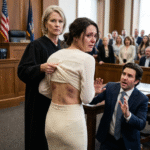
Sloane testified for two days.
On the second morning, Grant’s attorney displayed photographs of her at the mausoleum in white.
“You wanted Mrs. Whitmore’s life, didn’t you?”
Sloane looked at the photograph.
“I wanted the life I believed had been stolen from me.”
“And you blamed her.”
“You slept with her husband.”
“You accepted property purchased with disputed funds.”
“You wore jewelry belonging to her deceased mother.”
Sloane’s voice broke.
The attorney approached the jury.
“And now, to avoid prison, you expect us to believe Grant Whitmore deceived you?”
Sloane looked directly at Grant.
“No,” she said. “I expect you to believe I helped him because I wanted his lies to be true.”
The courtroom became silent.
That sentence did more than any denial could have done.
It acknowledged guilt without surrendering truth.
Grant was convicted on eleven counts.
When the verdict was read, he did not look at the jury.
He looked at me.
For thirteen years, I had been his mirror.
He searched my face for grief, love, satisfaction—anything proving he still occupied a room inside me.
I gave him nothing.
Afterward, reporters crowded the courthouse steps.
I issued one statement.
“Today was not revenge. Revenge is personal. Accountability belongs to everyone.”
The quote appeared across social media within minutes.
But the truth was more complicated.
A part of me had wanted revenge.
I had wanted Grant to feel small.
I had wanted Sloane to understand the cost of standing beneath my family crest in my mother’s emeralds.
I had wanted the world to watch him lose.
Pretending otherwise would have been another performance.
The difference was that I did not allow revenge to make the decisions.
Evidence did.
Law did.
The protection of innocent people did.
Anger lit the room.
It did not choose the furniture.
Two weeks before Grant’s sentencing, the Vale cemetery trustee called me.
“We have received an unusual petition,” he said.
“From whom?”
“Mr. Whitmore.”
Grant requested restoration of his burial license.
“He is facing decades in federal prison.”
“Why does he care where he is buried?”
“He claims the revocation was procedurally invalid.”
“It was not.”
“I agree.”
“Then deny it.”
“There is an attachment you should see.”
The attachment was a letter written in Grant’s hand.
Not to the trustee.
**You think the mausoleum was about burial. It was never about death. Conrad hid the final Morrow transfer inside the cemetery deed. If my license remains revoked, you inherit the debt but not the controlling voting share. Sloane does.**
**Ask Cross. He knows.**
**You have seven days before the annual registry closes. Restore my name, and I will sign away my claim. Refuse, and your sister will own the company you destroyed me to protect.**
For a moment, I almost admired him.
Even from a jail cell, he was attempting to place us against each other.
I sent the letter to Julian.
He called ten minutes later.
“There is no hidden Morrow transfer in the cemetery deed.”
“Are you certain?”
“You have been certain before.”
He accepted the blow.
“I reviewed it again.”
“Could Sloane hold a contingent share?”
“Not through the cemetery.”
“Through another document?”
“There is one instrument we never located.”
“What instrument?”
“The original charter of Morrow Holdings.”
My father’s archive contained amendments, transfers, debt schedules, and beneficial ownership records.
But not the original charter.
“Where would it be?” I asked.
“Conrad believed founding documents should remain with the first asset a company acquired.”
“What was Morrow’s first asset?”
Julian was silent.
Then he said, “Vale Hollow.”
The cemetery.
Grant’s claim might have contained a fragment of truth.
That was always his most effective method.
The next morning, Julian, Sloane, and I met at the mausoleum.
It was the first time the three of us had stood together beneath the crest.
Sloane wore a navy coat and no jewelry.
The ground was bright with frost.
The white roses from the dedication were long gone.
Inside the underground archive, we searched property ledgers dating back twenty years.
At noon, Sloane found a handwritten reference beside the original cemetery acquisition.
**Charter held where no heir can carry it alone.**
“Two keys?” Julian asked.
“The white cabinet required two,” I said.
We searched the mausoleum for dual locks.
None appeared.
At three in the afternoon, sunlight entered through the skylight and struck my father’s sarcophagus.
A bronze line appeared along its base.
Sloane saw it first.
“There.”
Two small depressions had been built into the bronze trim.
Not keyholes.
Handprints.
One on each side.
Where no heir can carry it alone.
I placed my palm against the left impression.
Sloane stood on the right.
For a second, nothing happened.
Then the bronze warmed beneath our hands.
A hidden mechanism released.
The front panel of the sarcophagus slid open.
Inside was not my father’s coffin.
That remained sealed beneath the stone.
Inside the panel was a narrow vault.
The original Morrow charter lay within it.
Beside it rested a final envelope addressed to:
**My Daughters.**
Sloane stopped breathing.
I opened the letter.
**Evelyn and Sloane,**
**If you are reading this together, then both of you have done something I failed to do: entered the same room without allowing my fear to keep you apart.**
Sloane covered her mouth.
I continued.
**Morrow Holdings was founded with one purpose—to ensure that no man who married into this family could separate its women from their power. Its controlling shares do not pass to one daughter over another. They require both.**
I looked at Sloane.
Her eyes widened.
The charter confirmed it.
Morrow’s voting control was divided into two equal stewardship shares.
One belonged to me.
The second belonged to any legally verified descendant of Conrad Vale born before the company’s formation.
Grant had known part of the truth.
He knew Sloane might inherit a share.
He had not known it required cooperation rather than competition.
My father’s letter continued.
**Grant will assume shared ownership creates weakness. Men like him believe two women with reason to resent each other can always be divided. Prove him wrong, not for me, but for yourselves.**
**Evelyn, you inherited my name openly.**
**Sloane, you inherited it in silence.**
**Neither form was fair.**
**The company belongs to you equally if you choose to hold it together. If either of you refuses, Morrow must be dissolved and its assets transferred to the Marianne Bennett Fund and the Claire Vale Foundation in equal portions.**
No coercion.
No forced sisterhood.
We could cooperate.
Or we could give everything away.
My father had finally created a structure that depended on consent.
Sloane sat on the stone step.
“He left me half.”
“He left us a choice.”
“I do not deserve half.”
“Deserving is not the question.”
“What is?”
“What we do with it.”
She looked at me.
“Do you trust me?”
The answer hurt her.
“But I am willing to build something that does not require blind trust,” I added. “Audits. Independent directors. Dual signatures. Public reporting.”
Her eyes filled.
“A company designed by women who know what happens when trust has no locks.”
Sloane laughed through her tears.
“That sounds terrible for men like Grant.”
“It does.”
Julian stood near the stairs, watching us.
“What will you do about Grant’s petition?” he asked.
I looked toward the burial registry above us.
“Deny it.”
“He may challenge.”
“He may try.”
Sloane rose.
“Can I ask something?”
“Do I have burial rights here?”
The question was quiet.
Not greedy.
Not triumphant.
It came from the little girl in the red coat, held by a woman who knew none of it was her fault.
“Legally, you qualify,” I said.
“And personally?”
I thought of the white dress.
My mother’s earrings.
The roses beneath the crest.
Then I thought of her testimony, the returned money, the photograph of my mother, and her hand beside mine on the sarcophagus.
“Personally,” I said, “I think you should decide after you have lived long enough to know where you belong.”
She nodded.
“That is fair.”
We returned to the surface.
Snow had begun to fall.
At the registry table, the trustee opened the book.
Grant Whitmore’s line remained crossed in red.
Below mine, a blank line waited.
The trustee dipped his pen.
“What name should I enter?” he asked.
I looked at her.
“Sloane Bennett Vale,” she said.
The trustee wrote it carefully.
Not as a replacement.
Not as a mistress.
Not as someone’s future widow.
As a daughter.
As my sister.
As herself.
## CONCLUSION — WHAT WE BUILT AFTER MIDNIGHT
One year after the mausoleum dedication, Vale Hollow opened a new memorial garden.
Not for the powerful.
For the forgotten.
The Marianne and Claire Garden honored women whose names had been omitted from family histories, inheritance records, birth certificates, and public monuments.
Sloane chose the magnolia trees.
I chose the dark stone paths.
Together, we placed a bronze inscription at the entrance:
**No life becomes less true because someone powerful refused to name it.**
The dedication was small.
No society reporters.
No dramatic arrival.
No one wore white.
Sloane brought a bouquet of garden roses and placed half at my father’s mausoleum.
The other half she carried to my mother’s grave by the lake.
This time, I went with her.
We stood beneath the magnolia tree in silence.
After a while, Sloane placed the old photograph beside Claire’s headstone.
“My mother forgave her,” she said.
“There was another letter. Marianne thanked her for coming.”
I looked at my mother’s name carved into the stone.
“She should have told me.”
“My father should have told both of us.”
“We cannot repair all of it.”
The agreement felt peaceful.
Some wounds do not close because we finally discover the perfect explanation.
They close because we stop asking them to become doors.
Sloane touched the headstone.
Then she walked back toward the garden, leaving me alone with my mother.
Julian waited near the lake.
He had returned to New York permanently three months earlier.
Not as trust protector.
Not as my attorney.
As the man I loved.
We still lived in separate homes.
We still argued.
He hated my habit of answering emails at two in the morning. I hated his belief that every vacation required a museum itinerary.
He never entered a room without knocking.
I never mistook peace for boredom again.
He came to stand beside me.
“Ready?” he asked.
“Lunch.”
“That sounds dangerously ordinary.”
“I booked a table without a single trustee.”
“Scandalous.”
There were new lines beside his eyes.
I loved them because they belonged to time we had actually lived, not years we had spent waiting.
As we walked toward Vale House, he reached for my hand.
I let him take it.
Not because I needed guidance.
Because I liked the warmth.
Behind us, the mausoleum stood among the cypress trees, silent and severe.
Grant had once believed a name carved in stone meant permanent possession.
He had been wrong.
Stone remembers only what the living choose to preserve.
The rest belongs to the ground.
That afternoon, the cemetery trustee closed the annual register.
Grant’s petition had been denied.
His line remained crossed out.
Sloane’s appeared beneath mine.
Two daughters.
One inheritance.
No husband between them.
Grant had promised his mistress a grave.
His wife owned the ground.