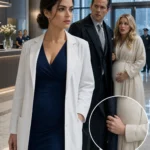
Some guests smiled too brightly.
Others pretended not to notice me.
Julian approached near the entrance to the dining carriage.
For a moment, his expression was almost human.
“You came.”
“You invited me as a courtesy.”
His gaze traveled over my dress.
“You look well.”
“You sound disappointed.”
He lowered his voice.
“This doesn’t need to be unpleasant.”
“You announced our divorce over dessert.”
“I made a difficult decision.”
“You brought your mistress to my family’s train wearing stolen emeralds.”
His jaw tightened.
“The necklace is marital property.”
“It belonged to my grandmother before you learned which fork to use.”
He glanced toward the guests.
“Not tonight, Eleanor.”
“Tonight was your idea.”
Celeste joined us.
She smelled of gardenias.
The emeralds rested perfectly against her skin.
“I hope we can be gracious,” she said.
I looked at the center stone.
“My grandmother wore that necklace when she buried her husband.”
Celeste’s fingers twitched.
I smiled.
“Don’t worry. It looked better on him too.”
Then I walked inside.
Dinner began at eight.
The train remained stationary during the meal, though the engines hummed beneath us. Each course recreated a dish from the Sovereign’s original menu.
Oysters Rockefeller.
Consommé beneath a pastry dome.
Roasted duck with cherries.
Baked Alaska flamed in blue fire.
Between courses, screens displayed photographs of the restoration.
There I was at twenty-six, standing inside a rusted carriage with rain dripping through the roof.
There I was at thirty-one, holding a recovered brass plate.
There I was beside my father during his final visit to the yard.
Julian narrated each image as though he had taken it.
“When I first saw the Sovereign,” he said, “I understood that America was hungry for a more intimate form of luxury.”
He had first seen the Sovereign four years after restoration began.
No one corrected him.
They did not need to.
Every lie became evidence of character.
At nine fifteen, dessert plates were cleared.
The train’s final certification had been completed ninety minutes earlier by federal inspectors.
The signed document rested inside Adrian’s briefcase.
Julian believed a copy was being delivered to him after the speeches.
He stood at the center of the dining carriage.
Celeste rose beside him.
“Tonight,” he began, “we honor the past by refusing to be trapped inside it.”
Applause.
He thanked the investors.
The board.
Vesper Capital.
He did not thank me.
Then he extended one hand in my direction.
“And we acknowledge Eleanor Vale Harrington, whose emotional commitment to her family’s history gave this project its beginning.”
Emotional commitment.
The phrase was precise.
Not leadership.
Not money.
Not nine years of labor.
Emotion.
Something feminine, unstable, and safely noncommercial.
Guests turned toward me.
I raised my glass.
Julian mistook the gesture for surrender.
His shoulders relaxed.
“As many of you know,” he continued, “Eleanor and I are moving in different directions. I wish her peace as she begins a quieter chapter away from the demands of public life.”
A few people looked uncomfortable.
He smiled.
“Some journeys end before we reach the station. Wise travelers understand when it is time to step off.”
Celeste lowered her head as though touched by his compassion.
Julian reached for her hand.
“Celeste represents the future of the Sovereign brand. Her vision, courage, and refusal to be intimidated by outdated expectations have transformed this launch.”
I watched the board members.
One looked sick.
Another drank too quickly.
The third stared at the table.
They had received Adrian’s notice at nine o’clock.
They knew what was coming.
That was the third gift he gave me.
His certainty.
“After the Vesper acquisition closes,” he said, “Celeste will oversee the redesign of the Aurelia carriage as her private executive suite.”
Celeste smiled at the applause.
Then she stood and led several investors toward the rear of the train.
I followed at a distance.
The Aurelia doors stood open.
Champagne waited inside.
Celeste entered as though crossing the threshold of a palace.
She ran one white-gloved hand over the mahogany walls.
“So dark,” she murmured. “We’ll lighten it.”
“Whatever you want.”
“The fireplace stays.”
“Of course.”
“And this bedroom?”
“The owner’s room.”
She turned slowly.
“Soon mine.”
A photographer captured the moment.
Julian noticed me standing near the service door.
He placed his hand at Celeste’s waist.
“Eleanor always preferred preservation to progress,” he told the investors. “She has never understood that old things survive only when stronger people decide what they should become.”
I looked at the walls I had saved from rot.
The ceiling I had restored star by star.
The fireplace beside which my grandmother had hidden the ledger.
“Stronger people?” I asked.
Julian’s smile became thin.
“Old wives should know when their journey is over.”
The room went quiet.
He had intended the sentence to be clever.
It was too cruel.
Even Celeste glanced at him.
I stood beside the service door because Julian had instructed the staff not to let me enter the owner’s salon during the ceremonial departure.
He wanted the photograph.
The old wife outside.
The new woman within.
The photographers raised their cameras.
Then the conductor arrived.
Samuel Reed had served the Vale family for forty-seven years. He wore a navy uniform with gold braid and carried the original silver departure bell on a polished tray.
His father had been conductor of the Sovereign before it was retired.
His hands were weathered.
His posture was perfect.
“Ladies and gentlemen,” Samuel said, “the Sovereign Limited has received full operating certification.”
Applause filled the carriage.
Julian exhaled.
The moment he had waited for had arrived.
Samuel continued.
“Under the charter of the Vale Preservation Trust, the inaugural departure must be authorized by the train’s legal owner.”
Julian extended his hand toward the bell.
Samuel did not move.
A pause opened.
Julian smiled as though the conductor had misunderstood.
“Thank you, Samuel.”
He reached again.
Samuel stepped back.
“The legal owner,” he repeated.
Every sound disappeared.
The photographers lowered their cameras, then raised them again.
Julian’s face changed.
Not much.
A tightening around the eyes.
A fraction of color leaving his mouth.
Celeste looked from him to Samuel.
“Julian?” she whispered.
The rear door opened.
Adrian entered with Lena, two attorneys from Vesper Capital, and a woman Julian recognized immediately.
Marian Holt.
Chair of the Vale Heritage Rail board.
She carried a black folder.
Julian looked at me.
“What have you done?”
I stepped away from the service door.
“Nothing you didn’t sign.”
Adrian handed Marian the federal certification.
She opened the folder.
“At nine twenty-three this evening,” she said, “certification activated Section Twelve of the Vale Preservation Trust and transferred fifty-one percent voting control of Vale Heritage Rail to Sovereign Meridian Holdings.”
Julian’s eyes moved rapidly between us.
“That entity has no authority here.”
“It owns the controlling shares,” Marian replied.
“Who is the beneficiary?”
No one answered.
He already knew.
He looked at me.
The word was almost soundless.
I entered the Aurelia.
Celeste remained beside the fireplace.
My grandmother’s emeralds burned at her throat.
“Remove that necklace,” I said.
Her hand rose defensively.
“He transferred stolen property purchased through diverted corporate funds.”
“That’s a lie.”
Lena placed a document on the table.
“It is a tracing report. Every dollar is accounted for.”
Celeste looked at Julian.
He said nothing.
I turned to the investors.
“My name is Eleanor Vale. I am the sole beneficiary and controlling director of Sovereign Meridian Holdings.”
The cameras flashed.
“Upon certification, Sovereign Meridian became the legal owner of fifty-one percent of Vale Heritage Rail, one hundred percent of the Meridian development rights, and all protected Vale trademarks associated with the Sovereign Limited.”
Julian recovered enough to laugh.
It sounded brittle.
“This is theater. The board approved the Vesper sale.”
Marian answered.
“The board’s approval relied on your representation that you possessed controlling authority. You did not.”
“The acquisition agreement is binding.”
One of the Vesper attorneys stepped forward.
“It is binding on the party that made the representations.”
Julian’s gaze sharpened.
“What does that mean?”
Adrian’s voice was calm.
“It means Vale Heritage Rail is not liable for your fraud.”
Julian’s face whitened.
“The company signed the agreement.”
“You signed on behalf of the company without authority,” Adrian said. “You also executed a personal indemnification covering misrepresentation, concealment, forged consent, and breach of fiduciary duty.”
Celeste turned toward Julian.
“You said Eleanor had signed.”
“She did.”
“No,” I said. “You forged my signature.”
I placed a copy of the Metropolitan Union approval on the table.
Beside it, Lena placed the metadata report, the notary payments, the recovered messages, and the photograph from Miami.
Julian stared at the documents.
For the first time, he looked afraid.
“That proves nothing.”
“The notary is cooperating,” Adrian said.
Julian’s head snapped toward him.
“The bank’s forensic examination identified the originating device. Your internal messages confirm knowledge. The company tablet establishes Ms. Arden’s participation.”
Celeste stepped away from Julian.
“What messages?”
Lena turned the screen toward her.
**The old signatures are accepted. We can pull the rest after launch.**
**And the wife?**
**She’ll take the carriage and disappear.**
Celeste’s lips parted.
“That isn’t what it looks like.”
“It looks like conspiracy,” Adrian said.
Julian moved toward the door.
Two men entered from the corridor.
One was a process server.
The other wore the badge of the New York County District Attorney’s financial crimes bureau.
They did not arrest him.
That would come later, after prosecutors completed their review.
Humiliation is often more powerful when the guilty understand exactly how much time remains before the next knock.
The process server handed Julian three envelopes.
A civil fraud complaint.
An emergency asset-freeze order.
And a notice of default from Black Oak Recovery.
Julian tore open the final envelope.
His eyes moved across the page.
“What is Black Oak?”
“A private creditor,” Adrian said.
“They bought my Metropolitan Union loans.”
I let the silence answer first.
Then I said, “I do.”
Celeste stared at me.
Julian looked as though I had struck him.
“The penthouse,” I continued, “the aircraft interest, the yacht, the Aspen property, and the Hamptons house are collateral securing loans now held by Black Oak.”
“You can’t take my homes.”
“They were purchased with money taken from my company.”
“The penthouse is marital property.”
“It was transferred to Harrington Residential Holdings six months ago to shield it from divorce proceedings. Your signature is on the deed.”
His own cleverness had removed my marital claim.
It had also placed the apartment directly beneath my creditor’s hand.
Julian’s breathing became audible.
“You planned this.”
I looked at the contract in his hand.
“You planned it. I read what you signed.”
One of the investors coughed to hide a laugh.
Julian turned on him.
“This isn’t finished.”
“No,” I said. “The breakup fee remains.”
His attention returned to Vesper’s attorneys.
“The transaction can still close.”
“It cannot,” the taller attorney said. “You do not control the asset.”
“Then waive the fee.”
“We decline.”
Julian stared at him.
“Who gave that instruction?”
The attorney glanced toward me.
That was enough.
Julian understood.
“You bought Vesper.”
“Not the entire firm,” I said. “Only the special-purpose acquisition vehicle created for this transaction.”
“With what money?”
“You didn’t have—”
He stopped.
His eyes moved around the Aurelia.
The mahogany.
The hidden panel.
The original crest above the fireplace.
He finally understood that the train had never been the whole inheritance.
It was merely the keyhole.
“How much?” he asked.
“Enough.”
“How much are you worth?”
The question was so perfectly Julian that several people looked away.
Not whether I had suffered.
Not whether I had loved him.
Not whether any part of our marriage could be remembered without poison.
That was the language beneath every promise he had ever made.
I stepped closer.
“You had nine years to ask what I valued,” I said. “You waited until tonight to ask what I was worth.”
Celeste removed the emerald necklace.
Her hands shook.
She placed it on the table.
“You told me she was finished,” she said to Julian.
He ignored her.
“You cannot enforce the full breakup fee against me.”
“The personal guarantee says otherwise.”
“I’ll fight it.”
“You should.”
“Your billable hours will support several excellent law firms.”
He looked toward the board.
“Marian, this woman has been absent from operations for months. She is emotionally compromised.”
Marian closed the folder.
“The board voted at nine thirty-one to remove you as chief executive for cause.”
“You cannot remove me without notice.”
“Fraud permits immediate suspension.”
“You all owe your positions to me.”
“No,” she replied. “We tolerated our positions because of Eleanor.”
Julian’s face hardened into something unrecognizable.
He stepped toward me.
“You think this makes you powerful?”
“You think humiliating me makes you better?”
“You were nothing before I gave this company direction.”
The room inhaled.
I felt the sentence enter me.
Years of marriage stood behind it.
Every dinner where he corrected me.
Every board meeting where he repeated my idea louder.
Every night I apologized for needing tenderness from a man who considered tenderness an inefficiency.
For one heartbeat, I wanted to hurt him.
Not legally.
Not elegantly.
I wanted to tell him the worst thing I knew about him and watch it break his face.
Then I remembered my grandmother.
Misunderstanding is expensive.
I picked up the departure bell.
The silver was cold against my palm.
Samuel Reed opened the exterior door.
Beyond it, the platform stretched beneath Grand Central’s lights. Hundreds of guests and reporters waited.
I walked outside.
Julian and Celeste followed because there was nowhere else for them to go.
The crowd saw the documents.
The process server.
The badge.
The missing necklace.
They understood before anyone explained.
Samuel raised his voice.
“Will the legal owner authorize departure?”
I stepped forward and rang the bell once.
Its sound traveled through the station—clear, bright, and final.
Then I turned to the porters.
“Remove Mr. Harrington’s and Ms. Arden’s luggage from the train.”
Julian stared at me.
“You wouldn’t.”
I looked at the man who had ended our marriage beneath painted angels.
The man who had placed me beside the service door so another woman could sit beneath my crest.
The man who had mistaken access for ownership and patience for weakness.
“I already did.”
Two porters entered the sleeping carriage.
Minutes later, Julian’s black cases appeared on the platform.
Celeste’s followed.
Her monogram glowed beneath the terminal lights.
C.A.
She stood frozen as hundreds of cameras captured the luggage being lined beside her.
Julian moved close to me one final time.
“This is cruel.”
His voice broke on the final word.
I almost pitied him.
Almost.
“No,” I said quietly. “Cruel was making me stand at the edge of my own life while you gave pieces of it away.”
The conductor’s whistle sounded.
Julian looked toward the train.
“You’re leaving me here?”
“You ended the marriage.”
The doors began to close.
His face disappeared behind polished glass.
The Sovereign Limited moved forward.
Slowly at first.
Then with gathering power.
The platform slipped away.
Julian remained beneath the lights beside his mistress and their luggage.
For years, he had promised to take me into the future.
In the end, the future left without him.
# **CHAPTER FIVE — THE LAST CAR BELONGED TO ME**
The party continued after we departed.
That surprised people.
Scandals usually stop a room.
Money teaches the room to adjust.
Within ten minutes, the musicians resumed playing. Champagne was poured. Investors opened new conversations with the speed of people stepping across a body before the blood reached their shoes.
I did not return to the dining carriage.
I went to the Aurelia and closed the door.
The train passed beneath the East River tunnels and emerged into the winter night. Manhattan fell behind us in shards of gold.
I stood at the window until my hands began to shake.
Then they would not stop.
Adrian entered without knocking.
He locked the door behind him.
“It’s done,” he said.
I pressed my palms against the cold glass.
“It has started.”
Outside, apartment windows flashed past. Families ate dinner. A woman stood at a kitchen sink. A child pressed his face to the glass as the blue train swept by.