“Of course you know.”
“I asked whether she is healthy.”
“She is.”
“She isn’t mine.”
“I held her for two hours before the results came.”
His voice broke.
“Lila kept saying the test was wrong.”
“I’m sorry.”
“Are you?”
He was silent.
“I lost everything for a lie.”
“No, Daniel.”
The old instinct to protect him rose automatically.
This time, I let the truth speak instead.
“You lost everything because of your choices.”
“Lila lied to me.”
“And you lied to me.”
“She used me.”
“And you used the company.”
“She made me believe—”
“I did not invite her to dinner.”
“I did not put my necklace around her throat.”
“I did not place the love letter in your hand.”
My voice never rose.
“You cannot make her the author of decisions you signed with your own name.”
He began to cry.
In fifteen years, I had heard Daniel cry twice.
Once when his father died.
Once when the doctor told us I would never carry a child.
I closed my eyes.
Part of me still remembered how to cross a room and hold him.
That part of me would probably exist for a long time.
Love does not always disappear when respect dies.
Sometimes it simply becomes a room you no longer enter.
“What happens now?” he asked.
“The divorce is finalized next month.”
“That isn’t what I meant.”
“Is there any possibility that we could start again?”
Rainwater dripped from the terrace railing.
Beyond the lawn, Blackwood’s windows shone gold against the evening.
“You want to come back because the life you chose collapsed.”
“That isn’t fair.”
“It is exact.”
“I was lost.”
“You were loved.”
“I forgot the difference.”
His honesty came too late, but it was honesty.
“What if I spend the rest of my life proving I understand?”
“You should spend the rest of your life becoming someone who does.”
“Without you?”
He breathed unevenly.
“I still have your wedding ring.”
I looked down at my bare hand.
“You have yours.”
“I sent yours back.”
“The ring I wore was mine.”
“The promise belonged to both of us.”
“You broke it.”
Neither of us spoke for several seconds.
Then he asked the question that finally ended our marriage.
“Did you ever love me as much as she said she did?”
I thought of the company I saved.
The hospital nights.
The scandals buried.
The three pregnancies lost before they became children.
The speeches I wrote beneath his name.
The house I opened to his family.
The truth I had carried alone so he could stand straight in public.
“She gave you a letter,” I said.
“I gave you a life.”
Then I ended the call.
# PART FIVE
## THE LAST THING HE ASKED ME TO READ
Our divorce became final on a clear morning in April.
There were no photographers inside the courtroom.
There were no speeches.
The judge reviewed the settlement, confirmed that both parties understood the terms, and dissolved fifteen years of marriage in less than twenty minutes.
Daniel retained his remaining personal savings, his father’s watch, his clothes, and the one car he had purchased before our wedding.
I retained Blackwood Manor, my family trusts, and controlling ownership of Ashford Crown.
The company’s restitution claims were resolved separately.
Daniel agreed to cooperate with investigators and accepted a permanent prohibition against serving as an executive or fiduciary of the Ashford Foundation.
The prosecutors ultimately declined to seek prison time after the funds were repaid and the board requested a civil resolution.
Daniel left the courthouse through a side entrance.
I walked down the front steps beside Naomi.
The air smelled of rain and flowering trees.
“How do you feel?” she asked.
“Quiet.”
“That is not a feeling.”
“It is today.”
At Blackwood, the staff had removed Daniel’s remaining belongings from storage.
Mr. Bell asked what should be done with the portrait from our wedding.
It showed Daniel and me descending the church steps beneath an arch of white roses.
He looked at me in the photograph as if the world had narrowed to one person.
For years, I had assumed photographs preserved truth.
Now I understood that they preserved moments.
A moment could be real even when the people inside it later changed.
“Wrap it carefully,” I said.
“Store it with the family archives.”
Mr. Bell looked surprised.
“You do not want it destroyed?”
“Destroying the photograph will not change what happened.”
That evening, I opened the drawer containing the letters.
Daniel’s original wedding letter lay beside Lila’s copy.
The paper, handwriting, and ink were different.
The promises were almost identical.
I read Daniel’s letter once more.
Not because I wanted him back.
Because I wanted to remember the woman who had believed it.
She had not been foolish.
She had loved honestly with the information she possessed.
I would not punish her for failing to predict betrayal.
I returned Daniel’s letter to its envelope.
Lila’s copy went into the legal archive with the financial records.
One had belonged to my life.
The other belonged to evidence.
Three months later, Ashford Crown hosted its annual leadership gala at the restored Meridian Hotel in Boston.
The ballroom had once been a railway terminal.
We preserved its vaulted ceilings, brass clocks, and marble floors while transforming the old ticket hall into a space filled with light.
More than eight hundred employees and guests attended.
I wore black silk and my grandmother’s emerald necklace.
The clasp had been repaired.
The stones rested cool against my skin.
Margaret attended quietly and sat beside her daughter.
We were not close in the way we had once been.
Trust, unlike money, could not be restored through a single transfer.
Still, when our eyes met across the ballroom, she smiled.
I returned it.
Caleb introduced me as chairwoman of Ashford Crown.
I walked onto the stage beneath the company name Daniel had once begged the court to protect.
For months, advisers had urged me to remove Ashford from the brand.
They believed the scandal had damaged it.
I kept the name.
Not for Daniel.
For the housekeepers, chefs, porters, engineers, managers, and families who had spent generations making the hotels worthy of it.
A name did not belong only to the loudest man who carried it.
Sometimes it belonged to the people who repaired what he broke.
I announced a new employee ownership program.
A portion of annual profits would fund shares for long-term staff.
The program had been designed from the recovered money and the sale of the Manhattan penthouse.
The apartment Daniel bought for his mistress would now help thousands of employees own part of the company they had built.
The ballroom rose in applause.
I stood beneath the lights and let myself feel it.
Not vengeance.
Not victory.
Relief.
After the gala, I returned to my suite and found an envelope waiting beneath the door.
Daniel’s handwriting covered the front.
Inside were four pages.
He wrote that he had begun therapy.
He wrote that he had taken a consulting job with a small hospitality firm in Philadelphia.
He wrote that Lila had moved to Los Angeles with Evan and the baby.
He wrote that he was learning how much of his life had depended on people he never thanked.
He apologized for the affair.
He apologized for the money.
He apologized for the dinner.
Most of all, he apologized for teaching me that loving him required disappearing.
At the end, he wrote one final sentence.
You do not owe me forgiveness, but I hope you will someday read this and believe I finally understand what I lost.
I sat beside the window overlooking Boston.
Below, headlights moved along the wet streets like ribbons of gold.
I read the letter twice.
Then I placed it on the table.
Daniel was right about one thing.
I did not owe him forgiveness.
But forgiveness and return were not the same.
I could release my anger without reopening the door.
I could wish him growth without offering him access to the woman his choices had created.
The following morning, I wrote six words beneath his final sentence.
I believe you understand it now.
I mailed the letter back without adding my address.
He already knew where Blackwood stood.
Knowing the location of a house did not give a person the right to enter it.
# CONCLUSION
## A TABLE SET FOR SPRING
One year after the anniversary dinner, I hosted another gathering at Blackwood Manor.
There were no reporters.
There were no board members.
There were no carefully arranged witnesses.
I invited the people who had remained after the spectacle ended.
Naomi came with her wife.
Caleb brought his two daughters.
Margaret arrived carrying peonies from her garden.
Mr. Bell opened a bottle of champagne older than our youngest guest.
We ate beneath the terrace lights while the gardens moved softly in the May wind.
The chair at the head of the table remained empty until everyone had arrived.
Then Margaret touched my arm.
“You should sit there.”
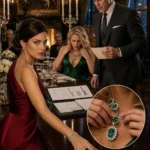
For a moment, I looked at the chair where Lila had once sat wearing my necklace and waiting to inherit a life she did not understand.
I remembered Daniel standing by the fireplace.
I remembered the letter shaking in his hand.
I remembered the room waiting for me to break.
I took my seat.
Not because it was the most powerful chair.
Because it was mine.
During dessert, Caleb’s youngest daughter asked whether Blackwood was a castle.
“No,” I told her.
“It is simply an old house.”
She looked around at the marble columns and chandeliers.
“It looks like a castle.”
“Many things look more powerful from the outside.”
She considered this seriously.
Then she asked the question only a child would ask.
“Are you a queen?”
Everyone laughed.
I smiled at her.
“What are you, then?”
The answer came easily.
“I am the woman who knows where everything belongs.”
Later, after the guests left, I walked through the quiet dining room.
The candles had burned low.
A few peony petals rested on the white tablecloth.
My grandmother’s emeralds caught the final light from the fireplace.
For years, Daniel had called my calmness cold.
Lila had called it stone.
They were both wrong.
My silence had never been emptiness.
It was patience.
It was memory.
It was the sound of a woman gathering facts while everyone else performed.
Daniel believed his mistress’s letter would become the final chapter of our marriage.
Instead, it became the opening statement in the case against him.
He read about freedom.
I read the transfers.
He offered her my chair.
I showed them who owned the room.
And when the evening was over, the woman they expected to humiliate did not beg anyone to stay.
She simply closed the door, reclaimed her name, and wrote the ending herself.
He read the love letter.
The wife read the money trail.