The cruelty of it might have softened me on a different day.
But not enough.
“Then you should have known better than to do the same thing to your own daughter.”
“No, Weston. You know now. That is not the same thing.”
He took the blow without defending himself.
For once.
“I was raised inside a machine,” he said quietly.
“Every good thing had a condition. Every gift had a string. My father loved me most when I performed correctly. My mother loved me most when I did not embarrass her.”
“When Oliver was born, they acted like history had corrected itself. A son. A proper heir. A clean line.”
“Clean,” I said.
The word tasted sour.
He looked at my daughter.
“I panicked.”
“You abandoned her.”
The word sat between us.
At least he did not dress it up.
“Did you love me?” I asked.
His face broke.
I hated him for the answer.
It would have been easier if everything had been false.
“Then why did you let them make me small?”
He stared at me, and the silence became an admission.
“Because I was small too,” he said.
I looked away.
The saddest excuse in the world.
Also, perhaps, the truest.
Marlo stirred.
Weston stood instinctively.
I lifted a hand.
He stopped.
“May I see her?” he asked.
“You may look.”
He approached slowly, as if walking toward a sacred thing.
Marlo’s fist rested against her cheek.
Her mouth puckered in sleep.
Weston’s eyes filled.
“She looks like you.”
“She looks like herself.”
“She does.”
A tear slid down his face.
I had seen Weston cry before, but always beautifully.
At weddings.
During films.
At the ultrasound.
This was different.
Ugly grief.
Useful grief, maybe.
“She deserves my name,” he whispered.
“She deserved it when it cost you something.”
He bowed his head.
After he left, Odette came into the room.
“You okay?”
She sat beside me.
“He looked like a man who had just found out the throne was made of bones.”
“That’s because it was.”
The court hearing was set for May.
By then, the story had escaped polite circles and entered the news.
Local papers called it a “succession dispute.”
Financial reporters called it a “founder equity challenge.”
Women in grocery stores stopped avoiding me and started pretending they had always been kind.
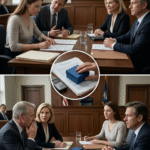
Camille testified first.
She wore a navy dress and no jewelry.
Oliver stayed with her mother.
Her voice shook, but she told the truth.
She spoke of Weston’s affair, Adele’s visits, Preston’s lawyers, and the pressure to keep her son available as an heir without making him too visible.
Then Weston testified.
He acknowledged Marlo.
He acknowledged Oliver.
He acknowledged the affair.
He admitted his parents had urged him not to sign Marlo’s birth certificate.
Preston watched him with dead eyes.
Adele sat very still.
When Weston confirmed the DNA results showing Elliot Vale was his biological father, a murmur moved through the courtroom like wind through dry leaves.
Preston’s attorney tried to object.
The judge overruled him.
Then Josephine called Adele Callaway.
For the first time since I had known her, Adele looked old.
Not elegant-old.
Not society-page-old.
Just tired, frightened, human-old.
Josephine approached with a copy of Mara’s photograph.
“Mrs. Callaway, did you know Mara Ellison?”
“Did you know she was pregnant when she died?”
“Did you know her daughter survived?”
Adele’s mouth tightened.
Josephine waited.
Adele looked at Preston.
He did not look back.
Josephine repeated, “Did you know her daughter survived?”
Adele closed her eyes.
The courtroom went still.
My breath caught.
Josephine’s voice did not change.
“When did you learn that child was Sable?”
Adele opened her eyes.
“Five years ago.”
The words struck me harder than Weston’s hospital confession.
Around the time I met him.
Around the time Adele began inviting me to family dinners with cool reluctance.
Around the time Preston started asking where my people came from.
Weston turned in his seat.
Adele would not look at him.
Josephine stepped closer.
“Mrs. Callaway, did you encourage your son to pursue Sable after learning who she was?”
Weston stood.
“Mother?”
The judge ordered him to sit.
Adele’s face trembled, then hardened.
“We needed to know whether Elliot had told her anything.”
My lungs forgot their purpose.
Josephine asked, “So Weston’s relationship with Sable began as surveillance?”
Adele whispered, “At first.”
At first.
Such a delicate phrase for a knife.
Weston looked at me across the courtroom.
The horror on his face was real.
I almost wished it were not.
“Did Weston know?”
Preston finally spoke.
“Adele.”
She turned on him with sudden fury.
“No, Preston. I have buried enough for you.”
The judge warned her.
She ignored it.
“I gave you my youth, my son, my silence. I helped you turn a dead woman into a footnote. I let you make Elliot a villain in his own story.”
“But I will not let you erase another girl.”
Marlo was at home with Odette.
Still, I felt as though my daughter had entered the courtroom.
Every word now belonged to her future.
Josephine asked the question that mattered most.
“Mrs. Callaway, did Preston Callaway knowingly conceal Mara Ellison’s surviving child to prevent her from inheriting founder shares?”
Adele looked at Preston one last time.
He stared ahead, carved from granite and pride.
“Yes,” she said.
The sound that moved through the room was not a gasp.
It was history changing its mind.
## PART FIVE: THE DAUGHTER THEY DID NOT COUNT
Preston Callaway’s empire did not fall in one dramatic crash.
Empires rarely do.
They are dismantled by signatures, sworn statements, revised ledgers, and the slow humiliation of men who discover paper can remember what people deny.
Within six months, Callaway Holdings entered a court-supervised restructuring.
Mara Ellison’s shares were restored to her surviving heir.
Elliot Vale’s shares passed according to his will.
Together, they gave me control Preston had spent nearly half a century trying to prevent.
The newspapers said I had won.
They were wrong.
Winning feels like joy.
This felt like standing in the ruins of a house and realizing every brick had once been someone’s grief.
I did not move into the Callaway estate.
I sold it.
Not because I needed the money.
Because no child of mine would learn to walk beneath portraits of men who mistook cruelty for legacy.
The proceeds funded a trust for children born into legal disputes, abandoned by powerful fathers, or used as bargaining chips by families with too much money and too little shame.
Odette said Mara would have liked that.
I hoped so.
Camille and I did not become friends.
Life is not that tidy.
But we became something quieter and perhaps more honest.
Two mothers standing on opposite sides of the same wreckage, determined our children would not inherit the worst of it.
Oliver was a sweet baby with solemn eyes.
The first time I held him, Camille cried.
“I thought you would hate him,” she said.
I looked at the boy sleeping in my arms.
“He didn’t betray me.”
Neither had Marlo.
Neither had any child.
That became the center of everything.
Weston signed Marlo’s amended birth certificate in late autumn.
He did it in a small conference room at Josephine’s office, under fluorescent lights, with no photographers and no family crest embossed on the paper.
His hand shook.
When it was done, he slid the document toward me.
“There,” he said.
Not triumphantly.
Not proudly.
Almost reverently.
I looked at the signature.
For months, I had imagined this moment would satisfy me.
It did not.
It was necessary, but it was not enough to repair the hours when Marlo had been unnamed by her own father.
Weston seemed to know that.
“I’m sorry,” he said.
“Will that ever matter?”
I folded the document.
“It matters to the record.”
He winced.
“And to you?”
I looked through the glass wall of Josephine’s conference room.
Marlo was with Odette in the waiting area, laughing at something only babies understand.
Her joy did not ask permission.
That was when I realized forgiveness was not a door Weston could knock on until I opened it.
It was a country I might visit someday alone.
“It may matter later,” I said.
“But later is not yours to demand.”
“I’m trying to be better.”
“That is good.”
He gave a sad smile.
“You say that like a judge.”
“I say it like a mother.”
“Can I see her more?”
I took a long breath.
“Slowly. Supervised. Consistently. Without using her to redeem yourself.”
His eyes filled.
“Thank you.”
“Do not thank me yet.”
I met his gaze.
“If you disappoint her, I will become the worst thing your family ever failed to prepare for.”
For the first time in months, Weston laughed.
A small, broken laugh.
“I believe you.”
Years passed.
Not many, but enough for Marlo to become a child with opinions.
She disliked peas, loved cardinals, and believed all dogs were named Biscuit unless corrected.
She had Weston’s dimple and my stubborn chin.
She had Mara’s eyes, according to Josephine, who kept the old photograph framed on her desk.
Preston was convicted of fraud and obstruction, though age and influence softened the punishment more than justice should have allowed.
He died two winters later in a private care facility, attended by nurses paid to be gentle.
Adele lived in a townhouse near Charleston.
She wrote to Marlo every birthday.
I kept the letters in a box.
When Marlo was old enough, she could decide whether to open them.
Weston became a decent father by discipline rather than instinct.
He came when scheduled.
He learned how to braid hair badly, then better.
He showed up to school plays, pediatric appointments, and one disastrous dance recital where Marlo refused to move until he stood and clapped the rhythm from the audience.
He never returned to being my husband.
Some betrayals do not ask to be repaired.
They ask to be survived.
On Marlo’s fifth birthday, Josephine invited us to the old Vale cottage.
It had passed to me through Elliot’s estate, a little white place near a tidal creek, with azaleas crowding the porch and bees still moving lazily through the herb garden.