“How much?”
“Four point eight million dollars over eleven months.”
“Where did it go?”
“Renovations, jewelry, a Range Rover, charter flights, and a consulting contract with Vale House Strategies.”
“Sloane.”
“Yes.”
I walked toward the windows.
Below us, yellow taxis moved along Fifth Avenue like pieces on a board.
“Does Grant know we are investigating?”
“No.”
“Does Charles?”
“Not yet.”
“Keep it that way.”
Naomi studied me.
“You suspected the affair.”
“I suspected Grant had become careless.”
“That is not the same answer.”
She waited.
Good attorneys understood the value of silence.
I touched the bare place on my left hand where my wedding ring had rested for ten years.
I had removed it after Grant left.
The skin beneath was pale.
“He used my name on her card,” I said.
Naomi’s expression changed by less than an inch.
For her, that was fury.
“Do you want a divorce?”
“I want facts.”
“You have enough facts.”
“I want every fact.”
She closed the folder.
“Then we proceed in layers.”
“Personal, corporate, criminal.”
“Quietly.”
“Always.”
Naomi slid another document toward me.
It was a photograph of Grant entering the Halcyon residential elevator with Sloane.
The timestamp was from the night before.
Our anniversary.
At seven thirty, he had texted me that the acquisition negotiations were running late.
At eight, I had changed out of my dress.
At nine, the chef sent home the truffle soufflé Grant had requested.
At ten, I extinguished the dining room candles myself.
The photograph showed Grant smiling at Sloane as if he had never learned how to smile at me.
She wore a red dress under a white coat.
His hand rested against the small of her back.
Behind them stood my father-in-law.
I looked closer.
Charles Mercer was not merely aware of the affair.
He had joined them.
“Why was Charles there?” I asked.
“We pulled the private dining records.”
Naomi opened another file.
“Grant, Sloane, Charles, and Victor Hale had dinner in the penthouse.”
Victor Hale was Mercer Crown’s chief financial officer.
He had worked for Charles for twenty-eight years.
He had also served as a witness to the governance agreement that made my voting proxy conditional.
“Business meeting?” I asked.
“Possibly.”
“On my anniversary.”
“Possibly not.”
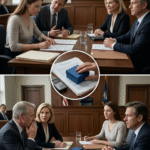
Naomi placed a small black audio device on the table.
“Our investigator installed this in the penthouse conference room six weeks ago.”
I looked at her.
“Inside my building.”
“Inside your building.”
“And?”
“We have recordings.”
My pulse changed.
“Play them.”
The first recording began with the clink of ice against crystal.
Grant’s voice followed.
“Once the merger closes, Evelyn becomes irrelevant.”
Charles laughed.
“Your wife has never been irrelevant.”
“She has shares, not courage.”
Victor Hale spoke next.
“What about the proxy conditions?”
Grant sounded amused.
“The board sees what I tell them to see.”
“And the Ashford trust?”
“My wife still thinks marriage is sacred.”
There was movement.
Then Sloane’s voice, soft and smug.
“How long before you tell her?”
Grant answered without hesitation.
“After the gala.”
“I’ll give her the divorce papers tomorrow morning.”
Sloane laughed.
“Right after your anniversary?”
“The timing makes it memorable.”
My hands remained still.
Naomi stopped the recording.
“There’s more.”
“Play it.”
Charles’s voice returned.
“Evelyn’s family will retaliate.”
“Her mother can barely leave Connecticut without a nurse.”
“And the trust?”
“She won’t use it.”
Grant paused.
“She loves me.”
Those three words did what the affair had not.
They wounded me.
Not because they were true.
Because he had turned my love into a weakness he planned to exploit.
Sloane asked, “And the penthouse?”
“It’s yours after the divorce.”
“What about this one?”
“This one belongs to me.”
He meant the home where I was standing.
The apartment my grandmother had purchased through Ashford Residential Holdings six years before I met him.
The apartment Grant had redecorated, photographed, and described in interviews as his personal expression of modern masculinity.
He had never once seen the deed.
Naomi stopped the audio.
The quiet that followed felt expensive.
Controlled.
Deadly.
“He intends to remove you from the company tomorrow,” she said.
“How?”
“The merger documents contain an amended voting structure.”
“He forged my consent.”
“Victor prepared signature pages.”
I turned from the window.
“When does the board vote?”
“Tonight at six thirty, one hour before the gala.”
Grant expected me to arrive at seven thirty in a beautiful dress, stand beneath the cameras, and smile while he celebrated the transaction that would strip me of power.
Then, the next morning, he planned to hand me divorce papers.
The cruelty was not impulsive.
It had a schedule.
I picked up the florist’s receipt.
“What does Sloane believe she is getting?”
“That is not what I asked.”
Naomi’s mouth curved slightly.
“The Halcyon penthouse, ten million dollars, a seat on the Mercer Foundation board, and a position as creative director after the merger.”
“Creative director of what?”
“No one seems to know.”
“She is being paid with stolen company funds.”
“Does she know?”
“We cannot prove that yet.”
I looked at the time.
One fourteen.
The board meeting began in five hours and sixteen minutes.
“Send preservation notices to the florist, the Halcyon, Vale House Strategies, and Victor’s office.”
“Already drafted.”
“Freeze the redevelopment accounts at four.”
“We can.”
“Notify the independent directors at five.”
“Not Charles.”
Naomi rose.
“And you?”
“I’m going to the gala.”
Her eyes narrowed.
“Grant asked me to wear something elegant.”
PART TWO: SILK, DIAMONDS, AND A KNIFE BENEATH THE TABLE
At four o’clock, Mercer Crown’s redevelopment accounts stopped moving.
At four twelve, Victor Hale attempted to transfer nine hundred thousand dollars to an offshore account.
The transaction failed.
At four fourteen, he called Grant.
At four sixteen, Grant called me.
I let the phone ring until it stopped.
He called again.
Then came the text.
ARE YOU AT THE BANK?
I read it while Celeste Moreau fastened the back of my gown.
Celeste had dressed first ladies, actresses, heiresses, and women attending funerals where the photographers mattered.
She had known me since I was twenty-three.
She chose a black silk gown with a sculpted neckline and no ornament except a line of diamonds at my throat.
The diamonds belonged to my grandmother.
Grant hated them.
He once said they made me look severe.
Celeste met my eyes in the mirror.
“Your husband called my studio twice.”
“What did he want?”
“To know what you were wearing.”
“Did you tell him?”
“I said black.”
I touched one diamond.
“I said it looked like a warning.”
I smiled for the first time that day.
My mother arrived at five.
Lillian Ashford had once been considered the most beautiful woman in Boston.
At sixty-eight, illness had thinned her body but sharpened her presence.
She walked with a silver cane and wore pearl-gray cashmere.
Grant believed she no longer understood the family business.
He was wrong.
She simply understood that silence caused arrogant people to reveal themselves.
She entered my dressing room and studied my face.
“You know,” she said.
It was not a question.
“How long?”
“Perhaps a year.”
“How cruel was he?”
I handed her the florist’s receipt.
She read it.
Her lips tightened.
“The flowers were yours.”
“Apparently not.”
“The card was.”
I looked away.
Of everything that had happened, the card seemed to offend her most.
My mother had survived my father’s infidelities with the polished discipline expected of women whose marriages were treated as financial institutions.
She never divorced him.
She never forgave him.
When he died, she wore white to the funeral.
“I should have warned you,” she said.
“You did.”
“I warned you that powerful men become entitled.”
“I thought Grant was different.”
“Every woman believes the man she loves is an exception.”
She reached for my hand.
“Until he proves he is merely a pattern.”
For a moment, I was not a trustee or a shareholder or the woman who owned the building where her husband entertained his mistress.
I was a daughter whose mother recognized the exact shape of her pain.
“Do you want me beside you tonight?” she asked.
“Then I will be there.”
My phone lit again.
This time, Grant left a voicemail.
His voice was clipped.
“Evelyn, something is happening with the accounts.”
“Call me immediately.”
“This is not the time for one of your moods.”
I deleted the message.
At five thirty, Naomi emailed the independent directors.
The subject line read: URGENT GOVERNANCE BREACH AND MATERIAL MISAPPROPRIATION.
Attached were the florist’s receipt, the redevelopment transfers, the consulting invoices, the Halcyon surveillance photographs, and selected excerpts from the penthouse recording.
We did not include everything.
Evidence, like perfume, was more powerful when people sensed there was more in the bottle.
At six ten, my car pulled beneath the Halcyon Crown’s gold awning.
Photographers shouted before the door opened.
“Mrs. Mercer, look this way.”
“Evelyn, are you excited about the merger?”
“Where is Grant?”
I stepped onto the carpet.
The hotel rose above me in glass and limestone.
My hotel.
My trust had purchased the land in 1989.
Grant’s company managed the property under a sixty-year lease.
He had spent years calling himself the owner because the truth sounded less impressive.
Inside, the lobby glowed beneath chandeliers shaped like falling stars.
A string quartet played near the staircase.
Politicians, investors, celebrities, and old families drifted through the marble halls carrying champagne.
My mother walked beside me.
When people saw her, conversations softened.
The Ashford name still had weight.
Not loud weight.
The kind that changed lending decisions and college endowments.
Grant waited near the ballroom entrance.
He wore a white dinner jacket and a fury he had not yet learned to conceal.
To the cameras, he looked devoted.
He took my hand and kissed it.
“Where have you been?”
“Getting dressed.”
“The board meeting was delayed.”
“I heard.”
“The bank froze our accounts.”
“Our accounts?”
His fingers tightened around mine.
“Do not do this here.”
“Do what?”
He leaned close.
“Play innocent.”
I looked toward the photographers.
“Smile, Grant.”
His jaw flexed.
We smiled.
The flashes exploded around us.
To anyone watching, we were a portrait of wealth, marriage, and mutual success.
Only Grant and I knew he was gripping my hand hard enough to leave marks.
“You contacted the directors,” he whispered.
“I speak to directors regularly.”
“You sent them confidential documents.”
“I sent them company documents.”
“You have no idea what you’re interfering with.”
“That must be frightening for you.”
His eyes turned flat.
Then someone behind him laughed.
Sloane approached wearing white.
Not ivory.
Not cream.
Bridal white.
Her gown was low-backed and covered in hand-sewn crystals.
At her wrist glittered a diamond bracelet purchased with Mercer Crown funds six weeks earlier.
She had the confidence of a woman who believed the wife was already gone.
“Evelyn,” she said brightly.
“You look beautiful.”
“So do you.”
Her smile widened.
“I hope the color isn’t inappropriate.”
“White is only dangerous when innocence is assumed.”
For one beat, she did not understand.
Then her eyes cooled.
Grant stepped between us.
“Sloane is here with the Vale House team.”
“Of course.”
She lifted her wrist so the bracelet caught the light.