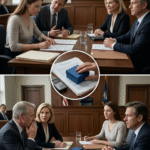
The board assembled in my mother’s library at three.
Conrad sat at the head of the table.
To his right were Lillian Ford, a retired federal judge; Dr. Samuel Rosen, a cardiologist; Beatrice Lane, an art patron who knew every secret on Park Avenue; and two younger residents Adrian had cultivated through charitable boards.
The building’s managing agent occupied the far corner.
Nathaniel sat beside him.
I took my mother’s chair near the fireplace.
Adrian entered without acknowledging me.
Sloane followed.
For a moment, she looked around the library with the pleased concentration of a buyer during a final walk-through.
Then she placed her renovation plans on the table.
Conrad cleared his throat.
“We are here to consider a petition regarding the occupancy and future residency status of Penthouse A.”
“Penthouse A has a resident,” I said.
Conrad’s smile was paternal.
“Evelyn, everyone understands this is difficult.”
“No one has explained what this is.”
Adrian folded his hands.
“I am seeking recognition as the primary resident and managing spouse for purposes of renovation, financing, and household administration.”
“Managing spouse,” Beatrice repeated.
Her eyebrows rose.
Adrian continued as though she had not spoken.
“Evelyn has spent increasing amounts of time away from the apartment and has struggled to maintain the residence since her mother’s death.”
“I spent nineteen nights in Connecticut last year,” I said. “Eleven were while the building replaced the west plumbing riser.”
Conrad shifted.
“This is not a trial.”
“No,” Nathaniel said quietly. “But accuracy remains useful.”
Every face turned toward him.
Adrian’s mouth tightened.
Sloane opened her portfolio.
She spread the plans across my mother’s desk.
“Our proposal,” she began, “is to modernize the penthouse while preserving its architectural integrity.”
She spoke for fifteen minutes.
The east gallery would be opened for entertaining.
The library would become a media lounge.
My mother’s bedroom would become a spa.
The service corridor would be widened.
The master suite would include a dressing room for Sloane.
She did not use her own name aloud.
She did not need to.
Her initials were printed on the plans.
S.M. WARDROBE.
S.M. BATH.
S.M. PRIVATE OFFICE.
Beatrice leaned toward the drawing.
“Who is S.M.?”
Sloane’s hand froze.
Adrian answered.
“Ms. Mercer assisted in preparing conceptual plans. The labels are placeholders.”
“Are her initials also placeholders?” Beatrice asked.
One of the younger board members coughed into his hand.
Conrad frowned.
“This meeting is not about personal insinuations.”
“No,” I said. “It is about a woman presenting plans to install her wardrobe in my bedroom.”
Sloane looked at me.
Her expression held triumph and fear in equal measure.
Adrian leaned back.
“Evelyn and I have not lived as husband and wife for some time.”
The cruelty was deliberate now.
He wanted witnesses.
He wanted the humiliation to become official.
He wanted me emotional enough to discredit myself.
So I gave him stillness.
“How long?” Judge Ford asked.
Adrian hesitated.
“Approximately a year.”
“A year?” I said.
He looked at me coldly.
“That is interesting.”
“Because eleven months ago, while my mother was dying, you gave an interview describing me as the love of your life.”
His face changed.
Only slightly.
I continued.
“Eight months ago, you used our anniversary photographs in the Vale House investment prospectus to promote the project as a family legacy.”
Conrad struck the table with his palm.
“This is precisely why the board should not become involved in marital disputes.”
“Then perhaps the board should not vote on removing a wife from her residence based on claims made by her adulterous husband.”
Silence.
The word adulterous was less fashionable than affair.
That was why I chose it.
Sloane’s face went pale.
Adrian spoke through his teeth.
“Be careful.”
“Is that a threat, Mr. Vale?”
“It is advice.”
“Then direct it to your own counsel.”
Adrian glanced at the empty chair beside him.
He had not brought counsel.
He believed Conrad was enough.
That was his third mistake.
Conrad adjusted his cuff links.
“Let us focus on ownership.”
“Yes,” I said. “Let us.”
Adrian turned to the board.
“The apartment was acquired during our marriage and has always been represented publicly as our marital residence. I have paid household expenses, building charges, staff costs, and renovation expenses.”
“From which account?” Nathaniel asked.
“Our account.”
“Which account?”
Adrian’s eyes narrowed.
“The Vale household account.”
“Funded primarily by distributions from the Ashcroft Residential Trust?”
“That is irrelevant.”
“It is precisely relevant if you are presenting payment of expenses as evidence of ownership.”
Conrad interrupted.
“Nathaniel, you are here as counsel to the board, not as Evelyn’s advocate.”
Nathaniel closed the folder before him.
“I am here to prevent the board from taking an action unsupported by the proprietary lease, the share ledger, or New York law.”
“And do you believe that is occurring?”
“I believe the board has not yet reviewed the controlling documents.”
Conrad’s face reddened.
“I have reviewed the file.”
“Which file?”
“The residency file.”
Nathaniel’s voice remained calm.
“I am referring to the original proprietary shares.”
The room changed.
Conrad looked toward the managing agent.
The man stared down at his notes.
Adrian spoke quickly.
“The shares were placed in a holding company for estate purposes. That does not alter the marital nature of the residence.”
Nathaniel opened the black leather folder.
He removed a certificate sealed in plastic.
“Penthouse A is allocated three thousand eight hundred proprietary shares. All are held by E.A. Holdings.”
Adrian nodded impatiently.
“Exactly. Evelyn and I control that entity.”
The word was quiet.
Absolute.
Nathaniel laid a corporate authorization beside the certificate.
“E.A. Holdings is wholly owned by the Eleanor Ashcroft Residential Trust. Mrs. Vale is the sole beneficiary and sole authorized controller. The trust is separate property. Mr. Vale has no equity interest, voting authority, or occupancy right independent of Mrs. Vale’s written consent.”
Adrian stared at the document.
“That is not possible.”
“It is documented.”
“My name is on the residence records.”
“As an approved occupant.”
“I have lived here for twelve years.”
“Occupancy does not create ownership.”
“I paid the maintenance.”
“The trust paid the maintenance.”
“I am her husband.”
“Marriage does not convert trust property into personal property merely because you prefer the result.”
A pulse moved in Adrian’s temple.
Conrad reached for the papers.
“This may require further review.”
“It has been reviewed,” Nathaniel said.
“By whom?”
“By the firm that prepared the structure, the trust administrator, and two independent real-estate counsel.”
Sloane’s chair made a faint sound as she shifted away from Adrian.
He noticed.
I did too.
Nathaniel removed another set of documents.
“Further, Mrs. Vale controls the proprietary shares associated with Units 2B, 3A, 4C, 6B, 7A, 8D, 9C, 10A, 11B, and two staff apartments.”
Dr. Rosen looked up sharply.
“That many?”
“Eleven additional units, plus the penthouse.”
Nathaniel turned to the board president.
“Together, those interests constitute the largest single voting block in One Aster House.”
Conrad’s face lost color.
“That arrangement has never been disclosed.”
“It appears in the original sponsor ledger.”
“I would have known.”
“Your predecessor knew. Mrs. Ashcroft exercised voting authority through a proxy company for privacy.”
Judge Ford looked toward me.
“And now you control it?”
“Why have you never voted the shares?”
“Because my mother believed power was most effective when it did not require display.”
Beatrice smiled.
“I miss Eleanor.”
“So do I,” I said.
Adrian pushed back from the table.
“This is absurd. Evelyn cannot use hidden corporate interests to retaliate against me in a marital disagreement.”
“I am not retaliating.”
“What do you call this?”
“Reading.”
His eyes flashed.
“You set me up.”
“You petitioned to remove me from my own apartment.”
“Because you refused to accept reality.”
“No, Adrian. I refused to leave quietly enough for you to refinance Vale House using property you did not own.”
The words struck the room like glass breaking.
Conrad’s head snapped toward me.
Adrian went perfectly still.
Nathaniel did not move.
That was how I knew the moment mattered.
“What refinancing?” Judge Ford asked.
“I have no idea what she is talking about.”
I opened the folder June had placed beside my chair.
Inside were copies of his lender communications.
“You submitted a residency certification to Hamilton Pierce Bank stating that you were the controlling owner of the penthouse.”
“This is outside the board’s authority.”
“Is it?” I asked. “You signed the bank authorization.”
Conrad’s mouth opened.
Then closed.
Adrian looked at him with naked fury.
The alliance fractured in silence.
Judge Ford held out her hand.
“May I see that?”
I passed her the document.
She read the first page, then the second.
“Mr. Hale,” she said, “this appears to use the building’s valuation records to support a private loan.”
Conrad stood.
“This meeting is adjourned.”
“No,” Beatrice said.
It was the first time she had spoken without irony.
Conrad stared at her.
She folded her hands over her cane.
“You invited us into Evelyn’s home to vote her out while assisting her husband in borrowing against it.”
“That is a gross mischaracterization.”
“Then sit down and improve it.”
He remained standing.
Nathaniel’s voice cut through the room.
“Before any member leaves, I am obligated to advise the board that relevant documents are subject to preservation. Destruction, alteration, or deletion may result in sanctions and potential criminal exposure.”
One of the younger members immediately placed his phone on the table.
The other followed.
Conrad sat.
Adrian looked at me.
There was no charm left in his face.
“You had no right to investigate my company.”
“I invested twelve million dollars in your company.”
“Our company.”
“You removed me from management.”
“I agreed because you told me the project would save our marriage.”
Sloane’s eyes moved between us.
For the first time, uncertainty entered her posture.
She had believed she was replacing a neglected wife.
Now she was beginning to understand that Adrian had offered her a throne he did not own, in a kingdom financed by the woman he mocked.
Nathaniel nodded to the managing agent.
The man opened a second ledger.
“Based on the controlling share records,” Nathaniel said, “Mr. Vale cannot establish independent residency without shareholder approval.”
Adrian’s voice was low.
“Evelyn will approve it.”
“No,” I said.
He turned toward me.
“You cannot throw me out of my home.”
The irony was almost too perfect.
I let the silence hold it.
Then I removed a document from my folder.
“This is formal notice revoking your occupancy consent, effective in thirty days, subject to access required by your attorneys and the court.”
His face emptied.
Sloane whispered, “Thirty days?”
I looked at her.
“Your residency application is denied.”
She flushed.
“You cannot—”
“I just did.”
Conrad struck the table again.
“You do not have unilateral authority to reject an applicant.”
Nathaniel turned toward him.
“Under the voting agreements attached to the sponsor shares, she does.”
I placed another document on the table.
“And I am calling a special board vote.”
“For what purpose?” Judge Ford asked.
“To remove Conrad Hale as president pending an independent investigation.”
Conrad stared at me with something close to hatred.
“You ungrateful little girl.”
The room went still.
I had known him since childhood.
He had carved the turkey at Thanksgiving after my father died. He had danced with my mother at my wedding. He had called me little girl when teaching me to sail off Newport.
The words should have wounded me.
Instead, they clarified him.
“My mother trusted you,” I said.
“Your mother understood loyalty.”
“My mother understood leverage. You only mistook her affection for blindness.”
His hands shook.
“You will destroy this building.”
“No. I will remove the men who treated it like private collateral.”
Judge Ford closed the file.
“I second the motion.”
Beatrice raised her hand.
“So do I.”
Dr. Rosen followed.
One by one, the room turned against Conrad.
The vote was not dramatic.
Real power rarely was.
There were no raised voices.
No shattered glasses.
Only names, shares, and percentages entered into the record.
Conrad Hale was removed as board president at 4:38 p.m.
His access to building financial systems was suspended at 4:42.
The board approved an independent forensic audit at 4:47.
At 4:51, Adrian Vale’s residency application was rejected.
At 4:53, Sloane Mercer withdrew hers.
Then Nathaniel closed the ledger.
“The meeting is concluded.”
For several seconds, no one moved.
The rain continued against the windows.
Adrian stood first.
He walked around the table toward me.
Nathaniel rose at the same time.
Adrian stopped.
“You think this makes you powerful?” my husband asked.
“No,” I said. “It makes the paperwork accurate.”
His mouth twisted.
“You will regret humiliating me.”
I looked around the library.
At the witnesses.
At the documents.
At the woman who had measured my mother’s bedroom for a spa.
“You brought your mistress into my home and called me an unwanted guest.”
I stepped closer.
“You humiliated yourself. I merely invited the board to take minutes.”
He left without another word.
Sloane followed him to the entrance hall.
Near the elevator, she caught his arm.
“What did she mean about the refinancing?”
“Not here,” he snapped.
“The townhouse—”
“Stop.”
“Is it ours?”
I saw the truth before she did.
Adrian had never intended to make Sloane an equal owner of anything.
He had added her name to Halcyon Residential because he needed a signature, a scapegoat, and someone vain enough not to read the operating agreement.
Sloane looked toward me.
For the first time, we were not wife and mistress.
We were two women standing on opposite sides of the same man’s lie.
The elevator doors opened.
Adrian stepped inside.
“Sloane,” he said.
She looked at him.
Then at me.
Finally, she entered the elevator.
The doors closed between us.
The board members departed in subdued groups.
Judge Ford squeezed my shoulder.
Beatrice kissed my cheek.
Dr. Rosen apologized for not asking more questions.
When the apartment was quiet, I returned to the library.
Nathaniel stood at the window.
The city had disappeared into rain.
“It is done,” I said.
He turned.
“This was the first door.”
“What is behind the second?”
“The bank. Vale House. The shell companies. And whatever Adrian does when he realizes charm will not save him.”
I sat in my mother’s chair.
For the first time all day, exhaustion reached me.
“He will come after me.”
“Professionally?”
“Socially?”
“Almost certainly.”
“Personally?”
Nathaniel’s expression became cold.
“He will not be given the opportunity.”
There was something in the way he said it.
Not possession.
Protection without ownership.
I looked down at my hands.
“They all watched him humiliate me.”
“They watched you remain standing.”
“That is not the same thing.”
“No,” Nathaniel said. “It is better.”
He crossed the room and stopped before me.
“You did not win because you endured him elegantly. You won because you prepared.”
I looked up.
“Is that what you think this was? A victory?”
His voice softened.
“I think it was an exit.”
Outside, thunder rolled over Manhattan.
Nathaniel held out his hand.
After a moment, I took it.
He drew me to my feet.
For one dangerous second, we stood too close.
The room remembered us.
So did I.
But he released my hand first.
“The will be uglier,” he said.
“Are you ready?”
I looked toward the elevator Adrian had just entered.
For twelve years, I had believed the worst thing he could do was leave me.
I had been wrong.
The worst thing would have been allowing his betrayal to become the final definition of my life.
“I’m ready.”
## Chapter Four: The Price of a Beautiful Lie
Adrian did not sleep at the penthouse that night.
At 11:16 p.m., he released a statement through his publicist.
It described me as emotionally fragile.
At 11:43, a society website published an article claiming I had used inherited wealth to punish my estranged husband.
By midnight, anonymous sources were discussing my grief, my mental health, my increasing isolation, and my refusal to accept the end of the marriage.
None mentioned the forged signatures.
None mentioned the missing money.
None mentioned the bank certification.
Adrian had always understood that in certain rooms, a woman’s pain could be used as evidence against her.
By morning, photographs of me leaving my mother’s hospice appeared beside the headline:
ASHCROFT HEIRESS IN BITTER PENTHOUSE WAR.
The image had been taken on the night my mother died.
My face was swollen from crying.
Adrian’s team had chosen it because grief looked unstable when cropped correctly.
June entered my office carrying coffee and fury.
“I can have the article challenged.”
“It contains provably false statements.”
She set down the cup.
“Every false statement creates another record.”
Nathaniel, seated near the window, looked up from his phone.
“He is trying to provoke a public response.”
“If you remain silent, he may escalate.”
June folded her arms.
“Then what are we doing?”
I opened the daily financial report.
“Letting him spend money.”
Adrian’s crisis firm cost sixty thousand dollars a week.
His family-law attorney required a two-hundred-thousand-dollar retainer.
Vale House had missed a contractor payment.
Hamilton Pierce Bank had frozen its refinancing application.
Each attack he launched tightened the pressure around his own company.
“Silence is becoming expensive for him,” I said.
Nathaniel’s gaze rested on me.
“Your mother used to say that.”
“She said many useful things after I stopped listening.”
At ten, Mara arrived with news.
Halcyon Residential had attempted to transfer the Bank Street townhouse to a newly formed entity at two in the morning.
The transaction failed because Nathaniel had filed an emergency notice against the property.
“Adrian knows we found it,” Mara said.
“Or Sloane does,” I replied.
June placed a tablet before me.
An email had arrived from an unknown encrypted account.
The message contained one sentence.
He is moving documents out of Vale House tonight.
Attached was a photograph of cardboard archive boxes stacked beside the hotel’s service entrance.
“Can we trace the sender?” I asked.
“Not yet,” June said.
Nathaniel studied the photograph.
“It could be bait.”
“It could be Sloane.”
“Would she help you?”
“She might help herself.”
We contacted the court-appointed monitor overseeing the preservation order.
By evening, a team entered Vale House and stopped three employees from loading corporate records into a rented van.