His mistress sat beside my husband at the most private auction house in Manhattan and lifted her paddle for my dead mother’s necklace.
Then she turned toward me and smiled as if she were buying my mother piece by piece.
PART ONE. THE WOMAN IN IVORY
There are rooms where rich people go to be admired.
Then there are rooms where they go to make things disappear.
Aldridge House belonged to the second kind.
It occupied six limestone floors on East Seventy-Second Street, behind bronze doors that never displayed a sign.
No tourists wandered through its galleries.
No reporters were permitted inside without written approval.
The people who attended its private auctions arrived in black cars, surrendered their phones, and spoke in the careful voices of people who had spent generations learning that money was most powerful when it whispered.
That Thursday evening, the entrance hall smelled of beeswax, white roses, and old money.
A quartet played something delicate beneath a ceiling painted with clouds.
Champagne moved through the room on silver trays.
Diamonds flashed at throats and wrists.
Men who had bankrupted companies discussed philanthropy.
Women who had destroyed marriages smiled beside their husbands.
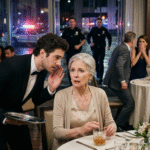
I stood beneath the central chandelier in a black silk column dress and watched my husband enter with his hand resting against another woman’s back.
Grant Mercer did not see me at first.
Or perhaps he did and decided pretending was easier.
He wore the midnight tuxedo I had ordered for him in Milan before our tenth anniversary.
The jacket fit his shoulders perfectly.
The woman beside him wore ivory.
Sloane Bennett always wore pale colors when she wanted to look innocent.
Her gown was cut low across her back and high against her throat, which made the emerald earrings Grant had given her impossible to miss.
They had belonged to me first.
I knew the tiny scratch near the left clasp because I had made it against a marble sink in Paris.
Sloane touched Grant’s sleeve and whispered something.
He leaned toward her with the intimate ease of a man who had stopped fearing consequences.
Then he looked across the room and found me.
For one second, the elegant mask slipped.
His face emptied.
May you like
Sloane followed his gaze.
Her smile arrived slowly.
She did not remove her hand from my husband.
Instead, she pressed closer.
That was the first mistake she made that night.
The second was assuming I had come alone.
“Evelyn,” Grant said when they reached me.
He spoke my name like it was a difficult item on an agenda.
“Grant.”
I let my eyes move toward Sloane.
She extended one manicured hand.
“Sloane Bennett.”
“I know who you are.”
Her fingers remained suspended between us.
A faint flush touched her throat.
Grant stepped in before the silence became embarrassing for him.
“Sloane is consulting on the Marlowe acquisition.”
The Marlowe acquisition had supposedly required six late nights, three weekends in Boston, and one emergency flight to Palm Beach.
It had also required Grant to purchase a penthouse under the name of a shell company and pay the private hospital bill for Sloane’s “exhaustion.”
I knew because I had copies of every transfer.
“I’m sure she has been very thorough,” I said.
Sloane lowered her hand.
The quartet continued playing.
Around us, conversations softened without appearing to stop.
People in our world could smell blood beneath perfume.
Grant’s jaw tightened.
“I didn’t realize you were attending.”
“My name was on the invitation.”
“I thought you were still in Connecticut.”
“My mother is buried in Connecticut.”
The words landed between us.
Grant looked away first.
My mother, Lenora Vale, had been dead for four years.
Cancer had reduced her body but never her authority.
She had spent her final months in a private room at St. Catherine’s Hospital overlooking the East River, signing documents between treatments and correcting doctors who mistook kindness for weakness.
Grant visited twice.
The first time, he brought white lilies even though she hated them.
The second time, he stood near the window answering emails while she slept.
Three days before she died, my mother asked everyone to leave the room except me.
Her voice was almost gone.
Her hand was cold inside mine.
“There will come a day,” she whispered, “when your silence is mistaken for surrender.”
I bent closer.
“What should I do then?”
She looked at me with the same gray eyes I saw in the mirror every morning.
“Let them.”
Those were the last clear words she ever said to me.
After her funeral, I withdrew her jewelry from public circulation.
Every significant piece was placed in the Vale Preservation Trust.
Nothing could be sold without my signature and the approval of two independent trustees.
The most important piece was the Celestine necklace.
My grandfather had commissioned it in 1958 for my grandmother’s wedding.
It held twenty-three old-mine diamonds around a blue diamond the size of a robin’s egg.
The press called it the Winter Star.
My mother called it unnecessary.
She wore it only twice in my lifetime.
The second time was to my wedding.
I still remembered her standing behind me in the chapel at St. Augustine’s, the necklace burning cold against her collarbone as she adjusted my veil.
“You can still leave,” she said.
I had laughed because I thought she was joking.
She had not been.
At eight fifteen that evening, the doors to the main auction gallery opened.
Aldridge attendants in black gloves guided the guests toward their assigned seats.
Grant glanced at the card in his hand.
“Sloane is seated with me.”
“I assumed she would be.”
His eyes narrowed.
“The committee handled the seating.”
“I know.”
Sloane smiled.
“I hope this isn’t uncomfortable.”
She wanted me to say it was.
She wanted a public scene she could later reshape into evidence of my instability.
Instead, I adjusted the diamond bracelet on my wrist.
“Not for me.”
Her smile weakened.
Grant touched my elbow.
The gesture looked marital from a distance.
Up close, his fingers were warning me.
“Whatever you think is happening,” he murmured, “this is not the place.”
I looked down at his hand until he removed it.
“You’re right.”
His shoulders loosened.
“This is not the place for lies.”
Before he could answer, an attendant approached me.
“Mrs. Mercer, your seat is ready.”
Sloane glanced toward the front row.
My place card was positioned directly across the aisle from hers.
She had expected me to be hidden in the back.
Grant had expected me not to exist at all.
I walked past them and took my seat.
The gallery had been restored to resemble a nineteenth-century opera house.
Three tiers of private boxes curved above the main floor.
Velvet walls absorbed sound.
Gold leaf shimmered beneath low amber light.
At the front, a single object stood beneath glass.
It was covered in black velvet.
I stared at it.
Nothing in the preliminary catalog had concerned me.
The listed lots included a Rothko study, a set of Fabergé cigarette cases, a first edition of The Great Gatsby, and a collection of watches from the estate of a disgraced hedge fund manager.
Then an attendant placed a slim black booklet on my lap.
A silver card had been inserted between pages forty-eight and forty-nine.
PRIVATE ADDENDUM.
LOT 117A.
ESTATE LIQUIDATION.
I did not move.
Across the aisle, Sloane opened her own booklet.
Grant kept his closed.
That told me he already knew what was inside.
The auctioneer appeared at the podium.
Charles Vane had worked at Aldridge House for thirty-one years.
He knew the provenance of every object in the building and the secrets of most people bidding on them.
His gaze met mine.
It lasted less than a second.
That was enough.
The first twenty lots passed quickly.
A bronze horse sold for twice its estimate.
A Hollywood producer purchased a letter written by Jacqueline Kennedy.
Sloane bid carelessly on a pair of sapphire earrings and won them for eighty thousand dollars.
Grant leaned close to congratulate her.
I watched without expression.
People often mistake stillness for weakness because movement makes them feel powerful.
By lot ninety, the air had changed.
Champagne glasses had been cleared.
Numbers had grown larger.
Faces had become sharper.
At ten seventeen, Charles Vane closed the catalog in front of him.
“We will now proceed to a private addendum.”
Two attendants approached the glass pedestal.
One lifted the velvet cover.
The Winter Star caught the light.
The room inhaled.
My mother’s necklace rested against black silk beneath the glass.
The blue diamond looked exactly as it had on my wedding day.
Cold.
Perfect.
Impossible.
For four years, it had been secured in a vault three floors beneath the Vale family office.
Only five people possessed the authority to access that vault.
One was dead.
One was me.
Two were independent trustees.
The fifth was my husband.
Grant did not look at the necklace.
He looked at the floor.
Charles Vane’s voice remained formal.
“Lot 117A is the Celestine diamond necklace, commonly known as the Winter Star.”
A murmur passed through the gallery.
“The necklace is offered as part of a confidential estate liquidation with an opening bid of two million dollars.”
My pulse beat once against my throat.
The Celestine necklace was insured for eighteen million.
An opening bid of two million meant the sale had not been designed to reach fair value.
It had been designed to establish a transfer.
Sloane raised her paddle.
“Two million.”
Her voice carried clearly through the room.
She did not look at the auctioneer.
She looked at me.
Grant’s mouth became a hard line.
Charles Vane nodded.
“I have two million dollars.”
A man in the second row lifted his paddle.
“Two point five.”
Sloane responded immediately.
“Three.”
She crossed one leg over the other.
The ivory silk of her dress parted at her thigh.
She looked beautiful.
She looked certain.
I remembered my mother in her hospital bed, her skin almost translucent beneath the morning light.
I remembered Grant standing at the window, pretending not to hear when she asked for water.
I remembered Sloane wearing my emeralds.
I remembered every dinner where Grant had called me paranoid.
Every evening he had kissed my forehead before leaving to meet her.
Every time he had suggested that grief was making me confused.
“Three and a half,” the man behind me said.
Sloane lifted her paddle.
“Four million.”
She smiled at me again.
This time, I smiled back.
Grant finally turned his head.
He knew me well enough to understand that I did not smile when I was defeated.
Charles Vane looked toward me.
“Four million dollars is bid.”
The room waited.
I stood.
Every face turned in my direction.
Grant rose halfway from his chair.
“Evelyn.”
I did not look at him.
I looked at Charles Vane.
“Withdraw the item and call the police.”
PART TWO
THE CATALOG OF LIES
For three seconds, no one moved.
Then the side doors opened.
Four officers from the New York City Police Department entered the gallery with two investigators from the Manhattan District Attorney’s Office.
They were followed by Miriam Cross, general counsel for the Vale Preservation Trust.
Miriam was sixty-four, silver-haired, and built like a verdict.