Ava stepped back again.
This time more than one inch.
Bennett saw it.
“Ava,” he said.
She stared at the flowchart.
“My company is on there.”
“Yes,” I said.
“Three times.”
Her lips parted.
“I thought those were consulting payments.”
“You consulted on stealing my mother’s tribute.”
“I didn’t know.”
The line was old.
It had saved many pretty women in many ugly rooms.
It did not save her there.
June clicked the remote.
The next slide appeared.
Email Correspondence: Bennett Whitaker to Graham Pierce.
Bennett lunged toward the nearest technician.
Security moved before he touched anyone.
Two guards blocked him.
One placed a hand near his shoulder, not quite touching.
The humiliation of almost being handled in front of donors did what nothing else had.
His face went red at the neck.
The email appeared in large text.
June had redacted names that did not matter.
But Bennett’s did.
Graham,
Push the museum amendment through before Claire wakes up to the asset side.
She is still foggy from the hospital and emotionally unreliable.
If she contests, we frame it as grief instability.
Margaret thinks Harper will fold if Ava is already public-facing.
Do not leave this sitting.
B.
Someone whispered, “Oh my God.”
Ava covered her mouth.
Margaret closed her eyes.
Only for a second.
But I saw it.
She had known about the plan.
She had not expected him to write it down.
That was the curse of men like Bennett.
They believed their own names were security clearance.
June clicked again.
Another email.
Mother is right.
Claire will fight unless we isolate her first.
The psychiatrist letter helps.
Use Sophie only if necessary.
I heard my heartbeat then.
Not loud.
Not frantic.
Heavy.
Every word had sat in my chest for eleven days.
I had read that email at three in the morning on the floor of my mother’s old study, wearing one of Bennett’s shirts because I had not yet learned to hate the scent.
I had not screamed.
I had not thrown my laptop.
I had not called him.
I had printed it.
Then I had made tea.
Then I had called June.
That was the night my marriage ended.
Not tonight.
Tonight was only the funeral.
Bennett turned to the crowd.
“You are seeing privileged marital communication.”
June smiled faintly.
“You sent it to your CFO.”
The room laughed.
Not kindly.
The laugh made Bennett look smaller.
Margaret finally spoke.
“This is enough. The Whitaker family has supported this museum for generations.”
“The Whitaker family has rented virtue from women with better consciences.”
Her face whitened.
The line landed.
I knew because four people looked down to hide their reactions.
Bennett moved close enough that the guards shifted.
“You think this makes you powerful?”
“No.”
I looked around the wing.
At the glass cases, the warm lighting, the first exhibit of my mother’s surgical journals and letters from artists she had funded anonymously.
“This makes me late.”
His eyes narrowed.
“You do not want to go to war with my family.”
“I already did,” I said.
“You just missed the first battle because you were onstage with Ava.”
Ava flinched.
A man near the side entrance cleared his throat.
Not a donor.
Not a board member.
Elias Ward.
He wore a black suit without a tie and stood with one shoulder against the wall as if he did not belong to anyone in the room.
He had been my mother’s favorite architect.
He had designed the wing around her notes, her quiet demands, her hatred of useless grand staircases.
Years ago, before Bennett, before the Whitaker name, before I learned that love could arrive wrapped as strategy, Elias had asked me to coffee in a museum courtyard in Chicago.
I had said no because I was engaged.
He had smiled like it hurt and sent flowers when my mother died anyway.
Tonight, he was not there to rescue me.
I had not asked him to.
But when Bennett looked at me like I was something he intended to break, Elias straightened.
I saw Bennett notice.
Men like Bennett could smell another man’s refusal to be impressed.
The screen changed to a signed document.
Bennett’s signature at the bottom.
Mine beside it.
The audience could not know it was important yet.
But Bennett did.
He stared at it.
His lips barely moved.
“The prenup.”
I nodded.
Margaret turned sharply toward him.
“What prenup?”
That was the first time all night I almost laughed for real.
Because Margaret Whitaker, empress of private schools and trust officers, had forgotten the one rule my mother taught me first.
Never marry into a family that wants your money without making them sign the map to the exit.
Bennett had signed our prenuptial agreement in a glass conference room on Park Avenue two weeks before our wedding.
He had not read past page six.
Margaret had told him to sign because refusing would make the Whitakers look greedy.
My mother had watched him do it.
She had worn gray cashmere and the tiniest smile.
The screen highlighted Section 14.
Misappropriation or attempted control of separate inherited assets.
June read aloud.
“In the event either spouse, directly or through agents, relatives, corporate entities, romantic partners, or affiliated foundations, attempts to seize, redirect, conceal, leverage, or publicly misrepresent the other spouse’s separate inherited property, said spouse waives all claims to marital support, all rights to discretionary trust distributions, and all claims to assets derived from the injured spouse’s separate estate.”
Bennett’s face drained.
Margaret whispered, “No.”
“Yes.”
“Further, any corporate debt secured by guarantees from the injured spouse’s separate estate shall be subject to immediate acceleration, review, and conversion rights where applicable.”
A board member from Whitaker Holdings stood up too quickly.
His chair scraped the floor.
Conversion rights.
That phrase finally made the business people understand.
This was not only a scandal.
This was a hostile sunrise.
Bennett turned toward the screen again.
His voice was thin now.
I stepped closer.
“You used my mother’s endowment as collateral.”
“That was temporary.”
“You used my signature.”
“You were my wife.”
I looked at him until his own words began to rot between us.
“I was unconscious.”
He had no answer.
Ava backed away from him as if distance could bleach her.
June clicked once more.
A final slide appeared.
Notice of Default and Conversion: Whitaker Cultural Holdings, Whitaker Hotels Midtown, Whitaker Family Office.
The room inhaled.
I heard someone say, “She owns it?”
Not yet.
But close enough to make Bennett look at me with something new.
Not regret.
Fear.
I had wanted that fear to satisfy me.
It did not.
It was too small.
My grief was bigger.
My mother was dead.
My child had asked whether her father stole from her grandmother.
No court filing could balance that scale.
But it could make sure he never used the scale again.
Bennett’s phone began buzzing.
Then Margaret’s.
Then three board members’.
Then Ava’s.
That was the sound of wealthy people realizing news travels faster than loyalty.
Dr. Harper approached me with wet eyes.
“Claire,” she whispered, “I am so sorry.”
“You knew enough to be afraid.”
Her mouth trembled.
“I thought I was protecting the wing.”
“You were protecting the donors from discomfort.”
She bowed her head.
There was no pleasure in saying it.
Only accuracy.
Margaret pushed past her.
“This ends now.”
She stood in front of me, pearls glowing against her throat.
“You have made your point.”
“My point?”
“You will not destroy a family because your pride was wounded.”
For one second, I saw Bennett as a boy behind her.
Not innocent.
Never innocent.
But trained.
Raised in a house where cruelty wore perfume and called itself preservation.
Then Margaret leaned closer.
“Take the settlement,” she said under her breath.
“The house in Greenwich. Twenty million. Joint custody. Public reconciliation. Ava leaves quietly. Bennett stays married to you in name until this cools.”
I stared at her.
She had negotiated this while standing beneath my mother’s portrait.
That was her genius.
And her disease.
“You think I came here for money.”
Her eyes flicked across my face.
“I think everyone comes for money.”
I stepped back so the nearest camera could see us both.
“I came for my name.”
I turned to the crowd.
“The wing will remain open tonight under the supervision of the Vale Trust. Tomorrow morning, the board will receive formal notice of breach. By Friday, my attorneys will file in probate, charities, civil court, and corporate court.”
Bennett’s phone buzzed again.
He did not look at it.
He looked at me.
For the first time since our wedding day, he seemed to understand that I had been standing beside him by choice.
Not dependency.
Not need.
Choice.
And choices could end.
Ava suddenly spoke.
“Bennett told me you didn’t care about the wing.”
Her voice was small.
Dangerously small.
“He said your mother controlled you. He said you wanted to sell the collection and move to Europe.”
The room turned to her.
Bennett’s eyes flashed.
“Ava, stop talking.”
But Ava had finally understood something the rest of us already knew.
A man who betrays his wife will eventually betray the woman who helped him.
She touched the bracelet.
“He said this was from his family vault.”
I looked at her wrist.
“Take it off.”
Her eyes filled.
For a second, she looked very young.
Then she unclasped it with shaking fingers and placed it on the nearest display table.
It landed beside my mother’s handwritten note about funding rural art teachers.
Diamonds next to ink.
A perfect little American tragedy.
Bennett looked at the bracelet, then at Ava.
“What are you doing?”
She did not answer.
Margaret did.
“She is saving herself.”
Ava looked at me.
“I didn’t know about the hospital.”
I believed her.
That did not make her innocent.
It only made Bennett worse.
June’s phone vibrated once.
She looked down.
Then she stepped close to me.
“The emergency custody filing just hit the system.”
The room seemed to tilt.
Bennett’s mouth curved.
There he was.
The man behind the man.
“If you want war,” he said quietly, “we will discuss Sophie in court.”
My hands did not move.
My face did not change.
But every light in that museum became sharper.
June handed me her phone.
I read the first line.
Petitioner Bennett James Whitaker seeks temporary emergency custody due to Respondent’s erratic public conduct, obsession with deceased parent, and financial instability.
Financial instability.
After stealing from me.
Obsessed with deceased parent.
At her memorial.
Erratic public conduct.
After making me watch his mistress cut my mother’s ribbon.
I looked up.
Bennett waited for me to break.
Again.
I gave June back the phone.
Then I leaned toward the microphone.
“My husband has just filed for emergency custody of our daughter.”
The room recoiled.
Even Margaret looked surprised.
Not because she objected.
Because timing was supposed to be hidden.
Bennett’s face went cold.
“Claire.”
I did not stop.
“In that case, I will see him in court.”
I looked at Ava.
“And he may want to bring a paternity attorney.”
Ava went white so fast I thought she might fall.
Bennett turned to her.
“What does that mean?”
I did not answer.
Some truths need a judge.
PART 4: The Courtroom Where Ava Stopped Smiling
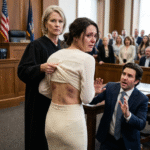
The courtroom smelled like old wood, wet wool, and expensive panic.
By eight-thirty the next morning, the story had already escaped the museum.
By nine, three donors had resigned from Whitaker committees.
By ten, a photograph of Ava holding my mother’s diamond scissors had been shared so many times that strangers in Ohio were calling her Ribbon Barbie.
By eleven, Bennett’s publicist had released a statement about a private family matter, a grieving wife, and inaccurate allegations.
By noon, the judge had asked why a private family matter required six attorneys, two crisis managers, a forensic accountant, and a museum director sitting in the back row like a condemned woman.
Judge Evelyn Ross presided from the bench in a black robe and reading glasses that made her look kinder than she was.
I liked that.
Kind people who know how to be hard are rare.
Bennett sat at the opposite table in a charcoal suit.
No tuxedo now.
No champagne.
No mistress at his side.
Ava sat two rows behind him wearing pale gray and no bracelet.
Margaret sat beside her, not out of affection.
Control.
Margaret had one hand on her crocodile handbag and the other resting lightly on Ava’s forearm, like a queen preventing a hostage from running.
Sophie was not there.
That had been my first demand.
No child in that room.
No child hearing strangers discuss whether her mother was unstable because she had refused to clap for a mistress.
Lucia had taken Sophie to my mother’s house in Connecticut.
Elias had driven them.
I had not asked him.
He had simply said, “No press will follow my truck.”
He drove an old black Ford F-150 because, unlike Bennett, he had nothing to prove to parking valets.
Before leaving, Sophie had wrapped her arms around my waist and asked, “Are you going to be okay?”
I had said, “Yes.”
Then she had asked, “Is Daddy?”
I had not lied.
“I don’t know.”
Now Bennett’s attorney, Paul Renshaw, stood in front of Judge Ross and tried to turn my restraint into a symptom.
“Your Honor,” he said, “Mr. Whitaker has deep concerns regarding Mrs. Whitaker’s emotional stability.”
Judge Ross looked over her glasses.
“Based on?”
Renshaw lifted a folder.
“Several incidents, including last night’s public disruption of a philanthropic event.”
June Wallace stood.
“If exposing alleged fraud at a philanthropic event is instability, Your Honor, half of Manhattan should be medicated.”
The judge did not smile.
But the court reporter did.
Renshaw cleared his throat.
“Mrs. Whitaker has become fixated on her late mother’s estate.”
“It is her late mother’s estate,” Judge Ross said.
“She has accused Mr. Whitaker of theft.”
June lifted a hand.