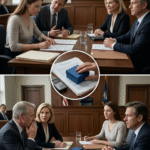
“He does not have the family trust.”
Julia’s eyes lifted.
“The proxy was revoked in 2019.”
“Does Graham know?”
“He signed the revocation.”
Julia leaned back.
“You kept the original?”
“My mother taught me to keep everything a confident man considers boring.”
That was when the vow renewal became useful.
Graham believed he was arranging a public coronation.
Sloane believed she was choosing the flowers for her own ascension.
I let them continue.
Every vendor order created a paper trail.
Every revised contract exposed another transfer.
Every conversation held inside a Beaumont conference room was preserved under the company’s security and compliance policy.
Graham had signed that policy too.
He wanted a celebration.
I gave him a stage.
By the day of the tasting, I already had the evidence to remove him from the company.
What I did not have was proof that his mother and sister knew.
Then Sloane arrived in white.
Victoria Sterling wore navy silk and the expression of a woman offended by consequences.
She waited until the tasting ended before following me into the powder room.
The room was lined with rose-colored marble and smelled faintly of gardenias.
Victoria closed the door behind us.
“You handled that well,” she said.
I washed my hands.
“Did I?”
“Sloane is provocative.”
“She is sleeping with your son.”
Victoria’s face did not change.
That was answer enough.
“You’ve been married fifteen years,” she said.
“Men become restless.”
“Do they also become embezzlers?”
Her eyes flickered.
Only once.
I dried my hands on a linen towel.
“Be careful, Claire.”
“Is that advice or a threat?”
“It is a reminder that families like ours survive unpleasant things by keeping them private.”
“Families like yours survive because women like me pay the invoices.”
She stepped closer.
“You have no idea what Graham carries.”
“I know what he carries.”
I placed the towel beside the sink.
“Two phones, three million dollars of stolen company funds, and hotel key cards he should have destroyed.”
For the first time, Victoria looked afraid.
It lasted less than a second.
“You will not humiliate my son at his own anniversary.”
I opened the door.
“Then he should not have invited an audience.”
PART TWO — THE MARRIAGE BEHIND THE CRYSTAL
I met Graham when I was twenty-seven and tired of being described as sensible.
My mother had been diagnosed with ovarian cancer six months earlier.
I spent my days in hospital rooms negotiating treatment schedules and my nights reading hotel reports beside her bed.
Graham entered my life like a door opening onto sunlight.
He was charming without seeming rehearsed, ambitious without looking desperate, and attentive in the effortless way only practiced men can be.
Our first date lasted six hours.
Our second ended with us walking through Central Park in the rain.
By the third month, he knew how I took my coffee, which songs made me turn up the radio, and why I never sat with my back to a restaurant door.
He proposed in the Beaumont’s closed ballroom while the room was being renovated.
There were ladders against the walls and dust sheets over the tables.
He told me he did not need perfection to know what belonged in his future.
I believed him because I wanted to.
My mother died seven weeks before the wedding.
I offered to postpone it.
Graham refused.
“She wanted to see you happy,” he said.
He held me through the funeral.
He chose the readings when I could not.
He tasted wedding cakes while I signed death certificates.
There are betrayals that begin with cruelty.
Ours began with tenderness.
That was why it took me so long to accept what he had become.
For the first decade of our marriage, I did not feel used.
I felt loved.
Perhaps parts of it were real.
That question stopped mattering once he weaponized the memories.
The original wedding had taken place in the Beaumont ballroom beneath twelve thousand white roses.
My mother’s empty chair sat in the front row with one gardenia on the seat.
Before the ceremony, Mateo brought me a crystal coupe filled with the cocktail she had designed.
The Vow was bright at first taste and bitter at the end.
I drank half of it before walking down the aisle.
After Graham kissed me, he whispered that he would spend the rest of his life making sure I never felt alone.
Fifteen years later, he watched his mistress cross my mother’s final gift off a menu.
He called it symbolic.
He was right about that.
The symbol was not that Sloane had replaced me.
The symbol was that Graham no longer remembered what I had placed in his hands.
The Beaumont.
The company.
The townhouse on East Seventy-Second Street.
The summer property in Southampton.
The private jet he called ours.
All of it was tied, directly or indirectly, to the Ashford Heritage Trust.
After my mother’s death, Graham’s father came to me with a problem.
Sterling Hospitality had defaulted on two major loans.
The Beaumont was being quietly marketed.
The family mansion in Greenwich had been pledged as collateral.
Richard Sterling cried in my office.
Not dramatically.
Just two silent tears from a man who had spent his life believing wealth made him invulnerable.
I agreed to help.
The Ashford Trust purchased the debt, provided operating capital, and acquired fifty-eight percent of Sterling Hospitality’s voting shares.
To protect the family from embarrassment, the acquisition was made through Bellweather Holdings, a Delaware company whose beneficial ownership remained confidential.
Graham became chief executive officer.
I became chair of the investment committee.
Publicly, the Sterlings remained the face of the company.
Privately, they answered to me.
Graham understood the arrangement when it saved him.
He simply chose to forget it when it limited him.
Our prenuptial agreement was equally clear.
Any appreciation in my inherited assets remained separate.
Any spouse who intentionally misappropriated funds from a trust-controlled entity forfeited all unvested equity granted during the marriage.
Any affair conducted using company assets triggered immediate review of executive compensation.
Graham had insisted on the infidelity language himself.
At twenty-nine, he told me it would prove we were serious.
At forty-four, it would cost him nearly everything.
Sloane did not know about the prenup.
She also did not know that Graham’s shares in Mercer Sterling had been purchased using misappropriated money.
That meant the new company belonged, in equity, to the party from whom the money had been stolen.
Me.
By the week of the vow renewal, I owned sixty-eight percent of the Beaumont, fifty-eight percent of Sterling Hospitality, and a legally enforceable claim against the company Graham had created for his mistress.
They were not building a life together.
They were renovating a room inside my house.
Graham continued to play the devoted husband in public.
He sent flowers to my office.
He approved interviews about our lasting marriage.
He posted an old wedding photograph with the caption FIFTEEN YEARS, STILL CHOOSING YOU.
Sloane liked the post within thirty seconds.
That evening, he came home after midnight.
I was sitting in the library with a book open on my lap.
He loosened his tie and poured himself a whiskey.
“You’re still awake.”
“I live here.”
“You know what I mean.”
“Do I?”
He watched me for a moment.
Graham had always relied on my honesty.
Silence made him nervous because he could not negotiate with it.
“You seem distant,” he said.
“I had surgery six months ago.”
“I know.”
“You missed my follow-up appointment.”
“I had the Chicago meeting.”
“You were at the Beaumont.”
His hand stopped above the decanter.
I turned a page.
The room was so quiet I heard the old clock near the fireplace shift between seconds.
“Were you checking on me?” he asked.
“No.”
That was true.
The hotel checked on everyone.
He came closer.
“Claire, what is this?”
“A conversation you chose to have at midnight.”
His face softened.
For one dangerous moment, he looked like the man who had sat beside my mother’s hospital bed and learned every nurse’s name.
He knelt in front of me.
“I know this year has been hard.”
I looked at his hand resting on my knee.
He still wore his wedding ring.
“There are things I haven’t handled well,” he continued.
“That sounds almost like a confession.”
“It’s an acknowledgment.”
“Those are cheaper.”
His jaw tightened.
Then he smiled again.
“We need the vow renewal.”
“Why?”
“To remind ourselves who we are.”
I studied him.
He believed he was controlling the story.
He believed the ballroom, the press, the family photographs, and the ritual of choosing me in public would make whatever came next appear merciful.
He planned to betray me twice.
First as a husband.
Then as a witness to my supposed decline.
“All right,” I said.
Relief moved across his face.
He kissed my forehead.
“Thank you.”
I closed my eyes as his lips touched my skin.
Not from affection.
I wanted to remember the exact sensation of a lie delivered gently.
After he went upstairs, I called Julia.
“He’s going forward,” I said.
“So are we?”
I looked toward the dark window.
My reflection appeared composed.
Behind it, Manhattan glittered as though nothing ugly had ever happened in an expensive room.
“Yes,” I said.
“We are.”
PART THREE — THE WOMAN WHO OWNED THE ROOM
The morning after the cocktail tasting, I arrived at the Beaumont before sunrise.
The lobby smelled of beeswax, coffee, and fresh peonies.
Night staff moved quietly beneath the chandeliers.
No cameras waited outside.
No family members followed me.
For the first time in months, I entered my hotel without pretending to be a guest.
Mateo met me in the empty ballroom.
He carried two folders and the gold-embossed menu Sloane had approved.
“I’m sorry, Mrs. Sterling,” he said.
“For what?”
“The drink.”
“You didn’t change it.”